Home
Blog
Find & Send Cold Emails to 500 Unique Prospects Every Month for FREE.
Home
Blog
Manasa Goli
Published February 27, 2026
7 min
Try Oppora AI
Create Self-Running Agentic Sales Workflows like N8N just by chatting with AI
Get Started for FREE
Most B2B pipelines don’t fail because of poor targeting — they fail because of poor timing.
You might be reaching the right companies, but if they’re not actively evaluating solutions, even the best-crafted outreach will fall flat. On the flip side, when you engage buyers who are already showing interest, conversations become easier, faster, and far more productive.
This is exactly where buyer intent signals change the game.
Instead of guessing who might buy, intent signals help sales teams identify who is already moving toward a purchase decision. And in today’s competitive outbound landscape, that difference is everything.
Let’s break down the most important buying signals B2B teams should be watching — and how to actually use them.
Buyer intent signals are observable behaviors that indicate a company or stakeholder may be actively researching, evaluating, or preparing to purchase a solution.
Unlike static firmographic filters, intent signals reflect real-time movement in the buyer journey.
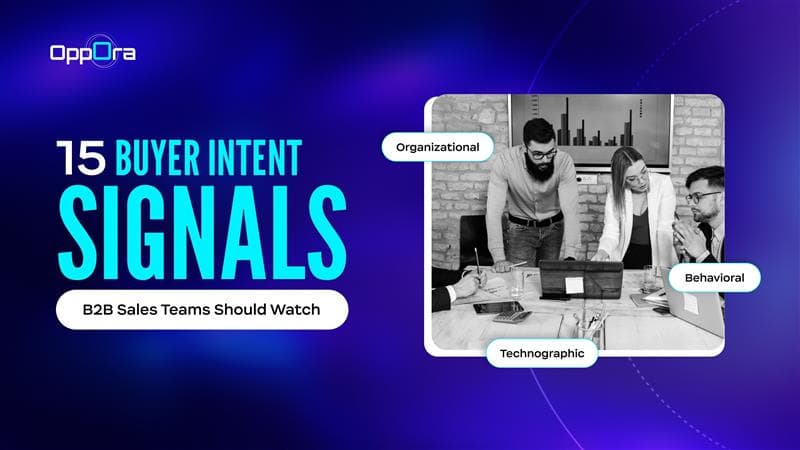
They typically fall into three categories:
The key idea is simple: the more high-intent behaviors you see, the more likely the account is in-market.
Outbound has become noisier than ever. Buyers are flooded with generic cold emails, and reply rates continue to drop across industries.
What’s separating high-performing teams today isn’t volume — it’s relevance and timing.
When you prioritize accounts based on real buying signals B2B prospects exhibit, you typically see:
In other words, intent data helps sales teams show up when buyers are already paying attention.
Not all signals are equal. Some indicate light curiosity, while others strongly suggest active buying motion.
Below are the signals that consistently create the best outbound opportunities.
When a company starts hiring for roles tied to your category, it usually reflects a structural change or new initiative internally.
For example, if a company begins hiring multiple SDRs, it often means outbound is becoming a priority. If they’re hiring RevOps, they may be preparing to clean up tooling, reporting, or processes.
What this signal really tells you: There is a problem emerging that requires people — and tools typically follow shortly after.
How to act on it:
👉 This is one of the most reliable early-stage buying signals B2B teams use.
Funding is not just about cash — it’s about pressure to execute.
After raising capital, leadership teams are expected to accelerate growth, improve efficiency, or expand market reach. That often triggers new tech investments within the next 3–9 months.
What this signal really tells you: Budget availability + urgency to scale.
How to act on it:
A tech stack change is rarely isolated. When companies replace or add one tool, they often review adjacent systems.
For instance, a new CRM implementation frequently triggers evaluations of:
What this signal really tells you: The company is already in a buying mindset.
How to act on it:
Pricing page traffic is often misunderstood. A single anonymous visit means little — but repeat, account-level pricing activity is highly predictive.
When buyers reach pricing, they’re usually:
What this signal really tells you: The buyer has moved from curiosity to evaluation.
How to act on it:
Top-of-funnel content signals learning. Bottom-funnel content signals decision preparation.
High-intent assets include:
The more specific the content, the stronger the buying signal.
What this signal really tells you: The buyer is validating vendors, not just researching the problem.
How to act on it:
Leadership changes are one of the most underutilized buyer intent signals.
New executives typically spend their first few months:
Research consistently shows many enterprise tool changes happen within the first 6 months of new leadership.
What this signal really tells you: The status quo is vulnerable.
How to act on it:
When buyers start evaluating competitors, the buying journey is already in motion.
At this stage, they are typically:
What this signal really tells you: The problem is fully recognized — and budget discussions may already be happening.
How to act on it:
Sustained hiring across departments often creates operational strain, which drives software purchases.
Growing teams commonly face:
What this signal really tells you: Their current systems may soon become bottlenecks.
How to act on it:
Expansion introduces complexity — and complexity drives tooling needs.
When companies enter new markets, they often must adjust:
What this signal really tells you: Their existing setup may not support the next growth phase.
How to act on it:
One visitor is noisy. Multiple stakeholders visiting repeatedly is a signal.
In B2B, buying committees often research silently before engaging vendors. A surge in account-level activity typically indicates internal discussions have started.
What this signal really tells you: You may already be on their radar.
How to act on it:
Email engagement becomes powerful when viewed as a pattern, not a single event.
Strong indicators include:
What this signal really tells you: Interest is building — but the buyer may still be evaluating.
How to act on it:
By the time buyers hit review sites, they are usually in vendor evaluation mode.
This stage often involves:
What this signal really tells you: The deal cycle may already be underway.
How to act on it:
Formal buying processes are late-stage but high-confidence signals.
If a company is issuing RFPs or running vendor evaluations, the purchase timeline is typically defined.
What this signal really tells you: Budget and urgency likely already exist.
How to act on it:
Many B2B buyers now validate tools publicly before engaging vendors.
Signals often appear as:
What this signal really tells you: Early-stage buying research is happening in the open.
How to act on it:
For product-led companies, in-app behavior is often the strongest intent signal available.
High-value patterns include:
What this signal really tells you: The buyer is experiencing real value — and expansion or conversion may be near.
How to act on it:
Knowing these signals is only half the battle. The real challenge is operationalizing them at scale.
Many teams run into problems like:
By the time reps act, the buying window has often cooled.
This is exactly the gap modern revenue teams are trying to close.
Platforms like Oppora.ai are built specifically to help sales teams move from signal detection to execution without manual overhead.
Instead of reps constantly hunting for buying signals B2B teams care about, Oppora.ai helps:
The goal isn’t just more data — it’s faster, smarter action when intent appears.
The future of outbound isn’t about sending more messages. It’s about sending the right message at the right moment.
Buyer intent signals give B2B teams that timing advantage.
Sales teams that win consistently are the ones that:
If your team is still relying mostly on static lists, you’re likely missing the accounts that are quietly moving toward a purchase decision right now.
There is no fixed number, but most high-performing teams focus on 5–8 high-confidence signals rather than trying to monitor everything. Tracking too many weak signals creates noise and slows response time. Start with signals that historically correlate with pipeline in your segment, then expand gradually.
Not always. SMB buying journeys are typically faster and more behavior-driven, so signals like website activity and email engagement tend to be more predictive. Enterprise sales cycles are longer and committee-based, which makes organizational signals (like hiring, funding, and leadership changes) more valuable.
No — they work best together.
ICP filters tell you who could be a good fit, while buyer intent signals tell you who is ready right now. Removing ICP targeting often leads to chasing high-intent but poor-fit accounts, which hurts conversion and retention.
Intent models should be reviewed at least quarterly. Buyer behavior, market conditions, and product positioning evolve over time. Teams that continuously refine their signal weighting usually maintain stronger pipeline quality than those using static scoring models.
Summarize with AI
Share