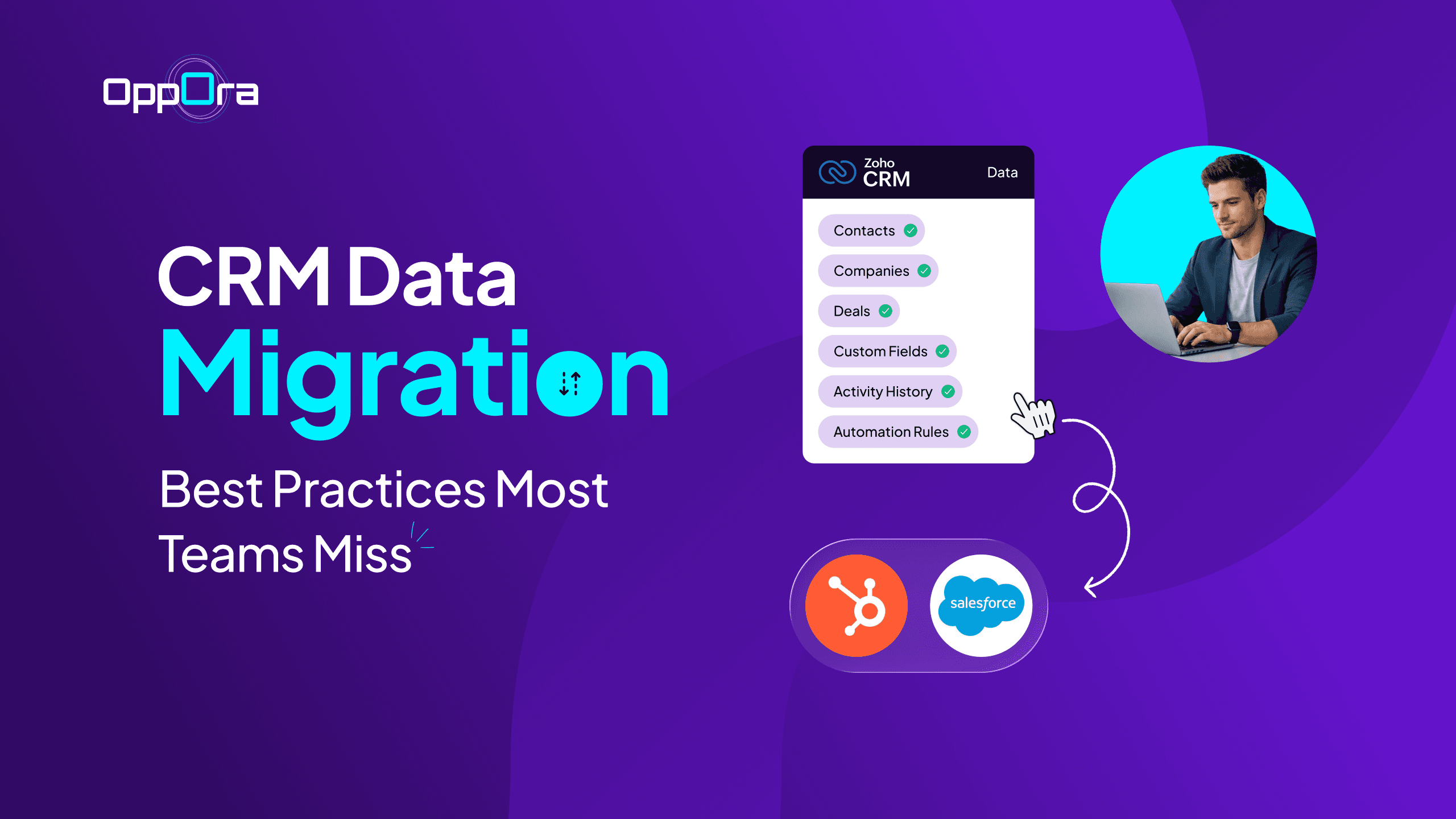
CRM data migration is far more than just moving rows of data from one system to another. It’s a strategic transformation that impacts sales forecasts, customer service, reporting accuracy, automation, and every team that touches customer data.
Yet, most migrations don’t go as planned. Common consequences include:
- Data loss or corruption
- Broken automations and workflows
- Teams resisting the new system
- Missed revenue opportunities
👉 In this article, we’ll uncover essential CRM migration best practices that many teams overlook, and show how Oppora.ai simplifies and accelerates every step of the process—from planning to adoption.
What is CRM Data Migration?
CRM data migration is the process of transferring customer data, objects, workflows, settings, and relationships from one CRM to another—for example:
📌 A company moving from a legacy system like Zoho CRM to a modern platform like Salesforce or HubSpot.
Successful migration means preserving not just data, but context—associations between contacts, companies, deals, custom fields, activity history, and automation rules.
Why it matters:
- Accurate reporting: Your business decisions rely on clean, complete data.
- Operational continuity: Sales, marketing, and support teams depend on workflows that operate consistently.
- Revenue impact: Data inconsistencies can lead to lost deals or poor customer experience.
CRM Data Migration Best Practices: Strategic vs Technical Approaches
Migrating a CRM is not just moving data—it’s about ensuring business continuity, preserving relationships, and enabling teams to work effectively in the new system. Success requires strategic planning and technical execution, each with its own best practices.
Part 1: Strategic / Planning Best Practices
These form the foundation of a successful migration. Without strategy, even the most technically perfect migration can fail.
1. Define Clear Business Goals & Success Metrics
Before touching any data or tools, you need absolute clarity on why you are migrating. Without this, migration becomes a technical activity instead of a business improvement initiative.
A CRM should solve real problems—not just replace an old system.
What defining goals actually means:
- Identify current pain points
- Slow lead response
- Poor data visibility
- Inaccurate reporting
- Multiple disconnected systems
- Translate those into clear, measurable outcomes
Examples of strong business goals:
- Reduce lead response time by 25%
- Improve reporting accuracy from 80% → 95%
- Increase sales team productivity by reducing manual data entry
- Consolidate multiple CRMs into one single source of truth
How to measure success (very important):
You need measurable KPIs, otherwise you won’t know if migration worked.
- Adoption metrics
- % of active users
- Login frequency
- Data quality metrics
- Reduction in duplicates
- Increase in complete records
- Operational metrics
- Workflow completion rate
- Lead conversion rate
- Performance tracking
- Use dashboards to compare before vs after migration
Practical example:
A SaaS company migrated CRM to improve pipeline visibility.
- Before migration:
- After migration (with clean data + structured workflows):
👉 That’s a 20% improvement, directly impacting revenue decisions.
Key takeaway:
👉 If you don’t define success clearly, your migration might “finish”—but it won’t deliver results.
CRM is not just a tool—it’s used by Sales, Marketing, Support, and Operations. If these teams are not aligned, your migration will fail due to miscommunication and resistance.
Why this matters:
- Different teams use CRM differently
- Each team has unique workflows and priorities
- Without alignment:
- Important workflows get missed
- Teams reject the new system
What strong ownership looks like:
- Assign department champions:
- Sales lead → pipeline & deals
- Marketing lead → lead tracking
- Support lead → customer interactions
- IT → technical setup
- Create a migration task force
- Responsible for decisions and approvals
Best practices to implement:
- Weekly migration review meetings
- Clear escalation process for issues
- Shared documentation across teams
Example:
A company skipped cross-team alignment:
- Sales workflows weren’t migrated properly
- Marketing automation broke
- Result → Teams stopped using the CRM
Later, they fixed it by:
- Assigning team champions
- Rebuilding workflows with input from each team
Unique insight:
👉 Strong executive involvement prevents:
- Scope creep (constant changes)
- Delays in decision-making
- Lack of accountability
Key takeaway:
👉 CRM migration is a team project, not an IT project.
3. Define Scope & Prioritize Data
One of the biggest mistakes is trying to migrate everything. This increases complexity, cost, and risk.
The goal is not to move all data—it’s to move useful data.
Why scope matters:
- Reduces migration time
- Improves data quality
- Simplifies mapping and validation
How to define scope properly:
Step 1: Categorize your data
- Critical data (must migrate):
- Active customers
- Open deals
- Key contacts
- Essential workflows
- Optional data:
- Closed deals older than 2–3 years
- Inactive leads
- Archive data:
- Test records
- Duplicate entries
- Outdated or irrelevant fields
Example:
Instead of migrating 10 years of data:
- Migrated only:
- Last 24 months of deals
- Active customers
👉 Result:
- 50% faster migration
- Cleaner reporting
Advanced tip (very practical):
Use a data usage heatmap:
- Identify:
- Which fields are frequently used
- Which fields are never touched
👉 Only migrate what actually drives business decisions.
What happens if you skip this:
- Cluttered CRM
- Slower performance
- Confusing reports
Key takeaway:
👉 Migration is a chance to clean and simplify, not carry forward legacy chaos.
4. Plan Risk Mitigation
Every CRM migration has risks. The difference between success and failure is how well you prepare for them.
Common risks in CRM migration:
- Data loss
- Duplicate records
- Broken workflows
- System downtime
- User resistance
How to plan for risks:
1. Identify high-risk areas
- Large datasets
- Complex custom objects
- Critical workflows
2. Create a rollback plan
- Always have a backup of original data
- Define how to restore data if migration fails
3. Plan migration timing
- Choose low-activity periods
- Avoid peak business hours
4. Communicate clearly
- Inform teams about:
- Downtime
- Changes
- Expected impact
Example:
A B2C company migrating CRM:
- Scheduled migration during weekends
- Used incremental syncs to capture live updates
- Had a rollback plan ready
👉 Result:
- No downtime impact
- Zero data loss
What happens without risk planning:
- Lost customer data
- Business disruption
- Panic during migration
Key takeaway:
👉 Migration success is not about avoiding risks—it’s about being prepared for them.
Part 2: Technical / Operational Best Practices
This is where execution meets precision. The strategies below are often missed and cause most migrations to fail.
5. Data Audit & Cleaning (The Most Critical Step)
What it means: Before moving anything, you need to understand and fix your data. Most CRM issues after migration come from poor data quality—not the migration itself.
What to check during a data audit:
- Duplicate records
- Same contact saved multiple times with slight variations
- Example:
- Incomplete data
- Missing emails, phone numbers, company names
- Leads without key identifiers become unusable post-migration
- Outdated data
- Old leads (3–5+ years)
- Inactive customers or closed deals
- Inconsistent formats
- Phone numbers: 1234567890 vs +1-123-456-7890
- Dates: MM/DD/YYYY vs DD/MM/YYYY
How to clean data properly:
- Run deduplication logic (exact + fuzzy matching)
- Standardize formats across all records
- Remove or archive irrelevant data
- Fill critical missing fields where possible
- Assign ownership to each record
Example: Before vs After Cleaning
Field | Before | After |
Email | john.doe@ | [email protected] |
Phone | 987654321 | +91-98765-43210 |
Duplicates | 3 records | 1 clean record |
Why this matters:
- Prevents duplicate outreach
- Improves reporting accuracy
- Ensures workflows trigger correctly
👉 Reality: If you skip this step, your new CRM will inherit all old problems—just in a new system.
What it means: Field mapping is about telling the new CRM where each piece of data should go—but it’s not always a 1:1 match.
Common challenges in mapping:
- Different field types across systems
- Missing equivalent fields
- Complex relationships between objects
Types of mapping scenarios:
A. Simple Mapping (Easy)
- Old: Email → New: Email
- Direct, no transformation needed
- Old: “Lead Source” (text field)
- New: “Lead Source” (dropdown/picklist)
Solution: Convert text values into predefined categories
Example:
- “Facebook Ads” → “Paid Social”
- “Google Search” → “Organic Search”
C. Relational Mapping (Complex)
- Contacts linked to accounts and deals
Example:
- Company: ABC Pvt Ltd
- Contacts: 5 employees
- Deals: 3 active opportunities
👉 These relationships must remain intact after migration.
Best practices:
- Create a field mapping document before migration
- Define transformation rules clearly
- Test mapping on sample data
- Ensure relationships (parent-child links) are preserved
What goes wrong if ignored:
- Data lands in wrong fields
- Reports become meaningless
- Workflows fail due to incorrect values
7. Controlled Cut-Off & Incremental Sync Strategy
What it means: During migration, your data is still changing. If not handled properly, you’ll end up with missing or duplicated records.
Two main approaches:
A. Hard Cut-Off (Freeze Method)
- Stop all updates in the old CRM
- Perform migration
- Start using new CRM
Best for:
- Small teams
- Short migration windows
B. Incremental Sync (Live Systems)
- Data continues updating during migration
- Changes are synced in batches
Best for:
- Large organizations
- 24/7 operations
Example:
An e-commerce company cannot stop order flow. So they:
- Migrate initial dataset
- Run nightly syncs for new customers/orders
- Perform final sync before switching systems
Key checks:
- Track “last updated timestamp”
- Sync only changed records
- Validate final dataset before switching
Risk if ignored:
- Lost leads or deals
- Duplicate entries
- Data mismatch between systems
8. Pilot Migration (Test Before Full Execution)
What it means: Instead of migrating everything at once, you test with a small dataset first.
How to run a pilot migration:
- Select a subset:
- 50–100 contacts
- Few accounts and deals
- Include different data types (active, inactive, custom fields)
- Run full migration process
What to validate:
- Data accuracy
- Field mapping correctness
- Workflow functionality
- Relationships between objects
Example:
A company tested 100 records and discovered:
- Deal stages mapped incorrectly
- Workflow emails not triggering
Fixing this early saved thousands of records from corruption.
Why this is powerful:
- Identifies issues early
- Reduces risk in full migration
- Improves confidence before launch
9. Execution, Validation & Quality Assurance
What it means: Migration doesn’t end when data is imported—it ends when data is verified and trusted.
Execution phase includes:
- Running final migration scripts
- Monitoring logs during import
- Tracking errors in real-time
Validation checklist:
- ✅ Record count matches (old vs new CRM)
- ✅ Critical fields are populated correctly
- ✅ Relationships (accounts, contacts, deals) are intact
- ✅ No duplicate records created
Quality Assurance (QA) checks:
- Spot-check high-value accounts
- Verify pipeline reports
- Test automations:
- Lead assignment
- Email triggers
- Task creation
Example:
A company migrated 10,000 deals:
- Found 500 missing due to filter error
- QA helped recover them before go-live
Key insight:
👉 Migration without validation = blind trust And blind trust in data is risky.
10. Training, Adoption & Data Governance
What it means: Even perfect migration fails if teams don’t use the new CRM properly.
Training best practices:
- Role-based sessions:
- Sales → pipeline & deals
- Marketing → leads & campaigns
- Support → tickets & customer history
- Provide:
- Quick guides
- Video walkthroughs
- FAQs
Adoption tracking:
- Login frequency
- Data entry completeness
- Workflow usage
Ongoing governance:
- Assign data owners per team
- Schedule monthly data audits
- Monitor integrations (to avoid data corruption)
- Set rules:
- Mandatory fields
- Duplicate prevention
Example:
A SaaS company noticed low adoption after migration:
- Sales reps weren’t updating deals
- Reports became inaccurate
Solution:
- Conducted retraining
- Set mandatory deal updates
- Adoption improved by 40%
Reality check:
👉 Migration is not the finish line—it’s the starting point of better data management.
Why Most CRM Migrations Fail
Many migrations fail—not because it’s technically hard, but because teams underestimate the complexity of real business data.
Here are common failure points:
❌ Dirty or duplicate data
Multiple records for the same customer Outdated or inconsistent formatting
❌ Misaligned fields or workflows
Fields that don’t map cleanly between old and new systems Custom automation breaks after migration
❌ Lack of user adoption
Teams don’t embrace the new system due to poor training
❌ Poor planning & scope creep
Unplanned "scope changes" derail timelines
👉 Most of these problems are preventable with structured planning and execution—but only if the team prioritizes them.
Conclusion: Migration Is a One-Time Event—But Its Impact Is Long-Term
CRM data migration isn’t just a technical upgrade—it’s a business-critical reset.
Done right, it gives you:
- Clean, reliable data
- Accurate forecasting
- Seamless workflows
- Higher team productivity
Done wrong, it creates:
- Confusion instead of clarity
- Broken processes instead of efficiency
- And missed revenue instead of growth
The difference doesn’t come down to tools alone—it comes down to how intentionally you approach the process.
The best-performing teams treat migration as:
- A data clean-up opportunity, not just a transfer
- A process redesign moment, not just system replacement
- A foundation for future growth, not just a one-time project
That’s why the practices covered in this guide—from defining goals and scoping data to validation, testing, and governance—aren’t optional. They’re essential.
And while these best practices are clear in theory, executing them consistently at scale is where most teams struggle.
That’s where platforms like Oppora.ai make a meaningful difference—by reducing manual effort, minimizing risk, and ensuring your migration is not just completed, but trusted and usable from day one.
Frequently Asked Questions
1. How long should a CRM data migration realistically take?
The timeline depends on data volume, complexity, and preparation—not just the migration itself.
- Small migrations (clean data, simple CRM): 2–4 weeks
- Mid-sized (custom fields, multiple teams): 1–3 months
- Complex (multiple CRMs, heavy automation): 3–6+ months
Most delays don’t happen during migration—they happen during data cleaning, mapping, and validation.
2. How do you ensure no data is lost during migration?
You can’t rely on a single check—you need multi-layer validation:
- Pre-migration backup of all data
- Record count comparison (before vs after)
- Field-level validation (critical fields only)
- Random sampling of high-value records
The key is: trust, but verify at multiple levels.
3. What’s the difference between data migration and data integration?
Many teams confuse the two:
- Data Migration: One-time transfer from old CRM to new CRM
- Data Integration: Continuous syncing between systems (CRM, marketing tools, etc.)
Migration is the starting point, but integration ensures your data stays consistent afterward.