Home
Blog
Find 500 B2B Contacts for Free Every Month with Built-In Outreach.
Home
Blog
Manasa Goli
Published March 14, 2026
8 min
Try Oppora AI
Create Self-Running Agentic Sales Workflows like N8N just by chatting with AI
Get Started for FREE
Modern B2B marketing is no longer about sending random emails and hoping for replies. Buyers today expect timely, relevant communication that aligns with their interests and stage in the buying journey.
To manage this process effectively, businesses rely on automated outreach strategies, especially drip campaigns and nurture campaigns. At first glance, these two approaches may look similar because both involve sending a sequence of emails over time.
However, they serve different purposes and work in different ways.
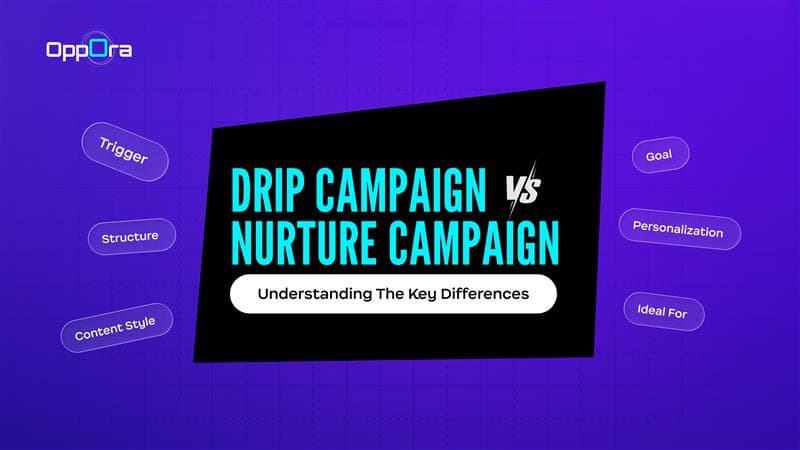
Understanding the difference between a drip campaign vs nurture campaign can help sales and marketing teams design better outreach strategies, improve engagement, and guide prospects toward conversion more effectively.
In this guide, we’ll explore how these campaigns work, their key differences, real-world examples, and when to use each strategy.
A drip campaign is an automated series of emails sent to prospects at predefined time intervals after a specific trigger event.
The emails are scheduled in advance and follow a linear sequence, meaning every prospect receives the same messages in the same order.
The main goal of a drip campaign is to deliver information gradually and keep prospects engaged while guiding them toward a desired action, such as booking a demo or signing up for a trial.
A drip campaign typically begins after a user performs a specific action, such as:
Once the trigger occurs, the system automatically sends emails according to a schedule (for example: Day 1, Day 3, Day 7).
Imagine a SaaS company offering an outbound sales platform.
When someone signs up for a free trial, they might receive a drip sequence like this:
Day 1: Welcome email and product overview
Day 3: Feature explanation and use cases
Day 5: Case study from a successful customer
Day 7: Invitation to book a demo
Each email builds on the previous one, gradually introducing the product and encouraging engagement.
Drip campaigns are best suited for situations where you want consistent communication with a large audience.
Use drip campaigns when:
Because these campaigns are simple and predictable, they are ideal for top-of-funnel lead engagement.
Drip campaigns can be used across different stages of the customer journey. Businesses commonly implement them for several purposes.
These campaigns are triggered when someone subscribes to a mailing list or creates an account. The goal is to introduce the brand, explain what subscribers can expect, and begin building trust.
Example flow:
Onboarding drip campaigns help new users understand how to use a product effectively. This is especially common in SaaS businesses where adoption plays a critical role in customer retention.
Typical onboarding emails may include:
When users start a free trial, drip campaigns guide them toward experiencing the most valuable features of the product.
For example:
Day 1: Welcome and account setup guide
Day 2: Feature overview
Day 4: Case study showing real results
Day 6: Reminder about trial expiration
Day 7: Upgrade offer
Educational campaigns provide valuable insights and resources over time. These are often used by B2B companies to position themselves as thought leaders in their industry.
Examples include:
If subscribers become inactive, companies can trigger re-engagement sequences designed to bring them back.
These emails might include:
Drip campaigns follow a predefined sequence of automated messages sent at scheduled intervals after a specific trigger event. The structure is simple but highly effective because it allows businesses to maintain consistent communication with leads without requiring manual follow-ups.
The core idea behind a drip campaign is that instead of overwhelming prospects with too much information at once, companies deliver small pieces of relevant content over time. This gradual communication helps prospects understand a product or service while keeping the brand top of mind.
A typical drip campaign operates through a structured automation workflow.
Every drip campaign begins with a trigger action performed by the user. This trigger activates the automated sequence.
Common triggers include:
Once the trigger occurs, the automation system places the user into a prebuilt email workflow.
After the trigger event, the system begins sending a series of scheduled emails. These messages are written in advance and delivered in the same order for all recipients within that campaign.
For example, a SaaS onboarding drip campaign may look like this:
Day 1: Welcome email introducing the platform
Day 3: Key product features and benefits
Day 5: Case study demonstrating results
Day 7: Invitation to schedule a product demo
Each email builds upon the previous message, gradually educating the prospect and encouraging engagement.
Unlike nurture campaigns, drip campaigns follow a time-based schedule rather than behavior-based triggers. The messages are delivered regardless of whether the recipient opens the previous email or interacts with it.
This structured timing ensures that every lead receives consistent communication across the entire sequence.
Every drip campaign is designed with a specific objective, such as:
The final emails in the sequence typically contain stronger calls-to-action, such as scheduling a demo, starting a trial, or speaking with a sales representative.
A nurture campaign is a more advanced outreach strategy designed to build relationships with leads through personalized, behavior-driven communication.
Instead of sending emails on a fixed schedule, nurture campaigns respond to prospect behavior, engagement signals, and stage in the buyer journey.
For example, if a prospect:
The system can automatically send tailored content that matches their level of interest.
Nurture campaigns focus less on pushing immediate sales and more on educating prospects, building trust, and gradually moving them through the sales funnel.
Nurture campaigns work best when prospects require more information before making a decision.
This is especially common in:
Use nurture campaigns when:
These campaigns help move marketing-qualified leads (MQLs) closer to becoming sales-qualified leads (SQLs).
While drip campaigns follow a fixed schedule, nurture campaigns take automation a step further by using behavior-based communication.
Instead of sending emails at predefined intervals, nurture campaigns analyze how prospects interact with content and respond with highly relevant messaging.
This approach allows companies to build stronger relationships with leads by delivering content that matches their interests, intent, and stage in the buying journey.
Nurture campaigns operate through a more advanced workflow compared to drip campaigns.
A lead typically enters a nurture campaign after showing some level of interest, such as:
These actions signal that the prospect may be considering a solution.
Once the lead enters the nurture workflow, the marketing automation platform begins tracking engagement signals, including:
These signals help determine the prospect’s level of interest.
Unlike drip campaigns, nurture campaigns adjust messaging based on how prospects interact with content.
For example:
If a prospect repeatedly visits the pricing page, they might receive:
If a prospect engages with educational content instead, they may receive:
This adaptive approach ensures that every lead receives contextually relevant information.
As engagement increases, nurture campaigns help identify leads who are more likely to convert.
Marketing teams often assign lead scores based on behavior.
For instance:
Opening multiple emails → moderate interest Downloading product guides → higher intent Requesting a demo → strong buying signal
Once a lead reaches a certain score threshold, they may be handed over to the sales team for direct outreach.
Imagine a prospect downloads a report titled:
"The Future of AI Sales Automation."
Their nurture journey could look like this:
Step 1: Thank-you email with the downloaded resource
Step 2: Email sharing related industry insights
Step 3: Case study from a company in a similar industry
Step 4: Product comparison showing advantages
Step 5: Invitation to schedule a demo
However, if the prospect skips certain emails or engages with different content, the campaign might adjust the next message accordingly.
This flexibility is what makes nurture campaigns far more dynamic and personalized.
Although both strategies rely on marketing automation and email sequences, they differ in structure, purpose, and personalization.
Here’s a clear comparison.
The biggest difference lies in how messages are triggered.
Drip campaigns send emails at predetermined intervals, while nurture campaigns adapt communication based on user behavior and engagement signals.
Managing outreach sequences manually becomes difficult as sales teams scale their prospecting efforts.
This is where automation platforms like Oppora can make a significant difference.
Oppora helps sales teams run structured outbound campaigns by enabling them to:
Instead of sending random cold emails, teams can design structured campaign flows that guide prospects through the sales journey, combining the efficiency of drip campaigns with the intelligence of nurture-based outreach.
This approach ensures consistent communication while still allowing teams to tailor messaging based on prospect behavior.
Both drip campaigns and nurture campaigns are essential tools in modern marketing automation.
While drip campaigns focus on delivering scheduled messages, nurture campaigns concentrate on building relationships through personalized engagement.
Understanding how these strategies differ — and how they work together — allows businesses to create more effective outreach workflows that convert leads into customers.
By combining automation, personalization, and behavioral insights, companies can build scalable marketing systems that keep prospects engaged throughout the entire buying journey.
Yes, businesses can run drip campaigns and nurture campaigns simultaneously as part of a broader marketing automation strategy. A drip campaign may handle scheduled communication such as onboarding or educational emails, while a nurture campaign can adapt messaging based on a prospect’s engagement and behavior. Using both together allows businesses to maintain consistent outreach while still delivering personalized experiences to leads.
The ideal duration of a campaign depends on the product, sales cycle, and audience. Drip campaigns typically run for 1 to 4 weeks, especially for onboarding or trial activation sequences. Nurture campaigns, however, may continue for several months, particularly in industries with longer buying cycles like B2B SaaS or enterprise software. The key is to maintain relevance and avoid overwhelming prospects with excessive messaging.
In many B2B industries, prospects take weeks or even months to make purchasing decisions. Drip and nurture campaigns help maintain communication throughout this period by delivering helpful resources, product insights, and industry knowledge. This consistent engagement keeps the brand top of mind while gradually building trust with potential buyers.
Small businesses can benefit from both strategies, but they often start with drip campaigns because they are easier to implement. As marketing efforts grow and more customer data becomes available, businesses can introduce nurture campaigns to deliver more personalized messaging and improve lead conversion.
Summarize with AI
Share