Home
Blog
Find & Send Cold Emails to 500 Unique Prospects Every Month for FREE.
Home
Blog
Manasa Goli
Published February 7, 2026
11 min
Try Oppora AI
Create Self-Running Agentic Sales Workflows like N8N just by chatting with AI
Get Started for FREE
Let’s be honest — most email templates you find online sound like they were written for everyone and no one at the same time.
They’re overly polished, painfully generic, and easy to ignore.
Yet email continues to deliver one of the highest ROIs in marketing. The difference between an email that gets deleted and one that gets a reply often comes down to how real it feels.
That’s exactly what this guide is built for.
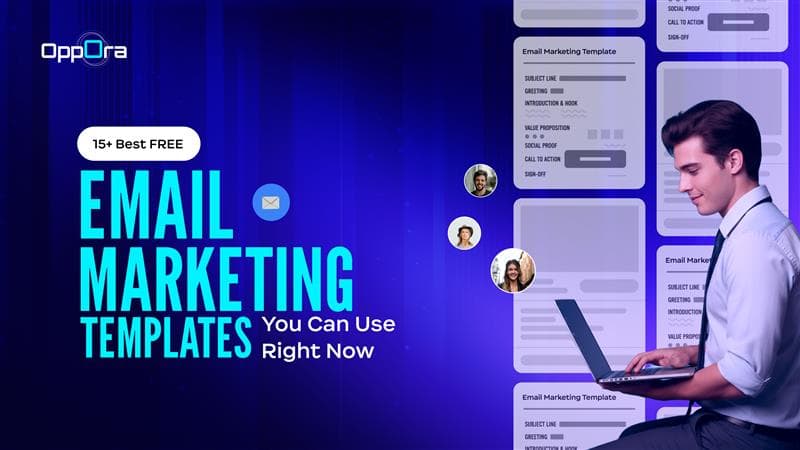
Instead of dumping dozens of lifeless formats, you’ll find carefully selected, high-performing email marketing templates designed for real-world situations — whether you’re reaching out to cold prospects, welcoming new subscribers, recovering abandoned carts, or nurturing long-term relationships.
More importantly, you’ll learn:
✅ When to use each template
✅ Why it works psychologically
✅ How to adapt it without sounding robotic
✅ What most marketers forget when sending emails
Think of this as your go-to playbook, not just a swipe file.
Let’s start with the templates.
When to Use This Template
Use this when contacting someone who has never heard of you before. Perfect for founders, agencies, SaaS teams, recruiters, and consultants.
Cold emails fail when they try to explain too much too quickly. This template works because it lowers commitment — you're not asking for a meeting immediately, just opening a conversation.
Subject: Quick question, [First Name]
Hi [First Name],
I came across [something specific about their company/work] and had a quick question.
Are you currently exploring ways to improve [specific outcome]?
If yes, I’d love to share an idea that has worked well for similar teams.
Either way — keep up the great work at [Company].
– [Your Name]
Why This Works
Psychology at play: People are far more likely to respond to questions than pitches.
When to Use
Best for high-value prospects where personalization matters more than volume.
Subject: Noticed this about [Company]
Hi [First Name],
I was exploring your [product / recent launch / article] and noticed how you’re focusing on [specific strategy].
Many teams run into [related challenge] at this stage.
If it’s on your radar, I’m happy to share what we’ve seen work.
Worth a conversation?
– [Your Name]
Why It Works
Most “personalized” emails just insert a name.
This one shows situational awareness, which instantly separates you from mass senders.
When to Use
Great if your audience is tired of aggressive sales emails.
Subject: Should I close your file?
Hi [First Name],
I wasn’t sure if improving [pain point] is still a priority for your team.
If now isn’t the right time, just let me know and I won’t clutter your inbox.
If it is — happy to share a few ideas.
– [Your Name]
Why It Works
Here’s something many blogs won’t tell you:
👉 Most replies don’t come from the first email. They come from follow-ups.
Yet marketers either forget to send them or make them sound automated.
When to Use
Send 2–3 days after your first email.
Subject: Just bubbling this up
Hi [First Name],
Wanted to gently bring this back to the top of your inbox in case it slipped through.
Happy to reconnect whenever the timing is better.
– [Your Name]
Why It Works
When to Use
When the prospect hasn’t responded — add value instead of repeating yourself.
Subject: Thought this might help
Hi [First Name],
I recently came across this insight on [topic] and immediately thought of your team.
[Insert 1–2 sentence insight]
I hope it’s useful regardless.
– [Your Name]
Why It Works
Now we move from outreach → relationship building.
When to Use
Immediately after signup.
Welcome emails often get 2–3x higher open rates than regular campaigns — wasting them is a huge mistake.
Subject: Really glad you’re here, [First Name]
Hi [First Name],
Thanks for joining us — we don’t take inbox space lightly.
Here are three resources people usually start with:
• [Link]
• [Link]
• [Link]
Tell me — what made you sign up?
I read every reply.
– [Your Name]
Why It Works
👉 Competitors almost NEVER include this.
When to Use
Right after the welcome email.
Subject: What you can expect from us
Hi [First Name],
Here’s what you’ll get from being on this list:
✔ Practical strategies
✔ No fluff
✔ No daily spam
Just useful ideas to help you grow.
And if we ever send something irrelevant — unsubscribe anytime. No hard feelings.
– [Brand]
Why It Works
When to Use
New feature, product, or update.
Subject: It’s finally here…
Hi [First Name],
After months of building (and rebuilding), we’ve launched [product].
It helps you:
• Save time
• Reduce manual work
• Focus on what matters
See it in action → [Link]
Why It Works
Story + anticipation > announcement.
When to Use
When you want conversions without sounding pushy.
Subject: Might be useful
Hi [First Name],
If [pain point] has been slowing you down, this might help.
We built [solution] to make it simpler.
Take a look — and decide for yourself.
[Link]
Why It Works
Autonomy increases buying behavior.
No one likes being “sold.”
When to Use
1–3 hours after abandonment.
Subject: Your cart is still waiting 🙂
Hi [First Name],
Looks like you left something behind.
Happens to the best of us.
Grab it before it’s gone → [Link]
Why It Works
Friendly reminder > urgency spam.
When to Use
After 30–60 days of inactivity.
Subject: Still want to hear from us?
Hi [First Name],
Noticed you’ve been quiet lately — and that’s okay.
Want to stay subscribed, or should we stop emailing?
Just click below.
No awkward breakups 🙂
Why It Works
When to Use
Send immediately after a purchase, signup milestone, upgrade, or meaningful interaction. Most brands redirect users to a confirmation page and stop there — which is a missed emotional opportunity.
Gratitude is memorable.
Subject: Just wanted to say thank you
Hi [First Name],
We don’t say this enough — thank you for choosing us.
Out of so many options available, you trusted us, and that means everything to our team.
If there’s ever anything we can do to improve your experience, just reply to this email. We’re listening.
Appreciate you being here.
— [Your Brand / Name]
Why It Works
Unexpected appreciation creates emotional stickiness. Customers may forget transactions, but they remember how a brand made them feel.
It also subtly invites conversation — something automated confirmation emails never do.
When to Use
Send after a positive moment — successful onboarding, great feedback, repeat purchase, or strong product usage.
Never ask for referrals from neutral users. Ask when satisfaction is high.
Subject: Know someone who’d love this?
Hi [First Name],
We’re growing mostly through word of mouth, and that tells us we’re doing something right 🙂
If you know someone who might benefit from [your product/service], we’d be grateful for an introduction.
As a small thank-you, we’ll make sure there’s something in it for both of you.
Here’s your referral link: [Insert Link]
Thank you for being part of our journey.
— [Your Name]
Why It Works
When to Use
Subject: Celebrating you today 🎉
Hi [First Name],
Today marks [1 year / 100 days / milestone] since you joined us.
We couldn’t let the moment pass without saying thanks for being part of our story.
To celebrate, here’s something for you: [Reward / Discount / Bonus Feature]
Looking forward to many more milestones together.
— [Brand Name]
Why It Works
When to Use
After support resolution, product delivery, onboarding completion, or event attendance.
Timing matters — send it while the experience is still fresh.
Subject: How did we do?
Hi [First Name],
Your experience matters to us, and we’d genuinely love your feedback.
What worked well?
What could we do better?
It’ll only take a minute: [Feedback Link]
Thanks for helping us improve.
— [Your Name]
Why It Works
It signals humility. Brands that ask for feedback feel more human and trustworthy.
Also — customers who give feedback become more invested in your product.
When to Use
Subject: Should we give this another shot?
Hi [First Name],
We noticed you’re no longer using [product], and we completely understand — needs change.
Since you left, we’ve made some meaningful improvements, including:
• [Upgrade]
• [Feature]
• [Enhancement]
If you’re open to it, we’d love to welcome you back.
Here’s something to make the return easier: [Offer]
Either way, we appreciate the time you spent with us.
— [Brand]
Why It Works
At the beginning, writing emails feels manageable.
You research the prospect, tweak a few lines, personalize the opening, and hit send.
But as your outreach grows, something changes.
What once took 5 minutes now takes hours.
You start wondering:
This is the stage where having the right system matters.
Platforms like Oppora.ai are built to support this exact transition — helping teams create tailored email campaigns without starting from scratch every time.
Instead of juggling spreadsheets, rewriting templates, and manually building follow-ups, you can generate structured sequences, adapt messaging for different segments, and keep your outreach consistent as it scales.
The real advantage isn’t just automation.
It’s protecting the human feel of your emails while removing the repetitive workload behind them.
Because growth shouldn’t force you to sound robotic.
Here’s a secret many experienced marketers learn late:
👉 The highest-performing emails rarely sound like marketing.
They sound like messages you’d send a colleague.
If you wouldn’t say it in conversation, don’t write it.
Read your email out loud — you’ll instantly catch stiffness.
“You're” beats “You are.” “It’s” beats “It is.”
Small shifts create a relaxed tone.
Clarity is more persuasive than intelligence.
Avoid buzzwords like:
They dilute authenticity.
Shift the focus from “we” → “you.”
Instead of: "We built a platform with advanced capabilities..."
Try: "You can now automate this in minutes."
Readers care about their outcomes — not your features.
Over-polished emails feel automated.
A slightly conversational tone builds trust because it feels real.
Perfection is forgettable. Personality is not.
Even strong templates fail when execution goes wrong. Before you send your next campaign, make sure you’re not falling into these common traps.
If your email reads like it was approved by five departments, it’s already in trouble.
People connect with people — not organizations.
👉 Replace: "We are delighted to inform you..."
👉 With: "Excited to share this with you."
Simple language always wins.
An email is not a landing page.
Over-explaining creates friction and drains attention. The best emails are easy to scan and even easier to understand.
When editing, ask yourself: “Can I remove 20% of this without losing meaning?”
Usually, the answer is yes.
When you ask readers to do five things, they usually do none.
Pick one clear action.
Clarity converts.
Generic emails feel invisible because they are.
Even light personalization — referencing a role, industry, or behavior — dramatically improves engagement.
Relevance beats cleverness every time.
A great email sent at the wrong moment is still a bad email.
Welcome emails should feel immediate. Follow-ups should feel intentional — not automated. Promotions should feel timely.
Context is half the strategy.
🔥 Send plain-text emails — they outperform designed ones in many cases. 🔥 One email = one goal. 🔥 Short beats are clever. 🔥 Specific beats creative.
And always optimize for replies — not just opens.
Great email marketing isn’t about sending more emails — it’s about sending the right ones at the right time. The templates in this guide give you a practical starting point for every stage, from cold outreach to long-term retention.
But remember, templates work best when they don’t feel like templates. Keep your emails clear, relevant, and genuinely helpful.
As your campaigns grow, maintaining that level of personalization can become challenging. Platforms like Oppora.ai can help you create tailored email sequences faster while keeping the human touch intact — so your outreach scales without sounding automated.
Start simple, test what works, and keep refining.
Because the emails that get replies rarely sound like marketing — they sound like someone worth responding to.
Most businesses see strong engagement with 1–3 emails per week. This keeps your brand visible without overwhelming subscribers. Focus on consistency rather than volume — sending one valuable email regularly is far more effective than multiple low-quality ones. If unsubscribes rise or open rates drop, reduce frequency.
Plain-text emails often generate more replies because they feel personal and conversational rather than promotional. Designed emails work best for product launches, newsletters, and visual campaigns. If your goal is building relationships or starting conversations, choose plain text. If your goal is attention and clicks, a clean design can be more effective.
Emails between 50–125 words tend to perform best. Shorter emails respect the reader’s time, reduce friction, and make responding easier. If your message isn’t clear within the first few lines, it’s probably too long. Prioritize clarity over creativity — concise emails almost always outperform lengthy ones.
High-performing subject lines are clear, relevant, and curiosity-driven. Proven formulas include:
Keep subject lines under 6–9 words when possible, and avoid clickbait — trust matters more than cleverness.
A strong email funnel guides readers from awareness to loyalty. Start with a welcome email, follow with value-driven content, introduce your offer naturally, and send timely follow-ups. After conversion, focus on retention through helpful updates and occasional referral requests. The goal is to build a relationship — not just push promotions.
Wait about 2–3 days before sending your first follow-up. This gives the recipient enough time to see your email without feeling pressured. If there’s still no response, space additional follow-ups 3–5 days apart. Gentle persistence works better than aggressive reminders.
Yes — email templates save time, improve consistency, and help you scale outreach faster. However, they perform best when lightly personalized. Even small details like referencing a company, role, or recent activity can dramatically increase reply rates and engagement.
Summarize with AI
Share