Home
Blog
Find 500 B2B Contacts for Free Every Month with Built-In Outreach.
Home
Blog
Manasa Goli
Published March 7, 2026
7 min
Try Oppora AI
Create Self-Running Agentic Sales Workflows like N8N just by chatting with AI
Get Started for FREE
Modern B2B deals rarely depend on a single decision-maker.
Even when one person discovers your product, multiple stakeholders usually influence the final decision. Finance evaluates the budget. Operations checks implementation risks. Leadership reviews strategic value. Procurement negotiates pricing.
Yet many outbound sales teams still rely on a single-threaded approach—reaching out to just one contact inside an account.
This creates a major risk: if that one contact goes silent, changes roles, or loses influence, the deal stalls.
That’s where multithreading in sales becomes essential.
In this guide, we’ll break down what multithreading means, why it matters in modern B2B sales, and how AI SDR platforms like Oppora help sales teams scale multi-threaded sales outreach effectively.
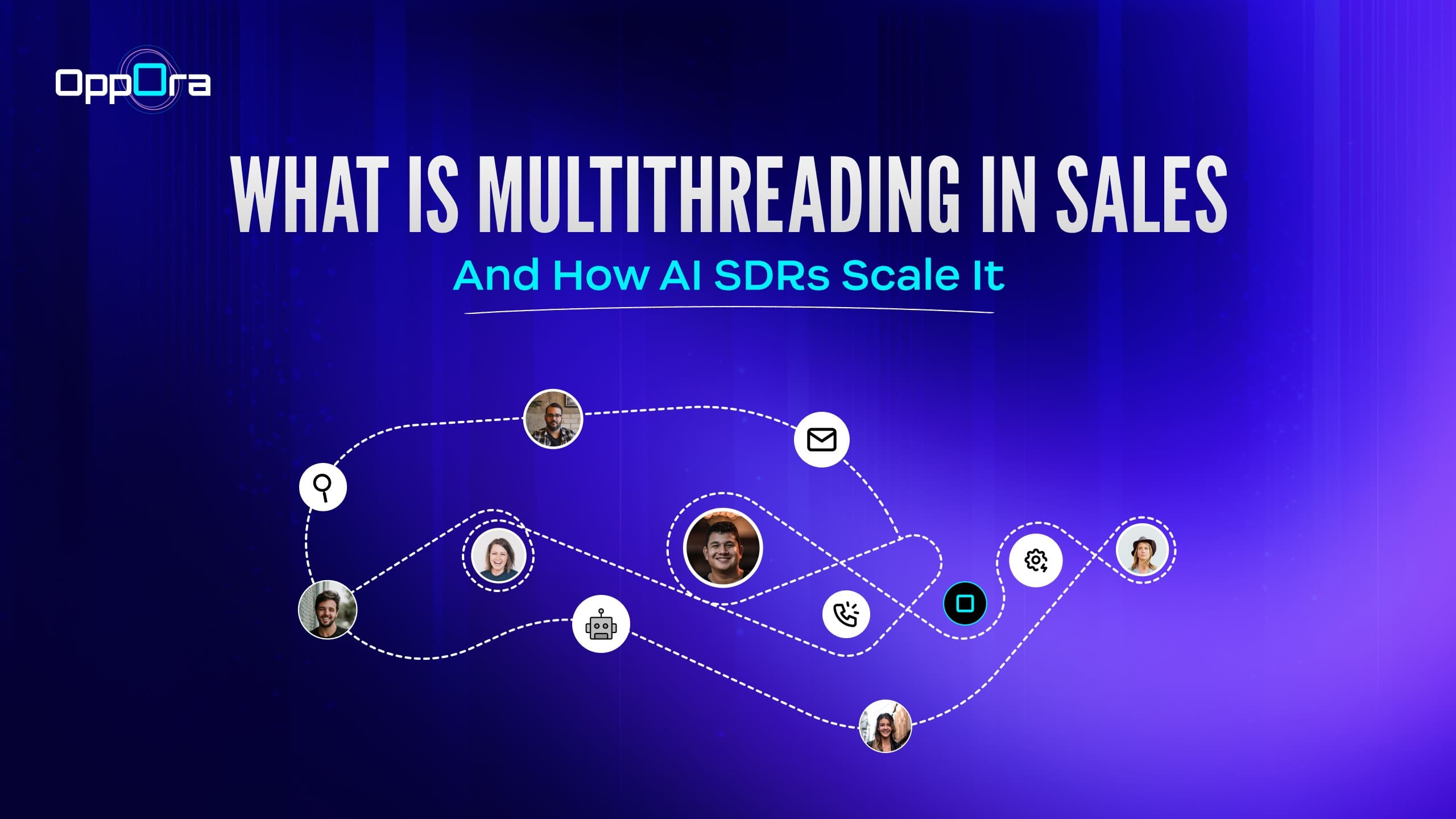
Multithreading in sales is the strategy of engaging multiple stakeholders within the same target account simultaneously throughout the sales process.
Instead of relying on a single champion, sales teams build relationships across different roles involved in the buying decision.
For example, if you're selling a SaaS analytics platform, your outreach might include:
Each stakeholder cares about different outcomes.
By engaging all of them, you reduce deal risk and create internal alignment.
This is the foundation of multi-threaded sales.
Despite the complexity of modern B2B buying, many outbound campaigns still target only one person per account—usually a champion or main contact. While this may seem efficient at first, relying on a single contact carries significant risks that can undermine your sales pipeline.
When a sales process revolves around a single contact, your entire deal depends on their engagement. If this person leaves the company, changes roles, or simply becomes unresponsive, the deal often stalls—or worse, dies.
Example: Imagine you’re selling a marketing automation tool to a mid-sized tech company. You’ve built a strong rapport with the Head of Marketing, but halfway through the negotiation, they leave the company. Suddenly, your contacts vanish, and you have to start building relationships with a new decision-maker who may have different priorities.
This is why multi-threaded sales—engaging multiple stakeholders—reduces dependency on any one individual and ensures your deal continues to move forward, even if personnel changes occur.
If only one stakeholder is engaged early, other departments often surface objections late in the process. These late-stage objections can delay deals, increase friction, or even kill them entirely.
Example: You’ve convinced the VP of Sales that your CRM integration will improve efficiency, but you never involved IT. At the implementation stage, IT flags security concerns, which could have been addressed months earlier if they were included in conversations from the beginning.
Multi-threading allows you to identify potential objections early, address concerns proactively, and create internal alignment across the buying committee.
Single-threaded sales tends to extend the time it takes to close deals. Because only one person is pushing the decision internally, approvals from other departments trickle in late, often creating bottlenecks.
Research in B2B SaaS and technology sales shows that most buying decisions involve 5–10 stakeholders, including executives, department heads, finance, and operations. Ignoring these stakeholders early means your sales team is navigating a complex buying committee blind, slowing down deal progression.
Example: A software company targeting a Fortune 500 firm only engages the procurement officer. The deal might sit in limbo for weeks until the finance and legal teams review the contract, delaying the closure unnecessarily.
Let’s look at a simple example.
Imagine a company selling an AI-powered sales intelligence platform.
Instead of emailing just the VP of Sales, a multi-threaded sales approach might look like this:
Account: TechScale Inc
Outreach targets:
Each message addresses a specific pain point relevant to that role.
For example:
This approach builds multiple entry points into the organization and strengthens the deal internally.
While the benefits of multithreading are obvious—stronger deal champions, reduced risk, and faster sales cycles—executing it consistently across accounts is much harder than it sounds. Manual workflows quickly become overwhelming, especially as your pipeline grows.
Finding the correct decision-makers and influencers in every account takes time and research. Titles can vary across organizations, and sometimes the person who controls the budget isn’t the same one approving the software. Without a structured approach, sales teams often miss key contacts, leaving gaps in the buying committee coverage.
Example: A SaaS company targeting a mid-sized logistics firm may think the Head of Operations is the decision-maker, only to discover Finance and IT teams must approve the purchase first.
Each stakeholder has unique priorities. Executives care about ROI and strategy, operations managers about efficiency, and technical teams about compatibility and security. Creating personalized messages for multiple contacts in the same account is labor-intensive and error-prone when done manually.
Tracking conversations, follow-ups, and engagement for several stakeholders within the same account quickly becomes chaotic. Without automation, it’s easy to duplicate efforts, miss responses, or send generic messages that fail to resonate.
AI-powered sales development platforms are changing how teams approach account-based outreach.
Instead of relying on manual prospect research and messaging, AI SDRs automate much of the multithreading workflow.
This allows teams to run multi-threaded sales campaigns across hundreds of accounts simultaneously.
Key capabilities include:
AI can identify multiple relevant contacts within a company based on role, department, and seniority.
Instead of finding just one prospect, sales teams can quickly map an entire buying group.
Different stakeholders receive messaging tailored to their priorities.
For example:
AI SDR platforms coordinate communication across multiple contacts inside the same account, ensuring outreach stays organized and consistent.
This turns multithreading from a manual task into a scalable outbound strategy.
Oppora is built specifically to help outbound teams focus on high-intent accounts and the right stakeholders within them.
Instead of starting with a generic contact list, Oppora helps teams identify:
Once accounts are identified, teams can build multi-threaded outreach strategies targeting multiple roles within the same organization.
For example, a SaaS company using Oppora might:
This structured approach helps teams move beyond basic lead lists and run intent-driven, multi-threaded outbound campaigns.
The result:
Implementing multithreading effectively requires a structured approach.
Here are several best practices used by high-performing outbound teams.
Before outreach begins, map out the typical stakeholders involved in your deals.
For most B2B SaaS companies, this includes:
Each stakeholder should receive messaging aligned with their priorities.
Avoid sending identical messages to everyone within the same account.
Reference the company’s industry, growth stage, or technology stack to make outreach relevant.
If multiple stakeholders engage with your outreach, it’s a strong buying signal.
Multithreading allows you to detect these signals earlier.
Account-based marketing campaigns and sales outreach should support the same target accounts and stakeholders.
B2B buying processes are becoming more complex every year.
More stakeholders are involved in decisions, and deals require stronger internal consensus.
Because of this, multithreading sales strategies are no longer optional—they’re becoming the standard for modern outbound teams.
The challenge isn’t understanding the concept.
The challenge is executing it at scale.
That’s where AI-driven platforms are redefining how sales teams approach prospecting and account engagement.
By combining account intelligence, stakeholder discovery, and automated outreach coordination, tools like Oppora help sales teams run scalable multi-threaded outbound strategies without overwhelming their SDR teams.
Multithreading in sales is about building relationships across the entire buying committee—not relying on a single contact to carry a deal.
By engaging multiple stakeholders within target accounts, sales teams reduce risk, strengthen internal alignment, and increase the chances of closing complex B2B deals.
However, doing this manually across hundreds of accounts is difficult.
AI SDR platforms like Oppora make multi-threaded sales outreach scalable, helping teams identify the right accounts, connect with the right stakeholders, and run coordinated outbound campaigns that mirror how modern buying decisions actually happen.
In a world where B2B decisions involve multiple voices, multithreading isn’t just a tactic—it’s the foundation of effective outbound sales.
Multithreading should begin as early as the prospecting stage, not just after the first meeting. Reaching out to multiple stakeholders during initial outreach helps sales teams identify potential champions, understand internal priorities, and avoid relying on a single contact to move the deal forward.
Multithreading focuses on engaging multiple stakeholders within a single account, while account-based sales or account-based marketing focuses on targeting specific companies as strategic accounts. In practice, the two strategies work together. Account-based strategies identify high-value companies, and multithreading ensures that multiple decision-makers inside those companies are engaged.
Yes. When multiple stakeholders are involved early in the conversation, potential objections are addressed sooner and internal alignment builds faster. This often leads to shorter sales cycles and fewer late-stage deal blockers, especially in complex B2B sales environments.
In most B2B sales processes, 5–10 stakeholders are typically involved in evaluating and approving a purchase. A strong multithreading strategy usually targets at least 3–5 key roles within an account, including decision-makers, influencers, and operational users. Engaging multiple stakeholders early helps reduce deal risk and ensures alignment across departments.
Summarize with AI
Share