Home
Blog
Find & Send Cold Emails to 500 Unique Prospects Every Month for FREE.
Home
Blog
Stephen Parker
Published February 22, 2026
9 min
Try Oppora AI
Create Self-Running Agentic Sales Workflows like N8N just by chatting with AI
Get Started for FREE
Most B2B companies don’t struggle with effort. They struggle with predictability.
You run campaigns, book some meetings, close a few deals but the pipeline never feels steady. One month looks great. The next feels dry.
That usually happens because there’s no structured system behind your outreach. Just tactics stitched together.
Studying real b2b sales funnel examples changes that.
Instead of guessing what to try next, you can model what already works and adapt it to your sales motion.
In this guide, you’ll learn how modern B2B funnels are structured, why they work, and nine proven models you can replicate quickly whether you rely on outbound, content, partnerships, or product-led growth.
Let’s start with the foundation.
A B2B sales funnel is the structured journey you guide potential buyers through from first discovering your company to becoming a long-term customer.
It’s not just about closing deals.
It’s about moving decision-makers step by step with the right message at the right time.
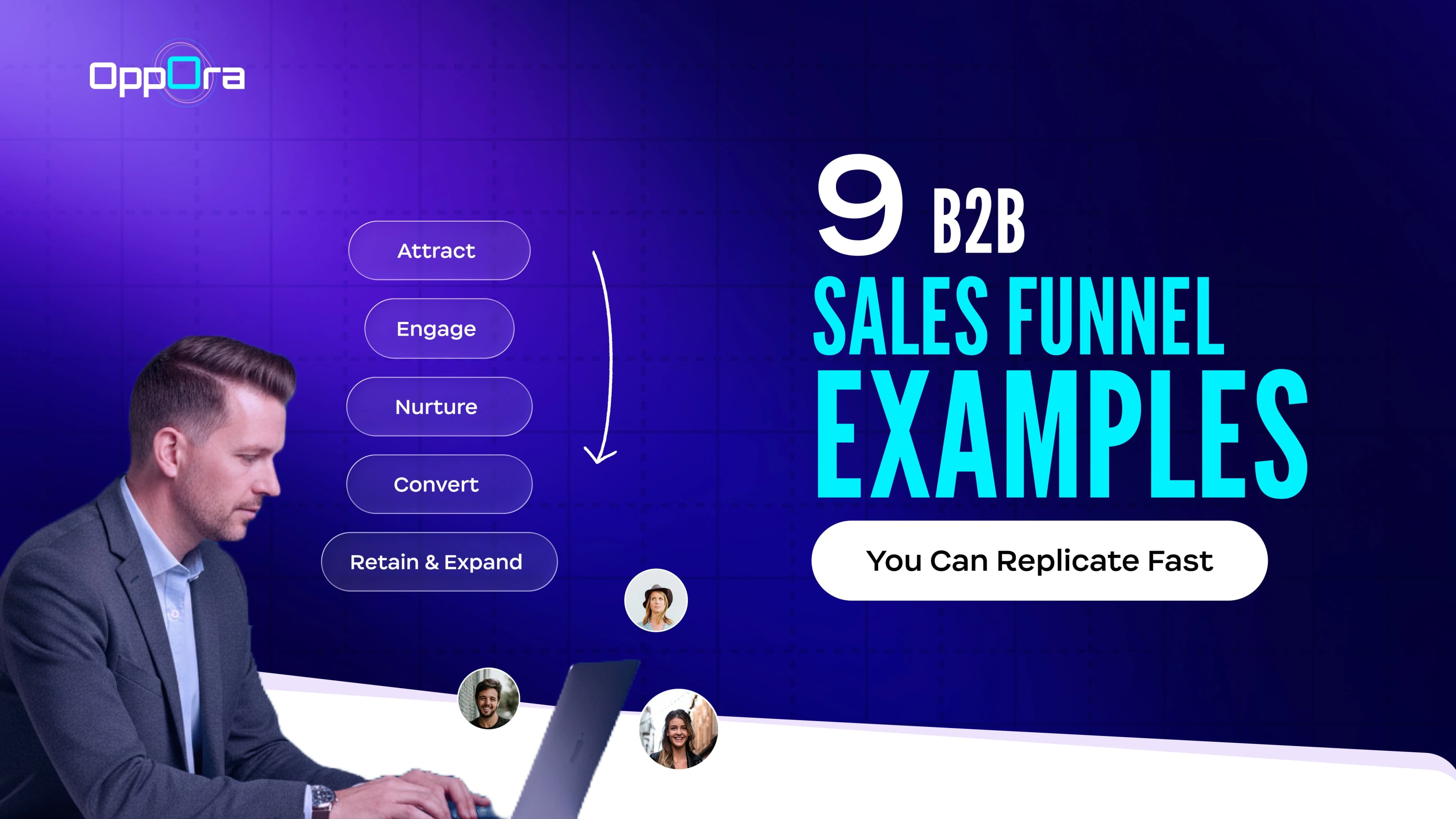
Most B2B funnels follow four core stages:
Now here’s where many teams get confused.
A marketing funnel generates interest and leads.
A sales funnel converts qualified leads into revenue.
Marketing attracts and educates. Sales qualifies, negotiates, and closes.
In B2C, this journey can happen in minutes.
In B2B, it often takes weeks or months.
Why?
Because you’re not selling to one person.
You’re selling to multiple stakeholders founders, managers, procurement teams, finance, and sometimes even legal. Each has different priorities, risks, and approval power.
That’s why B2B funnels require structure, consistency, and follow-up logic. Without that structure, your pipeline becomes reactive instead of predictable.
And that’s exactly what the examples in this guide will help you fix.
Now let’s turn theory into execution.
Below are nine structured b2b sales funnel examples you can model immediately. Each one follows the same core stages but the entry strategy and momentum driver are different.
Choose the one that aligns with how you sell.
Flow:
Targeted lead sourcing → Multichannel outreach → Automated follow-ups → Booked meetings
This is the fastest way to generate pipeline when you need control.
You define exactly who you want to reach and initiate the conversation yourself.
Core Structure:
The advantage here is predictability.
You’re not waiting for traffic. You’re engineering conversations daily.
Best for:
Agencies, IT services, staffing firms, consultants, early-stage B2B startups.
Modern outbound funnels often rely on structured workflows that combine prospect discovery, email sequencing, and reply tracking in one system platforms like Oppora.ai follow this model to reduce manual work and increase consistency.
If speed matters, this is the funnel to deploy first.
Flow:
Target high-value accounts → Personalized outreach → Custom proposal → Closed deal
If broad outbound feels inefficient, account-based selling narrows the focus.
Instead of targeting hundreds of leads, you target 10–50 strategic companies and go deep.
Core Structure:
This funnel works because relevance beats volume.
When decision-makers feel understood, resistance drops and deal velocity improves.
Best for: Enterprise B2B, high-ticket services, complex multi-stakeholder deals.
Execution requires structured tracking across accounts and clear workflow visibility so personalization doesn’t turn messy.
Flow: Free trial → Onboarding → Demo → Paid upgrade
This funnel removes early friction. Instead of selling first, you let users experience value directly.
But here’s the key.
The trial itself doesn’t convert.
Activation does.
Core Structure:
Your goal is to move users from curiosity to realization quickly.
Best for: Mid-to-high ACV SaaS products where hands-on experience drives decisions.
If onboarding is weak, this funnel collapses.
Flow: SEO → Lead magnet → Nurture → Sales call
This funnel attracts instead of interrupts.
You create high-intent content around real buyer problems and let search traffic compound over time.
Core Structure:
Trust builds before outreach ever happens.
Prospects enter conversations already educated.
Best for: Founders with expertise, long sales cycles, and long-term growth focus.
This funnel takes patience but produces compounding pipeline.
Flow: Registration → Training → Follow-up → Demo
Webinars compress trust-building into a single event. You gather interested prospects and educate them live.
Core Structure:
Education first. Pitch second. That balance determines conversion rate.
Best for: Consultants, agencies, SaaS founders selling strategic or complex solutions.
Webinars work when value delivery feels genuine.
Flow: Download → Segmented emails → Offer
This is a simplified inbound funnel.
Instead of relying heavily on SEO, you drive traffic directly to a resource.
Core Structure:
Segmentation is everything here. Not every download is ready to buy.
Best for: Businesses with clear audience segments and well-defined problem-solution messaging.
Done right, sales conversations feel warm and expected.
Flow: Free access → Usage triggers → Upsell
This is product-led growth at scale.
Users start free, experience value, and upgrade when limits or needs expand.
Core Structure:
Timing matters. You introduce paid plans at the exact moment users recognize value.
Best for: Self-serve SaaS platforms with strong product analytics.
This funnel reduces reliance on direct sales but demands precise data tracking.
Flow: Co-marketing → Shared leads → Conversion
You leverage someone else’s audience instead of building everything alone.
Trust transfers from partner to you.
Core Structure:
Partnership funnels shorten trust cycles dramatically. But clarity on ownership and follow-up is critical.
Best for: Agencies, SaaS tools, B2B service providers with overlapping audiences.
Alignment determines success here.
Flow: Conference capture → Segmentation → Structured follow-up
Events generate energy.
Structure converts it into revenue.
Core Structure:
Speed determines conversion. Wait too long and context fades.
Best for: Companies attending conferences, trade shows, or industry summits.
Warm leads need structured execution to turn into pipeline.
Understanding b2b sales funnel examples is powerful. But predictable revenue comes from structured execution.
A modern funnel isn’t a collection of random tools. It’s a connected system where every stage feeds the next. Here’s how you build one with clarity and control.
Everything starts with precision.
Before outreach begins, you need a clearly defined Ideal Customer Profile (ICP):
If your targeting is vague, your messaging will be vague.
Structured platforms like Oppora.ai begin here filtering who fits your criteria before a single email is sent. This prevents wasted effort and improves reply quality immediately.
Clarity at this stage determines conversion downstream.
Once your ICP is defined, discovery begins. But discovery without segmentation creates noise.
A modern funnel organizes leads by:
Instead of one generic campaign, you run tailored messaging for each segment.
This structured discovery and organization step keeps personalization scalable rather than chaotic.
Now you activate the funnel.
Modern B2B outreach isn’t single-channel.
It blends:
For example, cold prospects receive educational positioning.
Warm prospects receive value reinforcement and call invitations.
When outreach aligns with funnel stage, conversations feel natural instead of forced.
Most deals close after follow-ups. But manual follow-ups create inconsistency.
A structured funnel uses sequencing logic:
The goal isn’t automation for volume.
It’s automation for consistency.
When reply handling, qualification, and scheduling happen inside one workflow, no lead slips through gaps.
Finally, you measure.
A modern B2B funnel tracks:
If replies are low, refine messaging.
If meetings don’t convert, refine qualification.
If deals stall, refine proposal positioning.
Instead of guessing, you improve stage by stage.
That’s how structured execution turns scattered outreach into predictable pipeline.
You don’t need to implement all nine funnels at once. You need to choose one that aligns naturally with how you sell and how your buyers prefer to engage.
Start by selecting a funnel that fits your revenue model and deal complexity. Your sales motion should determine your funnel, not trends.
When the funnel matches your selling style, execution becomes smoother and conversion rates improve.
Once you choose your funnel, map how prospects move from awareness to decision. Clarity here prevents friction later in the pipeline.
Ask yourself:
When you understand the journey, your funnel stops feeling forced and starts feeling intentional.
Messaging should evolve as the buyer moves forward. Sending the same pitch to everyone weakens your funnel.
Cold prospects need problem awareness. Warm prospects need proof and differentiation. Decision-stage buyers need clarity, confidence, and risk reduction.
Consistency should not depend on memory. Follow-ups, reminders, segmentation, and scheduling should run inside a defined system.
Automation reduces human error and protects your pipeline from unnecessary leaks.
Finally, measure where prospects move and where they drop off. Visibility into each stage makes optimization practical instead of reactive.
When you track these transitions consistently, improvement becomes predictable rather than guesswork.
Most B2B companies don’t struggle because they lack effort; they struggle because their sales process lacks structure and consistency. Studying real b2b sales funnel examples gives you clear blueprints to replace guesswork with predictable execution.
But examples alone won’t grow your revenue unless you apply them with focus and discipline. Choose one funnel that fits your sales motion, define each stage clearly, and align messaging to your buyer’s journey.
Shift your energy from constant research to structured implementation. Launch the funnel, automate repetitive steps, track stage-by-stage conversions, and improve based on real numbers.
Predictable pipeline comes from clarity and consistency, not complexity or scattered tactics. And if you want a structured way to run outbound as a connected system, Oppora.ai can help you unify prospect discovery, outreach, follow-ups, and tracking into one streamlined workflow.
A B2B sales funnel is a structured process that moves business buyers from awareness to becoming paying customers. It defines clear stages so your pipeline becomes predictable instead of inconsistent.
You should choose a funnel based on how you sell and how your buyers prefer to engage. High-ticket services often benefit from outbound or account-based funnels, while SaaS companies may perform better with trial or freemium models.
B2B decisions usually involve multiple stakeholders, longer buying cycles, and higher financial risk. Because of this complexity, your funnel must include structured follow-ups, qualification steps, and stage-specific messaging.
Outbound funnels can generate meetings within days if executed consistently and targeted correctly. Content-led funnels may take longer to build traction but often deliver sustainable long-term pipeline growth.
Track stage-by-stage metrics such as reply rate, meeting rate, opportunity rate, and close rate. Monitoring drop-offs between stages helps you identify exactly where messaging, targeting, or qualification needs improvement.
Summarize with AI
Share