Home
Blog
Find & Send Cold Emails to 500 Unique Prospects Every Month for FREE.
Home
Blog
Sagar Sharma
Published December 14, 2025
15 min
Try Oppora AI
Create Self-Running Agentic Sales Workflows like N8N just by chatting with AI
Get Started for FREE
Ever stared at a blank email and not known what to send?
That happens more often than people admit.
Email blasts are meant to make things easier. One message. Many people. Sent in minutes. When done right, they work quietly in the background and get the job done.
This guide pulls together email blast templates you can actually use. They are written for common situations. Nothing fancy. Nothing overthought.
You will see when email blasts make sense and when they do not. Then you can pick a template, tweak a few lines, and send it with confidence.
An email blast template is a pre-written email meant to be sent to many people at once. The message stays mostly the same. Only small details change, like a name or date.
People use email blasts to save time. Instead of writing from scratch, they reuse a structure that already works. This is why email blasts templates are common for updates, promos, and announcements.
The problem is not the template. It is how and when it gets used.
If you send the right message to the right group, email blasts work well. If you send the wrong message to everyone, they fail fast.
The difference comes down to context. Let’s break that down.
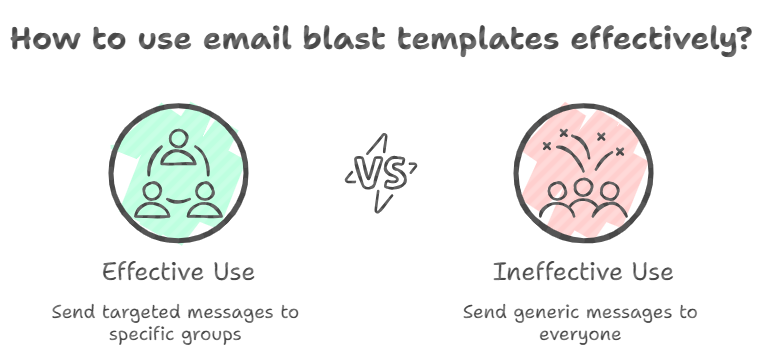
Email blasts work best with warm or opted-in audiences.
For example, you run a webinar. People sign up. You send one email with the replay link. That is a good blast.
Another example. A product update goes out to existing customers. Same message. Clear value. Expected timing.
Promotions, event reminders, holiday notes, and simple updates all fit. The reader knows you. The message matches why they hear from you.
Email blasts are risky for cold outreach.
Sending the same message to strangers often triggers spam filters. Even worse, it feels impersonal.
They also fail for sensitive topics. Pricing changes. Account issues. Anything that needs care should not be blasted.
If the message needs context or trust, one-size emails do more harm than good.
Before using even the email blast templates, you need to follow a few basics. These are not technical rules. They are common sense habits that reduce risk.
Think of spam filters like people. They react to signals. Loud words. Repetition. Too much too fast.
A clean email blast template design keeps things calm and readable. That matters more than clever copy.
Here are two rules that matter most.
Avoid all caps. Avoid too many exclamation marks. Avoid hype words like “guaranteed,” “act now,” or “free money.”
Keep links minimal. One or two is enough.
Short paragraphs help. So do plain fonts. If it looks like an ad, it often gets treated like one.
Less is safer.
If you email daily, people stop opening. Some mark you as spam. That hurts future sends.
For most lists, one email a week is enough. Sometimes less.
If you only email when there is real value, people stay engaged. And engaged readers keep your emails out of spam folders.
At this point, you already know two things.
Email blasts work when the message is expected. And they fail when the message feels random or forced.
So now we get to the part that actually matters. Writing the email.
The templates below are meant to be used as they are. You can copy one, change a few details, and send it without worrying if it sounds wrong. Each template fits a common situation where email blasts make sense. Nothing clever. Nothing salesy unless it needs to be.
Start with the scenario that matches what you are sending today.
These templates are for updates, notices, and general communication. They are useful when you want to inform people, not convince them. A good email blast template in this category feels calm, clear, and respectful of attention.
Subject: A quick update
Hi,
I wanted to share a quick update.
[Explain the update in one or two short lines.]
Nothing changes on your end right now. We just wanted to keep you informed.
If you have questions, feel free to reply to this email.
Thanks,
[Your name]
Subject: Small change to our schedule
Hi,
We are making a small change to our schedule.
Starting [date], [clearly explain what is changing].
Everything else stays the same. If this affects you directly, we will reach out.
Thanks for your understanding.
[Your name]
3. Service Availability Announcement
Subject: Heads up about availability
Hi,
We wanted to let you know that [service or feature] will be unavailable on [date and time].
This is temporary and planned. Everything will be back to normal shortly after.
We appreciate your patience.
[Your name]
Subject: Quick note for everyone
Hi,
Just a quick note to share something with the group.
[Short announcement in plain language.]
No action needed. We just wanted to keep everyone in the loop.
Thanks,
[Your name]
Subject: Reminder for [event name]
Hi,
This is a quick reminder about [event].
It is happening on [date and time]. If you already planned to attend, you are all set.
Here is the link in case you need it:[Link]
See you there.
[Your name]
These templates are for promotion. Not hype. Not pressure. Just clear offers sent to people who already know you.
A solid marketing email blast template keeps the message focused on one outcome and makes the next step obvious.
Use these when you are sharing something useful, timely, or relevant. Skip them for cold lists.
Subject: Something new you might find useful
Hi,
We just introduced a new offer for people who want to [specific outcome].
It is designed to help you [short benefit]. No long setup. No extra steps.
You can see the details here: [Link]
If it is not relevant right now, feel free to ignore this email. We will share more updates soon.
Thanks,
[Your name]
Subject: One feature worth pointing out
Hi,
I wanted to quickly highlight one feature that many people miss.
It helps you [specific task] faster and with less effort. If you are already using [product], you may want to try this next.
Here is where you can see it in action: [Link]
No rush. Just sharing in case it helps.
[Your name]
Subject: A small bonus for existing users
Hi,
This is a short note for existing users.
We are offering [bonus or perk] to people who already use [product or service]. It is our way of saying thanks for sticking around.
You can access it here: [Link]
It is available until [date]. If you have questions, just reply to this email.
Thanks again,
[Your name]
Subject: Quick reminder before this ends
Hi,
Just a quick reminder about [offer].
A few people asked about it, so I wanted to make sure you did not miss it. It ends on [date].
Here is the link again: [Link]
If you already checked it out, you can ignore this message.
[Your name]
Subject: If you want to go a step further
Hi,
Some users asked what comes next after using [basic plan or feature].
If you are looking for more [benefit or outcome], we have an option that might make sense. It adds [one or two improvements] without changing how things work.
You can take a look here: [Link]
No pressure. Just sharing for those who asked.
[Your name]
These templates are not about selling right away. They are about giving something useful first.
Free offers work when they remove friction. A checklist. A short guide. A tool. Early access. Something that helps without asking for a credit card or commitment.
Use these emails when you want to build trust, restart conversations, or give people a reason to pay attention again. The goal is value, not conversion pressure.
Subject: This might help
Hi,
We put together a short resource on [topic].
It covers [one clear outcome] and takes about [time] to go through. No sign-up required.
You can access it here: [Link]
Sharing it in case it is useful for you.
[Your name]
Subject: You can try this for free
Hi,
We opened up free access to [tool or feature].
It helps with [specific task] and works well for people who [use case]. You can use it right away without setting anything up.
Here is the link: [Link]
If you have feedback, just reply to this email.
[Your name]
Subject: A quick guide we just published
Hi,
We just published a short guide on [topic].
It walks through [problem] and shows a simple way to approach it. No fluff. Just the basics.
You can read it here: [Link]
Hope it helps.
[Your name]
Subject: Offering free access to a small group
Hi,
We are giving free access to [product, session, or resource] for a small group.
This is for people who want to [specific outcome] and are open to sharing feedback after.
If that sounds useful, you can get access here: [Link]
No obligation at all.
[Your name]
Subject: Something useful for you
Hi,
We noticed many people asking about [problem].
Here is a simple resource that explains it clearly: [Link]
No need to reply or sign up. Just sharing in case it saves you some time.
Take care, [Your name]
Holiday emails are easy to get wrong. Most inboxes are full. Everyone is sending something. That is why these emails need a softer tone.
Seasonal email blasts work best when they feel human. Not loud. Not urgent unless it truly matters. A good holiday email blast template respects attention and keeps things simple.
Use these templates when you want to stay visible during holidays or seasonal moments without pushing too hard. They fit both business and community style lists.
Subject: Wishing you a great holiday
Hi,
Just a quick note to wish you a happy holiday.
We hope you get some time to rest and enjoy it in your own way.
Thank you for being part of our list. We appreciate it more than you might realize.
Take care, [Your name]
Subject: Holiday schedule update
Hi,
With the holidays coming up, we wanted to share a quick schedule update.
Our team will be unavailable on [dates]. Everything will be back to normal starting [date].
If you need anything before then, feel free to reach out early.
Wishing you a calm and enjoyable holiday season. [Your name]
Subject: A small holiday offer
Hi,
To mark the holiday season, we are offering [offer].
This is available until [date] and applies to [what it applies to]. Nothing changes beyond that.
If it is useful for you, here is the link: [Link]
If not, no worries at all. Just wishing you a good holiday.
[Your name]
Subject: Wrapping up the year
Hi,
As the year comes to a close, we wanted to say thank you.
This year brought a lot of changes, and we are grateful you stayed with us through it. We learned a lot and are taking those lessons into the next year.
No action needed here. Just a note of appreciation.
Wishing you a smooth end to the year. [Your name]
Subject: A quick hello for the new year
Hi,
Happy new year.
As things start up again, we wanted to check in and say hello. We hope the year ahead treats you well.
If there is anything you want to explore or revisit this year, we will be here.
All the best, [Your name]
Real estate email blasts work when they feel local, timely, and useful. People open them because the information matters to them right now. Not later. Not in theory.
These email blast real estate email templates are written for agents, brokers, and teams who need to keep in touch without sounding salesy. They work best for people already in your network. Past clients. Subscribers. Local leads who asked for updates.
Each template below fits a common real estate situation. Copy one. Change the details. Send it.
Subject: New listing just hit the market
Hi,
I wanted to share a new listing that just came on the market.
It is located in [area or neighborhood] and includes [one or two key details like beds, baths, or price range].
You can view the full details here: [Link]
If you have questions or want to see it in person, just reply to this email.
[Your name]
Subject: Open house this weekend
Hi,
We are hosting an open house at [address].
It will take place on [day and time]. You are welcome to stop by at any point during that window.
Here are the details and directions: [Link]
Feel free to share this with anyone who might be interested.
Hope to see you there. [Your name]
Subject: Quick market update for [area]
Hi,
I wanted to share a short market update for [area].
Over the past [time period], we have seen [one simple insight such as prices rising, inventory changing, or demand shifting].
If you are thinking about buying or selling, this is useful context to have. If not, feel free to ignore this email.
You can see the full breakdown here: [Link]
[Your name]
Subject: A home just sold nearby
Hi,
A home in [area or neighborhood] just sold.
It sold for [price or general range] after [time on market]. This gives a helpful signal about current demand in the area.
If you are curious how this affects your home or plans, feel free to reply.
Just sharing the update. [Your name]
Subject: Checking in
Hi,
I was thinking about you and wanted to check in.
If you need anything related to your home or have questions about the market, I am always happy to help.
No action needed. Just saying hello.
Hope everything is going well. [Your name]
Follow-up emails are not about chasing people. They are about timing.
Most people do not respond because they are busy, not because they are not interested. A good reminder email keeps things moving without making the reader feel cornered.
These templates are for moments when someone already saw something. An invite. A message. An offer. A resource. You are not introducing anything new. You are simply bringing it back to the top of their inbox.
Each template below keeps the tone light and respectful.
Subject: Just following up
Hi,
I wanted to quickly follow up on my last email.
In case you missed it, I shared [short reminder of what was sent]. No rush at all. Just wanted to make sure it did not get buried.
Here is the link again for convenience: [Link]
Let me know if you have any questions.
[Your name]
Subject: Checking back in
Hi,
I am checking back in regarding my earlier email.
If now is not a good time, that is completely fine. I just wanted to close the loop on [topic or offer].
Here is the link again in case you want to revisit it: [Link]
Either way, thanks for your time.
[Your name]
Subject: Reminder for [event or deadline]
Hi,
This is a quick reminder about [event, deadline, or action].
It is happening on [date and time]. If you already planned to attend or take action, you are all set.
Here is the link in case you need it again: [Link]
Looking forward to it. [Your name]
Subject: In case this is useful
Hi,
Just sharing this again in case it is useful.
A few people found [resource or offer] helpful, so I wanted to resend it once more.
You can take a look here: [Link]
No need to reply unless you want to.
[Your name]
Subject: Last note from me
Hi,
This will be my last note on this.
I wanted to follow up one final time about [topic]. If it is not relevant right now, no problem at all.
Here is the link again for reference: [Link]
Thanks for reading, and feel free to reach out anytime.
[Your name]
By now, you have the words. Design is what makes those words readable.
Most email blasts fail visually, not because they look bad, but because they try too hard. Good email blast design templates stay quiet. They guide the eye. They do not compete with the message.
Design here is not about branding or decoration. It is about clarity. If someone opens your email on their phone and understands it in five seconds, the design did its job.
Keep everything narrow and simple.
One column works best. Short paragraphs work better than long ones. Leave space between lines so the email can breathe.
Avoid heavy images unless they add meaning. For example, a product screenshot or a property photo makes sense. Decorative banners usually do not.
Stick to one clear action. If your email blast template design includes five buttons, the reader clicks none.
Subject lines should match the tone of the email.
If the email is calm, the subject should be calm. If the email is a reminder, the subject should say that clearly.
For example, “Quick update” works better than “Big news inside.” Clear subjects get opened more often because they feel honest.
Avoid tricks. People notice.
If you need ready-made layouts, these are useful starting points:
Use these for structure. Replace the copy with your own.
After using a few examples, many people want to write their own. That is where learning how to create email blast template formats helps.
You do not need to reinvent anything. Most good emails follow the same simple flow.
Start with context. Why are you writing?
Then share the main message. One idea only.
End with a clear next step. A link, a reply, or no action at all.
For example, a reminder email starts with what you are reminding them about, explains timing, and ends with the link again.
That structure works almost every time.
You can reuse a template without copying it word for word.
Change the opening line. Adjust the example. Switch the order of sentences.
If you are learning how to create an email blast template, focus on structure, not exact phrasing. Structure scales. Copy can change.
That way, your emails stay familiar without feeling repeated.
By now, you have seen how email blast templates can cover almost every situation. Announcements. Promotions. Follow-ups. Even seasonal messages.
Most people start sending these emails manually. Gmail. Outlook. Copy, paste, send. That works for a while.
The problem shows up when sending becomes regular.
When the same email goes out again and again from one inbox, deliverability takes a hit. Opens drop. Replies slow down.
Even well-written email blast templates start landing in spam, not because they are bad, but because they look repetitive.
This is where having the right system matters.
Oppora is designed for this exact stage. It helps you keep using email blast templates without risking your inbox or rewriting copy every week.
Here is what it takes care of for you:
You still write the message once. Oppora makes sure it stays safe and effective as volume grows.
If you are reaching a point where email blasts are part of your regular workflow, this is usually when people stop managing everything by hand.
You can start slowly, too. Oppora has a Free Forever plan, and you can sign up without a credit card. It is an easy way to see how automated sending feels before committing to anything.
Email blasts still work when they are done with care.
What matters is not volume, but clarity and timing.
You now have 30 templates you can copy and send without overthinking. You also know the simple rules that keep emails out of spam and when blasting makes sense in the first place.
If email blasts stay occasional, keep it manual. If they become frequent, there is a safer way to scale. Either way, you are now working with intent, not guesswork.
These templates are best for warm or opted-in audiences. Using them for cold emails increases spam risk unless you add personalization, pacing, and proper warm-up.
Yes. They often work better on small lists because the audience is more engaged. Clear messages usually get higher opens and replies.
Short. Most effective email blasts are under 150 words and focus on one clear message or action.
You can reuse the structure, but change wording slightly. Sending identical copy repeatedly can hurt engagement and deliverability.
Yes, but only if they add value. Too many images or large files can trigger spam filters and slow loading.
There is no perfect day. Midweek mornings often work well, but consistency matters more than timing.
Watch open rates, replies, and bounces. Sudden drops usually signal deliverability issues.
When sending becomes frequent or volume grows. That is when automation, warm-up, and variation become important to protect inbox health.
Summarize with AI
Share