Home
Blog
Find 500 B2B Contacts for Free Every Month with Built-In Outreach.
Home
Blog
Manasa Goli
Published March 25, 2026
6 min
Try Oppora AI
Create Self-Running Agentic Sales Workflows like N8N just by chatting with AI
Get Started for FREE
Cold emailing doesn’t fail because of bad copy.
It fails because you’re sending the right message to the wrong people.
If your emails aren’t getting replies, the problem usually isn’t your subject line—it’s your targeting.
In fact, most high-performing cold email campaigns have one thing in common:
They deeply understand their target audience before writing a single email.
In this guide, you’ll learn:
Your target audience for email outreach is the specific group of people most likely to benefit from your product or service.
It’s not “everyone who might be interested.” It’s a narrowed, high-intent segment.
For example:
The more specific you are, the better your results.
Why? Because relevance drives replies.
Research shows that personalized and segmented campaigns significantly improve engagement and revenue
You can write the best cold email ever—but if it lands in the wrong inbox, it gets ignored.
Here’s what proper targeting actually does:
Think of it this way: 👉 Targeting is not one step in cold emailing—it’s the foundation of everything.
Without it, you’re just guessing.
Now that you understand what a target audience is, let’s look at the practical process of finding it—using Oppora.
Instead of doing everything manually across different tools, Oppora lets you handle the entire workflow in one place—starting from defining your audience to launching campaigns.
Most people get stuck at this stage because their ICP is too vague.
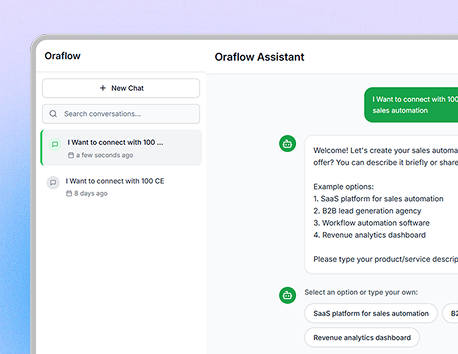
Instead of writing long documents, Oppora allows you to define your audience conversationally.
“Find B2B SaaS companies with 20–100 employees that rely on outbound sales and are struggling with lead generation”
Behind the scenes, Oppora interprets:
👉 This instantly converts your idea into a structured targeting framework
Why this matters: You move from “broad assumption” → “data-backed targeting” in seconds.
Once your ICP is defined, Oppora pulls data from its 700M+ lead database.
Instead of:
You get:
👉 All in one place, ready to use
Example Output:
Why this matters: You skip hours (or days) of manual prospecting.
This is where average targeting becomes high-performing targeting.
Most tools give you static data. Oppora helps you identify who is more likely to respond right now.
Instead of targeting all SaaS companies → You target:
SaaS companies actively hiring sales teams (clear signal they need outreach help)
👉 This increases:
Why this matters: You’re no longer guessing—you’re targeting based on intent.
Even with the right companies, outreach fails if you contact the wrong person.
Oppora helps you filter by role and decision-making power.
If your product improves outbound: 👉 Target → Head of Sales 👉 Not → HR or generic inboxes
Why this matters: Reaching the right person can double or triple reply rates.
Once you have your leads, segmentation becomes critical.
Instead of sending one generic message, Oppora allows you to group leads into meaningful segments.
Each segment receives:
👉 This improves relevance without increasing workload.
Why this matters: Segmentation is the key to scaling personalization effectively.
Most workflows break here—after building the list.
With Oppora, you don’t need to:
You can directly:
👉 Your audience instantly becomes a live campaign
Why this matters: You reduce friction between targeting and execution.
Once campaigns are live, Oppora helps you:
Instead of sending one email: 👉 You build a sequence tailored to your audience
Why this matters: Consistent follow-ups significantly increase response rates.
Targeting is not a one-time task—it’s an ongoing process.
Oppora provides insights like:
👉 You can:
Why this matters: You continuously improve targeting instead of starting from scratch.
Let’s say you sell an AI outreach tool.
“B2B SaaS founders struggling with low reply rates from cold email campaigns”
Now your messaging becomes obvious:
Finding your target audience for cold emailing isn’t just one step in the process—it’s the foundation that determines whether your campaigns succeed or fail.
When you clearly define your ICP, understand real pain points, and focus on high-intent prospects, everything else becomes easier—from writing emails to getting replies and closing deals.
The biggest shift is moving away from guesswork to a structured, repeatable system. Instead of targeting broadly and hoping for results, you identify exactly who needs your solution and reach them with relevance.
And when you combine this approach with tools like Oppora, the process becomes faster and more effective. You’re not just finding leads—you’re building, testing, and refining your audience continuously in one place.
👉 In the end, cold emailing isn’t about sending more emails—it’s about reaching the right people with the right message at the right time.
Start as narrow as possible by combining specific role + industry + clear problem. For example, instead of targeting “startups,” go for “B2B SaaS founders struggling with outbound sales.” Once you start getting consistent replies, you can gradually expand to similar segments. Narrow targeting helps you validate faster and improves early campaign performance.
Yes, but you shouldn’t use the same messaging. The audience can stay the same, but your email should change based on the campaign goal—whether it’s booking demos, partnerships, or lead generation. Each objective requires a different angle, value proposition, and call-to-action to stay relevant.
Ideally, review and refine your audience every 1–2 months or after each campaign cycle. Use performance data like reply rates and engagement to identify what’s working. Markets, roles, and priorities change, so regularly updating your audience ensures your outreach stays relevant and effective.
Targeting matters more. Even a well-written email won’t perform if it’s sent to the wrong people. On the other hand, an average copy can still get replies if the audience is highly relevant. Strong targeting makes writing emails easier and naturally improves personalization.
If your emails are getting delivered but you’re seeing very low or no replies, it’s usually a targeting issue. This means your message isn’t resonating with the audience’s needs or pain points. In such cases, revisit your ICP, refine segments, or focus on higher-intent prospects before changing the copy.
Summarize with AI
Share