Home
Blog
Find 500 B2B Contacts for Free Every Month with Built-In Outreach.
Home
Blog
Manasa Goli
Published April 8, 2026
8 min
Try Oppora AI
Create Self-Running Agentic Sales Workflows like N8N just by chatting with AI
Get Started for FREE
You sent the email. You waited. And then… nothing.
No reply, no feedback, just silence. So you follow up, hoping it will fix things. But even that often gets ignored.
Here’s the truth most people miss: your first email rarely gets the response. It’s your follow-ups that actually drive replies — but only when done right.
A poorly timed or generic follow-up can kill interest completely, while a thoughtful one can restart the conversation instantly.
In this guide, you’ll learn:
You might think your first email does all the heavy lifting. But in reality, it rarely gets the job done.
Most people don’t reply because they’re busy, distracted, or simply forgot. Not because they’re not interested.
That’s where follow-ups change everything. They give you multiple chances to get noticed without starting from scratch.
A well-timed follow-up puts your message back at the top of the inbox. It reminds the prospect why your email mattered in the first place.
And more importantly, it shows persistence without being pushy.
In fact, a large percentage of replies happen after the second or third follow-up. Which means if you stop after one email, you’re leaving opportunities on the table.
Follow-ups aren’t just reminders. They’re where real conversations begin.
Now that you know why follow-ups matter, let’s talk about where things go wrong.
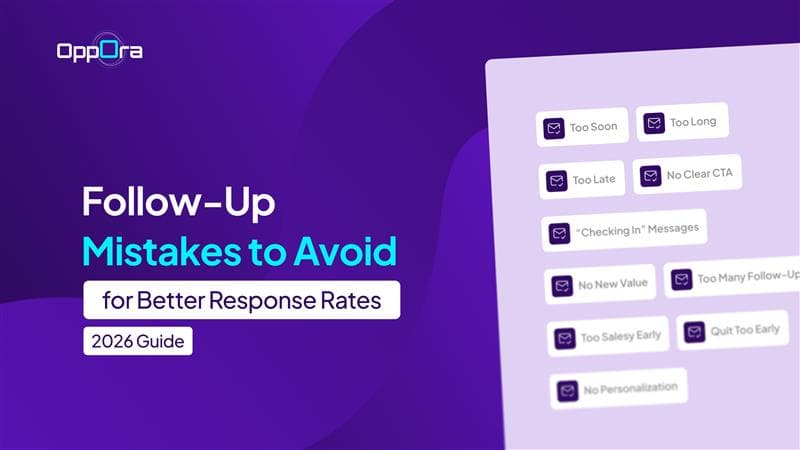
Most poor response rates aren’t about bad offers. They come from small follow-up mistakes that quietly kill interest.
Sending a follow-up within a few hours feels impatient.
It signals desperation and gives your prospect no time to even see your first email.
Wait at least 48–72 hours before your first follow-up so it feels natural, not pushy.
On the flip side, waiting too long makes people forget you.
If your follow-up comes after a week or more, you’re basically restarting the conversation from zero.
Consistency matters more than gaps. Stay visible without disappearing.
“Just checking in” adds zero value.
It doesn’t give the recipient any reason to reply or engage with you.
Instead, every follow-up should introduce something new — insight, context, or relevance.
Repeating the same message in different words doesn’t work.
Each follow-up should move the conversation forward in some way.
You can share a quick idea, a use case, or a fresh angle that makes your message worth reading again.
Jumping straight into a pitch in your follow-ups can turn people off.
Especially when there’s no trust built yet.
Your early follow-ups should focus on helping, not selling. Build curiosity before pushing for a decision.
Generic follow-ups feel like mass emails.
And people can spot them instantly.
Even a small detail — like referencing their role, company, or recent activity — can make your message stand out.
Long paragraphs reduce your chances of getting a reply.
Most people skim emails, not read them fully.
Keep your follow-ups short, clear, and easy to scan so the key message is instantly visible.
If your follow-up doesn’t guide the reader, they won’t act.
A vague message leads to no response.
Tell them exactly what to do next — whether it’s replying, booking a call, or sharing thoughts.
Too many follow-ups can hurt your credibility.
It starts to feel like spam instead of genuine outreach.
Stick to a structured sequence instead of sending messages randomly every day.
Most people quit after one or two follow-ups.
That’s where they lose the majority of potential replies.
A well-planned sequence gives you multiple chances to connect. Stopping early means missing out on conversations that could have happened.
Avoiding these mistakes isn’t complicated.
But fixing them can completely change how your follow-ups perform and how often people respond.
Now that you understand the common mistakes, the next step is knowing what a good follow-up sequence actually looks like.
Because the difference between getting ignored and getting replies often comes down to structure.
A strong follow-up sequence isn’t about sending more emails. It’s about sending the right message at the right time with a clear purpose behind each step.
Instead of guessing what to say next, you follow a simple progression that builds attention, trust, and intent.
This is your first touchpoint, so clarity matters more than creativity.
You introduce who you are, why you’re reaching out, and what’s relevant to them.
Keep it short and focused on their context, not your pitch.
This is where most people make mistakes by repeating the same message.
Instead, you should bring something new to the table.
Share a quick insight, idea, or observation that helps them think differently about a problem they already have.
At this stage, the prospect is aware of you but still unsure.
So you reduce that friction by showing proof.
This could be a result you’ve achieved, a similar company you’ve worked with, or a quick outcome that builds credibility without sounding like a sales pitch.
Now you bring the conversation back without sounding pushy.
A simple, polite follow-up works here, but it should still feel intentional.
You can reference your earlier message and make it easy for them to respond without overthinking.
This is where you close the loop.
Instead of chasing endlessly, you give them a clear option to respond or opt out.
Interestingly, this email often gets replies because it creates a sense of finality and removes pressure.
When you follow this structure, your outreach starts to feel natural instead of repetitive.
Each email has a purpose, each step builds on the previous one, and the entire sequence works like a system rather than random follow-ups.
And that’s exactly what improves your response rates over time.
Now that you understand the structure, let’s make it practical.
Because sometimes the difference between a reply and being ignored comes down to just a few lines.
Seeing a side-by-side comparison makes it easier to spot what’s actually going wrong.
Hi, just checking in on my previous email.
Let me know if you had a chance to review it.
Looking forward to your response.
At first glance, this seems harmless.
But the problem is — it adds no value, gives no context, and puts all the effort on the recipient.
There’s no reason for them to reply, so most people won’t.
Hi [First Name],
I wanted to quickly share an idea that might be relevant to you.
Notice that teams in your space often struggle with low reply rates because follow-ups feel repetitive.
One simple change that’s been working is adding a new angle in each follow-up instead of repeating the same pitch.
Would you be open to seeing a quick example of how this could work for your outreach?
A bad follow-up focuses on you waiting for a reply.
A good follow-up focuses on giving the other person a reason to respond.
Once you shift that mindset, your follow-ups stop feeling like reminders and start becoming meaningful touchpoints.
By now, you know what good follow-ups look like.
But knowing and doing are two very different things when your outreach starts scaling.
Because the real problem isn’t writing one good follow-up.
It’s doing it consistently across dozens or hundreds of prospects without breaking the flow.
When you’re handling follow-ups manually, things start slipping fast.
You miss timings, forget context, or end up sending inconsistent messages.
And even if you try to stay organized, it quickly turns into a tracking problem instead of a messaging problem.
That’s where most response rates start dropping.
To fix this, most people turn to automation.
But then a new problem shows up.
Your follow-ups become templated, repetitive, and easy to ignore.
On the other side, if you try to fully personalize every message, you slow down your entire outreach.
So you’re constantly stuck choosing between:
The real solution isn’t choosing one over the other.
It’s building a system where follow-ups stay relevant without requiring manual effort every time.
That means:
This is exactly where most follow-up systems fall apart — and where Oppora fits in.
Instead of treating follow-ups as separate tasks, it runs them as part of a complete outreach flow.
So instead of you remembering when to follow up or what to say next:
The result is simple.
Your follow-ups don’t feel automated, even though they are.
When you fix follow-ups this way, you’re not just avoiding mistakes.
You’re removing the root cause behind them — inconsistency at scale.
Follow-ups aren’t just a small part of your outreach.
They’re where most of your replies actually come from.
But the difference between getting ignored and getting responses usually comes down to how you follow up, not how you start.
If your timing is off, your message adds no value, or your sequence feels repetitive, people won’t engage.
On the other hand, when your follow-ups are structured, relevant, and easy to respond to, conversations start naturally.
The goal isn’t to send more follow-ups.
It’s to send better ones that feel intentional at every step.
Once you fix that, improving response rates becomes predictable instead of random.
Follow-ups work for both. In cold outreach, they help build familiarity and increase visibility, while in warm conversations, they help move the decision forward. In fact, cold emails benefit more from follow-ups because the initial message is often missed or ignored.
If you’re not getting opens or clicks, it’s likely a deliverability issue. But if emails are opened and still get no replies, the problem is usually with messaging, timing, or lack of relevance in your follow-ups.
Not always. Replying in the same thread keeps context intact and improves visibility. However, if the thread is long or ignored repeatedly, testing a new subject line can help re-engage attention.
A multi-channel approach often works best. If email follow-ups don’t get responses, trying LinkedIn or another channel can increase your chances. The key is to stay consistent without overwhelming the prospect.
There’s no fixed rule, but most successful campaigns fall between 4–6 follow-ups. Beyond that, diminishing returns kick in unless you introduce a completely new angle or context.
Summarize with AI
Share