How to Follow Up on Cold Email: Timing, Tips + 8 Templates
Stephen Parker
Published February 11, 2026
20 min
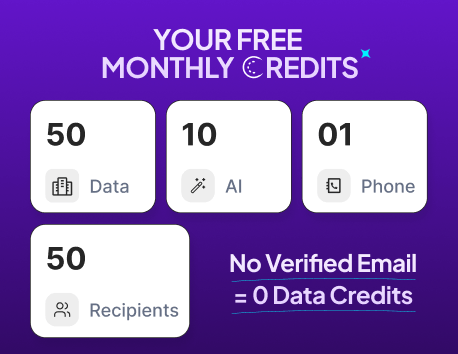
Complete Agentic Email Outreach
AI agents find and enrich prospects, personalize emails, follow up, handle replies, and book meetings automatically.
Claim Your FREE Credits
You sent a cold email, but the prospect never replied. Does that mean they are not interested? Not necessarily.
Silence can mean bad timing, a crowded inbox, or that your first message did not give them enough reason to respond.
That is why a cold email follow up should add something useful instead of repeating, “Just checking in.”
For most B2B outreach, send your first follow-up after 2–3 business days, then gradually widen the gaps. A practical sequence includes 3–4 follow-ups over roughly 2–3 weeks.
In this guide, you will learn:
- When and how to follow up on a cold email
- How to build an effective email outreach follow up cadence
- How to write better follow-ups using 8 practical templates
- How to automate and improve your follow up on cold email campaigns
When Should You Follow Up on a Cold Email?
For most B2B outreach, 2–3 business days is a practical starting point for your first follow-up.
That gives your prospect enough time to see the original message without letting the conversation go cold.
After that, widen the gaps between each cold email follow up. You want to stay visible without making the prospect feel like you are chasing them.
Suggested Reading:
Best Time to Send Cold Emails by Day, Hour, and Time ZoneA Practical Cold Email Follow-Up Cadence
A good follow-up sequence gives each email a different job.
Your first follow-up can simply resurface the original message. Later emails should introduce new context, proof, or another reason to respond.
Treat this as a starting framework, not a universal rule.
Your ideal cadence will depend on who you are contacting, what you sell, and how much consideration the buying decision requires.
Adjust the Cadence to Your Sales Cycle
A prospect considering a simple service usually does not need the same follow-up schedule as an executive evaluating a six-figure solution.
For transactional or SMB sales, you can usually keep the gaps relatively tight because decisions tend to happen faster.
Mid-market outreach often works well with the standard cadence above, where touches gradually spread across two to three weeks.
When you are contacting enterprise buyers or senior executives, give them more space. Their inboxes are crowded, decisions involve more stakeholders, and aggressive follow-ups can work against you.
For high-value accounts, use the extra time between emails for research. Look for a new business signal, relevant challenge, or useful insight you can bring into the next message.
Weekends and Time of Day
There is no single weekday or hour that guarantees better replies for every audience.
Start by prioritizing your prospect's timezone so your email arrives during a reasonable part of their working day.
Then test different weekdays and sending windows using your own campaign data. The best time for your audience may look very different from someone else's.
If you want to explore this in more detail, see our guide on the best time to send cold emails.
When Should You Stop Following Up?
Knowing when to stop matters just as much as knowing when to send the next email.
Stop your active follow-up sequence immediately if the prospect explicitly declines, asks to unsubscribe, tells you the problem is irrelevant, or gives you a specific date to reconnect.
If they give you a future date, respect it rather than continuing the current sequence.
Silence is different.
When there is no response at all, around 3–4 follow-ups is a sensible default for many B2B campaigns.
After that, move the prospect into a nurture or re-engagement workflow instead of continuing to send increasingly frequent reminders.
The goal of a follow up on cold email is not to keep appearing in someone's inbox forever. It is to create several relevant opportunities for them to respond while giving them enough space to make that decision.
How Many Cold Email Follow-Ups Should You Send?
For many B2B campaigns, start with 3–4 follow-ups after the initial email, or roughly 4–5 total emails.
It is important to separate follow-ups from the total number of emails in your sequence:
- Initial email + 3 follow-ups = 4 total emails
- Initial email + 4 follow-ups = 5 total emails
Sending more emails does not automatically lead to more replies.
After a certain point, each additional follow-up may produce less value while increasing the chances of unsubscribes, complaints, or negative responses.
The right number of follow-ups depends on several factors:
- Account value: High-value prospects may justify more thoughtful follow-ups.
- Sales-cycle length: Longer sales cycles can support wider gaps and additional touches.
- ICP fit: Strong-fit prospects are usually worth more effort than weak-fit accounts.
- Available value: Every follow-up should introduce a new insight, resource, proof point, or angle.
- Campaign performance: Watch reply, positive reply, unsubscribe, and complaint rates.
You should also look at what happens later in the sequence.
If Follow-Up #3 and #4 consistently generate almost no conversations, adding Follow-Up #5 or #6 may not solve the problem.
Instead, review your targeting, offer, messaging, and CTA.
Most importantly, do not use more follow-ups to compensate for weak targeting or an irrelevant offer.
A shorter sequence that stays relevant will usually create a better prospect experience than a long sequence that repeats the same pitch.
How to Follow Up on a Cold Email Without Being Annoying
Following up becomes annoying when every email says the same thing in a slightly different way.
A better approach is to make each cold email follow up feel useful, relevant, and easy to answer.
You can use the following framework to keep your follow-ups persistent without making them feel repetitive.
1. Reference the Previous Conversation Briefly
You do not need to summarize your original email.
One short sentence is usually enough to remind the prospect why you are reaching out.
You could write:
- “Following up on my note about improving your outbound response rates.”
- “Wanted to circle back on the idea I shared around reducing manual prospecting.”
The goal is to restore context quickly.
Do not make the reader scroll through a long paragraph just to remember what the conversation was about.
2. Add Something New to Every Follow-Up
Every follow-up should give the prospect another reason to respond.
If you simply repeat the same value proposition, the second email adds very little that the first one did not already offer.
Instead, introduce something new, such as:
- A relevant company event
- A new pain hypothesis
- A useful resource
- A short case study
- A recent customer result
- Clarification around a likely objection
- An industry insight
Think of each follow-up as another angle into the same problem, not another attempt to resend the same pitch.
This makes your sequence feel more like a useful conversation and less like repeated chasing.
3. Personalize Around Business Context, Not Trivia
Personalization works best when it connects directly to a business problem.
Writing, “Loved your LinkedIn post,” may show that you did some research, but it does not explain why your email matters.
A stronger approach is to connect a real signal to the problem you solve.
That signal might include:
- A hiring push
- A recent expansion
- New funding
- A product launch
- A leadership change
- A new role
- A technology change
If a company is hiring multiple SDRs, for instance, you could connect that growth to prospecting capacity, pipeline coverage, or outbound efficiency.
That gives your personalization a purpose.
4. Keep the Follow-Up Short
A follow-up should usually be shorter than the original email.
Your prospect already has the background from your first message, so there is no need to write another full sales pitch.
Keep the email easy to scan.
A useful structure is:
- One sentence of context
- One new idea or proof point
- One simple CTA
If the reader can understand the message in a few seconds, they are more likely to decide whether to reply.
5. Use One Low-Friction CTA
Avoid asking for a 30-minute meeting in every email.
Sometimes the easiest way to restart the conversation is to ask a smaller question.
You could use:
- “Is this something you're working on?”
- “Worth sending the examples?”
- “Is someone else closer to this?”
- “Is timing the main issue?”
These questions require less commitment and make it easier for the prospect to respond quickly.
One CTA is enough.
Adding several questions, links, and meeting requests only gives the reader more decisions to make.
6. Know When to Reply in the Same Thread
In most cases, stay in the original email thread.
This keeps the earlier context visible and helps the prospect understand that your message is part of the same conversation.
Consider starting a new thread only when:
- The original subject line clearly failed
- Your outreach angle has materially changed
- A considerable amount of time has passed
If your original message was relevant and your follow-up continues the same idea, there is usually no reason to reset the conversation.
The broader rule is simple: when you follow up on a cold email, do not focus only on getting back into the inbox.
Give the prospect a fresh reason to care once you get there.
A Cold Email Follow-Up Sequence That Adds Value at Every Touch
A strong follow-up sequence should not feel like the same email sent four times.
Each message should move the conversation forward by adding a new reason to reply.
Here is a practical way to structure your sequence.
Follow-Up #1 — Resurface the Original Problem
Timing: Day 2–3
Your first follow-up should be the shortest message in the sequence.
The goal is simply to bring the original problem back to the prospect’s attention and make replying easier than it was the first time.
You do not need to repeat your entire pitch.
Instead:
- Remind them what the original email was about
- Keep the context to one sentence
- Ask one simple question
- Avoid adding multiple links or meeting requests
A low-friction CTA such as “Is this something you are currently working on?” is usually enough.
Follow-Up #2 — Introduce a New Angle or Useful Resource
Timing: Around Day 6–8
If the first follow-up gets no response, the second should add something the prospect has not seen before.
This is where your email outreach follow up starts creating additional value instead of simply resurfacing.
You could introduce:
- A new observation about their business
- A relevant guide or resource
- An industry benchmark
- A different use case
- A fresh pain-point angle
Keep the new information directly connected to the reason you contacted them.
The goal is to make the prospect think, “This might actually be relevant to me.”
Follow-Up #3 — Add Proof or Address a Likely Objection
Timing: Around Day 11–14
By the third follow-up, the prospect already understands your general offer.
Now give them a reason to trust it or remove something that may be stopping them from replying.
You can use:
- A relevant customer result
- A short mini case study
- An alternative approach
- An answer to a likely objection
- A measurable outcome from a similar company
Keep the proof concise.
Instead of writing a full customer story, explain the problem, what changed, and the result in one or two sentences.
Final Follow-Up — Close the Loop
Timing: Around Day 18–21
Your final follow-up should make it easy for the prospect to close the conversation.
Do not guilt them for staying silent or create fake urgency.
Give them clear options, such as:
- Not now
- Not interested
- Wrong person
- Reconnect later
You might simply ask whether the topic is still relevant or whether someone else owns it.
This removes pressure while still giving the prospect one final opportunity to respond.
The best cold email follow up cadence is not only about spacing emails correctly.
It is about making sure every touch earns its place in the sequence by adding new value, context, or clarity.
8 Cold Email Follow-Up Templates for Different Situations
A follow-up works best when it matches the reason the prospect has not replied yet.
Sometimes they simply missed your first email. Other times, you need a stronger angle, more proof, or an easier question.
Use these cold email follow up templates as starting points, then adapt the language to your prospect, offer, and sales context.
Template 1: First Follow-Up After No Response
When to use: Day 2–3 after your initial cold email.
This message should be short. Your goal is to resurface the original conversation without repeating the entire pitch.
Subject line: Re: [Original subject]
Template:
Hi [First Name],
Following up on my note about [specific problem or outcome].
Is improving [specific outcome] something you are focused on right now?
Best,
[Your Name]
Why it works:
The email gives the prospect immediate context and asks only one simple question.
It also avoids the common mistake of writing another long sales email when the prospect already has the original message below.
Template 2: Value-Add Follow-Up
When to use: Around Day 6–8, usually as your second follow-up.
Use this when you have something genuinely useful to share instead of sending another reminder.
Subject line: Thought this might be useful
Template:
Hi [First Name],
I came across [resource, benchmark, idea, or observation] and thought it might be useful given [specific challenge or goal].
The main takeaway is [one-sentence insight].
Happy to send over [additional resource/examples] if that would help.
Best,
[Your Name]
Why it works:
This follow-up adds something new to the conversation.
Instead of asking the prospect to give you time immediately, you give them useful information first and make the CTA easy to answer.
Template 3: Research-Based / Trigger Event Follow-Up
When to use: When something relevant has changed at the prospect's company.
Useful trigger events can include:
- Hiring activity
- A product launch
- Expansion into a new market
- Recent funding
- New leadership
- A change in technology
Subject line: Noticed [specific company event]
Template:
Hi [First Name],
I noticed [Company] recently [specific trigger event].
That often creates challenges around [relevant problem], especially when [short explanation of why the trigger matters].
We help teams handle that by [brief value proposition].
Is that becoming a priority for you as well?
Best,
[Your Name]
Why it works:
The personalization is connected to a real business event rather than surface-level trivia.
That gives the prospect a clear reason to understand why you are contacting them now.
Template 4: Case Study or Social-Proof Follow-Up
When to use: When the prospect understands the problem but may need more confidence before replying.
Choose a customer story that is similar to the prospect in industry, company size, use case, or challenge.
Subject line: How [Similar Company] improved [Outcome]
Template:
Hi [First Name],
One quick example that may be relevant.
[Similar Company] was dealing with [specific problem]. After [brief explanation of solution or change], they achieved [measurable result].
Thought it might be useful given what I mentioned about [prospect's relevant challenge].
Worth sending a little more context?
Best,
[Your Name]
Why it works:
The email moves from claims to evidence.
Keeping the case study to one or two sentences makes the proof easy to understand without turning the follow-up into a long customer story.
Template 5: Objection or “Bad Timing” Follow-Up
When to use: When the offer seems relevant, but timing, budget, priorities, or another internal project may be getting in the way.
You can use this even when the prospect has not stated the objection directly.
Subject line: Better time later?
Template:
Hi [First Name],
I realize [specific initiative or problem] may not be the priority right now.
If timing is the main issue, I am happy to reconnect when it becomes more relevant.
Would [next month/next quarter/later this year] make more sense?
Best,
[Your Name]
Why it works:
This message reduces pressure instead of increasing it.
The prospect does not have to choose between booking a meeting and ignoring you. They can simply tell you that the timing is not right.
Template 6: Wrong-Person / Referral Follow-Up
When to use: When you are unsure whether the person you contacted actually owns the problem.
This is particularly useful in enterprise outreach, where responsibilities are often spread across several teams.
Subject line: Quick direction?
Template:
Hi [First Name],
Quick question before I close the loop.
Are you the person responsible for [specific area/problem] at [Company]?
If not, is there someone else on the team who is closer to it?
Thanks,
[Your Name]
Why it works:
The CTA is easy and does not require the prospect to evaluate your entire offer.
Even if they are not interested personally, they may point you toward the right decision-maker.
Template 7: The Short “9-Word” Follow-Up
When to use: When your previous emails already contain enough context and you want to make replying as easy as possible.
The idea is not to hit an exact word count. The goal is brevity.
Subject line: Re: [Original subject]
Template:
Hi [First Name],
Are you still looking to improve [specific outcome] this quarter?
Best,
[Your Name]
Why it works:
There is almost nothing for the prospect to process.
The question brings the conversation back to the desired outcome and gives them a simple way to answer yes, no, or not now.
You can create similar short follow-ups such as:
- “Is reducing [specific problem] still a priority?”
- “Worth exploring this for [Company]?”
- “Still working on [specific initiative] this quarter?”
The exact number of words matters far less than keeping the message focused.
Template 8: The Break-Up / Close-the-Loop Email
When to use: As the final email in your active follow-up sequence, usually around Day 18–21.
The purpose is to close the conversation politely while leaving the door open.
Subject line: Should I close this out?
Template:
Hi [First Name],
I have reached out a few times about [specific problem or outcome], so I will close the loop here.
If it is simply not a priority right now, no problem.
And if it becomes relevant later, feel free to reach out and I will be happy to pick the conversation back up.
Best,
[Your Name]
Why it works:
The message respects the prospect's silence instead of trying to guilt them into replying.
There is no fake scarcity, pressure, or dramatic “last chance” language.
It also keeps the relationship open for a future conversation, which is useful when the issue is timing rather than fit.
These templates work best when you treat them as frameworks rather than copy-and-paste scripts.
Personalize the business context, keep the message short, and make sure every email adds a new reason to respond.
That is what makes a cold email follow up feel relevant instead of repetitive.
Suggested Reading:
15 Follow-Up Email Templates for Sales, Networking, and No ResponseWhat to Do When a Prospect Still Doesn't Reply
No reply does not always mean the prospect is rejecting your offer.
Before changing your entire sequence, look at what actually happened and respond based on the signal you have.
They Didn't Reply at All
If the prospect stays silent, do not automatically assume they are not interested.
First, check a few basics:
- Targeting: Is this person actually a strong fit for your offer?
- Address validity: Are you sending to a valid email address?
- Deliverability: Are your emails reaching the inbox?
- Relevance: Does your message connect to a problem they are likely to care about?
- Offer: Is the value clear enough to justify a response?
If these elements look healthy, send the next planned follow-up rather than restarting the campaign.
The next message should introduce a better angle, stronger proof, or a simpler CTA.
They Opened the Email but Didn't Reply
An open does not always mean the prospect carefully read your message.
Email open tracking is imperfect, so avoid writing things like, “I saw you opened my email.”
That can feel invasive and may create unnecessary friction.
Instead, continue the sequence normally.
Use the next follow-up to add something stronger, such as:
- A useful observation
- A relevant customer result
- A new pain-point angle
- A simpler question
Focus on giving them another reason to respond rather than reacting to the open itself.
They Said “Not Now”
“Not now” is different from “no.”
Ask when it would make sense to reconnect.
You might ask whether next month, next quarter, or another specific period would be better.
Then stop the active sequence and schedule the next follow-up for that timeframe.
Respecting the timing they gave you is more useful than continuing to push.
They Said “No”
If the prospect clearly says no, stop the campaign.
Do not keep sending the same offer through additional follow-ups.
A clear rejection is a signal to move on, not an invitation to increase frequency.
Good cold outreach is not only about knowing when to follow up. It is also about recognizing when the conversation should end.
How to Automate Cold Email Follow-Ups Without Sounding Automated
Automation should remove repetitive work, not remove the human context from your emails.
The best setup automates when follow-ups are sent while keeping each message connected to the prospect, company, and previous conversation.
Suggested Reading:
AI Follow-Up Automation: How to Turn More Conversations Into Booked MeetingsAutomate the Timing and Stop Conditions
You should not have to remember when every prospect needs their next follow-up.
Your automation system should handle the basic sequence rules, including:
- Schedule each touch based on your chosen cadence
- Respect the recipient's timezone when sending emails
- Cancel remaining follow-ups as soon as someone replies
- Stop outreach after an opt-out or unsubscribe request
- Prevent duplicate outreach to the same prospect
These controls help you scale your email outreach follow up without accidentally contacting someone after they have already responded.
Personalize Each Follow-Up With Real Lead Context
Automation becomes obvious when every prospect receives the same “just checking in” message.
Instead, build your follow-ups around information that explains why your message is relevant to that specific prospect.
You can use:
- Prospect data: Role, responsibilities, location, or seniority
- Company context: Industry, size, growth, or current initiatives
- Previous email context: What you already discussed or offered
- Lead and account signals: Hiring, funding, expansion, or other changes
- Campaign variables: Pain points, use cases, proof, and relevant outcomes
The goal is not to insert more variables into an email. It is to give each follow-up a reason to exist.
Use AI to Handle Replies and Route Next Steps
Once follow-ups are automated, the next challenge is managing what happens when prospects respond.
AI can help identify interest, answer routine questions, qualify responses, route warm prospects, and trigger the appropriate next step.
This is where Oppora.ai goes beyond being a simple follow-up scheduler.
Oppora works as an AI outbound sales agent, with workflows that can connect the broader outbound process:
Lead discovery → list building → outreach → automatic follow-ups → reply handling → meeting booking → CRM workflow
Its AI agents can find and enrich prospects, send outreach, respond from your inbox, qualify interest, book meetings, and sync activity to your CRM.
You can build this into an automated workflow or use Finder and manual campaign setup when you want more control.
That flexibility matters because good automation should not force every campaign into the same process.
It should handle repetitive execution while you stay in control of targeting, messaging, and the context behind each conversation.
How to Measure and Improve Your Cold Email Follow-Ups
A follow-up sequence should not stay unchanged forever.
The best way to improve it is to look at which messages actually create conversations, then update the sequence based on real campaign performance.
Track More Than Open Rate
Open rate can give you a rough directional signal, but it should not be your main success metric.
Pay more attention to:
- Reply rate: How many prospects respond
- Positive reply rate: How many replies show real interest
- Meeting-booked rate: How many conversations turn into meetings
- Replies by sequence step: Which follow-up creates the response
- Bounce rate: How many emails fail to deliver
- Unsubscribe rate: How many prospects opt out
- Spam complaint rate: Whether your outreach is creating negative signals
These metrics tell you much more about whether your cold email follow up sequence is actually working.
Measure Replies by Follow-Up Step
Do not judge the sequence only as a whole.
Look at which specific email is generating conversations.
If Follow-Up #2 consistently performs better than Follow-Up #1, examine what is different about it.
Compare:
- Angle
- Value proposition
- CTA
- Proof
- Message length
You may discover that prospects respond better when you introduce a new insight instead of simply resurfacing the original pitch.
Test One Variable at a Time
When you update cold email copy, avoid changing the entire sequence at once.
Test one element at a time, such as:
- Subject line
- CTA
- Timing
- Proof point
- Personalization angle
This makes it easier to understand what actually caused the performance change.
If you change the timing, CTA, subject, and copy together, you will have very little idea which adjustment helped.
Know When to Rewrite the Sequence
Small tests are useful, but sometimes the sequence needs a broader rewrite.
Consider rebuilding it when:
- Multiple campaigns consistently underperform
- Positive reply rates start falling
- The same objections keep appearing
- Later follow-ups generate almost no responses
- Unsubscribe or spam signals begin rising
Your sequence should evolve as your audience, offer, and campaign data change.
The goal is not to find one perfect email and use it forever. It is to keep learning which messages give your prospects the strongest reason to respond.
7 Cold Email Follow-Up Mistakes to Avoid
Even a good cold email sequence can lose momentum if your follow-ups feel repetitive, pushy, or disconnected from the prospect.
Watch for these common mistakes.
Saying “Just Checking In” Without Adding Value
“Just checking in” gives the prospect no new reason to reply.
Use the follow-up to add context, a useful insight, proof, or a different angle instead.
Repeating the Same Pitch
If every email repeats the same value proposition, the sequence quickly becomes noise.
Change the reason for responding with each touch.
Following Up Too Quickly
Sending another email a few hours later can feel impatient.
Give the prospect enough time to see and process the original message before sending the next touch.
Sending Too Many Follow-Ups
More follow-ups do not automatically mean more opportunities.
If later emails consistently generate no replies, review your targeting and offer instead of extending the sequence indefinitely.
Repeating the Same Meeting CTA
Asking for a 30-minute call in every email adds friction.
Use lower-commitment CTAs such as:
- “Worth sending the details?”
- “Is this a priority right now?”
- “Should I speak with someone else?”
Ignoring Deliverability and Opt-Out Signals
A follow-up cannot work if the email never reaches the inbox.
Monitor bounces, spam complaints, and unsubscribe requests, and stop outreach immediately when someone opts out.
Using Generic AI Personalization
AI-generated personalization can still feel generic if it only inserts a name, role, or vague compliment.
Strong personalization connects real business context to the problem you solve.
Use signals such as:
- Hiring
- Funding
- Expansion
- Technology changes
- New initiatives
The goal is not to make every follow-up look personalized.
It is to make every follow-up feel relevant enough to deserve a response.
Cold Email Follow-Up Checklist
Before you send your next cold email follow up, run through this quick checklist.
- Does this email add something new?
- Is the reason for contacting this prospect clear?
- Is the follow-up shorter than the original email?
- Is there only one CTA?
- Can the prospect answer in one sentence?
- Is the message relevant to their current situation?
- Am I respecting the planned follow-up cadence?
- Will the sequence stop automatically after a reply or opt-out?
- Would this still sound natural if I sent it manually?
If you answer “no” to several of these questions, revise the message before sending it.
A strong follow-up should feel easy to read, easy to answer, and clearly connected to the prospect’s situation.
The goal is not simply to send another email. It is to give the prospect another relevant reason to respond.
Conclusion
A good cold email follow up comes down to three things: timing, new value, and consistency.
Give prospects enough space between touches, add a fresh reason to reply each time, and keep your sequence structured instead of relying on random reminders.
Small teams can manage this manually when they are only contacting a limited number of prospects.
But once you start scaling personalized research, follow-up timing, reply handling, and campaign optimization across hundreds of leads, the process becomes much harder to manage consistently.
That is where Oppora.ai can help.
Its AI outbound workflows can connect prospecting, outreach, follow-ups, reply handling, meeting booking, and CRM activity in one process while keeping each interaction tied to prospect context.
The goal is not to automate more emails.
It is to make every follow-up more relevant and easier to manage at scale.
Frequently Asked Questions About Cold Email Follow-Ups
How soon should you follow up after a cold email?
For most B2B cold outreach, send your first follow-up after 2–3 business days. This gives the prospect enough time to see your initial message without letting the conversation lose momentum.
How many times should you follow up on a cold email?
A practical starting point is 3–4 follow-ups after the initial email, which means around 4–5 total emails. Adjust the number based on account value, sales-cycle length, ICP fit, and campaign performance.
What follow-up cadence works best for cold outreach without being annoying?
A useful starting cadence is Day 0 for the initial email, Day 2–3 for Follow-Up #1, Day 6–8 for Follow-Up #2, Day 11–14 for Follow-Up #3, and Day 18–21 for the final follow-up. Treat this as a framework and adjust it based on your audience and sales cycle.
Should cold email follow-ups stay in the same email thread?
Usually, yes. Staying in the same thread keeps the previous context visible, but you can start a new thread if the original subject failed, your angle has changed significantly, or a long time has passed.
Can cold email follow-ups be automated?
Yes. Automation can manage timing, stop-on-reply rules, opt-outs, personalization, and AI reply handling, while tools like Oppora can connect these steps with lead discovery, outreach, meeting booking, and CRM activity in one outbound workflow.
Summarize with AI
Share