How to Find the Decision Maker in a Company for Outreach
Stephen Parker
Published July 16, 2026
23 min
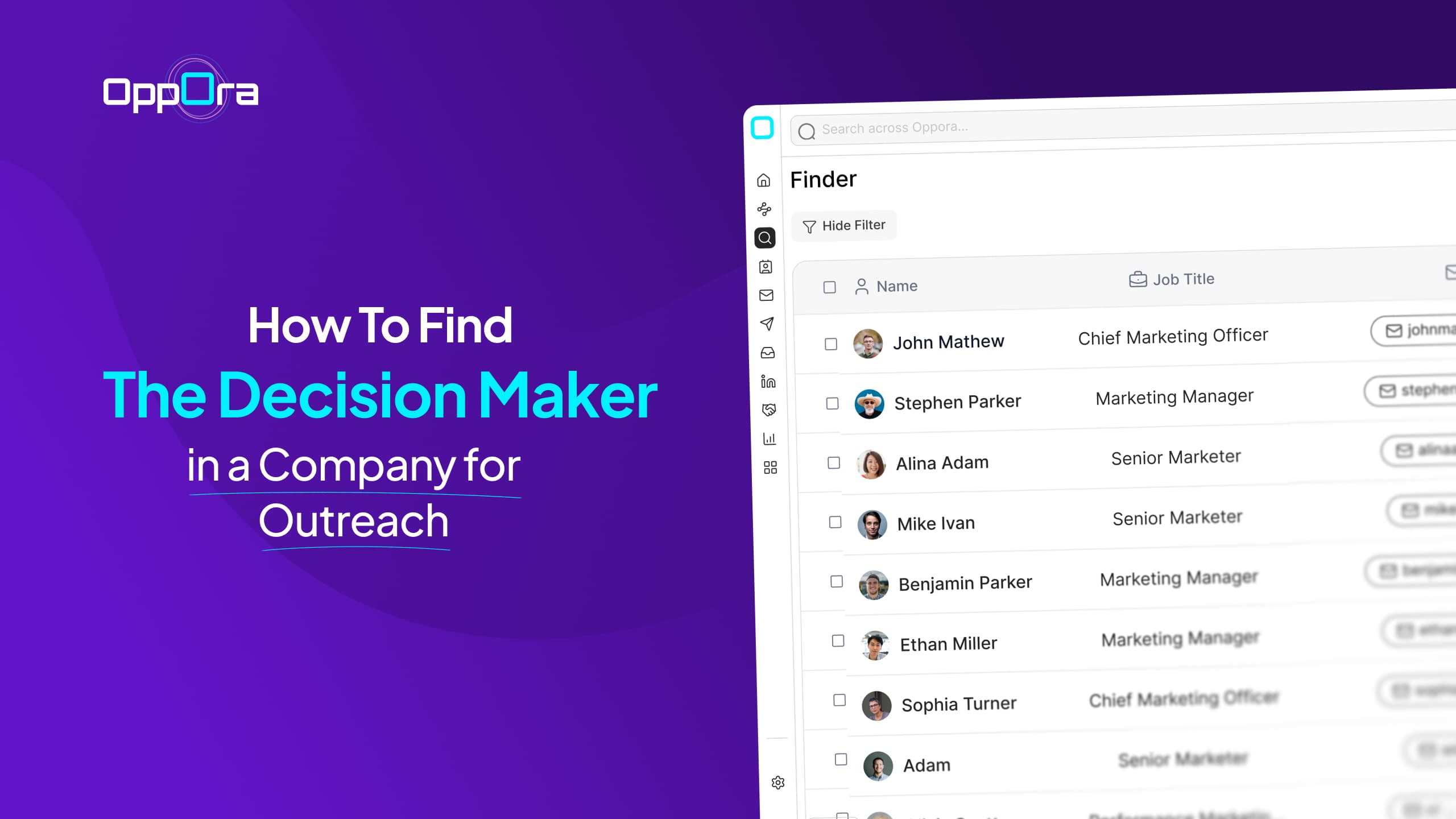
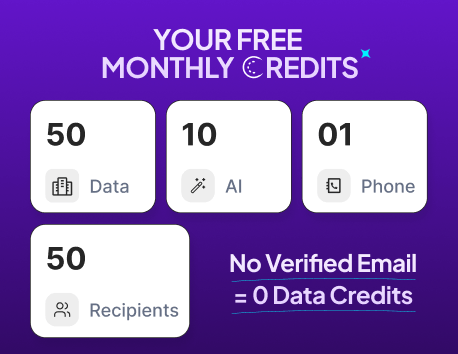
Complete Agentic Email Outreach
AI agents find and enrich prospects, personalize emails, follow up, and handle replies with your meeting link.
Claim Your FREE Credits
You can target the right company and still get no response if you contact someone who cannot evaluate, approve, or fund your offer.
The challenge is that the most senior person is not always the real decision-maker. Who you should contact depends on what you sell, which problem you solve, and how the company makes buying decisions.
A reliable process looks like this: company → business problem → responsible function → buying role → individual → verified contact → outreach.
In this guide, you’ll learn how to:
- Identify the right decision-maker
- Find and verify their contact details
- Use Oppora.ai to scale the process
How Do You Find the Decision Maker in a Company?
Finding the right decision-maker starts with understanding the problem your offer solves, not with searching for the most senior person in the company.
A CEO may have authority, but that does not mean they are the right person to evaluate your solution. In many cases, the real buyer sits within the department that owns the problem.
A practical process looks like this:
- Identify the company you want to target. Make sure it fits your ideal customer profile before researching individual contacts.
- Define the business problem your offer solves. Be specific about the outcome you help improve, reduce, or fix.
- Find the department that owns that problem. A sales issue may belong to Sales or RevOps, while a recruitment problem usually sits with HR or Talent Acquisition.
- Search for the right level of seniority and responsibility. Look for Heads, Directors, VPs, or executives who actually manage that function.
- Map other stakeholders involved in the purchase. Larger deals may also involve finance, procurement, IT, security, or other department leaders.
- Confirm the person still holds that role. Titles and responsibilities change, so outdated information can send your outreach in the wrong direction.
- Find and verify their business contact information. Confirm the email or other contact details before starting outreach.
The key question is not “Who is the most senior person?” It is “Who owns the problem my product solves?”
You can research this manually for a few accounts. When you need to repeat the same process across larger lists, Oppora can connect company discovery, decision-maker search, enrichment, verification, and outreach within one workflow.
Suggested Reading:
How to Find Direct Phone Number of Decision-Maker in 10 MinutesWho Is Actually a Decision-Maker in a B2B Company?
In B2B sales, the decision-maker is not always one executive sitting at the top of the company.
Depending on the size of the business and the value of the purchase, several people may influence the decision. Together, they form a buying committee, with each stakeholder playing a different role.
Economic Buyer
The economic buyer is the person with the authority to approve or control the budget.
This person may be a:
- Founder
- CEO
- CFO
- VP
- Department head
They usually care about cost, return on investment, business impact, and whether the purchase makes financial sense.
For smaller companies, the economic buyer may also be the person evaluating the solution directly.
Functional Decision-Maker
The functional decision-maker owns the department or workflow your product affects.
If you sell sales software, this could be the VP of Sales or CRO. For HR technology, it may be the Head of HR or CHRO. A marketing platform could be evaluated by the CMO or VP of Marketing.
This person often has strong decision-making authority because they understand the problem and are responsible for the outcome.
Technical or Operational Evaluator
Some purchases need approval from people who determine whether your solution can actually work inside the company.
That may include teams such as:
- IT
- Security
- Operations
- Engineering
- RevOps
They may review integrations, security requirements, implementation effort, workflows, or technical compatibility.
Even when they do not control the budget, they can strongly influence whether a deal moves forward.
Champion or Influencer
A champion is often the person experiencing the problem most directly.
They may not have final buying authority, but they understand the pain and are willing to support your solution internally.
In practice, your champion may be the first person to reply to your outreach, even though someone else eventually approves and signs the contract.
Gatekeeper
A gatekeeper controls access to other stakeholders without necessarily making the final decision.
This can include assistants, procurement teams, managers, or coordinators who screen vendors, organize meetings, or manage purchasing processes.
The important takeaway is that you should not look for one universal decision-maker. You should understand the economic buyer, functional owner, evaluator, champion, influencer, gatekeeper, and other stakeholders involved in the purchase before deciding who to contact.
Which Decision-Maker Should You Target?
Once you understand that B2B buying decisions can involve several people, the next question is more practical: which person should you actually target first?
The answer depends on what you sell, which problem it solves, and how the company is structured.
Start With the Problem Your Product Solves
A simple way to narrow down the right person is to follow this path:
problem → department → responsibility → seniority
If your product improves sales productivity, start with Sales or RevOps. If it solves a recruitment challenge, look at HR or Talent Acquisition.
The same logic applies elsewhere:
- Infrastructure problem → IT or Engineering
- Financial operations problem → Finance
- Marketing performance problem → Marketing
- Customer retention problem → Customer Success or Revenue teams
From there, look for the person who owns that responsibility at the right level of seniority.
You are not trying to find the highest-ranking person in the company. You are trying to find the person who is senior enough to influence or approve the purchase and close enough to the problem to care about solving it.
Adjust the Target Based on Company Size
Company size changes who is likely to hold decision-making authority.
In a small business or startup, the founder, CEO, owner, or co-founder may directly evaluate and approve the purchase because responsibilities are less divided.
In a mid-market company, decisions are more likely to sit with department heads, directors, VPs, or functional executives. These people often control both evaluation and part of the budget.
In an enterprise, one person is rarely enough. You may need to map a buying committee that includes the functional leader, finance, procurement, security, technical evaluators, and an executive approver.
That means your target should evolve as the company becomes more complex.
Decision-Maker Title Matrix
Use this matrix as a starting point rather than a fixed rule:
The goal is not to memorize job titles. It is to understand who owns the problem, who has enough authority, and who else may influence the decision.
How to Find Decision-Makers in a Company Manually
If you only need to research a few companies, you do not necessarily need a prospecting platform.
You can often identify the right decision-maker manually by combining LinkedIn, the company website, Google, public announcements, and your existing network.
The goal is not just to find a senior title. You want enough context to understand who owns the problem, whether they still hold that role, and why they may be worth contacting now.
Search LinkedIn by Company, Department, and Job Title
LinkedIn is usually the easiest place to start because it lets you see employees, job titles, career history, and company relationships in one place.
Open the company page and review its employee list. From there, narrow your search by the current company and the department related to the problem your product solves.
If you sell a sales productivity tool, you might search people in Sales or Revenue Operations.
Then look across title variations instead of relying on one exact phrase.
Useful variations can include:
- VP
- Head
- Director
- Chief
- C-level titles
- Department-specific leadership roles
You can also use a simple Boolean-style search such as:
("VP Sales" OR "Head of Sales" OR CRO) AND "Company Name"
The important part is what happens after you find a title.
Open the person's profile and review their current responsibilities, experience, and how long they have been in the role. A "Director" at one company may control budget and strategy, while the same title somewhere else may have limited buying authority.
Also check that they are still working at the company. An outdated profile or old search result can lead you to contact someone who has already changed jobs.
Check the Company Website
LinkedIn gives you one view of the company, but its own website can help you confirm what you find.
Start with the leadership, team, or About pages. These can show you who leads specific functions and how the company describes their responsibilities.
Executive biographies are especially useful when job titles are broad. A bio may reveal that a VP oversees revenue operations, partnerships, technology, or another area directly connected to your offer.
You can also review:
- Press releases
- Investor relations pages
- Leadership announcements
- Corporate news sections
Press releases may confirm that someone recently joined or changed positions, while investor relations pages can reveal leadership structures at larger or public companies.
Use these pages as confirmation rather than assuming the first name you find is automatically the right decision-maker.
Use Google to Find Hidden Company Information
Sometimes the information you need exists on a company website but is difficult to find through its navigation.
Google search operators can help uncover those pages.
Try searches such as:
site:company.com "VP Sales"
site:company.com "Head of Marketing"
site:company.com leadership
site:company.com filetype:pdf "Director"
You can replace the job title with the department or responsibility you care about.
This can surface old press releases, leadership profiles, conference PDFs, reports, team pages, and other documents that do not appear prominently on the main website.
The method is especially helpful when you already know the type of role you want to verify.
Look at Job Postings and Company Announcements
Job postings can tell you far more than which positions a company is trying to fill.
Read the description carefully and you may uncover:
- Reporting lines
- Department structure
- Technology stack
- New initiatives
- Expansion priorities
Suppose a company is hiring several RevOps employees who will report to a newly appointed VP of Revenue Operations. That gives you a strong clue about who owns that function.
It may also give you a reason to reach out now.
The same applies to company announcements involving:
- Funding
- New executives
- Acquisitions
- Product launches
- Geographic expansion
- Team growth
These sales trigger events help answer two different questions: who should you contact, and why might the conversation be relevant right now?
A new executive may be reviewing existing systems. A funding round may support expansion. A growing department may be dealing with new operational pressure.
That context can make your prospecting more precise.
Use Referrals and Existing Connections
Manual research does not always have to end with cold outreach.
Before contacting someone directly, check whether you already have a path into the company.
Look for:
- LinkedIn mutual connections
- Existing customers
- Business partners
- Former employees
- Industry event connections
A mutual connection may be able to confirm whether you have identified the right person before making an introduction.
Customers and partners can also provide useful context about how the company is structured or who usually evaluates a particular type of solution.
This matters because a warm introduction can sometimes bypass the gatekeeper entirely.
For a small number of high-value accounts, combining these manual methods can give you a detailed picture of the company, its buying structure, and the people most likely to influence the purchase.
How to Find Decision-Makers at Scale With Oppora.ai
Manual research works well when you are targeting a handful of high-value companies. The challenge begins when you need to repeat the same process across hundreds or thousands of accounts.
You still need to identify the right company, find the responsible person, verify their contact information, and decide who deserves outreach first. Oppora.ai brings those steps into one connected prospecting workflow instead of making you research every account separately.
Step 1 — Find Companies That Match Your ICP
Finding the right decision-maker starts with finding the right company.
If the account does not match your ideal customer profile, spending another 15 minutes identifying its VP, Director, or Founder does not make your pipeline better.
With Oppora Smart Finder and company search, you can narrow your search using criteria such as:
- Industry
- Location
- Company size
- Business type
- Target market
- Company attributes
- Relevant business signals
The idea is to create a pool of companies that already make sense for what you sell.
Suppose you sell recruitment software to growing technology companies. Instead of researching every company you come across, you can focus on businesses that match your market, size, location, and other relevant conditions.
This gives you a cleaner starting point before you begin searching for individual decision-makers.
Step 2 — Find the Right People by Role, Department, and Seniority
Once you have qualified companies, the next step follows the same logic we used earlier:
company → relevant department → seniority → likely buying role
Oppora can help you search individual leads within those accounts using criteria such as:
- Job title
- Department
- Seniority
- Management level
- Company
If you sell sales automation software, you might search for people across Sales and Revenue Operations rather than simply entering "CEO."
That could surface roles such as VP of Sales, CRO, Head of Sales, Sales Director, or RevOps leadership.
But you should not automatically choose the highest-ranking person returned.
The goal is to identify the most relevant person with enough authority to influence, evaluate, or approve the purchase.
A VP who directly owns the problem may be a better first contact than a CEO who rarely gets involved in that workflow.
Step 3 — Map More Than One Stakeholder
Finding one promising contact does not always mean your research is finished.
For larger B2B purchases, you can build a small buying group around each account instead of saving only one name.
That group might include:
- Economic buyer: Controls or approves the budget
- Functional owner: Manages the department affected by your solution
- Potential champion: Experiences the problem and may support your solution internally
- Technical evaluator: Reviews implementation, integration, security, or operational requirements
You do not need four people for every opportunity.
For a smaller purchase, one or two well-chosen contacts may be enough. For a larger account, mapping several stakeholders gives you more ways to enter the conversation.
It also helps you avoid depending entirely on one person who may ignore your message, leave the company, or simply not own the final decision.
Step 4 — Enrich the Decision-Maker's Contact Information
Knowing the person's name and title is useful, but you still need a reliable way to contact them.
Depending on the available data, enrichment can help build a fuller decision-maker contact record with information such as:
- Business email
- Phone number
- LinkedIn profile
- Current job information
- Company data
This is where company or domain-based lookup becomes useful. Instead of manually searching different websites for every decision-maker email address or business number, you can enrich the contacts attached to the accounts you have already qualified.
Oppora uses waterfall sourcing and multiple enrichment providers rather than relying on only one source. Its product information also includes built-in email verification and the option to connect additional data-provider APIs.
That matters because one provider may have information another provider does not.
You are not simply trying to collect more data. You are trying to create an outreach-ready record for the person you have already identified as relevant.
Step 5 — Verify the Contact Before Outreach
Finding an email address does not automatically mean you should send to it.
The person could have changed companies, the mailbox may no longer exist, or the data may simply be outdated.
Sending to bad contact information can lead to:
- Email bounces
- Wasted search or outreach credits
- Lower sender reputation
- Deliverability problems
- Time wasted contacting former employees
That is why verification should sit between enrichment and outreach.
The workflow becomes:
find → enrich → verify → save → outreach
Oppora includes email search and email verification as separate prospecting functions, so verification can remain part of the same broader workflow instead of becoming another manual lookup step.
You still need to confirm that the person is strategically relevant, but verification helps ensure the contact information you plan to use is usable.
Step 6 — Score and Prioritize the Best Decision-Makers
Now imagine you find two VPs of Sales at two different companies.
Their titles look equally relevant, but their actual value to your campaign may be very different.
One company may closely match your ICP and show a relevant buying signal. The other may technically fit your filters but have little reason to change anything right now.
That is where prioritization becomes important.
You can consider signals such as:
- ICP match
- Role relevance
- Seniority
- Company fit
- Buying signals
- Contact completeness
- Timing
Oppora combines lead scoring with enrichment and buying-signal capabilities, helping you move beyond a flat list where every decision-maker is treated equally.
The goal is not simply to find more contacts.
You want to identify the right account + right person + right reason to prioritize them before spending outreach effort.
Step 7 — Move Qualified Decision-Makers Directly Into Outreach
The final step is where scaled prospecting often becomes messy.
You may find companies in one tool, research people in another, enrich emails somewhere else, verify them separately, export a CSV, clean it, and then import everything into an outreach platform.
Every handoff adds more work.
Oppora is designed around a connected flow where its AI Sales Agents can find companies, identify decision-makers, enrich and score leads, verify contact details, and move them into outbound activity.
That turns the process into:
company search → decision-maker search → enrichment → verification → prioritization → list → campaign
You can still control who enters your outreach.
The difference is that once you define the process, you do not have to rebuild the same research workflow manually for every new account.
That is the real advantage of finding decision-makers at scale. You are not changing the logic behind good prospecting. You are making that logic repeatable across a much larger pipeline.
How to Verify You've Found the Right Decision-Maker
Finding someone with a senior title does not automatically mean you have found the right person to contact.
Before you add someone to outreach, validate whether they actually own the problem, have enough authority, and are still active in the role.
Does This Person Own the Problem?
Start by checking whether their responsibilities match what your product solves.
If you sell sales automation software, a VP of Sales or RevOps leader is usually more relevant than a senior executive with no direct responsibility for the sales process.
Look at their role, department, team ownership, and recent activity.
The question you want to answer is simple: Would this person care if this problem became worse tomorrow?
If the answer is no, they are probably not your best first contact.
Do They Have Enough Authority?
Relevance matters, but so does buying authority.
Look for signs that the person has responsibility for:
- Budget ownership
- Team ownership
- Vendor decisions
- Strategic initiatives
- Leadership over the affected function
A manager may understand the problem better than anyone else but still need approval from a Director, VP, or executive.
That does not make them a bad contact. They may still be a strong champion, but you should understand where they sit in the buying process.
Is Their Information Current?
People change roles, companies restructure, and old contact databases can quickly become outdated.
Cross-check the person using:
- Company website
- Recent company news
- Oppora enrichment data
You are looking for consistency across these sources.
If LinkedIn shows a new employer while an old company page still lists them, treat the information carefully before starting outreach.
Current role information and verified contact data help you avoid messaging someone who no longer has any connection to the account.
Is Someone Else Likely to Be Involved?
Even when you have found the right functional decision-maker, they may not make the purchase alone.
Ask whether the deal is likely to require:
- Financial approval
- Technical approval
- Procurement
- Security review
- Executive sign-off
If the answer is yes, map those stakeholders early.
This is especially important for larger deals, where one person may support your solution but another controls budget or final approval.
Decision-Maker Validation Checklist
Before moving a contact into outreach, confirm:
- Correct company
- Correct department
- Relevant responsibility
- Appropriate seniority
- Current role
- Verified contact data
- Clear reason to contact now
If all seven points are clear, you are no longer relying on a job title alone. You have a stronger reason to believe that the person is relevant, reachable, and worth prioritizing.
How to Find Decision-Maker Contact Information Without Buying an Entire Database
You do not always need access to a massive contact database just to find one decision-maker's email or business details.
If you are researching a small number of accounts, you can often find useful contact information manually through public sources.
Start with:
- LinkedIn to confirm the person's current role and company
- Company websites for team pages, leadership pages, and contact details
- Google to uncover indexed profiles, PDFs, and older company pages
- Press releases to confirm new hires, promotions, and leadership changes
- Public filings for executive and company information
- Email pattern research to identify likely business email formats
- Referrals from customers, partners, mutual connections, or former employees
These methods can work well when you are researching a handful of high-value accounts.
The trade-off is time.
Once you need to research hundreds or thousands of prospects, manually checking multiple sources for every person becomes difficult to manage. You also still need to verify that the email address or contact information you find is current before using it.
That is where a platform such as Oppora becomes useful.
Instead of paying for access to an entire database and then searching through it manually, you can focus on the companies and contacts you actually want to target, enrich those prospects, verify their contact data, and move qualified decision-makers into outreach.
The principle stays the same: find only the people you need, validate their relevance, and verify their contact information before you reach out.
Use Buying Signals to Decide Who to Contact First
Finding the correct decision-maker does not mean every qualified contact should enter your outreach at the same time.
Two people can have the same title and similar authority, but one may have a much stronger reason to consider your offer right now. That is where buying signals help you prioritize.
Executive Changes
A newly appointed executive often comes into a role with pressure to review existing systems, processes, and vendors.
A new CRO may rethink the sales process. A new CMO may reassess marketing tools. A new Head of Talent may look for better ways to manage hiring.
That does not guarantee they are ready to buy, but it gives you a stronger reason to pay attention to the account.
Hiring and Team Expansion
Hiring activity can reveal what is happening inside a department before the company says much publicly.
A growing team may indicate:
- New budget
- Department expansion
- Technology investment
- Operational pressure
If a company is hiring several salespeople, RevOps specialists, or recruiters, the department may also need new systems to support that growth.
You can then prioritize the decision-maker who owns that expanding function instead of treating the account like any other prospect.
Funding, Expansion, and Product Launches
Funding rounds, geographic expansion, acquisitions, and new product launches can also create new priorities.
A company entering a new market may need more sales capacity. A newly funded business may invest in hiring or infrastructure. A product launch may increase pressure on marketing, sales, customer success, or operations.
These events help you connect who you should contact with why the timing may be relevant.
Prioritize Signals With Oppora
When you are researching many companies, tracking these signals manually can become difficult.
Oppora includes company and buying-signal capabilities alongside lead enrichment and AI-based prioritization, helping you evaluate prospects using more than job title alone.
You can combine factors such as company fit, role relevance, seniority, available buying signals, and contact completeness to decide which decision-makers deserve attention first.
The goal is simple:
right account + right person + right time
Buying signals do not tell you that someone will purchase. They help you decide where your outreach is most relevant and which qualified contacts should move to the front of the list.
How to Reach a Decision-Maker Once You Find Them
Finding the right decision-maker gives you a better starting point, but your outreach still needs to feel relevant to that person's role and priorities.
The goal is not to prove that you researched them. It is to show that you understand why the conversation could matter to them.
Personalize the Message Around Their Responsibility
Basic personalization such as adding a first name and company name is not enough.
Your message should connect to:
- Their role: What they are responsible for inside the company.
- Company situation: What is currently changing or happening in the business.
- Relevant business signal: Hiring, expansion, funding, leadership changes, or another timely event.
- Likely problem: The challenge they are probably responsible for solving.
- Outcome: The result your product or service can help them achieve.
If you are reaching out to a VP of Sales after the company has expanded its sales team, your message could focus on sales productivity, pipeline management, or scaling the sales process.
That is more relevant than sending a generic introduction about your product.
Use Email and LinkedIn Together When Appropriate
You do not have to depend on one outreach channel.
Each channel can play a different role in the conversation:
- Cold email: Introduce the problem, relevance, and reason for reaching out.
- LinkedIn connection: Create another touchpoint and make your name more familiar.
- LinkedIn message: Continue the conversation with a short and contextual message.
- Follow-up: Bring the conversation back to the prospect's attention without repeating the original pitch.
The channels should support each other rather than deliver the same message word for word.
Oppora can combine email and LinkedIn activities within one outreach workflow, helping you coordinate these touchpoints without managing each channel separately.
Suggested Reading:
How to Combine LinkedIn Outreach with Email CampaignsMulti-Thread Larger Accounts
For larger companies, reaching only one decision-maker may not be enough.
You may need to contact multiple stakeholders, but each message should reflect what that person actually cares about.
- CFO → Cost, financial impact, and ROI
- CRO → Pipeline, revenue, and sales performance
- IT Director → Security, integrations, and technical requirements
- Operations Leader → Efficiency, workflows, and process improvement
Sending all four people the same pitch reduces relevance.
Multi-threading works better when every stakeholder receives a message connected to their individual responsibility and priorities.
Automate Follow-Ups Without Losing Relevance
Follow-ups matter because even the right decision-maker may miss your first message.
However, automation should not turn every follow-up into the same generic reminder.
A better follow-up can:
- Add another relevant insight.
- Reference the original business problem.
- Connect to a recent company signal.
- Introduce a different outcome or benefit.
- Make the next step easy to understand.
Oppora supports automated outreach workflows and AI-powered reply handling, including follow-up activity and responses from connected inboxes.
Whether you automate the process or manage it manually, every message should still answer one question for the decision-maker:
Why is this relevant to my role, my responsibility, and what is happening in my company right now?
Suggested Reading:
How to Combine LinkedIn Outreach with Email CampaignsCommon Mistakes When Finding Company Decision-Makers
Even when your target company is right, a few common mistakes can send your outreach to the wrong person.
Assuming the CEO Is Always the Decision-Maker
A CEO may have final authority, but they may not own the problem your product solves.
Fix: Start with the department and responsibility connected to the problem, then identify who has enough authority to evaluate or approve the purchase.
Searching Only One Exact Job Title
Companies use different titles for similar responsibilities. Searching only for “VP Sales” may cause you to miss a Head of Sales, CRO, or Sales Director.
Fix: Search across title variations, departments, and seniority levels.
Contacting Only One Person in a Large Account
Larger purchases often involve several stakeholders.
Fix: Map a small buying committee that may include the economic buyer, functional owner, champion, technical evaluator, or procurement contact.
Trusting a Single Data Source
One database or profile can contain outdated job titles or incorrect contact details.
Fix: Cross-check role information using LinkedIn, company pages, recent announcements, and verified contact data before outreach.
Contacting Junior Employees or Unrelated Departments
Reaching interns, coordinators, or people in unrelated functions can waste both outreach time and prospecting spend.
Fix: Confirm that the person works in the relevant department and has enough responsibility to influence the decision.
Finding the Right Person but Ignoring Timing
A relevant decision-maker may still have no reason to consider your offer today.
Fix: Look for buying signals such as hiring, funding, leadership changes, expansion, or new initiatives before deciding who to prioritize.
The pattern is simple: right company + right role + verified data + relevant timing gives you a much stronger outreach target than job title alone.
Manual Research vs Oppora.ai for Finding Decision-Makers
Manual research and automated prospecting are not competing approaches. They are useful at different stages and for different volumes of work.
If you are targeting a small number of high-value accounts, manual research can give you useful context. You can review LinkedIn profiles, company pages, press releases, and leadership information before deciding who to contact.
The challenge is repetition.
Once you need to find and verify decision-makers across a larger list of companies, the same manual process can become difficult to manage consistently.
The main difference is not the logic behind the process.
Both approaches still require you to identify the right company, understand which department owns the problem, find the relevant decision-maker, verify the contact, and decide whether the timing makes sense.
Manual research is useful when you are targeting a few accounts. Oppora is useful when the same process needs to become repeatable and scalable.
Instead of replacing the research framework, Oppora helps you apply it across more companies while keeping company discovery, role filtering, enrichment, verification, prioritization, and outreach connected in one workflow.
Example: From Company Name to Outreach-Ready Decision-Maker With Oppora
Here is what the process can look like when you move from a target account to a decision-maker who is ready for outreach.
Target: B2B SaaS company
Offer: Sales automation platform
Step 1: Define the Company
Start by confirming that the company fits your ICP based on factors such as industry, size, location, target market, or other relevant account criteria.
There is little value in researching decision-makers at companies that are unlikely to need what you sell.
Step 2: Identify the Relevant Function
Because the offer is a sales automation platform, the most relevant functions are likely Sales and Revenue Operations.
That immediately narrows the search.
Step 3: Search the Likely Buying Roles
Next, search role and seniority variations such as:
- CRO
- VP of Sales
- Head of Sales
- Sales Director
- Head of Revenue Operations
- VP of Revenue Operations
The objective is not to choose the most senior person automatically. You want someone close enough to the problem and senior enough to influence the purchase.
Step 4: Build a Small Buying Group
Instead of saving one contact, identify two or three relevant stakeholders.
That might include:
- Economic buyer: CRO or VP Sales
- Functional owner: Sales or RevOps leader
- Potential champion: Sales Operations or Revenue Operations manager
For a larger purchase, you may also need a technical or finance stakeholder.
Step 5: Enrich and Verify the Contacts
Oppora can enrich prospect records with available business contact and company information, then verify email addresses before outreach. Its broader workflow includes lead discovery, enrichment, verification, scoring, and outbound activity.
The workflow becomes:
identify → enrich → verify → prioritize → save → outreach
Step 6: Prioritize and Launch Outreach
Use company fit, role relevance, seniority, contact completeness, and available buying signals to decide which contacts should come first.
Qualified contacts can then move into an Oppora outreach workflow rather than being exported across several separate tools.
Before Publishing This Example
Run this workflow on a real or anonymized account and document:
- Search criteria used
- Roles surfaced
- Whether each role was current
- Email verification status
- Screenshots of the relevant Oppora steps
- Date the test was performed
Do not add accuracy claims, time-saving percentages, contact counts, or conversion results unless they were actually measured during the test.
Conclusion
Finding a decision-maker is not simply about searching for the CEO or the most senior person in a company.
A more reliable process is:
identify the business problem → find the responsible function → map the buying roles → validate the people → verify their contact data → prioritize → outreach
For occasional account research, manual methods such as LinkedIn, company websites, Google, and referrals can be enough.
The challenge comes when you need to repeat the same process across a much larger prospect list.
That is where Oppora.ai can help connect company discovery, decision-maker search, contact enrichment, verification, scoring, email and LinkedIn outreach, follow-ups, replies, and CRM workflows in one place.
If your team is ready to make decision-maker research more repeatable, Oppora can help you turn the process into a connected outbound workflow.
Frequently Asked Questions
How do I find the decision-maker in a company?
Start with the problem your product solves, identify the department that owns it, narrow by seniority and responsibility, confirm the person’s current role, and verify their contact information before outreach.
What job titles are usually decision-makers?
Common decision-maker titles include Founder, Owner, Head of Department, Director, VP, and C-suite executives, but the right title depends on the company size and what you sell.
How can I find a decision-maker's email address?
You can use LinkedIn, company websites, Google, email lookup tools, contact databases, and enrichment platforms, then verify the email before outreach to avoid outdated or invalid contact data.
How can I tell whether someone actually has buying authority?
Look for signs of budget ownership, department responsibility, vendor selection authority, team leadership, and involvement in strategic initiatives related to the problem your product solves.
What is the fastest way to find decision-makers across many companies?
Manual research works for a few accounts, while a B2B prospecting platform such as Oppora can help you filter companies and people, enrich contacts, verify data, prioritize prospects, and prepare them for outreach at scale.
Summarize with AI
Share