Home
Blog
Find 500 B2B Contacts for Free Every Month with Built-In Outreach.
Home
Blog
Stephen Parker
Published February 11, 2026
7 min
Try Oppora AI
Create Self-Running Agentic Sales Workflows like N8N just by chatting with AI
Get Started for FREE
Most cold emails die in the inbox because of one simple mistake: giving up too soon. Statistics show that nearly 80% of sales require at least five touchpoints to close.
The 2026 sales landscape has officially outpaced manual effort. Simply sending a "just checking in" note is the fastest way to get marked as spam.
This guide explains exactly how to follow up on cold email with precision. We move beyond basic automation and into the world of agentic sales strategy.
You will find a structured timing cadence, strategic tips, and 8 copy-paste templates. Our goal is to help you build a predictable, self-scaling pipeline in today's market.
Success in outbound isn't about being loud; it’s about being persistent and relevant.
The first email is rarely about getting a "Yes" it is about getting noticed. Inboxes are more crowded and guarded than ever before, making silence a common reaction.
Data shows that 80% of sales require at least 5 follow-ups to get a positive response. However, 44% of sales reps give up after just one attempt at outreach.
This creates a massive opportunity for those who are willing to stay in the game. Consistency builds familiarity, and familiarity builds the trust needed for a deal.
A follow-up acts as a professional nudge to rise above the daily noise and AI filters. It proves you aren't just another mass-blaster, but someone who is genuinely interested.
When you follow up, your message moves back to the top of the prospect's priority list. It demonstrates that you have a solution worth their time and attention.
Many reps fear being annoying, but silence rarely means the prospect is uninterested. It usually means they are busy handling their own urgent business fires.
A well-timed follow-up signals that you are a professional who respects their time. You aren't pressuring them for a sale; you are offering a way to solve a problem.
If persistence is the engine of growth, timing is the steering wheel that guides it.
Timing is the difference between being a helpful resource and a digital nuisance. Sending an email at the wrong time can result in it being deleted before it’s read.
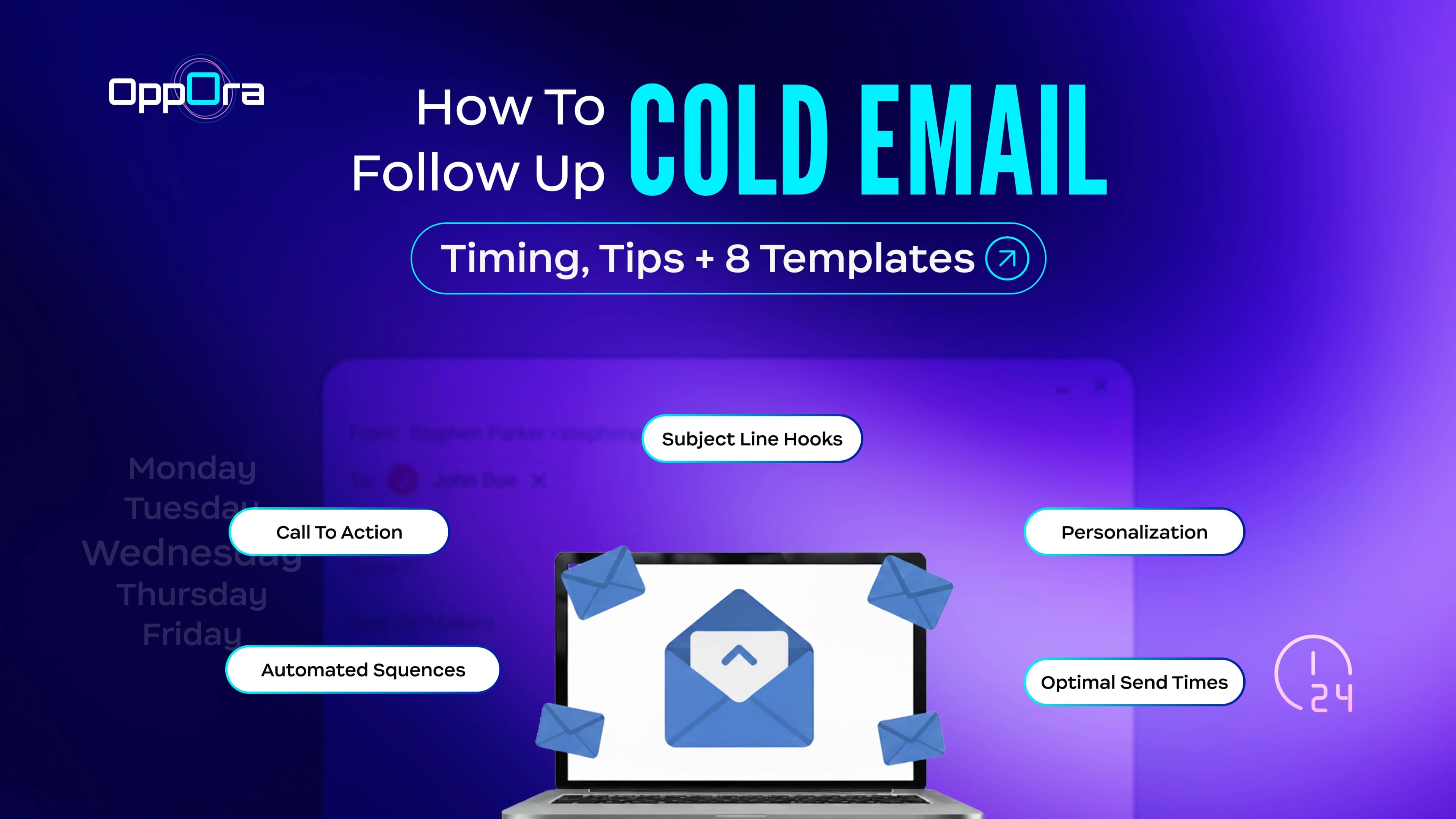
The optimal waiting period for your first follow-up is 2 to 3 business days. This gives the prospect enough time to clear their inbox without forgetting your name.
The second follow-up should land 4 to 5 days after the first reminder. By the third touchpoint, you should wait 7 days to avoid overwhelming the recipient.
Tuesdays, Wednesdays, and Thursdays remain the peak performers for B2B engagement. Mid-morning (10 AM) or early afternoon (2 PM) are the "golden hours" for opens.
However, for high-level B2B executives, the "Saturday Exception" is a secret weapon. Emails sent on Saturday afternoons often get higher engagement when the noise is low.
There is a fine line between persistent follow-up and damaging your domain reputation. Most high-growth teams stop their active cadence after 5 or 6 touchpoints.
Beyond this point, you risk being marked as spam, which hurts your overall deliverability. Read the signals if they haven't engaged by touch 6, it’s time to move them to a nurture list.
With the cadence set, the next challenge is ensuring your message actually provides value.
Never start a follow-up with "just checking in" or "following up on my last email." These phrases signal that you have nothing new to offer and waste the reader's time.
Every touchpoint must answer the prospect's silent question: "What’s in it for me?" Instead of asking for a meeting, offer a fresh insight, resource, or case study.
By adding value first, you earn the right to ask for a conversation later. The goal is to be perceived as a consultant, not just another vendor.
Brevity is the ultimate authority in 2026 sales outreach and professional communication. Statistics show that 41.9% of all B2B emails are now opened on mobile devices.
Keep your follow-ups under 4 lines to ensure they are readable on any phone screen. Short sentences and clear spacing reduce the cognitive load for the reader.
Always remind the prospect why you reached out in the first place to save them time. Reference the specific problem or goal you mentioned in your initial email.
This allows them to recall your value proposition without scrolling back through threads. It anchors the conversation and makes it easier for them to reply with a "Yes."
Transition away from heavy meeting requests and toward interest-based questions. Instead of "Can we chat Tuesday?" try "Is this something you're looking to solve?"
Low-friction CTAs reduce decision fatigue and make it much easier to start a dialogue. The goal of the follow-up is to get a reply, not necessarily a 30-minute booking.
Use company milestones, recent industry news, or LinkedIn activity to build real rapport. A single specific detail can prove you’ve done your research on their business.
This level of personalization bypasses the "automated email" radar entirely. It shows that you are targeting them specifically, not just blasting a generic list.
Strategic refinements like these can double your reply rates and fill your calendar.
Using templates provides structure, but they must be tweaked to fit your specific brand voice. Here are 8 proven templates designed for different stages of the follow up on cold email cycle.
Subject: Re: [Original Subject Line]
Hi [Name], I know things get busy. I wanted to ensure my previous note regarding [Pain Point] didn't get buried.
Do you have 5 minutes to chat about this later in the week? Best, [Your Name]
Subject: Resource for [Company]
Hi [Name], I thought you might find this [Resource/Case Study] on [Topic] helpful. It directly addresses the [Specific Challenge] we’ve seen other companies in [Industry] face.
Is this something your team is currently focusing on? Best, [Your Name]
Subject: How [Competitor/Similar Company] hit [Result]
Hi [Name], we recently helped [Similar Company] achieve [Specific Result] in [Timeframe]. I’d love to show you how we could replicate these results for [Company] as well.
Are you open to a brief walkthrough of our process? Best, [Your Name]
Subject: Quick question regarding [Topic]
Hi [Name], usually when I don't hear back, it's because the timing isn't right. If you're currently tied up with [Specific Project], I’m happy to circle back in Q3.
Should I keep this on your radar for later, or is there a better person to speak with? Best, [Your Name]
Subject: LinkedIn / Email follow up
Hi [Name], I sent you a connection request on LinkedIn but wanted to reach out here too. I have a few ideas on how to improve [Metric] that I think you’d find interesting.
Let me know if you’d like me to send over a quick overview. Best, [Your Name]
Subject: Re: [Original Subject Line]
Hi [Name], are you still looking for a way to improve [Metric] this quarter? Best, [Your Name]
Subject: Quick internal referral?
Hi [Name], if you aren't the best person to speak with about [Department], could you point me to the right teammate? I want to make sure I’m not cluttering the wrong inbox.
Thanks in advance for your help. Best, [Your Name]
Subject: Closing the loop
Hi [Name], it looks like [Topic] isn't a priority for [Company] right now. I’ll go ahead and close your file so I don't continue to occupy your inbox.
Feel free to reach out if things change down the road. Best, [Your Name]
Even with perfect templates, manual execution fails to scale as your company grows.
Oppora.ai is an AI-powered outreach platform it makes following up easy by handling the manual work for you. It lets you stay in touch with prospects without spending hours in your inbox.
You can set up a series of emails and decide exactly how many days to wait between them. Oppora sends these messages automatically so you never miss a chance to connect.
The AI reply agent can reply directly in the same email thread to keep the conversation natural. It can also share your meeting links or helpful files the moment a prospect asks for them.
You can easily create variants for your follow-up emails to see which one gets more interest. Testing different versions helps you find the most effective way to get a reply.
Oppora tracks which emails get opened and which message variants are performing best. Detailed campaign analytics show you exactly what is working so you can improve your results.
Automation is the only way to maintain a 100% follow-up rate without burning out your team.
Learning how to follow up on a cold email is a requirement for any growth-minded team. Most sales conversations only begin after the third or fourth interaction.
Success is built on a foundation of smart timing, brevity, and consistent value. Persistence should never come at the expense of professionalism or domain health.
By combining these tips with proven templates, you can turn a cold list into a hot pipeline. Don't leave your revenue to chance by relying on single-touch outreach campaigns.
Deploy your first automated follow-up Workflow today and start turning silence into conversations. Follow-ups are the engine of predictable growth let Oppora.ai handle the technical heavy lifting.
Ready to scale your follow-ups on autopilot? Start your journey with Oppora today and experience the power of agentic sales Workflows.
Most experts recommend sending between 4 and 6 follow-up emails to get the best results. Sending more than that often leads to diminishing returns and a higher risk of spam complaints.
A good rule is to wait 2-3 days for the first touch and 4-5 days for the second. After that, weekly intervals help you stay relevant without becoming a nuisance to your lead.
Yes, keeping follow-ups in the same thread provides context and proof of your previous effort. It makes it much easier for the prospect to see your original value proposition without searching.
You must stop all outreach to that contact immediately to remain professional and compliant. Ignoring a clear rejection can lead to severe damage to your domain reputation and your brand.
A multi-channel approach is usually best for reaching busy decision-makers who have guarded inboxes. Starting on email and moving to LinkedIn after a few touches significantly increases your chances of being seen.
Summarize with AI
Share