Home
Blog
Find 500 B2B Contacts for Free Every Month with Built-In Outreach.
Home
Blog
Manasa Goli
Published March 12, 2026
8 min
Try Oppora AI
Create Self-Running Agentic Sales Workflows like N8N just by chatting with AI
Get Started for FREE
Email outreach is still one of the most effective ways to start conversations with potential customers. Many B2B companies rely on cold email to generate leads, book meetings, and build relationships with prospects.
But there’s one major challenge that can ruin even the best outreach campaigns: your emails go to spam instead of the inbox.
If a message lands in the spam folder, it’s unlikely the recipient will ever see it. That means lower open rates, fewer replies, and lost opportunities for your sales team.
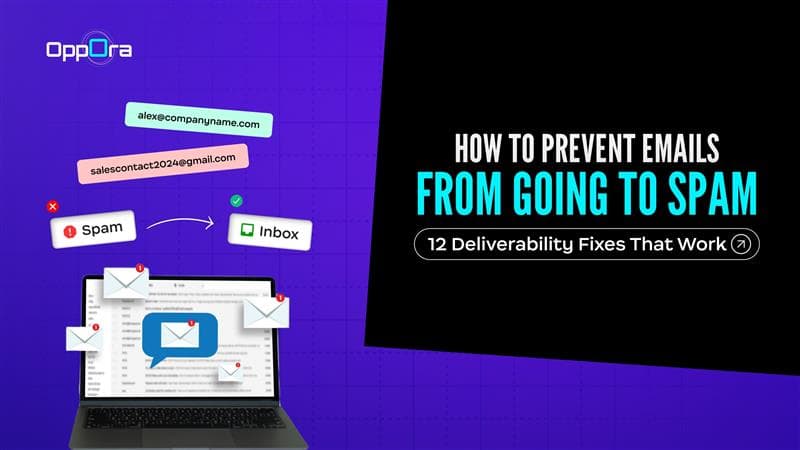
This is why understanding how to prevent emails from going to spam has become essential for companies that rely on outbound outreach.
The good news is that most deliverability problems can be solved. With the right technical setup, sending behavior, and email content practices, you can significantly improve inbox placement.
In this guide, we’ll explain why emails go to spam and how to avoid it, along with 12 proven deliverability fixes that help emails reach the inbox consistently.
Before learning how to avoid email going to spam, it’s important to understand how spam filters actually work.
Email providers like Gmail, Outlook, and Yahoo use advanced algorithms to decide whether an email should go to the inbox, promotions tab, or spam folder. These systems analyze multiple signals to determine whether a message looks trustworthy.
Some of the most important factors include:
If any of these signals indicate suspicious activity, the email provider may send the message to spam to protect users from unwanted emails.
For example, imagine a startup that just purchased a large email list and sends 500 emails from a brand-new domain. From Gmail’s perspective, that behavior looks risky because there is no previous sending history or trust established with the domain.
As a result, many of those emails will likely be filtered into spam.
Understanding these signals helps explain why deliverability problems happen—and what businesses can do to fix them.
Improving email deliverability requires a combination of technical setup, responsible sending behavior, and well-written email content.
Below are 12 proven fixes that help ensure your emails reach the inbox instead of the spam folder.
One of the most important steps in email deliverability is configuring email authentication.
Authentication protocols help email providers verify that your messages are legitimate and actually coming from your domain.
The three essential authentication methods are:
SPF (Sender Policy Framework)SPF confirms that the email server sending messages is authorized by your domain.
DKIM (DomainKeys Identified Mail)DKIM adds a digital signature that verifies the message hasn’t been altered during delivery.
DMARC (Domain-based Message Authentication)DMARC connects SPF and DKIM together and provides instructions to inbox providers on how to handle suspicious emails.
When these records are configured properly, email providers are much more likely to trust your domain. Without them, even legitimate emails can be flagged as spam.
Sending large volumes of emails from a new domain is one of the fastest ways to damage deliverability.
Inbox providers prefer to see gradual and natural sending behavior rather than sudden spikes in activity.
This process is known as email warm-up.
A simple warm-up schedule might look like this:
Week 1: 10–15 emails per day
Week 2: 20–30 emails per day
Week 3: 40–50 emails per day
Gradually increasing sending volume allows email providers to build trust with your domain.
Many outreach teams automate this process using dedicated tools so that the warm-up happens safely over time.
Poor-quality email lists are one of the biggest reasons emails go to spam.
If you send messages to invalid or outdated email addresses, the emails will bounce. A high bounce rate signals to inbox providers that your sending practices may be unreliable.
To maintain strong deliverability, always use verified and accurate contact data.
Best practices include:
Maintaining good data quality protects your sender reputation and helps ensure your emails reach real people.
Another common mistake is sending outreach emails from free email providers like Gmail or Yahoo.
While these services are great for personal communication, they aren’t ideal for professional outreach campaigns.
Instead, use a custom domain associated with your company.
For example:
Less [email protected]
More [email protected]
Using a company domain increases credibility and helps build trust with email providers and recipients.
Spam filters analyze the language used in email messages. Certain phrases commonly used in spam campaigns can trigger filtering systems.
Examples of common spam trigger words include:
While using these phrases occasionally won’t automatically send your email to spam, excessive promotional language increases the risk.
Instead, write emails in a natural and conversational tone that feels like a genuine message between professionals.
Another factor that affects deliverability is the number of links and attachments included in your emails.
Spam emails often contain multiple links or suspicious attachments, so inbox providers monitor this closely.
For cold outreach, a simple rule works well:
Use one link or no links at all.
If you need to share documents, consider linking to a hosted resource instead of attaching files directly to the email.
Keeping emails simple helps reduce the likelihood of triggering spam filters.
Many companies treat cold outreach like marketing campaigns filled with long paragraphs and promotional language.
However, cold emails perform better when they resemble normal one-to-one conversations.
For example:
Marketing-style email:
“Hello! We are excited to introduce our revolutionary solution designed to help businesses maximize productivity and efficiency.”
Conversational email:
“Hi Alex, quick question — how are you currently managing outbound prospecting?”
Short, conversational messages appear more authentic and often lead to higher engagement.
Generic mass emails are easy for spam filters—and recipients—to recognize.
Personalization improves not only response rates but also deliverability signals.
Examples of effective personalization include:
For instance:
“Noticed your team recently expanded your sales department. Are you currently scaling outbound outreach as well?”
When recipients respond or interact with emails, inbox providers interpret that engagement as a positive signal.
Sending too many emails too quickly can harm deliverability.
Even legitimate campaigns can look suspicious if the sending volume suddenly spikes.
A commonly recommended limit is:
30–50 emails per inbox per day for cold outreach.
If you need to send a larger volume, it’s safer to distribute emails across multiple inboxes rather than increasing the limit on a single account.
This approach helps maintain consistent sending patterns and protects sender reputation.
Over time, email databases naturally degrade. People change jobs, companies shut down, and email addresses become inactive.
Regular list maintenance helps avoid unnecessary bounces and complaints.
Good list hygiene practices include:
Maintaining a clean email list protects deliverability and ensures your messages reach relevant prospects.
While cold outreach emails are different from marketing newsletters, including an unsubscribe option can still be beneficial.
Allowing recipients to opt out reduces the likelihood that they will mark your email as spam.
A simple line like this can work:
“If this isn’t relevant, just let me know and I won’t reach out again.”
Small additions like this improve trust and reduce spam complaints.
As outreach campaigns grow, managing deliverability manually becomes increasingly difficult.
Sales teams often juggle multiple domains, sending limits, inboxes, and prospect lists. Without the right infrastructure, it’s easy for deliverability problems to appear.
This is why many outbound teams rely on specialized outreach platforms.
Tools like Oppora help teams manage cold email campaigns while protecting sender reputation.
With the right infrastructure in place, teams can:
Instead of worrying about whether emails are reaching the inbox, teams can focus on starting meaningful conversations with prospects.
Even experienced teams sometimes make mistakes that cause emails to go to spam.
Some of the most common errors include:
Avoiding these mistakes can significantly improve inbox placement.
As outbound campaigns grow, managing email deliverability becomes more challenging. Sales teams often send outreach from multiple inboxes, domains, and campaigns at the same time. Without the right structure, it becomes easy to make mistakes that can cause emails to land in spam.
This is where a dedicated outreach platform like Oppora can help.
Oppora is designed to help teams manage outbound outreach workflows while following deliverability best practices. Instead of manually tracking inbox usage, campaign activity, and prospect engagement, teams can organize everything in one place.
By maintaining structured outreach processes, businesses can reduce deliverability risks and improve the chances of emails reaching the inbox.
Some of the ways Oppora supports better outreach management include:
Some of the key features that support better deliverability include:
By combining verified contact data, warm-up processes, and personalized messaging, teams can run outreach campaigns that follow deliverability best practices while increasing the likelihood that emails reach the inbox.
This allows businesses to focus on building meaningful conversations with prospects rather than constantly dealing with spam or deliverability issues.
If your email goes to spam, your outreach efforts won’t generate results no matter how strong your offer is.
Preventing emails from going to spam requires attention to several key factors:
When these elements are combined, businesses can build a strong sender reputation and consistently reach prospects’ inboxes.
As outreach programs grow, tools like Oppora can help teams manage campaigns more efficiently while maintaining healthy deliverability practices.
The result is simple: more emails reaching the inbox, more replies from prospects, and more opportunities created through outbound outreach.
Emails typically go to spam due to poor sender reputation, missing authentication records, high bounce rates, spam complaints, or suspicious email content.
To improve inbox placement, configure SPF, DKIM, and DMARC records, warm up new domains gradually, send emails to verified contacts, and keep messages natural and personalized.
Most experts recommend sending 30–50 cold emails per inbox per day to maintain healthy deliverability.
Yes. Including too many links can trigger spam filters. Cold emails usually perform best with one link or no links.
Yes. Personalized emails often generate higher engagement and reply rates, which helps improve sender reputation and inbox placement.
Summarize with AI
Share