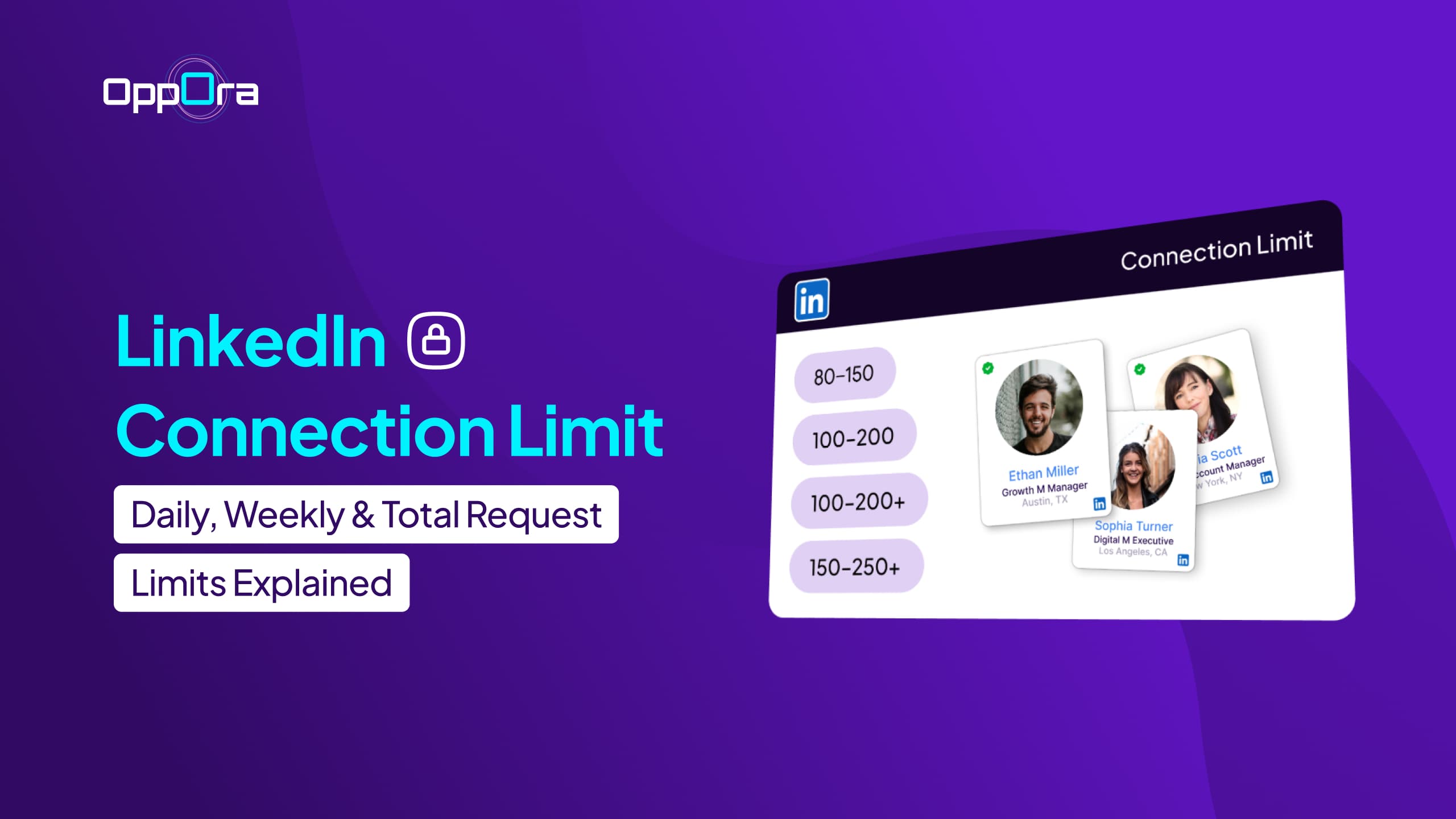
LinkedIn Connection Limit: Daily, Weekly & Total Request Limits Explained
Manasa Goli
Published April 7, 2026
9 min
Complete Agentic Email Outreach
AI agents find and enrich prospects, personalize emails, follow up, and handle replies with your meeting link.
Claim Your FREE Credits
You send a few connection requests on LinkedIn, and suddenly things slow down or stop — that’s not random.
LinkedIn reportedly restricts users to around 100–200 connection requests per week, but many users notice limits kicking in much earlier depending on their activity patterns and acceptance rates (source: LinkedIn Help + multiple outreach tool studies).
That’s because the linkedin connection limit isn’t fixed.
It depends heavily on your account trust score, which is influenced by how people respond to your requests.
In this guide, you’ll understand how these limits actually work and how to stay within safe zones while still growing consistently.
What Is the LinkedIn Connection Request Limit?
Now that you know LinkedIn doesn’t allow unlimited outreach, let’s break down what this limit actually means in practice.
The linkedin connection request limit refers to the maximum number of connection invites you can send within a specific timeframe — daily, weekly, and overall — to prevent spammy behavior.
But here’s the important part.
There is no single fixed number that applies to everyone, because LinkedIn dynamically adjusts your limit based on how trustworthy your account looks.
Your limit depends on factors like:
- How many people accept your requests
- How often your invites get ignored or marked as spam
- Your account age and activity consistency
- Whether you personalize your connection requests
So if you're searching for a clear answer to the linkedin connect request limit, think of it as a moving threshold rather than a fixed cap.
The better your behavior signals, the more flexibility LinkedIn gives you.
LinkedIn Daily Connection Request Limit
Now that you understand the overall concept, let’s narrow it down to what most people care about — daily activity.
The linkedin connection request limit per day is where most restrictions start, especially if you’re actively doing outreach or lead generation.
1. Safe Daily Limits
If you want to stay on the safer side, your daily activity should look natural and controlled.
For most accounts, a safe range is:
- 20–30 connection requests per day
- 10–15 per day if your account is new
- Up to 40–50 only if you have a strong acceptance rate
These numbers aren’t official, but they reflect what consistently works without triggering LinkedIn warnings.
2. Recommended Safe Zone
Instead of pushing the upper limits, it’s smarter to operate within a “safe zone” that keeps your account healthy long-term.
A good recommended safe zone is:
- 20–25 requests per day
- Spread across different time intervals, not all at once
- Personalized connection messages instead of blank invites
This approach improves your acceptance rate, which directly impacts your future linkedin connection request limit.
Read More: What are Impressions on Linkedin
What Happens If You Exceed Daily Limits?
If you cross the daily threshold too aggressively, LinkedIn starts reacting almost immediately.
Here’s what typically happens:
- You get a temporary restriction on sending invites
- Your pending requests may stop getting accepted
- LinkedIn may show warnings about “unusual activity”
- In repeated cases, your account can face stricter limits
The biggest issue is not just the block.
It’s that your account trust score drops, which reduces your future linkedin connect request limit even further.
LinkedIn Weekly Connection Limit
Once you start tracking your daily activity, it’s easy to assume that staying within daily limits is enough.
But in reality, the linkedin connection limit per week matters even more because LinkedIn evaluates your behavior over a longer window.
1. Weekly Limits Breakdown
If you’ve been wondering how many linkedin connections per week you can safely send, here’s a realistic benchmark.
Most users can send:
- Around 100–200 connection requests per week
- New or low-trust accounts should stay closer to 80–100
- High-trust accounts with strong acceptance rates can stretch slightly beyond
This is what people typically refer to as the weekly connection limit linkedin enforces behind the scenes.
2. Rolling 7-Day Rule
Here’s where most people misunderstand how limits work.
LinkedIn doesn’t reset your count every Monday or at the start of a new week.
Instead, it follows a rolling 7-day rule.
That means:
- Every new request you send is counted against the past 7 days
- Limits are continuously recalculated, not reset
- A high-activity day can impact your ability to send requests days later
So if you send 80 requests today, your available capacity reduces for the next several days.
3. Why Weekly Limit Matters More Than Daily
Even if you stay within daily limits, you can still hit restrictions if your weekly volume is too high.
That’s why the linkedin connection request limit is better understood weekly rather than daily.
Here’s why it matters more:
- LinkedIn tracks patterns, not just one-day spikes
- Weekly activity reflects consistency and intent
- Exceeding weekly limits can trigger stricter long-term restrictions
If you want to scale safely, think beyond daily numbers and manage your linkedin connection limit per week strategically.
LinkedIn Total Connection Limit
Now that you understand daily and weekly limits, there’s one more cap that often gets overlooked.
LinkedIn also has a total connection limit, which restricts how many 1st-degree connections you can have on your profile.
Currently, LinkedIn allows up to 30,000 1st-degree connections.
Once you reach this limit:
- You can no longer send new connection requests
- You can still receive requests from others
- Your profile automatically shifts focus toward followers instead of connections
This limit doesn’t affect most users early on.
But if you’re actively doing outreach or building a large network, this becomes a real ceiling you need to plan for.
LinkedIn Invitation Limits by Account Type
Now that you know limits are behavior-based, let’s look at how account type influences your flexibility.
Many people assume upgrading LinkedIn automatically increases the linkedin connection request limit.
That’s not entirely true.
Your limits still depend more on trust signals, but different account types do experience slightly different thresholds and capabilities.
Free vs Premium vs High-Trust Accounts
Here’s how it typically plays out:
- Free accounts: You operate within standard limits and stricter monitoring kicks in faster if your activity looks aggressive.
- Premium accounts (LinkedIn Premium, Sales Navigator): You get access to InMail and slightly better tolerance, but your core linkedin connect request limit still depends on behavior.
- High-trust accounts (aged + high acceptance rate): These accounts naturally unlock higher limits because LinkedIn sees them as safe and relevant.
So while account type gives you some edge, it doesn’t override your activity quality.
That’s why two people with the same plan can have completely different linkedin connection limit per week.
Quick Comparison Table
This table gives you a quick snapshot, but remember — your actual linkedin connection request limit will always depend on how your audience responds to you.
Hidden LinkedIn Limits You Should Know
By now, you understand the visible limits like daily and weekly caps.
But what actually restricts most users are the hidden limits that LinkedIn doesn’t clearly communicate.
These are the real reasons why your outreach suddenly slows down — even when you think you’re within the linkedin connection limit.
1. Pending Invitation Limit
This is one of the most overlooked restrictions.
LinkedIn limits how many unanswered connection requests you can have at any given time.
Once you cross this threshold (usually around 500–700 pending invites):
- You won’t be able to send new connection requests
- Your outreach will pause until some invites get accepted or withdrawn
This directly impacts your linkedin connection request limit because even if your weekly numbers are low, pending invites can block you completely.
A simple fix is to regularly withdraw old, ignored requests.
2. Acceptance Rate Impact
Your acceptance rate is one of the biggest factors influencing your limits.
If people accept your requests, LinkedIn sees your outreach as relevant.
If they ignore or reject them, your trust score drops.
Here’s how it affects your limits:
- High acceptance rate → higher linkedin connection limit per week
- Low acceptance rate → stricter limits and faster restrictions
- Rejected or “I don’t know this person” responses → major negative signal
This is why sending random, non-personalized invites hurts your account in the long run.
3. Activity Limits
Connection requests aren’t the only thing LinkedIn tracks.
Your overall activity also contributes to how your linkedin connect request limit is calculated.
This includes:
- Profile views in bulk
- Messages sent daily
- Follows, likes, and comments
- Automation-like behavior (fast, repetitive actions)
If your activity looks unnatural, LinkedIn may restrict your account even if your connection requests are within limits.
That’s why safe growth isn’t just about numbers.
It’s about behaving like a real human consistently across all actions.
Why LinkedIn Limits Connection Requests
Now that you’ve seen all the different types of limits, it’s worth understanding why LinkedIn enforces them in the first place.
Because once you get the intent, it becomes much easier to work with the system instead of constantly hitting restrictions.
LinkedIn’s main goal is to protect user experience.
If people start receiving too many irrelevant or spammy connection requests, the platform loses trust quickly.
That’s why LinkedIn uses the linkedin connection request limit to filter out low-quality outreach.
Here’s what LinkedIn is trying to control:
- Spam prevention: Too many random invites make the platform feel like cold email instead of networking
- Quality of connections: LinkedIn wants meaningful relationships, not inflated connection counts
- User trust and safety: Limiting outreach reduces fake accounts and aggressive automation
- Platform reputation: A cleaner network keeps users engaged and responsive
So when you hit the linkedin connection limit, it’s not just a restriction.
It’s LinkedIn signaling that your outreach needs to be more relevant and human.
How to Increase Your LinkedIn Connection Limit Safely
Now comes the part that actually matters — how do you increase your limits without risking your account?
The answer is not pushing harder.
It’s improving how LinkedIn perceives your behavior.
If you want to safely grow your linkedin connection limit per week, focus on these strategies.
1. Improve Your Acceptance Rate
This is the fastest way to unlock higher limits over time.
You can do this by:
- Personalizing every connection request
- Targeting relevant people instead of mass outreach
- Mentioning context (mutuals, content, industry)
Better acceptance = higher trust = higher limits.
2. Clean Up Pending Invitations Regularly
Don’t let old invites pile up and block your growth.
Make it a habit to:
- Withdraw requests older than 2–3 weeks
- Keep your pending invites below 300–400
This alone can immediately improve your ability to send new requests.
3. Warm Up Your Activity
If you suddenly start sending 50 requests daily, LinkedIn sees that as suspicious.
Instead:
- Start with 10–15 per day
- Gradually increase over 2–3 weeks
- Stay consistent rather than spiky
This helps you expand your linkedin connect request limit naturally.
4. Avoid Automation-Like Behavior
Even if you’re not using tools, your behavior can still look automated.
Avoid:
- Sending requests too fast in bulk
- Repeating the same message
- Performing multiple actions within seconds
LinkedIn tracks patterns, not just tools.
5. Focus on Relevance Over Volume
Sending fewer but highly relevant requests works better than blasting hundreds.
Try to:
- Narrow down your audience
- Engage with their content before connecting
- Build familiarity before sending requests
This improves both acceptance rate and long-term account trust.
If you follow these consistently, your linkedin connection request limit will gradually increase without you even noticing.
That’s the safest way to scale — not by forcing limits, but by earning them.
Final Thoughts
If there’s one thing you should take away, it’s this — the linkedin connection limit is not a fixed number you can “hack.”
It’s a dynamic system that adapts based on how you behave on the platform.
You can stay within 100–200 invites per week and still get restricted.
Or you can gradually push beyond that if your acceptance rate and activity signals are strong.
So instead of focusing only on numbers, focus on building trust with every action.
- Send relevant, personalized requests
- Keep your acceptance rate healthy
- Avoid aggressive or unnatural activity patterns
When you do this consistently, your linkedin connection request limit increases naturally over time.
And that’s how you scale outreach without ever worrying about restrictions again.
Frequently Asked Questions
1. Does withdrawing connection requests reset your LinkedIn limit?
No, withdrawing requests does not immediately reset your limit, but it improves your account health over time by reducing pending invites.
2. How long does a LinkedIn connection request stay pending?
Connection requests stay pending indefinitely unless accepted, ignored, or manually withdrawn.
3. Does sending connection requests without a note affect limits?
Yes, requests without personalization may reduce acceptance rates, which can indirectly lower your future limits.
4. Do LinkedIn limits differ by industry or niche?
No official difference exists, but high-rejection industries (like sales or recruiting) may experience stricter limits due to lower acceptance rates.
5. Is there a cooldown period after hitting LinkedIn limits?
Yes, LinkedIn may temporarily restrict actions for 24 hours or longer depending on how much you exceeded the limit.
6. Can viewing profiles increase your connection limit?
No, but consistent profile activity (like views and engagement) helps build trust signals that may positively impact limits over time.
7. Does using LinkedIn on mobile vs desktop affect limits?
No, limits remain the same across devices, but unusual login patterns across devices may trigger restrictions.
Summarize with AI
Share