Home
Blog
Find & Send Cold Emails to 500 Unique Prospects Every Month for FREE.
Home
Blog
Adam Hossain
Published December 24, 2025
12 min
Try Oppora AI
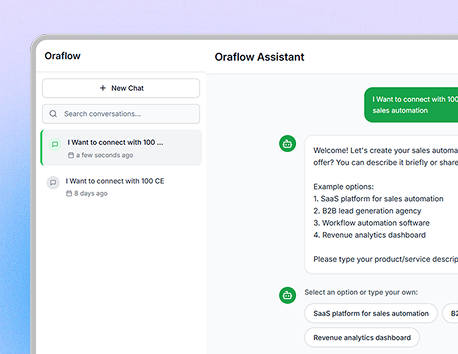
Create Self-Running Agentic Sales Workflows like N8N just by chatting with AI
Get Started for FREE
Reconnecting with old clients is one of the most practical ways to create new opportunities without starting from zero.
Many businesses already have past clients who were satisfied at one point but became inactive due to timing, changing priorities, or shifting needs.
Despite this, reaching out again often feels uncomfortable. Teams are unsure what to say or worry about sounding sales-focused. As a result, valuable relationships are left untouched.
This guide provides a structured approach to reconnecting through email.
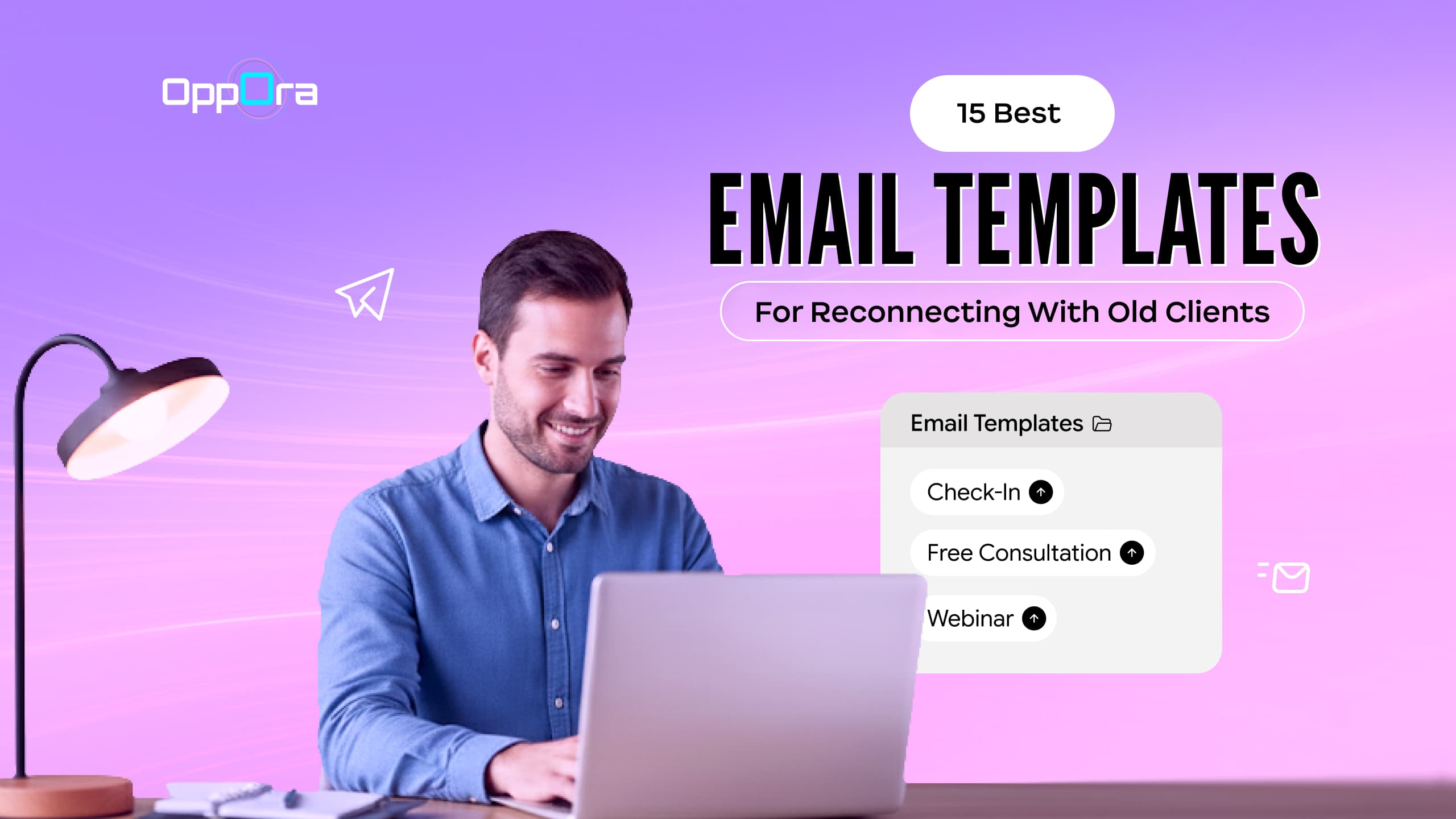
It includes fifteen clearly defined email templates designed for common real-world situations, such as checking in, sharing updates, or inviting a conversation.
Each template focuses on clarity, context, and tone, helping teams restart communication in a way that feels natural and respectful.
Used correctly, a reconnecting with old clients email template can simplify outreach and reduce hesitation.
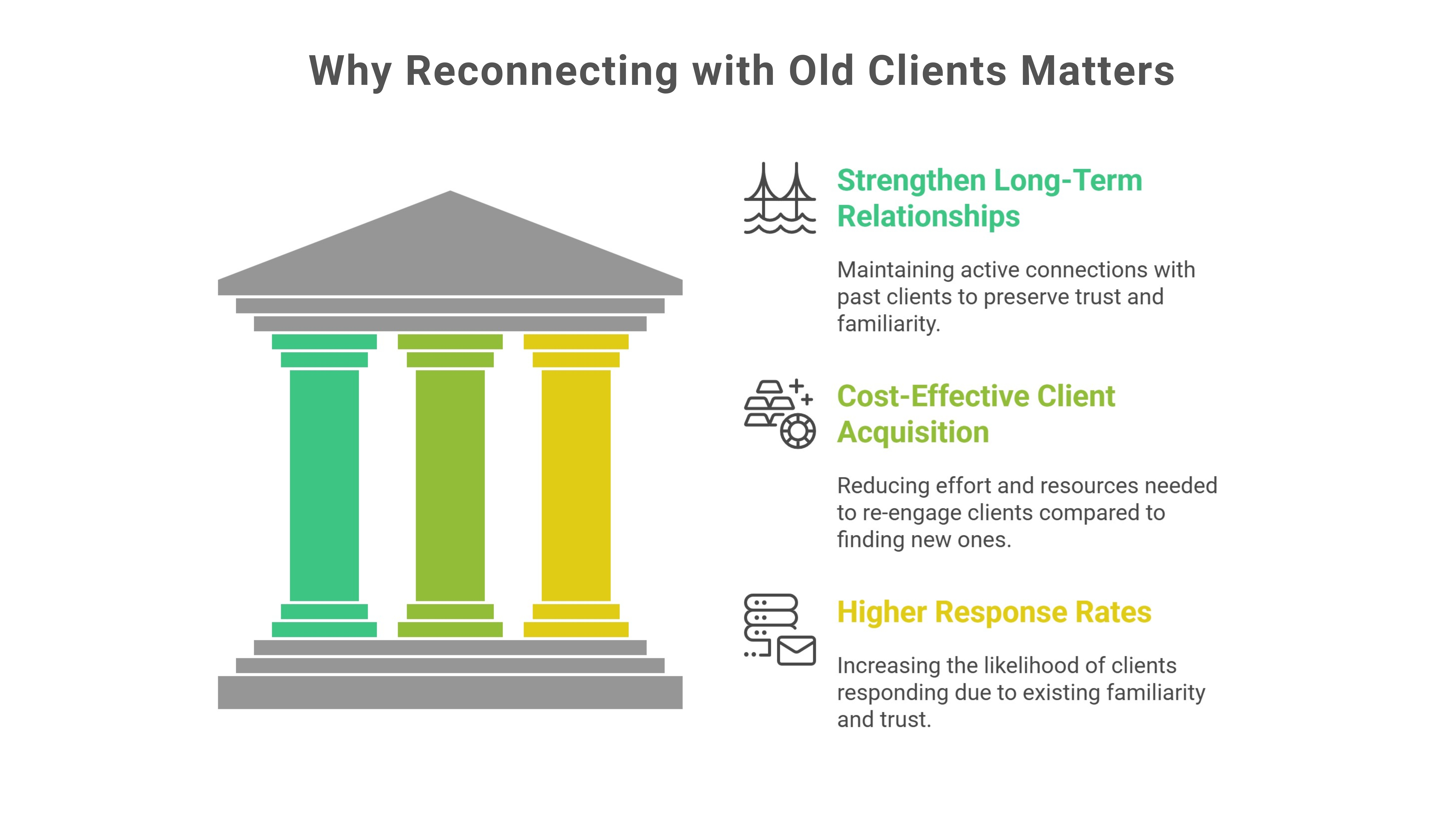
Reconnecting with old clients is not about selling or reopening deals immediately. It is about restarting conversations built on shared history and trust.
Past clients already know your work and communication style. That familiarity removes many of the barriers found in new outreach.
Because context already exists, these conversations feel more natural. They also feel less intrusive than cold outreach.
This is why reconnecting with past clients often works better than starting from scratch.
Old clients already understand your value and how you work. Reconnecting helps keep those relationships active instead of letting them fade.
Even light check-ins reinforce trust built during earlier engagements.They help preserve familiarity over time.
Staying in touch keeps your business present in the client’s mind. Future conversations then feel expected, not sudden.
Re-engaging past clients usually requires less effort than finding new ones. There is no need to rebuild credibility or explain your process again.
Previous experience already provides context. That shortens the time needed to restart discussions.
This approach also reduces outreach and marketing effort.Teams can explore opportunities more efficiently.
Messages sent to former clients are easier to recognize. The sender and context are already familiar.
This familiarity lowers hesitation when opening or replying. Clients feel more comfortable responding.
Unlike cold emails, these messages continue an existing relationship.As a result, response rates are often higher.
Reconnecting with old clients often requires different approaches depending on timing and context.A single message style does not fit every situation.
The email templates in this section are grouped by intent to help you choose the right message quickly.Each template is written to restart communication without pressure, sales language, or assumptions.
These templates are meant to act as starting points.They provide clear structure while allowing you to adjust tone, timing, and details based on the client relationship.
When to apply:
Ways to customize:
Subject: Just checking in
Hi {{Name}},
I hope you’ve been doing well.
It’s been a while since we last connected, so I wanted to check in. We previously worked together on {{project or context}}, and I was thinking about that collaboration recently.
No agenda here just reconnecting to see how things are going.
Best regards,
{{Your Name}}
When to apply:
Ways to customize:
Subject: Let’s catch up
Hi {{Name}},
I hope you’ve been doing well.
It’s been some time since we last spoke, and I thought it might be nice to reconnect. I wanted to reach out and see how things have been going for you lately.
No work-related agenda here, just a friendly note to catch up.
If you’re open to it, I’d enjoy reconnecting whenever it suits you.
Best, {{Your Name}}
When to apply:
Ways to customize:
Subject: It was great working together
Hi {{Name}},
I hope you’ve been doing well.
I was recently thinking about the time we worked together and wanted to reach out. We genuinely enjoyed collaborating and appreciated the experience.
There’s nothing specific to discuss, just a note to reconnect and say hello.
Warm regards, {{Your Name}}
When to apply:
Ways to customize:
Subject: Thank you for the opportunity
Hi {{Name}},
I wanted to take a moment to thank you for the opportunity to work together previously. It was a valuable experience, and I appreciated the chance to collaborate.
I’m reaching out simply to reconnect and express my appreciation. No expectations attached—just a quick note to say thank you and wish you well.
Kind regards, {{Your Name}}
When to apply:
Ways to customize:
Subject: A quick update
Hi {{Name}},
I wanted to share a brief update since we last connected. Recently, {{personal or company update}}, and it made me think about our earlier conversations.
I’m not reaching out for any specific reason—just wanted to reconnect and pass along the update.
Hope everything has been going well on your end.
Regards, {{Your Name}}
When to apply:
Ways to customize:
Subject: Thought this might be useful
Hi {{Name}},
I recently came across this {{article/resource}} and thought it might be relevant based on our earlier conversations.
I wanted to share it with you in case it’s helpful. No action needed just passing it along.
Hope everything has been going well.
Best Regards, {{Your Name}}
When to apply:
Ways to customize:
Subject: Quick thought on [Relevant Industry Trend]
Hi {{Name}},
I recently came across an industry update related to {{specific trend or topic}} and thought it might be relevant to you.
It raised an interesting point about {{short insight}}, which reminded me of our earlier discussions. I wanted to share it in case it’s useful or worth keeping an eye on.
No response needed just passing it along.
Sincerely, {{Your Name}}
When to apply:
Ways to customize:
Subject: Quick feedback request
Hi {{Name}},
I’ve been reviewing some of our past work and wanted to reach out with a quick question.
If you’re open to it, I’d appreciate any brief feedback on your experience working with us. Even a short response would be helpful as we reflect and improve.
No pressure at all just sharing the question in case you have a moment.
Thank you, {{Your Name}}
When to apply:
Ways to customize:
Subject: Sharing a resource you may find useful
Hi {{Name}},
I wanted to share a resource that might be useful for you. It’s a {{tool/resource type}} we recently put together, and it relates to {{brief context}}.
I thought I’d pass it along in case it’s helpful for your work or reference. There’s nothing you need to do just sharing it with you.
Hope you’re doing well.
With regards, {{Your Name}}
When to apply:
Ways to customize:
Subject: A quick update since we last spoke
Hi {{Name}},
I wanted to share a brief update since we last connected. We’ve recently made some changes to {{product/service area}}, which may be relevant based on our earlier work together.
I’m reaching out simply to keep you informed. If you’d like more details at any point, I’m happy to share.
Hope everything has been going well.
Kind regards, {{Your Name}}
When to apply:
Ways to customize:
Subject: Open to a quick conversation?
Hi {{Name}},
I wanted to reach out and see if you’d be open to a short conversation sometime. I’ve been offering brief consultation sessions to exchange perspectives and discuss general approaches around {{topic area}}.
There’s no commitment involved—just a chance to talk and see if the discussion is useful.
If it’s of interest, feel free to let me know. If not, no problem at all.
Sincerely, {{Your Name}}
When to apply:
Ways to customize:
Subject: A quick update on our services
Hi {{Name}},
I wanted to share a brief update since we last worked together. We’ve recently added support in {{new service area}}, which wasn’t available at the time of our previous collaboration.
I’m reaching out simply to keep you informed and reconnect.If it’s ever useful to explore, I’m happy to share more details.
Hope all is well.
Kind regards, {{Your Name}}
When to apply:
Ways to customize:
Subject: Exploring a possible collaboration
Hi {{Name}},
I wanted to reach out to share a collaboration idea that came to mind based on our past work and overlapping interests.It could be an interesting opportunity to explore together, if and when it feels relevant.
Let me know if you’d be open to a brief conversation at some point.
Warm regards, {{Your Name}}
When to apply:
Ways to customize:
Subject: Invitation to an upcoming session
Hi {{Name}},
I wanted to share an invitation to an upcoming {{event/webinar}} focused on {{topic}}. It may be of interest based on our earlier conversations, so I thought I’d pass it along.
Feel free to join if it’s useful, and no worries at all if not.
Best regards, {{Your Name}}
When to apply:
Ways to customize:
Subject: A limited offer you may find useful
Hi {{Name}},
I wanted to share a limited offer we’re currently making available related to {{service/product}}. I thought it might be useful to pass along, based on our earlier work together.
No pressure at all—just sharing in case it’s relevant.
Thanks, {{Your Name}}
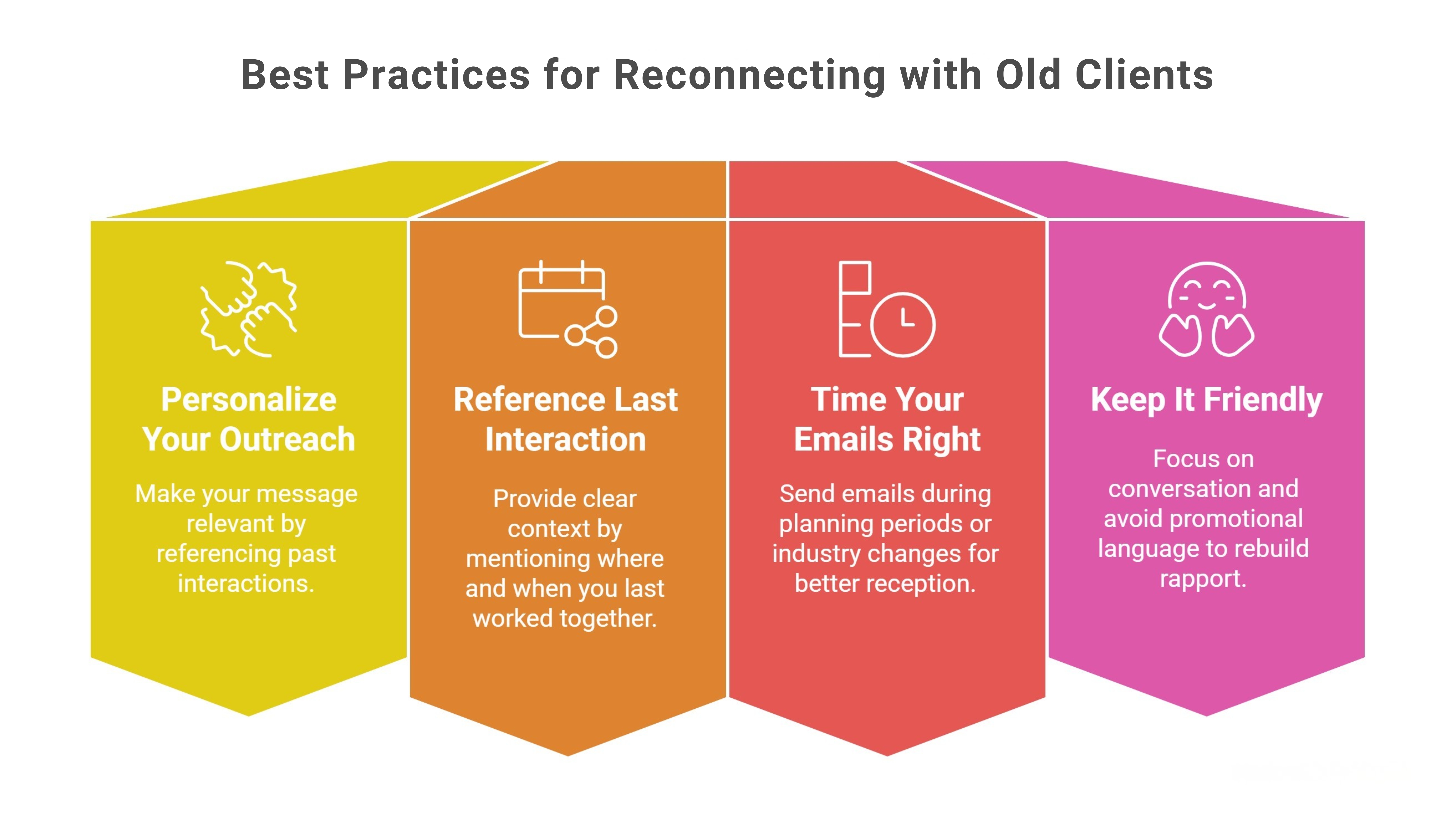
Reconnecting with old clients works best when the outreach feels intentional rather than rushed. The way a message is written, timed, and framed often determines whether it feels welcome or ignored.
Small details such as personalization, clarity, and tone play a larger role than complex messaging. Following a consistent approach helps avoid common mistakes that can make emails feel automated or sales-driven.
This section outlines practical best practices that support clear, respectful communication and help reconnection efforts feel natural and appropriate.
Personalization helps your message feel relevant instead of generic. Referencing a past project, discussion, or outcome reminds the client that the relationship already exists.
Even brief details, such as the type of work completed or the timing of your last interaction, add context. This shows the email is written with intention rather than sent in bulk.
Personalized outreach also reduces uncertainty for the reader. They immediately understand why the message matters to them.
Using an email template for reconnecting with old clients works best when it is adapted with small, meaningful details rather than sent unchanged.
Clear context helps clients quickly recognize the relationship. Mentioning where or when you last worked together prevents confusion and hesitation.
Clients often receive many emails daily. A short reminder of the previous interaction helps them place your message without effort.
This does not require detail. A simple reference to the project, timeframe, or collaboration is enough.
Clarity at the start of the email sets the tone.It makes the reconnection feel familiar rather than unexpected.
Timing affects how messages are received. Even well-written emails can be overlooked if sent at the wrong moment.
Reaching out during planning periods, business transitions, or industry changes often feels more natural. Clients are more open to reconnecting when they are already reviewing priorities.
Avoid sending reconnection emails during high-pressure periods. Choosing thoughtful timing improves visibility and reduces the chance of being ignored.
Reconnection emails should focus on conversation, not conversion.A relaxed tone lowers resistance and keeps the message approachable.
Avoid language that sounds promotional or outcome-driven. The goal is to reopen communication, not secure an immediate response.
Friendly language helps rebuild rapport. It signals respect for the relationship and gives clients space to respond comfortably.
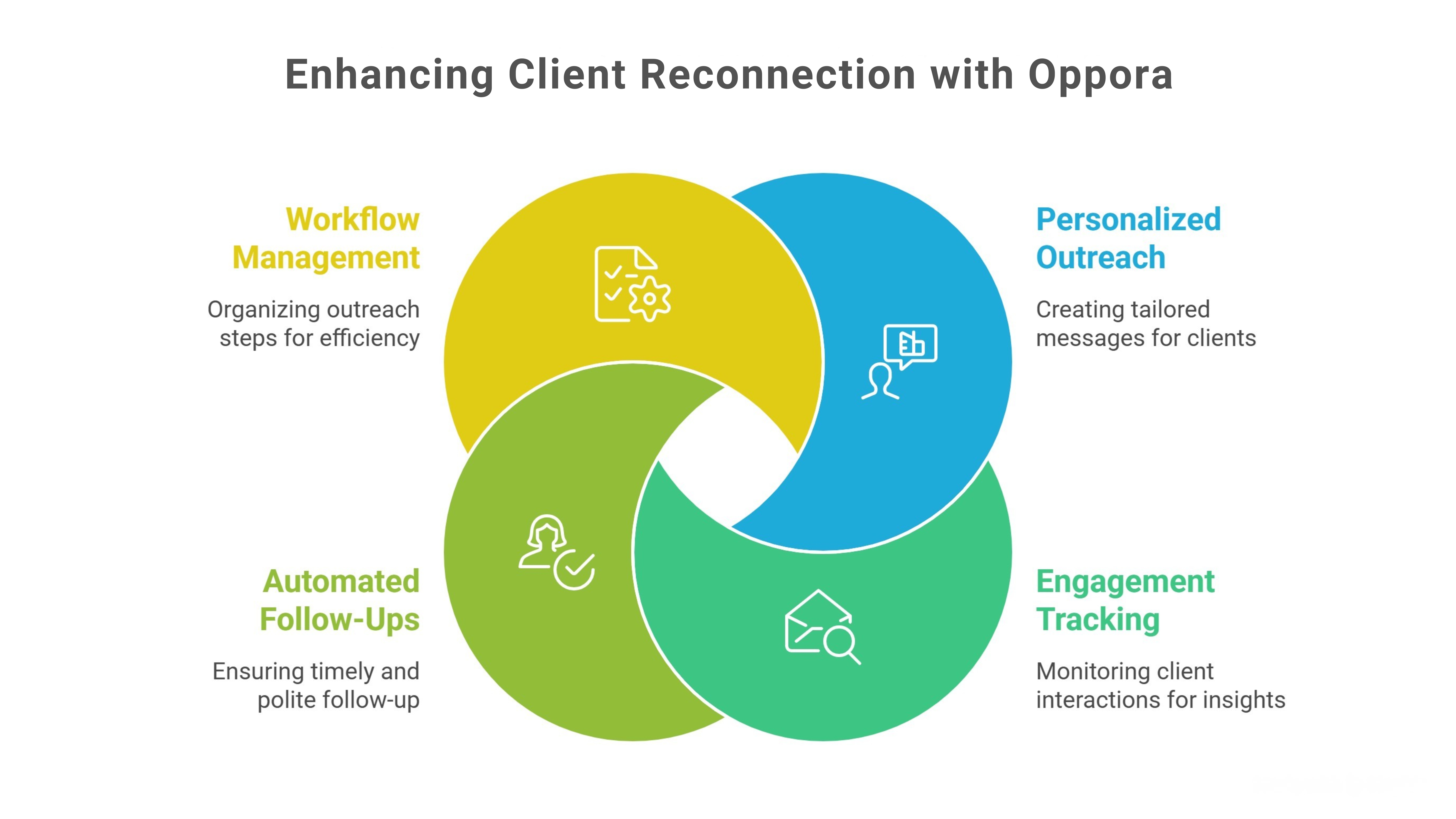
Managing reconnection manually becomes difficult as contacts grow.Personalization gets inconsistent, follow-ups are missed, and timing depends heavily on memory or spreadsheets.
When outreach lacks structure, even well-written messages lose effectiveness. Teams often struggle to maintain consistency across different clients and situations.
Oppora supports reconnection workflows quietly in the background. It helps organize outreach steps, manage timing, and maintain consistency without turning communication into automated or sales-driven messaging.
Used thoughtfully, email templates to reconnect with old clients can remain personal while being easier to manage at scale.
Personalization works best when it is consistent and repeatable. Oppora helps teams create structured templates that can be adapted with client-specific details.
Instead of rewriting emails each time, teams can reuse templates while adjusting context such as past interactions or timing. This keeps outreach aligned without making messages feel identical.
Automation also supports better scheduling. Emails can be sent at appropriate times without relying on manual reminders, helping teams stay organized while keeping communication intentional and controlled.
Understanding what happens after an email is sent is often overlooked. Oppora tracks basic engagement signals such as opens and replies to provide visibility.
This data helps teams see which messages are being noticed and which are not. Instead of guessing, outreach can be adjusted based on actual response patterns.
Over time, this insight supports better decision-making. Teams can refine messaging, timing, or follow-up approaches using clear signals rather than assumptions.
Follow-ups are often missed or sent inconsistently. Oppora helps manage this by automating reminders within defined limits.
Follow-ups can be spaced appropriately and written in advance. This ensures messages remain polite and timely rather than repetitive or intrusive.
Automation reduces reliance on memory while respecting boundaries. Teams can stay consistent without overwhelming clients or pushing conversations forward prematurely.
Reconnecting with old clients is most effective when outreach feels personal, timely, and pressure-free. Messages that acknowledge past context help restart conversations naturally instead of forcing engagement.
Using the right template for each situation brings clarity and consistency. It reduces hesitation about what to say and keeps communication focused and relevant.
Follow-ups matter, but only when they are controlled and respectful.Clear timing and organization help maintain momentum without overwhelming clients or damaging trust.
Having a structured process makes this easier to manage over time.Tools like Oppora can quietly support reconnection efforts by helping teams organize templates, track engagement, and manage follow-ups, while keeping the outreach tone unchanged and intentional.
How long should I wait before emailing an inactive client again?
Waiting three to six months is generally appropriate, depending on your past relationship. The goal is to allow enough time for relevance to return without making the outreach feel sudden or unnecessary.
Is it better to reconnect via email or another channel first?
Email is often the least intrusive option for reconnecting. It gives clients time to respond at their convenience and provides clear context without putting them on the spot.
Should I always mention past work when reconnecting with old clients?
Mentioning past work is helpful when it adds clarity. However, for casual check-ins or value-sharing emails, a simple reference to familiarity can be enough.
How many follow-ups are reasonable when reconnecting by email?
One or two polite follow-ups are usually sufficient. If there is no response after that, it’s best to pause and avoid over-communicating.
Can reconnecting with old clients harm the relationship if done poorly? Yes. Emails that feel sales-driven, repetitive, or poorly timed can create resistance. Keeping messages respectful, relevant, and optional helps protect the relationship.
Summarize with AI
Share