Home
Blog
Find 500 B2B Contacts for Free Every Month with Built-In Outreach.
Home
Blog
Manasa Goli
Published March 24, 2026
7 min
Try Oppora AI
Create Self-Running Agentic Sales Workflows like N8N just by chatting with AI
Get Started for FREE
Most sales teams don’t fail because they lack effort — they fail because their effort is scattered.
Reps are sending emails, doing calls, booking demos… yet deals don’t move consistently. One rep closes fast, another struggles. Some leads convert, others disappear without explanation.
At first glance, it feels like a performance issue.
But if you look closely, it’s something deeper:
👉 There is no clear, structured sales process behind the actions.
This is exactly where sales process mapping becomes critical — not as a documentation exercise, but as a way to bring clarity, consistency, and control into your entire sales motion.
In this guide, we’re not just going to define a sales process map. We’ll break down how to think about it, build it, and actually use it to improve results.
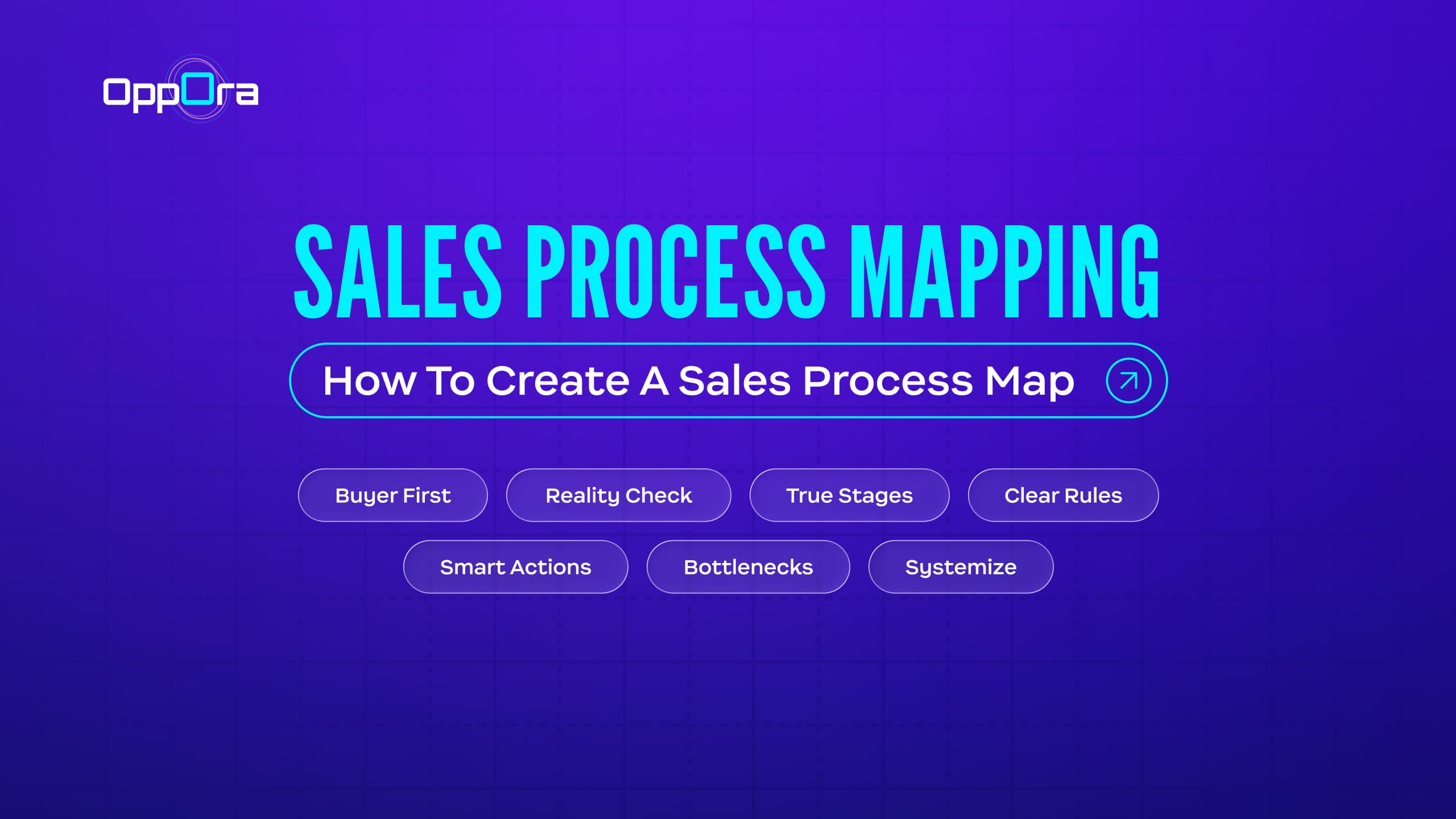
At a basic level, sales process mapping is about defining the steps a prospect goes through before becoming a customer.
But that definition is incomplete — and that’s where most teams go wrong.
A true sales process map is not just a list of steps like:
Instead, it answers deeper questions:
In other words, a good sales process map doesn’t just describe your pipeline — 👉 It explains how decisions happen inside it.
Without this clarity, your pipeline becomes misleading:
So before jumping into “how to map a sales process,” it’s important to shift your mindset:
👉 You’re not mapping activities — 👉 You’re mapping buyer progression and decision-making
Here’s something most teams don’t realize:
They already have activities… but they don’t have a process.
For example:
These are actions — but actions alone don’t create consistency.
A process, on the other hand, connects these actions into a logical progression:
“If this happens → then this should happen next → based on this condition”
That “logic layer” is what sales process mapping creates.
And once that logic exists, everything changes:
This is why mapping your sales process is not optional if you want to scale — 👉 It’s the foundation of predictable revenue.
Read More: https://oppora.ai/blog/b2b-sales-funnel-examples/
Now let’s go deeper — not just what to do, but how to think while doing it.
Most sales teams make a critical mistake here — They start by mapping what they do.
But a strong sales process starts from the opposite direction:
👉 How does your buyer move from unaware → interested → convinced → committed?
Because no matter how good your outreach is, deals only move forward when the buyer progresses mentally.
For example:
So instead of asking: ❌ “What steps do we follow?”
Ask: ✔ “What changes in the buyer’s thinking at each stage?”
This shift ensures your sales process map is aligned with real decision-making, not internal assumptions.
Now that you understand the buyer journey, the next step is to map your current sales flow — exactly as it happens today.
This step requires honesty.
Most teams are tempted to design a “perfect process,” but that creates a gap between:
Instead, write down:
For example, you might discover:
These are not flaws — they are insights.
Because you can’t improve a process you haven’t fully understood.
Now comes a crucial refinement.
Most teams define stages like:
But these are activities, not progress indicators.
A better way to define stages is:
👉 Based on what the buyer has confirmed or committed to
For example:
This shift ensures that your pipeline reflects real deal movement, not just completed tasks.
And this is critical because:
This is one of the most important — and most overlooked — parts of sales process mapping.
Each stage should clearly answer:
Let’s take an example:
Discovery Stage
Now compare that to a vague process:
The difference is huge.
With defined criteria:
Without it:
Now that your stages are clear, you define what actions support progression.
But here’s the key:
👉 Activities should not exist independently — 👉 They should be tied to stage objectives
For example:
Instead of:
Define:
Instead of:
Define:
This ensures every activity has context and purpose, not just execution.
Once your process is mapped, patterns become visible.
You’ll start noticing:
These are not random issues — They are process-level bottlenecks.
For example:
This is where mapping becomes powerful:
👉 It turns invisible problems into visible, fixable points.
Here’s where most sales process mapping efforts fail:
They stop at documentation.
But a process only creates value when it is consistently executed.
And this is where things usually break:
This gap between process design and execution is where tools like Oppora come in.
Once your sales process is clearly mapped, the next challenge is:
👉 How do you ensure it actually runs the way it’s designed?
Because manually executing every step:
This is where Oppora.ai acts as an execution engine for your mapped process.
Instead of replacing your process, it activates it.
For example:
Instead of random prospecting:
Instead of manual follow-ups:
Instead of scattered updates:
Instead of reps remembering steps:
So instead of: ❌ “We have a process, but it’s not followed”
You move to: ✔ “Our process runs consistently without friction”
Let’s connect everything with a real scenario.
👉 Now you don’t just have a process — 👉 You have a system that runs and improves over time
Most teams think of sales process mapping as a one-time task.
But in reality, it’s a strategic advantage.
Because once you map your process properly:
And when that process is supported by the right execution layer…
👉 Sales stops being unpredictable 👉 And starts becoming systematic and scalable
Creating a sales process map can take anywhere from a few days to a few weeks, depending on how complex your sales cycle is. The key factor is not speed, but accuracy—teams need to analyze real deal data, understand buyer behavior, and align internally before finalizing the process.
Sales process mapping is even more valuable for small teams because it reduces dependency on individual performance. With limited resources, having a clear and repeatable process ensures that every action contributes directly to revenue instead of trial-and-error efforts.
Yes, a well-defined sales process improves customer experience by making interactions more relevant and timely. When each stage is structured, prospects receive the right information at the right time, reducing confusion and increasing trust.
The biggest mistake is treating it as a one-time document instead of a living system. Without continuous updates based on real performance data, even a well-designed sales process can become outdated and ineffective.
Automation enhances a mapped sales process by ensuring that defined steps are executed consistently. It reduces manual effort, minimizes human error, and allows teams to focus more on high-value interactions rather than repetitive tasks.
Summarize with AI
Share