Home
Blog
Find 500 B2B Contacts for Free Every Month with Built-In Outreach.
Home
Blog
Manasa Goli
Published February 12, 2026
5 min
Try Oppora AI
Create Self-Running Agentic Sales Workflows like N8N just by chatting with AI
Get Started for FREE
Email prospecting isn’t just sending emails — it’s a strategic process of identifying the right prospect, writing outreach that resonates, and evaluating performance so you improve over time.
In 2026, buyers are overwhelmed with messages — generic outreach gets ignored. The difference between an ignored email and a reply isn’t luck — it’s craft, relevance, and personalization. This guide shows you:
📍 How to write effective prospecting emails
📍 13 proven templates you can use today
📍 How to evaluate your emails so you get replies
📍 Tools (like Oppora) that simplify and supercharge outreach
A prospecting email is the first message you send to someone you haven’t talked to before — usually a cold or warm lead. Its purpose isn’t to sell instantly, but to start a conversation with relevance, not noise.
A good one:
Your subject is the first impression — customers decide to open or delete in seconds. Focus on curiosity + relevance.
Good example: “Quick idea for your SaaS pricing page”
Bad example: “Grow your business”
Start by showing you understand their world — a recent achievement, an industry trend, a problem they likely face. Skip generic greetings like “hope you’re well.”
Tell them exactly what you want — reply yes/no, book a time, review a proposal. Clarity trumps cleverness.
Even the best email falls flat if you don’t have verified contact info. Sending an outdated or incorrect email hurts deliverability and reply rates.
This is where Oppora.ai becomes genuinely useful:
This means better input → better outreach → better replies.
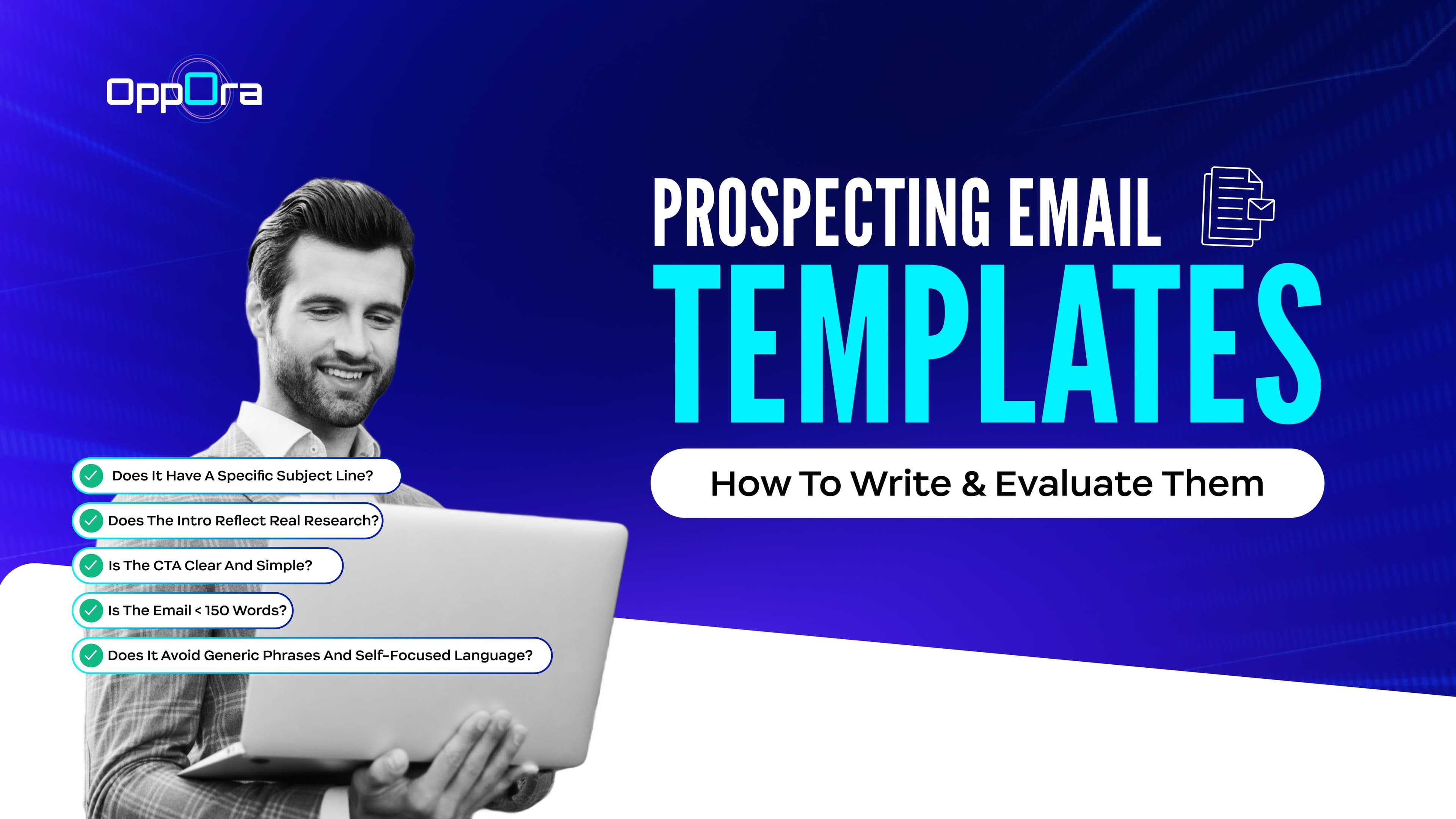
Before sending, use this quick checklist:
✅ Does it have a specific subject line?
✅ Does the intro reflect real research?
✅ Is there a value statement (how YOU help THEM)?
✅ Is the CTA clear and simple?
✅ Is the email < 150 words?
✅ Does it avoid generic phrases and self-focused language?
If the answer to all is “yes,” you’re in good shape.
Below are ready-to-use templates — each built for a specific scenario. Use them as inspiration and tailor to your audience.
Subject: Quick idea for [company]
Hi [First Name],
I saw [specific detail about prospect or company]. A few clients in [industry] faced similar challenges and increased reply rates with this approach — [brief benefit]. Curious if this resonates with you?
Best,
[Your Name]
Use when: You know a specific detail about their situation.
Subject: [Mutual connection] suggested I reach out
Hey [First Name],
[Referrer] mentioned your team is focusing on [initiative]. We helped similar teams achieve [specific result]. Would you be open to a quick 10-min chat to see if it’s relevant?
Thanks,
[Your Name]
Use when: You have a shared connection.
Subject: Are you still facing [problem]?
Hi [First Name],
Many [role] I talk with struggle with [common industry pain]. If that’s still top of mind, I’d love to share what’s worked for other teams. Chat this week?
Best,
[Your Name]
Subject: How [similar company] improved [metric]
Hey [First Name],
With [Company] we helped improve [metric] by X% in X weeks using [approach]. Thought it might be interesting given your focus on [initiative]. Open to a short conversation?
Cheers,
[Your Name]
Subject: Quick question
Hi [First Name],
I’ve been researching your company and wanted to ask — what’s your biggest priority in [area]?
Reply or let me know a good time to chat.
Thanks,
[Your Name]
Subject: Quick feedback on [company idea]
Hey [First Name],
I’m working on something that could help [industry] with [problem]. Before finalizing, would you mind sharing quick feedback?
Appreciate it!
[Your Name]
Subject: Thought you’d find this helpful
Hi [First Name],
I read your post on [topic] and thought you might like this [link/resource]. It dives into [specific thing].
Happy to discuss more if you’re interested.
Best,
[Your Name]
Subject: Great seeing you at [event]
Hey [First Name],
It was great meeting at [event]. You mentioned [specific challenge].
I’d love to continue the conversation.
Available for a short call?
Thanks,
[Your Name]
Subject: What we’re seeing in [industry]
Hi [First Name],
We’ve observed a trend — [specific insight]. Companies like [peer] are adjusting by [action].
Curious if this is top of mind for you? Let’s talk.
Best,
[Your Name]
Subject: No pitch — just a question
Hi [First Name],
I won’t pitch you anything — but I’m curious: how are you planning to tackle [problem] this quarter?
Reply with a quick thought if you’d like to share.
[Your Name]
Subject: Help with [specific pain point]?
Hi [First Name],
If your team needs support with [specific challenge], I can share a quick idea that’s worked well for others.
Want a short walkthrough?
Best,
[Your Name]
Subject: 10 minutes this week?
Hey [First Name],
I’ve got a few minutes Tuesday or Thursday. Could I spare 10 for a quick conversation about [topic]?
Thanks,
[Your Name]
Subject: Still interested in [topic]?
Hi [First Name],
We spoke earlier about [topic]. Just checking in — are you still looking for ideas or resources on that?
Reply if yes.
[Your Name]
After you send:
🔹 Open Rates: If low — improve subject lines.
🔹 Reply Rates: If low — improve personalization or CTA clarity.
🔹 Bounce Rates: If high — fix email list quality or verification.
🔹 Timeline: Track performance over time; improve with A/B tests.
Great prospecting emails are not random — they are strategic, personalized, and measurable. Use cold email prospecting templates as frameworks, not scripts. Always personalize, test different approaches, and refine based on real data.
And remember — the right tools make execution faster and more accurate. With verified contact data and personalized automation from platforms like Oppora, your outreach becomes smarter, more targeted, and more effective.
A prospecting email should ideally be between 75–150 words. Short, focused emails with a clear value proposition and single call to action tend to get higher reply rates.
A prospecting email is typically more targeted and research-driven, focused on starting a meaningful business conversation. Cold emails can be broader and sometimes less personalized.
Most outreach campaigns perform best with 2–4 follow-up emails spaced several days apart. Follow-ups should add value rather than simply repeating the original message.
Common mistakes include:
Using verified contact data platforms like Oppora.ai helps reduce bounce rates and improve deliverability. Tools such as Oppora’s Contact Hunter provide access to updated email and phone data to support accurate outreach.
Summarize with AI
Share