Home
Blog
Find 500 B2B Contacts for Free Every Month with Built-In Outreach.
Home
Blog
Adam Hossain
Published January 18, 2026
16 min
Try Oppora AI
Create Self-Running Agentic Sales Workflows like N8N just by chatting with AI
Get Started for FREE
In today’s competitive recruitment landscape, a solid business development strategy for recruitment agencies is crucial to staying ahead.
This blog will outline 12 proven strategies that can help your recruitment agency grow, build strong client relationships, and drive revenue.
Whether you're refining your approach or starting fresh, these strategies will guide you towards more effective business development.
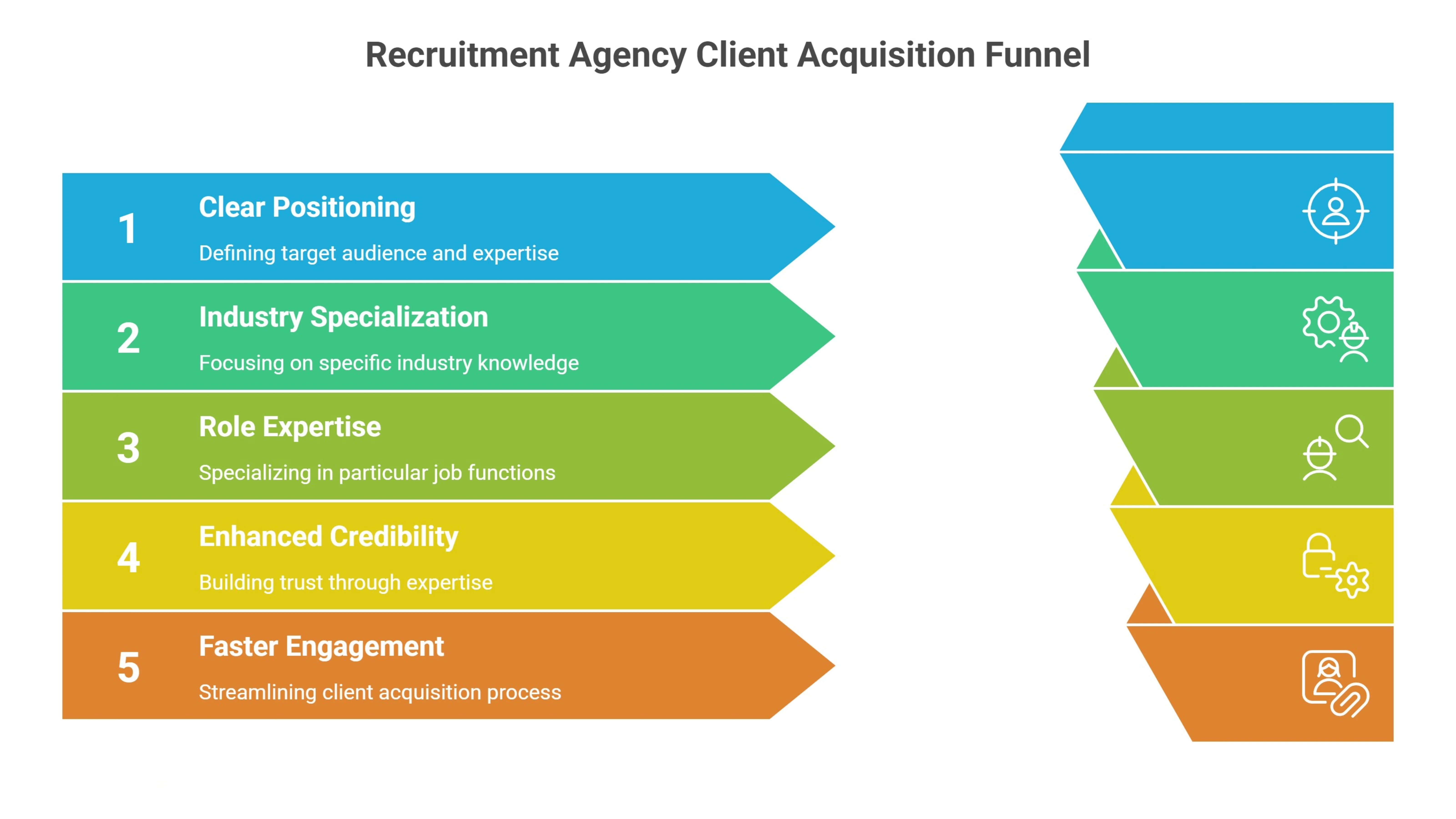
Clear market positioning is one of the strongest business development levers for recruitment agencies.
When you clearly define who you serve and what you hire for, clients understand your value faster.
Instead of explaining everything you do, your positioning speaks for you.
Specialization helps agencies enter conversations with relevance and credibility, making client acquisition easier from the very first touchpoint.
Industry-focused agencies win because they already understand their client’s operating environment.
Every industry comes with unique hiring pressures, timelines, and compliance requirements.
When your agency focuses on a single sector such as SaaS, healthcare, or manufacturing you don’t need long discovery calls to prove expertise.
Your outreach becomes sharper. Your messaging reflects real industry challenges.
Clients begin to see you as a hiring partner, not just another vendor. This reduces friction in sales conversations and helps clients move faster toward engagement.
Role-based positioning works differently.
It improves precision, not breadth.
When you specialize in specific functions like engineering, sales, or leadership roles, your strength lies in execution depth.
You know where these candidates are. You understand what motivates them. You anticipate what causes hiring delays.
This allows you to:
Clients prefer agencies that don’t need role education.
Clear role expertise shortens decision cycles and makes your value proposition easier to justify.
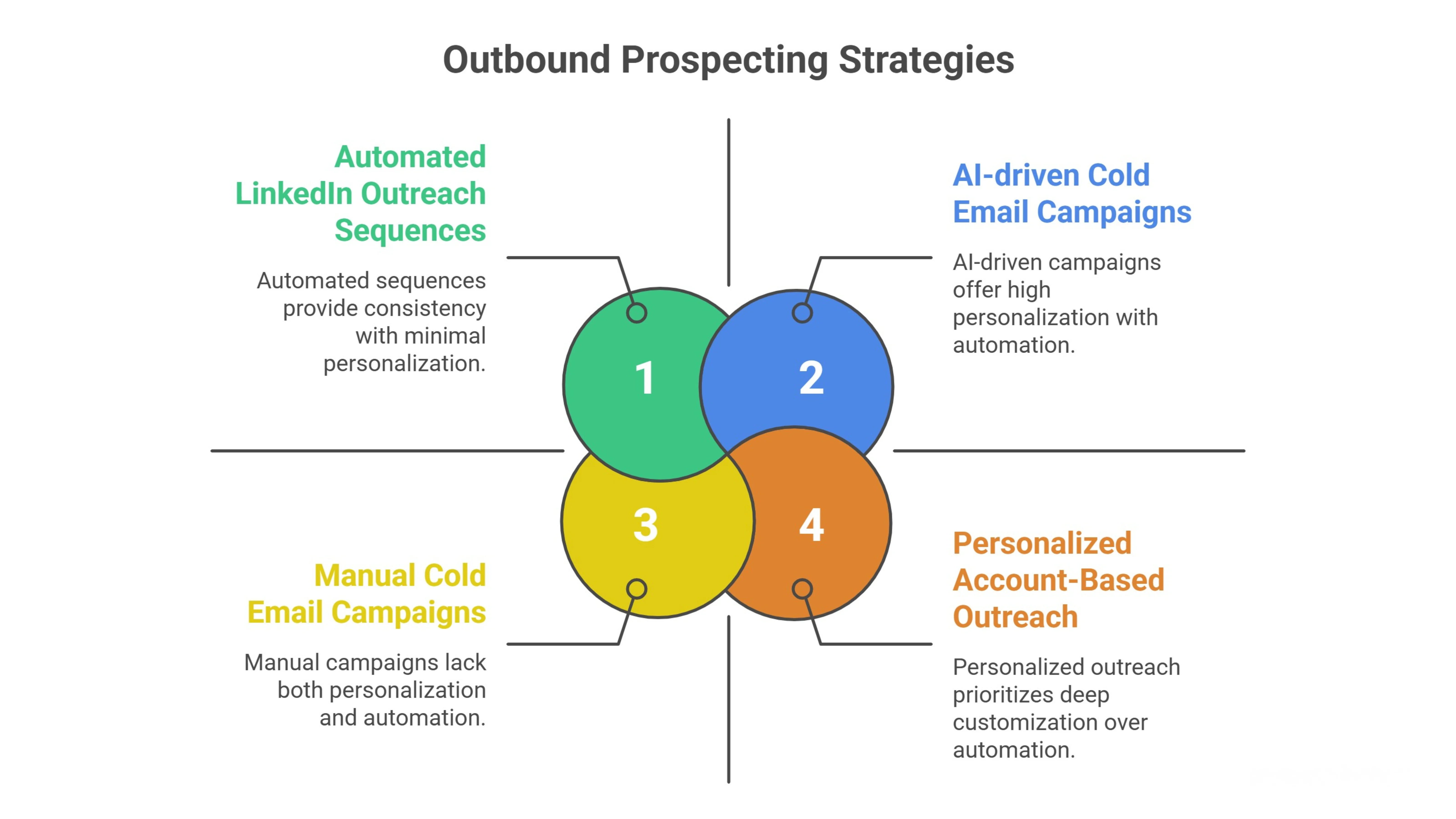
Outbound prospecting is a reliable business development strategy for recruitment agency teams when inbound leads are inconsistent.
Cold emails, LinkedIn outreach, and account-based outreach work best when they follow a simple system.
The goal is consistency without losing relevance.
Cold email can be a powerful way to engage potential clients.
In practice, most of the effort happens before the first email is sent.
Teams begin by identifying the right companies and locating decision-makers who are directly involved in hiring.
The preparation phase usually includes:
This alone can take hours.
Once the list is ready, personalization becomes the next challenge. Messages need to reflect role, industry, hiring signals, and pain points to avoid sounding generic.
After sending emails, follow-ups create another layer of complexity:
When handled manually, spreadsheets grow, notes get missed, and consistency drops.
This is where a system helps.
Tools like Oppora support this stage through AI-driven automation, helping organize prospect data, surface verified emails faster, and reduce the manual steps that slow cold outreach making consistency easier without adding complexity.
LinkedIn outreach works best when it’s contextual, not random.
The main challenge is research.
Recruiters must identify the right decision-makers, understand their role, and find a reason to reach out that feels relevant.
Effective LinkedIn outreach usually follows a sequence:
Managing this manually is difficult.
Outreach is spread across profiles, messages, notes, and reminders.
Without a simple tracking approach, it’s easy to forget who was contacted, what was said, or when to follow up.
As consistency drops, results decline.
Account-based outreach prioritizes quality over volume.
Instead of broad lists, teams focus on a smaller group of high-value companies.
The process begins with deep account research, including:
Next comes stakeholder mapping.
Most deals involve multiple contacts across HR, talent acquisition, department heads, and sometimes finance or operations.
Outreach is not a single message. It’s coordinated across email, LinkedIn, and occasional calls, with touchpoints spaced over time.
Manually managing this is difficult.Information gets scattered, context is lost, and momentum breaks.
Without proper tracking, teams miss timing and fail to build sustained engagement across the account.
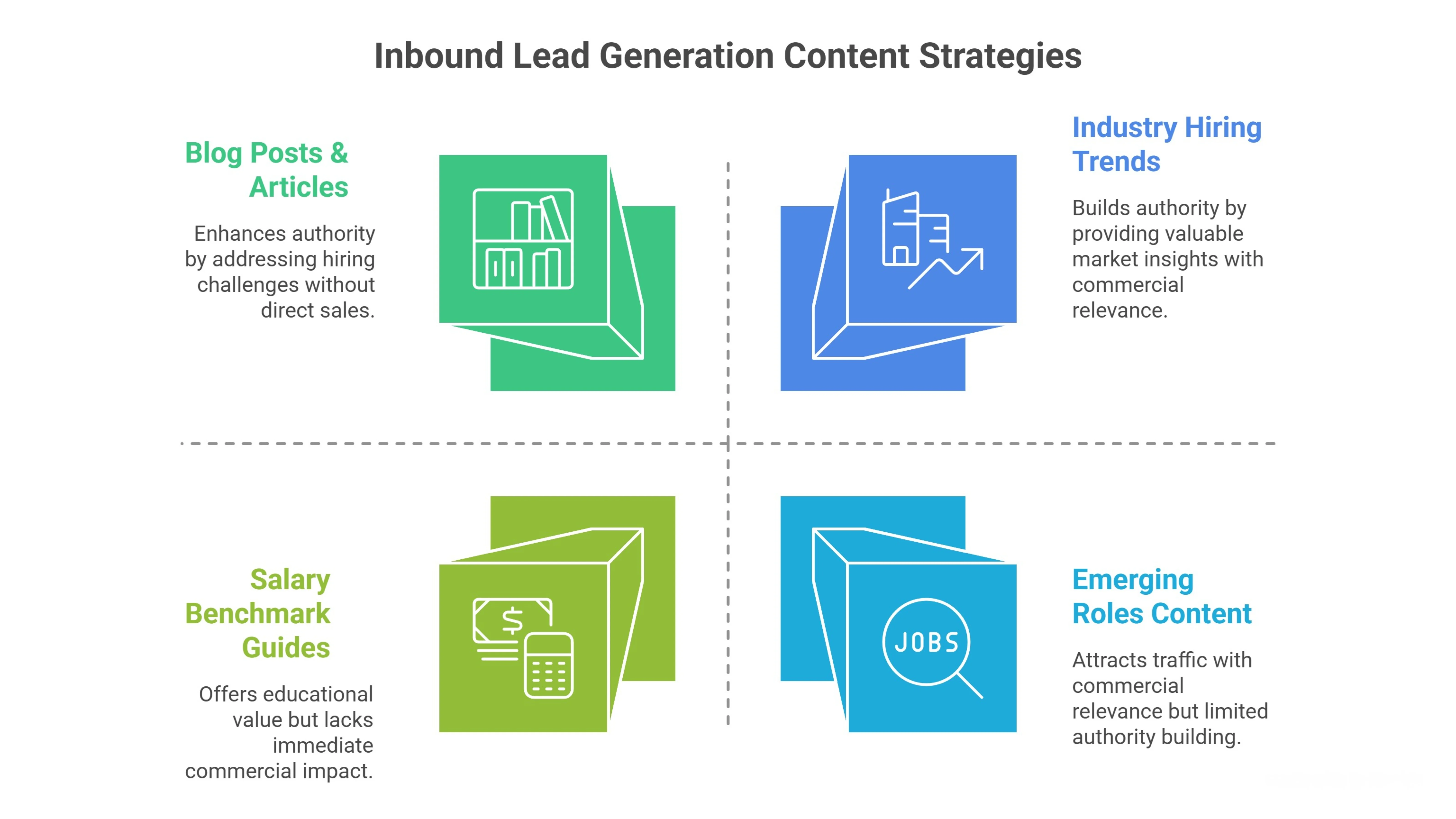
Inbound lead generation focuses on attracting hiring decision-makers before direct outreach ever happens.
When your content answers real hiring questions, potential clients arrive already aware of their challenges.
This reduces resistance, shortens sales cycles, and improves lead quality because conversations start with trust and context.
SEO content works best when it is practical, specific, and consistently published.
SEO-optimized blog posts are one of the strongest inbound channels for recruitment agencies.
Well-written articles help decision-makers understand hiring problems they may not have fully defined yet. The purpose is not to sell services directly, but to create clarity and trust.
Effective blog topics often include:
When articles focus on a specific industry or role, they rank better and resonate more deeply with the right audience.
Over time, these posts continue bringing in traffic without ongoing outreach, turning your website into a long-term lead source.
Salary benchmarking content attracts highly qualified inbound traffic.
Hiring managers often struggle to set competitive compensation, especially in fast-moving or talent-scarce markets. Clear salary guides help decision-makers make informed hiring plans.
Strong salary guides typically explain:
This type of content positions your agency as a trusted market reference rather than just a recruiter.
Because people searching for salary data are often preparing to hire, these guides are both educational and commercially relevant.
Industry hiring trend content helps build long-term authority.
Sharing insights shows that your agency understands the market beyond individual placements and stays informed about change.
High-value trend content often covers:
This content helps clients plan ahead instead of reacting late.
It also keeps your agency visible even when companies are not actively hiring. Over time, familiarity turns into inbound conversations when hiring needs resurface.
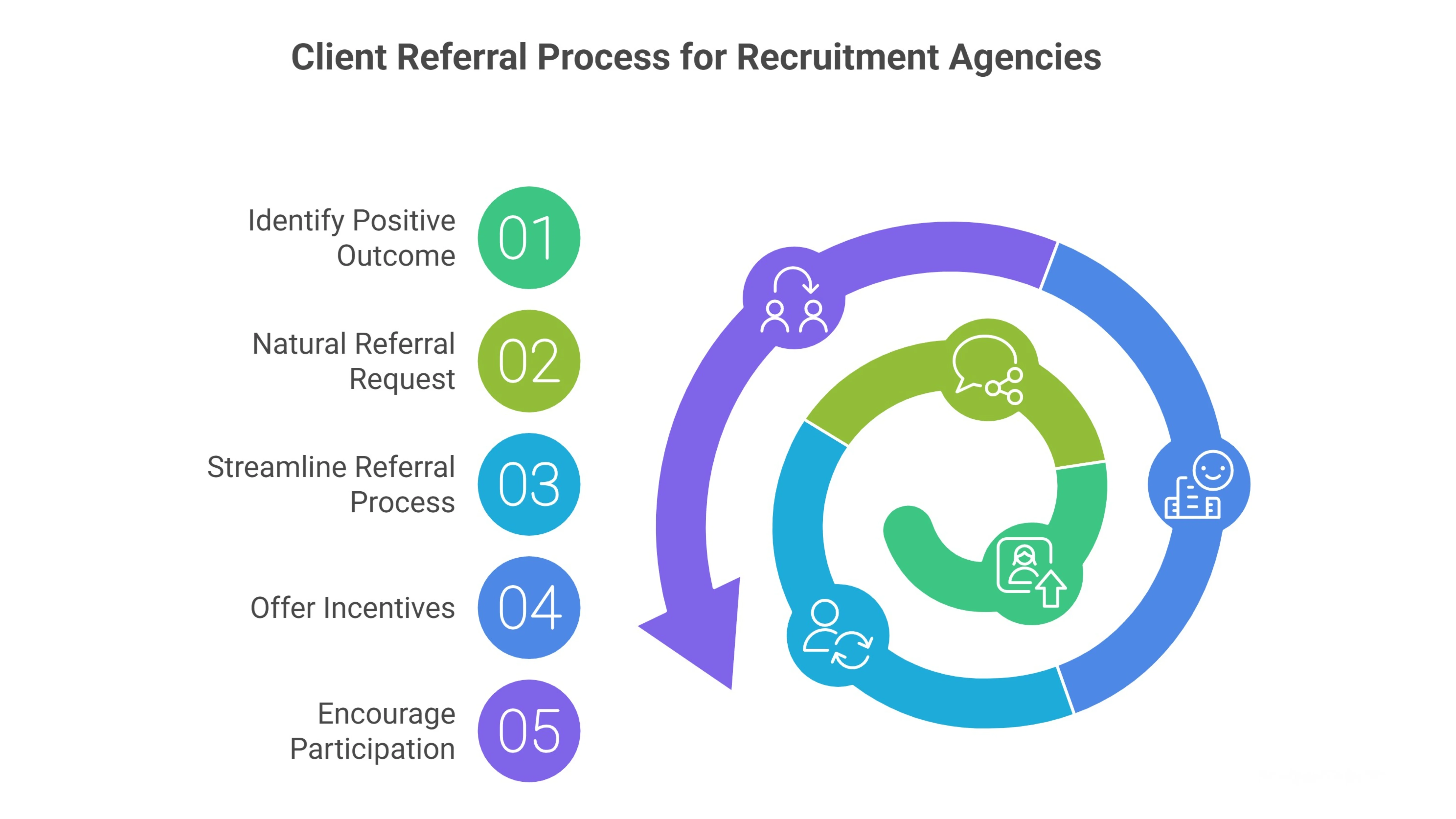
Client referrals are one of the most reliable and cost-effective parts of any business development strategy for recruitment agency growth.
Referred clients already trust your service because the recommendation comes from someone they know.
The challenge is not whether referrals work.
It’s knowing when to ask, how to make the process easy, and how to encourage clients to participate without pressure.
Timing plays a major role in referral success.
The best moment to ask is right after a positive outcome, such as a successful placement or a smooth hiring process.
At this stage, clients clearly see the value you’ve delivered.
Referral requests should feel natural, not scripted.
A simple conversation or short message that highlights the recent success works better than a generic request.
When clients feel appreciated rather than targeted, they are more willing to introduce you to others in their network.
Even happy clients may not refer if the process feels complicated.
The easier you make it, the more likely they are to follow through.
Clear instructions, short referral messages, or simple introduction templates remove hesitation.
Clients should never have to explain your services on your behalf.
When the referral process is straightforward, it reduces friction and increases participation.
A smooth system ensures referrals happen naturally instead of being delayed or forgotten.
Incentives can encourage referrals, but they should feel like appreciation rather than a transaction.
Small rewards such as service discounts, priority support, or referral credits often work better than large incentives.
The focus should remain on relationship value, not just rewards.
Transparent incentives set clear expectations and make referrals feel mutually beneficial.
When incentives align with your service offering, clients are more comfortable recommending your agency without feeling pressured.
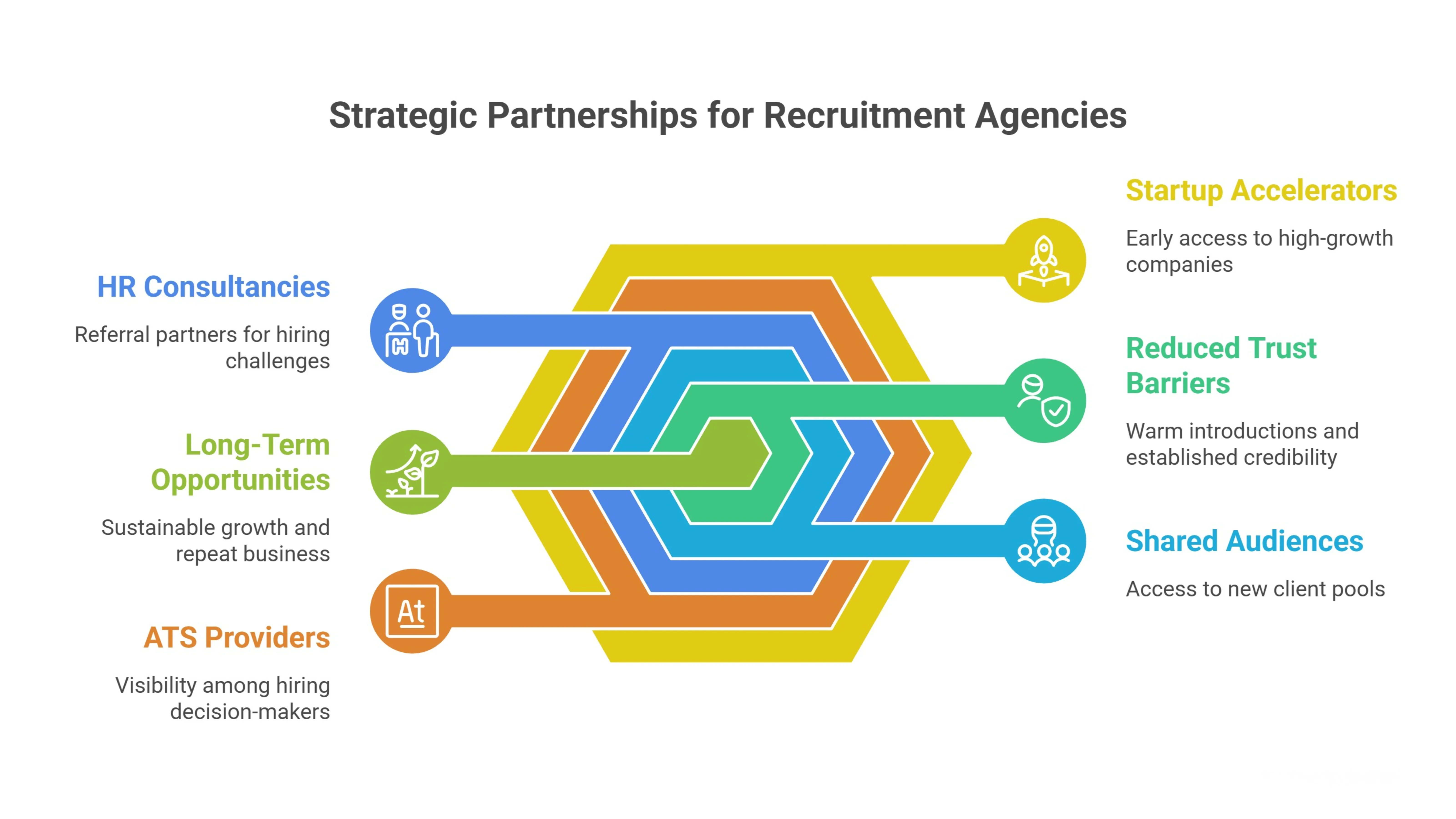
Strategic partnerships are effective business development ideas for recruitment agencies looking to grow without relying only on direct outreach.
By partnering with complementary businesses, agencies gain access to shared audiences and warm introductions.
These partnerships reduce trust barriers and open doors to long-term opportunities.
The key is choosing partners whose services naturally align with recruitment rather than overlap with it.
HR consultancies often work with companies that already have hiring challenges.
This makes them strong referral partners for recruitment agencies.
By collaborating, both sides can share insights, expertise, and client introductions without competing for the same service area.
Recruitment agencies bring talent acquisition knowledge, while HR consultancies offer process, compliance, and workforce strategy support.
When structured correctly, this partnership benefits clients by offering a more complete solution.
It also creates ongoing referral opportunities rather than one-time introductions.
Applicant Tracking System providers work closely with hiring teams and recruitment leaders.
These companies already serve organizations actively hiring or planning to scale.
Collaborating with ATS providers can increase visibility among decision-makers at the right stage of the hiring process.
Partnerships may include co-marketing, shared resources, or integration-based referrals.
When recruitment agencies align with ATS platforms, they position themselves closer to the hiring workflow.
This improves access to qualified prospects and strengthens long-term business relationships.
Startup accelerators support early-stage and fast-growing companies.
These businesses often need hiring support quickly but lack internal recruitment infrastructure.
Partnering with accelerators gives recruitment agencies early access to high-growth companies.
This allows agencies to build relationships before hiring becomes urgent.
By offering hiring guidance or early-stage recruitment support, agencies become trusted partners rather than last-minute vendors.
Over time, these partnerships lead to repeat business as startups continue to scale.
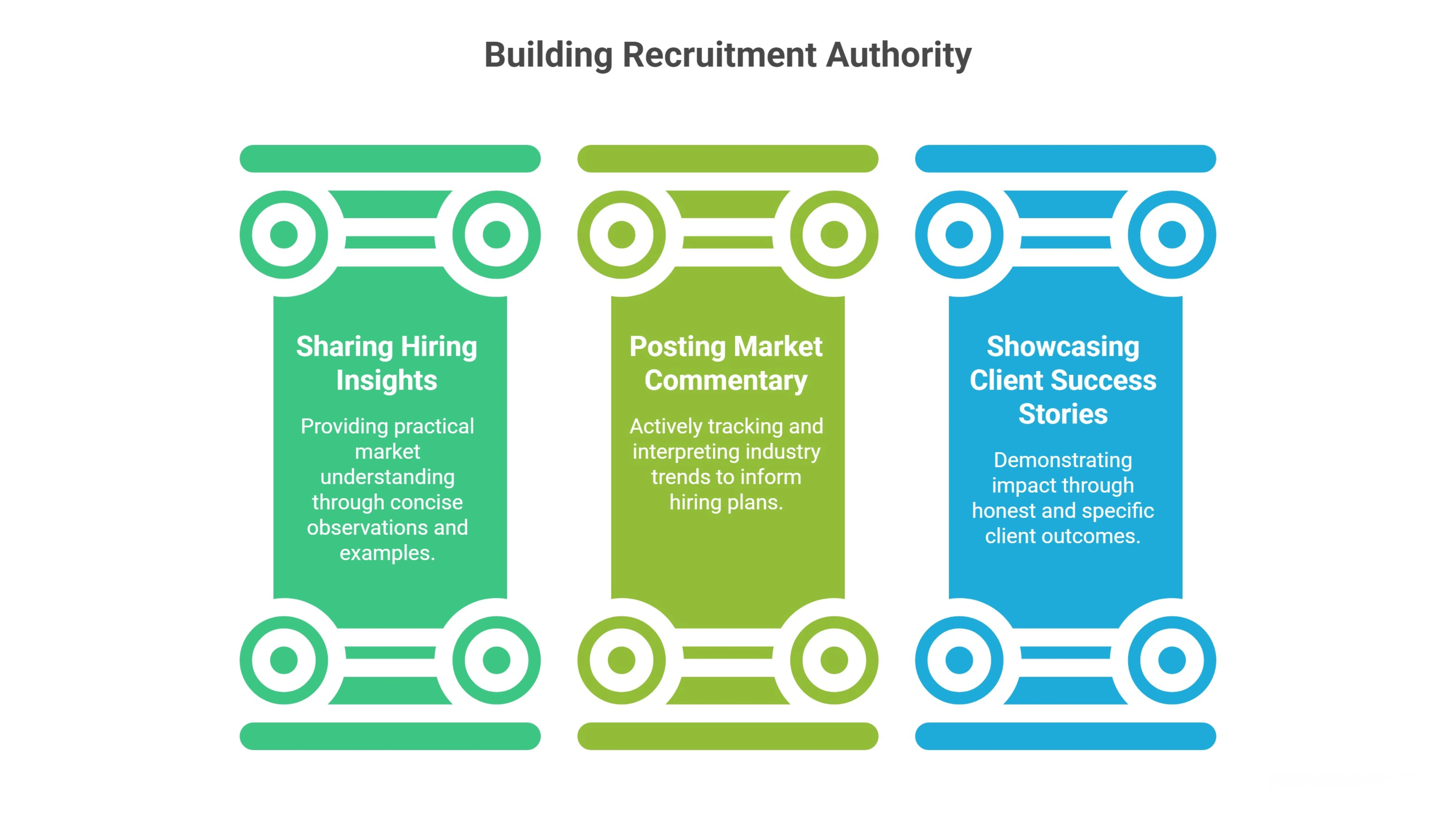
Building authority on professional platforms is a long-term business development strategy for recruitment agency growth.
Consistent, value-driven content helps your agency earn trust before any sales conversation begins.
Platforms like LinkedIn allow recruitment agencies to share insights, observations, and real experiences.
Over time, this visibility positions your agency as a reliable voice in the hiring market rather than just another service provider.
Sharing hiring insights helps demonstrate practical market understanding.
Posts that explain common hiring challenges, role-specific expectations, or candidate availability resonate with decision-makers.
These insights do not need to be complex.
Short observations, real examples, or lessons from recent searches are often more effective than polished content.
When agencies consistently share useful hiring advice, followers begin to associate them with clarity and expertise.
This familiarity builds confidence and increases the likelihood of inbound conversations when hiring needs arise.
Market commentary shows that your agency actively tracks industry movement.
Commenting on hiring trends, workforce shifts, or recruitment news helps position your team as engaged and informed.
The focus should be interpretation, not repetition of headlines.
Decision-makers value perspectives that explain what changes mean for their hiring plans.
Consistent commentary encourages discussion and keeps your agency visible in professional feeds.
Over time, this regular presence strengthens recognition and credibility within your target market.
Client success stories provide proof without selling.
Sharing real outcomes, such as reduced time-to-hire or successful niche placements, helps prospects understand your impact.
The most effective stories focus on challenges, approach, and results rather than praise.
When stories are specific and honest, they feel credible.
This builds trust and reassures potential clients that your agency has solved similar problems before, making engagement easier.
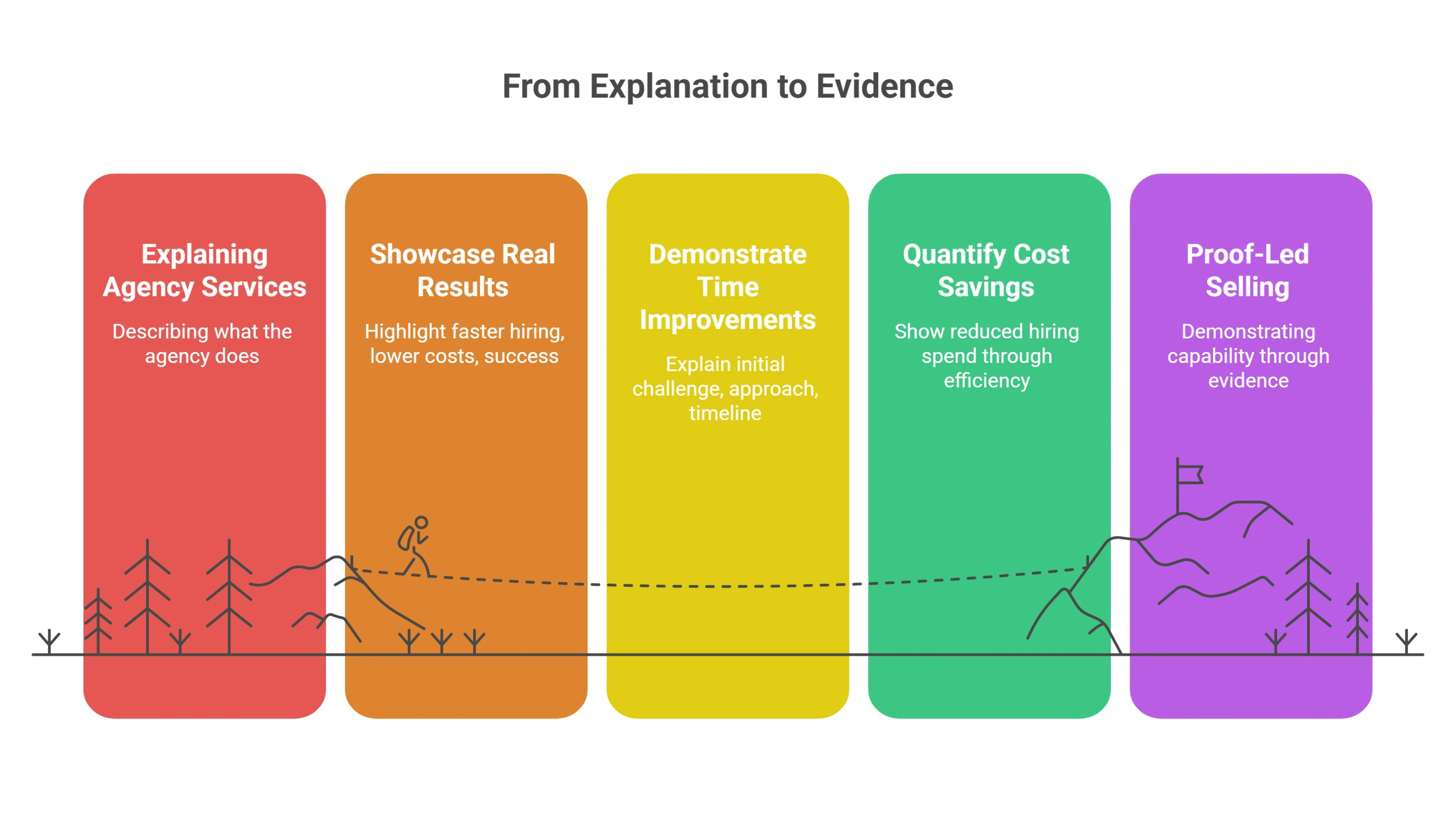
Case studies turn results into evidence.
Instead of explaining what your agency does, proof-led selling shows how your approach works in real situations.
Faster hiring, lower costs, and success in difficult roles help decision-makers build trust and evaluate capability before committing.
Time-to-hire is a critical metric for most hiring teams.
Long hiring cycles often result in lost candidates, delayed projects, and internal pressure.
Case studies that highlight reduced hiring timelines help clients understand the practical impact of your process.
These stories should explain the initial challenge, the approach taken, and how timelines improved.
Specific examples make the result believable.
When prospects see that your agency can move efficiently without sacrificing quality, it reduces hesitation and builds confidence in your ability to deliver.
Hiring inefficiencies often lead to hidden costs.
Extended vacancies, repeated interviews, and failed placements all increase expenses over time.
Case studies that demonstrate cost savings help clients see recruitment as an investment rather than an expense.
The most effective examples show how improved targeting, better screening, or faster placements reduced overall hiring spend.
Clear cost-focused results resonate strongly with decision-makers responsible for budgets.
They also reinforce the value of working with an agency that prioritizes efficiency and long-term outcomes.
Hard-to-fill roles test a recruitment agency’s depth and adaptability.
These may include niche technical positions, leadership roles, or roles in competitive markets.
Sharing examples of how your agency approached these challenges demonstrates problem-solving ability.
Strong case studies outline the obstacles, sourcing strategy, and final outcome.
This type of proof reassures clients facing similar challenges that your agency can handle complexity and deliver results where others may struggle.
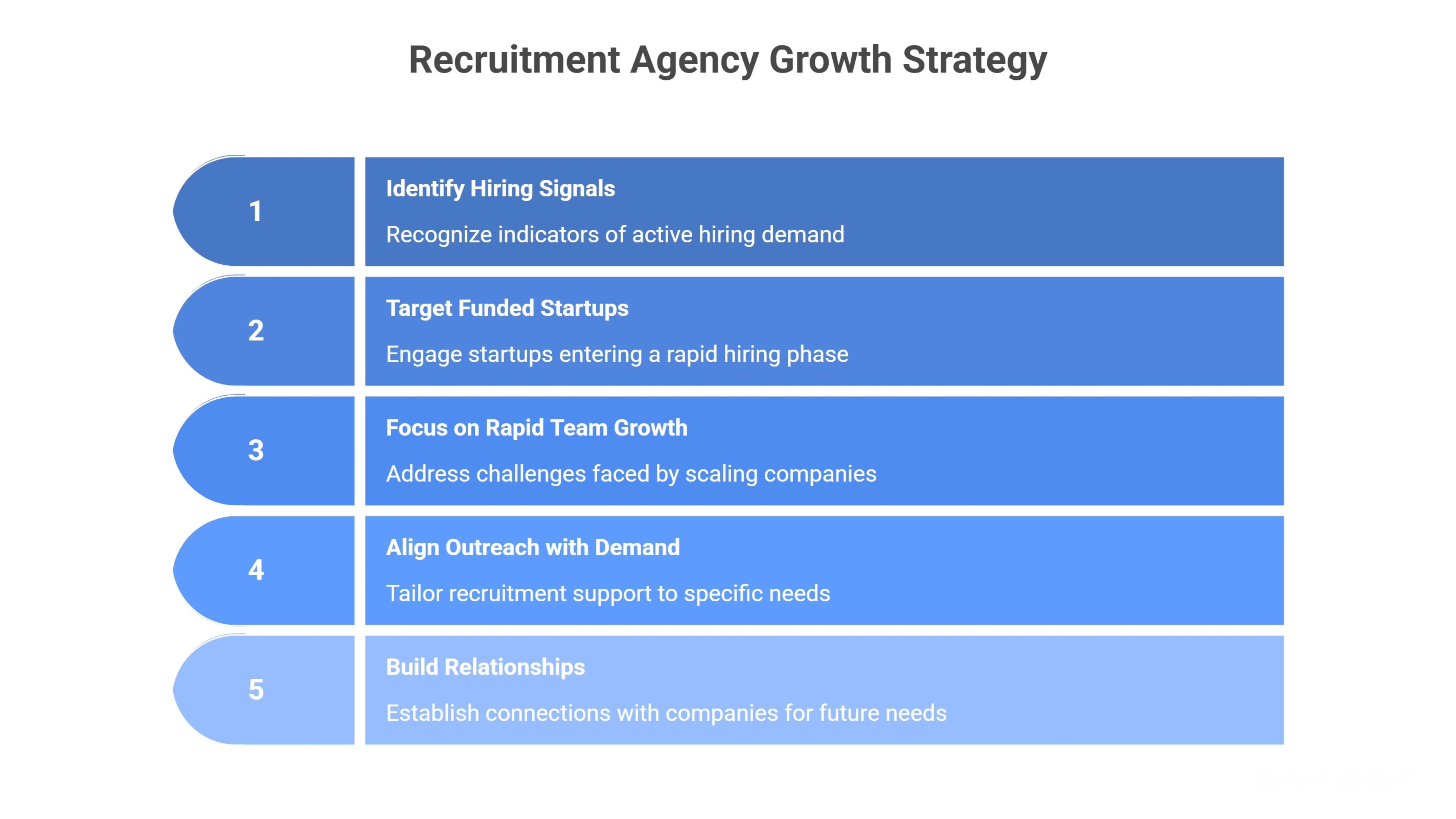
Targeting companies with active hiring demand is a focused business development strategy for recruitment agency growth.
Hiring signals such as multiple job openings, recent funding, or rapid team expansion indicate urgency.
Reaching companies at the right moment increases relevance and improves close rates.
Hiring signals help recruiters prioritize outreach and focus on companies with real hiring intent.
Organizations posting multiple roles within a short period often face capacity gaps or growth pressure. These signals indicate urgency rather than curiosity.
Common hiring signals include:
Tracking these signals allows agencies to focus on companies that are already hiring instead of convincing those who are not.
When outreach aligns with real demand, conversations become more productive and less sales-driven. This saves time and improves response quality.
Startups that have recently secured funding typically enter a rapid hiring phase.
New capital often leads to team expansion, leadership hiring, and accelerated role creation. Many early-stage startups lack internal hiring structure during this phase.
This creates a clear opportunity for recruitment agencies to provide organized hiring support.
Key indicators when targeting funded startups include:
Engaging startups early allows agencies to build relationships before hiring becomes urgent. As these companies grow, this often leads to repeat hiring needs over time.
Rapid team growth creates challenges beyond simply filling open roles.
Scaling companies often struggle with speed, consistency, and maintaining candidate quality across multiple hires.
Identifying growth patterns helps agencies tailor outreach more effectively.
Common growth signals include:
Outreach that acknowledges these growth challenges feels more relevant than generic pitches.
By aligning recruitment support with expansion goals, agencies position themselves as growth partners rather than reactive vendors.
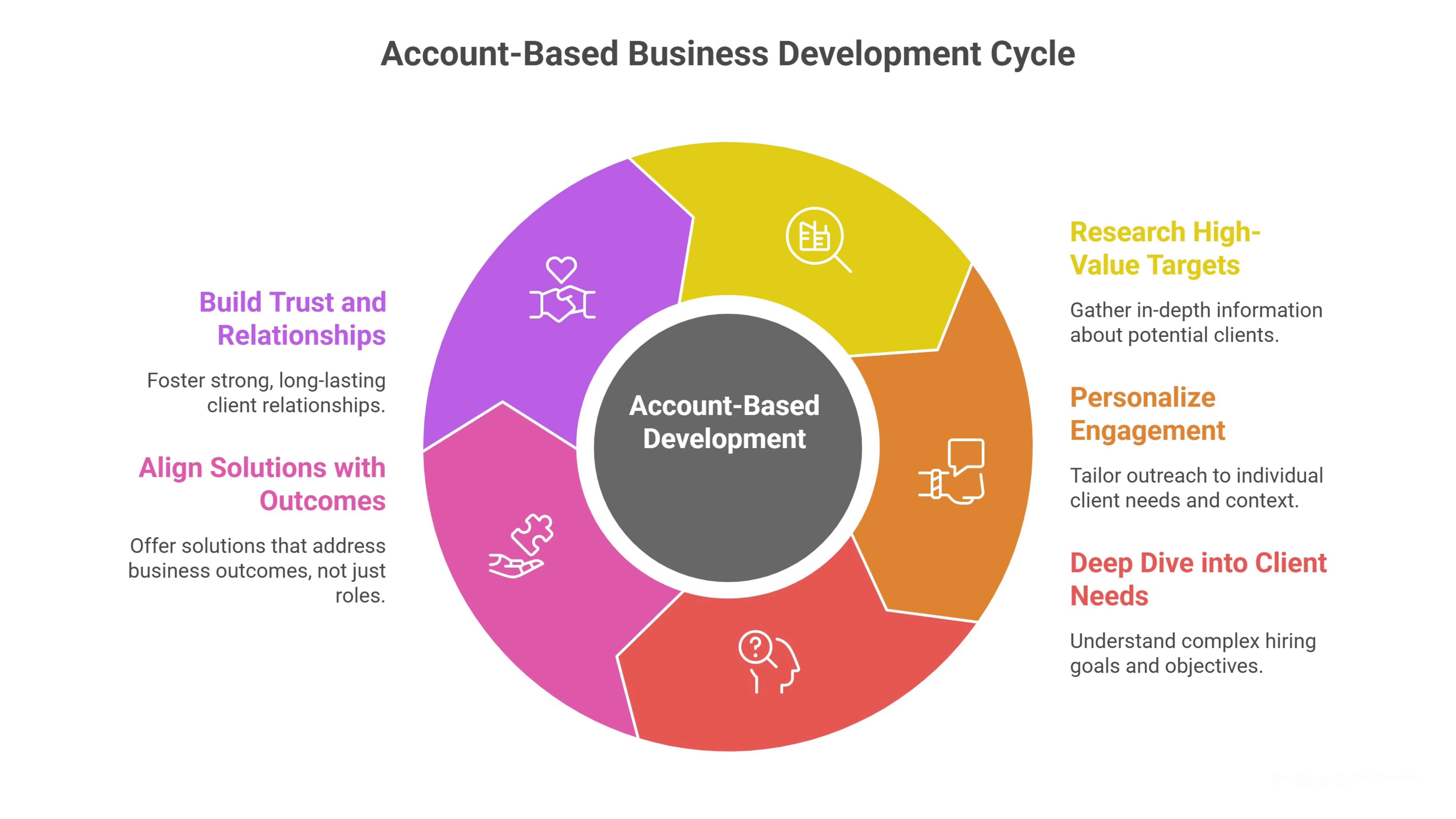
Account-based outreach is one of the most effective business development ideas for recruitment agencies targeting mid-market and enterprise clients.
Instead of broad outreach, this approach focuses on fewer accounts, deeper research, and tailored engagement.
Quality replaces volume.
Account-based development starts with research.
High-value clients require more than basic company information. Outreach fails when it’s based on surface-level details.
Strong research focuses on understanding how the organization hires and makes decisions.
Key areas to research include:
This preparation helps avoid generic outreach and reduces friction in early conversations.
When research is thorough, initial contact feels informed and relevant rather than intrusive. Strong research sets the foundation for meaningful engagement.
Personalization is essential when working with high-value accounts.
These clients receive frequent outreach and quickly ignore messages that feel generic or automated.
Effective personalization goes beyond using a name. It reflects real understanding of the business.
Strong personalized engagement often includes:
Messages should reflect understanding, not assumptions.
When engagement feels intentional, response rates improve, conversations deepen, and trust builds faster.
Understanding client needs goes beyond surface-level job requirements.
High-value accounts often have complex hiring goals tied to growth, restructuring, or long-term planning.
Recruiters must ask the right questions and listen carefully.
A deeper discovery process helps uncover:
This insight allows recruiters to align solutions with business outcomes, not just open roles.
A deeper understanding leads to stronger pitches, better alignment, and longer-lasting client relationships.
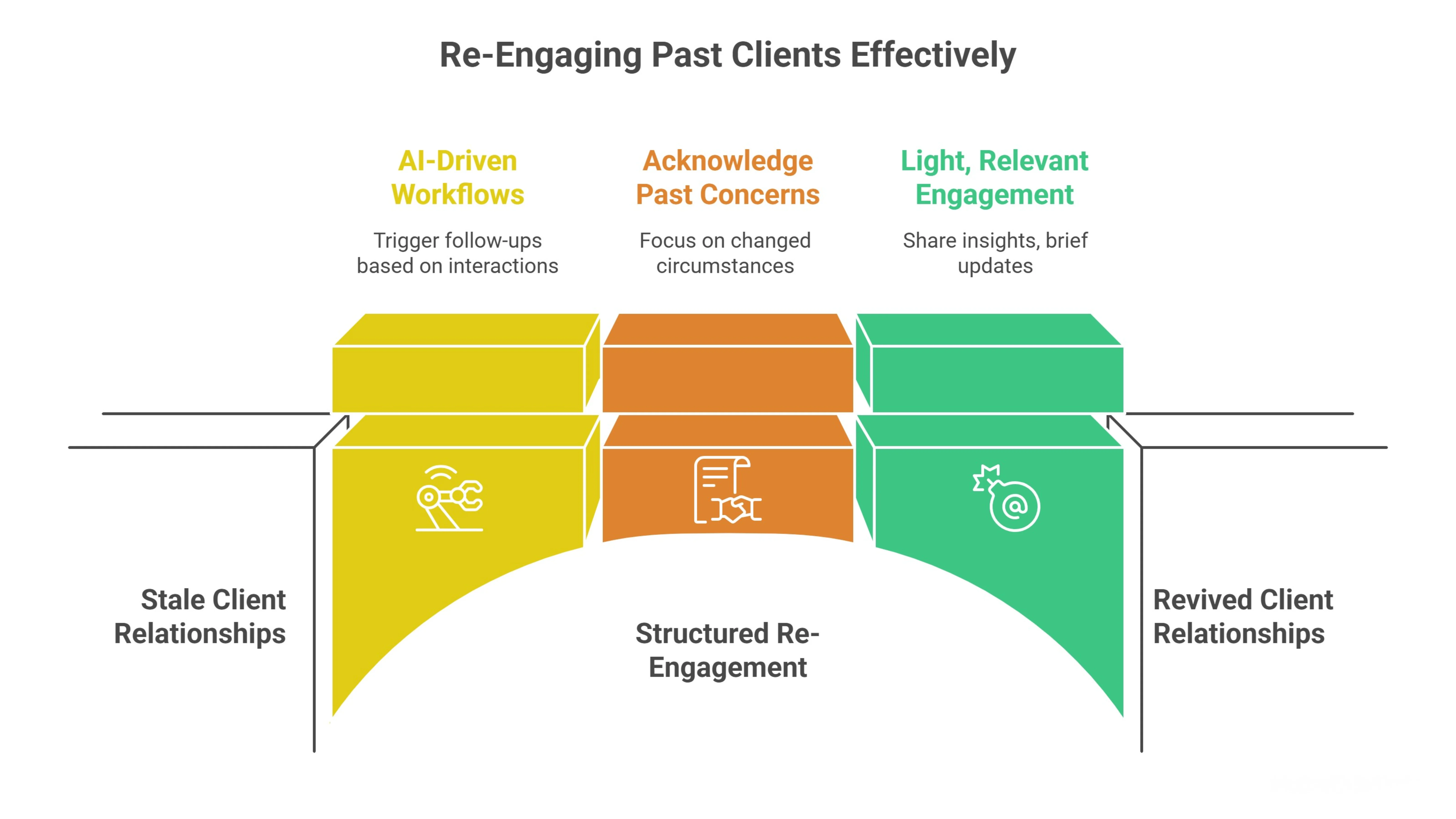
Client re-engagement focuses on restarting conversations with past clients, lost deals, and dormant accounts.
These contacts already know your agency, which lowers trust barriers.
Well-timed and relevant outreach helps reopen conversations when hiring needs resurface or priorities change.
Reconnecting with past clients is one of the highest-potential activities in client re-engagement.
These clients already understand how your agency works.The trust barrier is lower.
The difficulty lies in execution. Over time, client details become outdated. Hiring cycles change. Internal priorities shift.
Recruiters often struggle to know when to follow up and how to restart the conversation without sounding transactional.
Manual follow-ups make this harder.Notes are scattered across emails or tools.Reminders are missed.Context fades.
As a result, outreach becomes delayed or avoided altogether.
A structured approach helps remove this friction.
Tools like Oppora quietly support this process using AI-driven workflows that trigger follow-ups based on previous interactions.
This allows recruiters to reconnect at the right moment with relevant context, keeping the conversation natural rather than forced.
Lost deals are rarely lost forever.
Most pause due to timing, budget freezes, leadership changes, or shifting priorities.
Revisiting these deals requires understanding why the conversation stopped.
Effective follow-ups acknowledge past concerns instead of restarting the pitch.
A simple check-in focused on changed circumstances can reopen dialogue.
Agencies that revisit lost deals periodically are better positioned to capture opportunities when conditions improve.
The goal is conversation, not conversion.
Dormant accounts are relationships that went quiet, not closed.
These contacts may not be hiring now, but future needs often return.
The mistake many agencies make is either over-messaging or disappearing entirely.
Light, relevant engagement works best.
Sharing insights, brief updates, or periodic check-ins keeps the relationship alive.
When hiring resumes, familiarity matters.
Agencies that maintained quiet presence are remembered first.
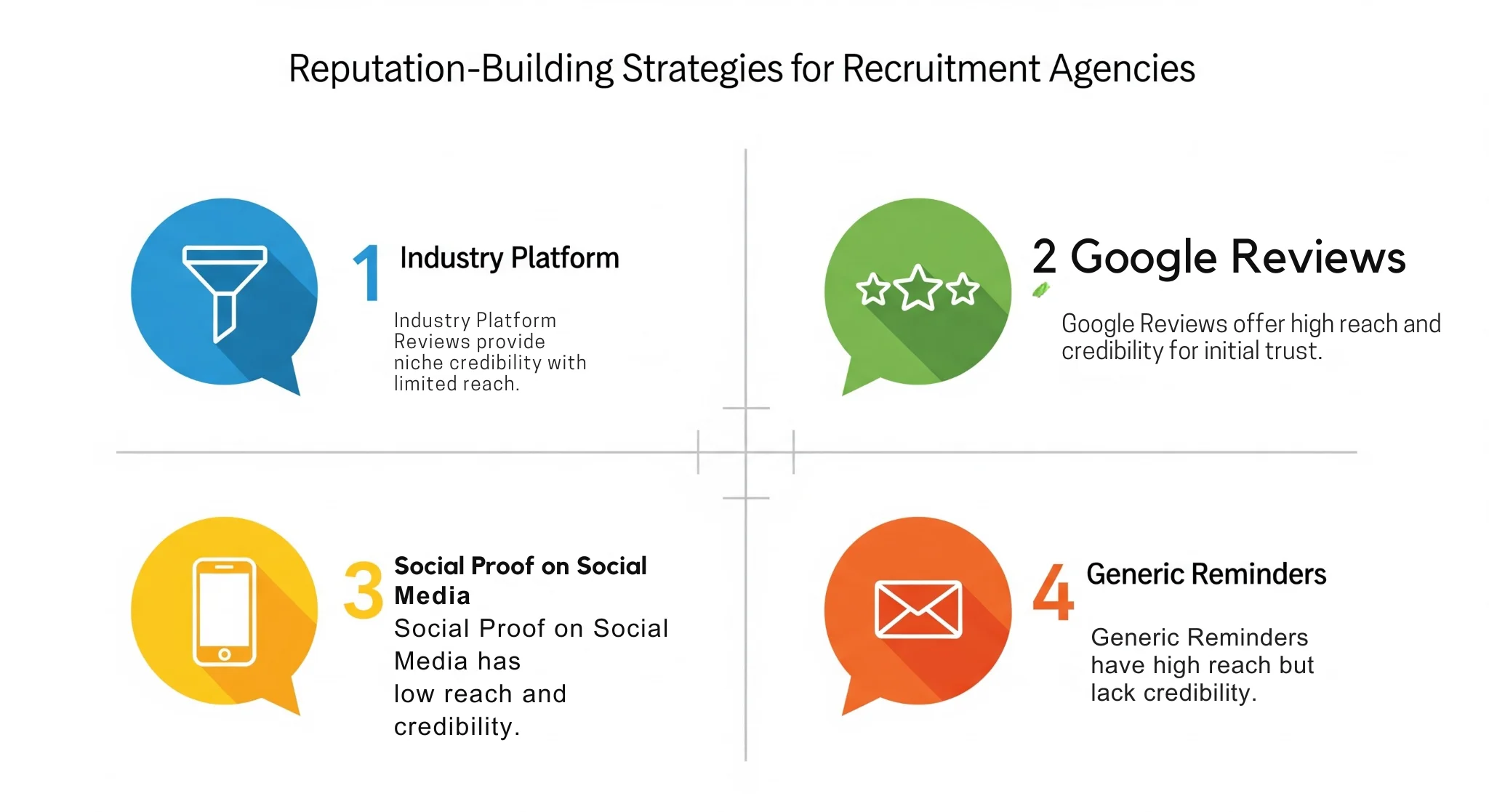
Reputation plays a major role in client acquisition and is one of the most practical business development ideas for recruitment agencies.
Before reaching out, prospects often check reviews and feedback.
Positive reviews build credibility early and validate your services before a sales conversation even begins.
Google reviews are often the first impression potential clients see.
Decision-makers frequently search agency names before responding to outreach or booking calls.
Encouraging satisfied clients to leave honest feedback helps strengthen this initial trust.
The best time to request a review is after a successful placement or positive hiring outcome.
Simple, timely requests work better than generic reminders.
Consistent reviews signal reliability and experience, making prospects more comfortable engaging with your agency from the start.
Industry-specific platforms carry additional credibility.
Reviews on niche recruitment or HR platforms feel more relevant because they come from peers within the same ecosystem.
These reviews often highlight deeper aspects of your service, such as communication quality, hiring speed, or candidate fit.
Encouraging feedback on relevant platforms helps reinforce your reputation among a more targeted audience.
This type of social proof supports decision-making when clients are comparing multiple agencies.
Social media allows agencies to amplify reviews beyond static platforms.
Sharing testimonials, client feedback, or short success notes increases visibility and reinforces trust.
This content works best when it feels authentic rather than promotional.
Simple posts that highlight outcomes or appreciation perform well.
When prospects repeatedly see positive feedback across platforms, familiarity builds.
That repeated exposure often makes outreach warmer and inbound conversations easier to start.
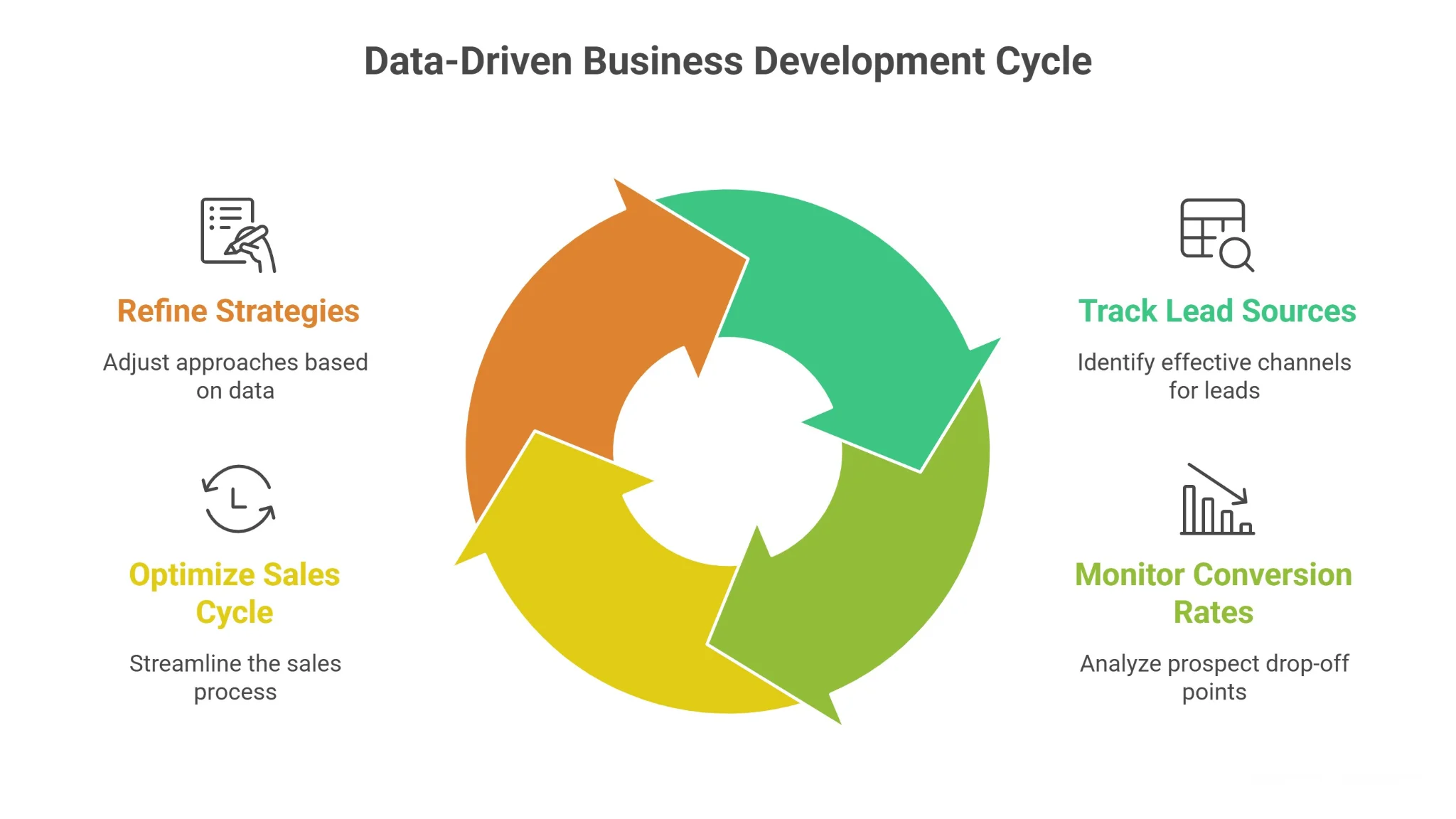
Data-driven systems help refine every business development strategy for recruitment agency growth.
By tracking lead sources, conversion rates, and sales cycles, agencies can identify what works and what doesn’t.
This allows teams to improve results through insight rather than guesswork.
Lead source tracking helps agencies understand where opportunities actually come from.
Different channels perform very differently. Without visibility, teams may spend time on sources that deliver low-quality leads.
Common lead sources to track include:
Clear insight into lead sources allows agencies to focus on efforts that consistently produce meaningful conversations.
Over time, this data helps refine marketing priorities and allocate resources more effectively across channels.
Conversion rates reveal where prospects drop off in the sales process.
Low response rates, stalled conversations, or delayed decisions often signal problems with messaging, targeting, or timing.
Key areas where drop-offs usually occur include:
Monitoring these patterns helps agencies identify friction early.
Instead of guessing why deals don’t move forward, teams can adjust outreach, qualification, or follow-up strategies using evidence.
Small improvements at each stage often lead to significant gains overall.
Sales cycle tracking shows how long it takes to move from first contact to agreement.
Extended cycles often indicate unclear value propositions or inefficient follow-ups.
Reviewing timelines helps uncover:
Optimizing the sales cycle does not mean rushing decisions.
It means removing unnecessary delays while maintaining quality conversations that lead to stronger, long-term client relationships.
Building a strong business development strategy for recruitment agency growth requires clarity, consistency, and focus.
The strategies covered in this blog help agencies attract better clients, improve engagement, and reduce reliance on guesswork.
By combining structured outreach, inbound visibility, partnerships, and data-driven decisions, recruitment teams can scale more predictably.
Long-term success comes from refining what works and removing what slows progress.
How long does it take for recruitment agencies to see results from business development efforts?
Results vary by strategy. Outbound efforts may show early traction within weeks, while inbound strategies like SEO and authority-building usually take a few months. Consistency and focus on the right audience significantly impact timelines.
Which business development strategy works best for small recruitment agencies?
Smaller agencies often benefit most from niche positioning, referrals, and targeted outbound outreach. These strategies require less budget, rely on relationship-building, and can deliver faster results compared to broad, resource-heavy approaches.
Should recruitment agencies prioritize inbound or outbound business development?
Both serve different purposes. Outbound helps create immediate pipeline activity, while inbound builds long-term visibility and trust. A balanced approach allows agencies to generate short-term leads while steadily strengthening their market presence.
How can recruitment agencies measure the success of their business development strategy?
Success can be measured through lead quality, response rates, conversion rates, and sales cycle length. Tracking these metrics helps agencies understand what’s working and where adjustments are needed.
How often should recruitment agencies refine their business development strategy?
Strategies should be reviewed regularly, ideally every quarter. Market conditions, hiring demand, and client behavior change over time, so ongoing refinement ensures efforts remain relevant and effective.
Summarize with AI
Share