Home
Blog
Find 500 B2B Contacts for Free Every Month with Built-In Outreach.
Home
Blog
Manasa Goli
Published April 2, 2026
7 min
Try Oppora AI
Create Self-Running Agentic Sales Workflows like N8N just by chatting with AI
Get Started for FREE
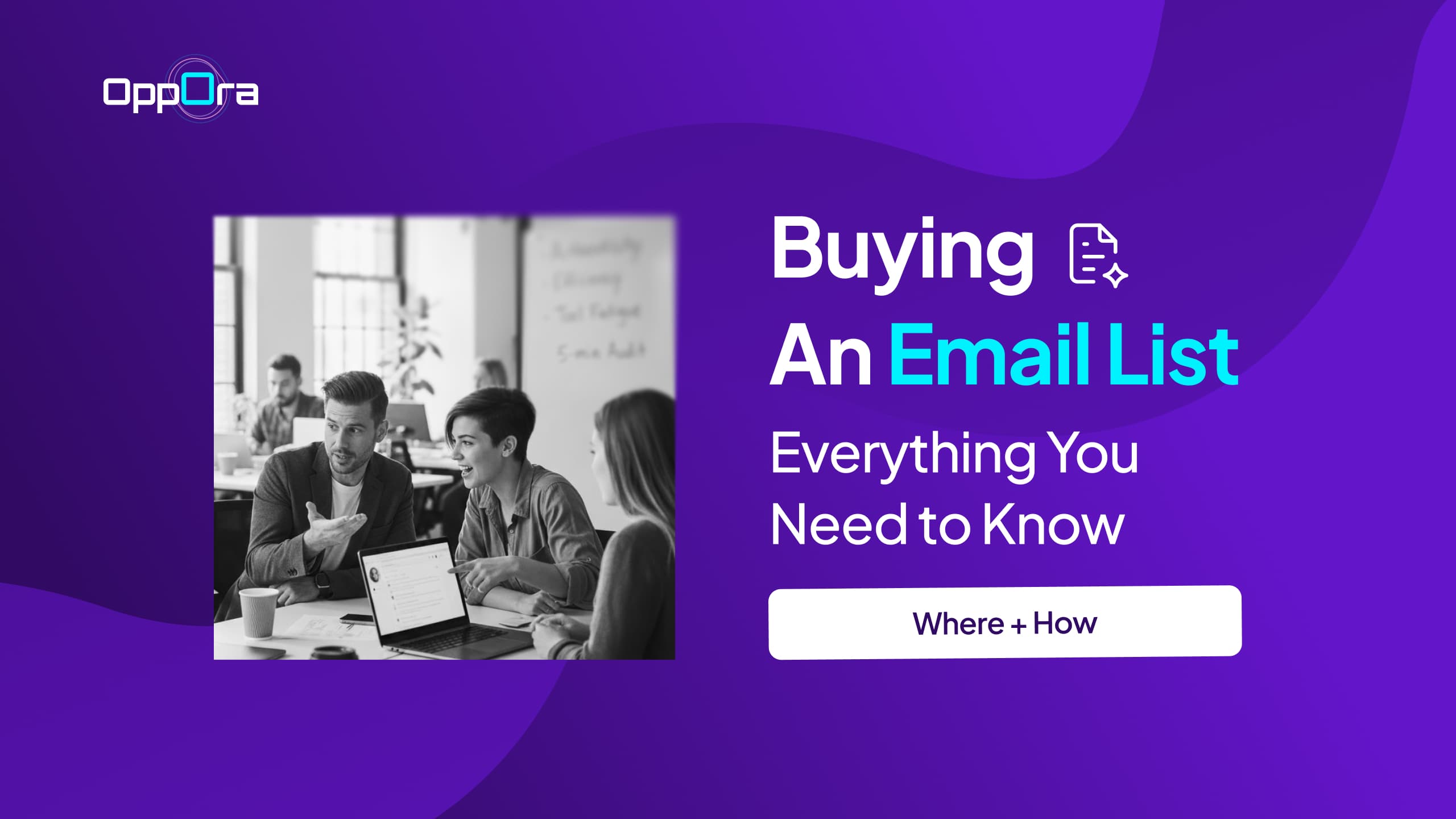
Buying an email list might seem like a quick shortcut to reach thousands of prospects instantly. Instead of building a list from scratch, businesses often consider purchasing email leads to save time and accelerate outreach.
But here’s the reality: buying email lists is one of the most misunderstood strategies in outbound marketing. When done wrong, it can damage your sender reputation, reduce deliverability, and even lead to compliance issues. When done right—with the correct approach and tools—it can still support targeted outreach campaigns.
This guide breaks down everything you need to know about buying an email list, including where to buy, how to use it effectively, and what to avoid.
Buying an email list refers to purchasing a database of email contacts from a third-party provider. These lists typically include:
These are often sold as “email leads” or “B2B contact databases.”
Not all purchased email lists are equal. The effectiveness of your outreach depends heavily on how the data is structured, filtered, and sourced.
B2B email lists contain contacts of professionals within organizations. These typically include job titles, company names, industries, and sometimes company size or revenue.
What makes B2B lists valuable is role-based targeting. Instead of emailing random individuals, you can reach decision-makers who influence purchasing decisions.
Example:
If you sell HR software, targeting “HR Managers in companies with 100–500 employees” is far more effective than emailing a generic business list.
However, B2B lists vary in quality. Some are outdated or scraped, which leads to:
The key is relevance + accuracy, not just volume.
B2C email lists focus on individual consumers rather than businesses. These lists are usually segmented based on:
These lists are often used for mass promotions, such as eCommerce campaigns or product launches.
Example:
An online clothing brand may purchase a list of “women aged 20–35 interested in fashion.”
The challenge with B2C lists is low intent. Just because someone fits a demographic doesn’t mean they’re ready to buy. This leads to:
Targeted lists are the most refined type of purchased data. These are built using multiple filters, such as:
Example:
“Founders of SaaS companies in India with 10–50 employees who recently raised funding.”
These lists perform better because they align closely with your ideal customer profile (ICP).
However:
👉 In practice, niche lists outperform broad lists because relevance drives response—not list size.
Buying email lists isn’t about “where” alone—it’s about how the data is collected and validated. Most providers fall into three categories:
These platforms offer large-scale contact databases that you can filter based on:
They often provide:
Example use case:
You need 5,000 marketing leaders across multiple regions quickly.
Reality:
These platforms allow you to build your own list instead of buying a pre-made one.
You can apply advanced filters like:
Example: Finding companies using Shopify + hiring marketers → strong signal for outreach.
Why this is better:
These sellers provide pre-packaged lists like:
They are:
But often:
👉 This is where most spam issues originate.
Instead of focusing on the platform name, evaluate:
👉 The best approach is not buying “lists,” but accessing filtered, intent-driven data.
Buying an email list is not illegal by itself—but how you use it determines compliance.
Most email regulations focus on consent and transparency, not just data ownership.
Key laws include:
Under these:
The biggest issue is lack of consent. Most purchased lists do not include explicit permission from recipients to receive your emails.
Example: If you email someone who never opted in, it’s considered unsolicited communication—even if their email is publicly available.
👉 In practice, this doesn’t always mean legal action—but it increases:
So the real risk isn’t just legal—it’s deliverability and trust.
Using purchased email lists effectively is less about the list itself and more about how you send emails, to whom, and in what volume.
Never use a purchased list as-is.
Run it through an email verification tool to:
Why this matters: High bounce rates signal spam behavior to email providers.
Most people make the mistake of sending one message to the entire list.
Instead, divide based on:
Example:
Same product → different messaging.
If you send 1,000 emails on day one from a new domain, it will likely get flagged.
Gradually increase volume:
👉 This builds sender reputation.
Basic personalization like “Hi {First Name}” is not enough.
Real personalization includes:
Example: Instead of: “Hey John, we offer marketing tools”
Say: “Noticed your team is scaling paid ads—are you facing rising CAC issues?”
👉 This shifts from spam → relevance.
Your first email should not try to sell aggressively.
Focus on:
Good approach:
Avoid blasting the entire list at once.
Instead:
👉 This reduces risk and improves learning.
Track:
If performance drops:
Purchased lists alone don’t work. You need:
👉 The difference between failure and success is not the list—it’s execution quality.
Purchased email lists fail because they are used like mass marketing tools instead of targeted outreach assets.
The most common mistakes include:
But the deeper issue is lack of intent.
People on purchased lists:
So when you send irrelevant messages at scale, recipients ignore or mark them as spam.
👉 This leads to:
In reality, purchased lists don’t fail on their own—they fail when used without targeting, personalization, and timing.
Oppora.ai is an AI-powered outbound platform that helps businesses find, qualify, and engage the right prospects more effectively by combining a high-quality, continuously updated lead database with intelligent targeting.
It bridges the gap between raw email data and effective outreach execution by using firmographic and intent signals to identify and prioritize high-quality prospects instead of relying on static purchased lists.
Here’s how it improves results:
Example: Instead of emailing 5,000 random contacts, you can use Oppora’s filtered and enriched lead database to reach 500 highly relevant prospects with personalized messaging—resulting in better replies and conversions.
👉 The shift is simple: From volume-driven outreach → precision-driven engagement.
Buying an email list can help you scale outreach quickly, but it only works when paired with the right strategy. The key is not volume—it’s relevance, targeting, and execution. Poor-quality or unsegmented lists lead to low engagement and deliverability issues, while well-filtered data combined with personalized messaging can drive real results.
Instead of treating purchased lists as ready-to-use, use them as a prospecting base to refine and target the right audience. The most effective approach is a balance between smart data, clear targeting, and thoughtful outreach.
👉 Ultimately, success comes from reaching the right people, not just more people.
It can work if the list is well-targeted and verified, but poor-quality lists often lead to low engagement and spam issues.
Validate the list, segment your audience, personalize messaging, and send emails in small, controlled batches.
Buying lists gives instant access to contacts, while lead generation focuses on attracting interested prospects with higher intent.
Yes, targeted lists perform better because they align closely with your ideal customer profile and improve response rates.
Summarize with AI
Share