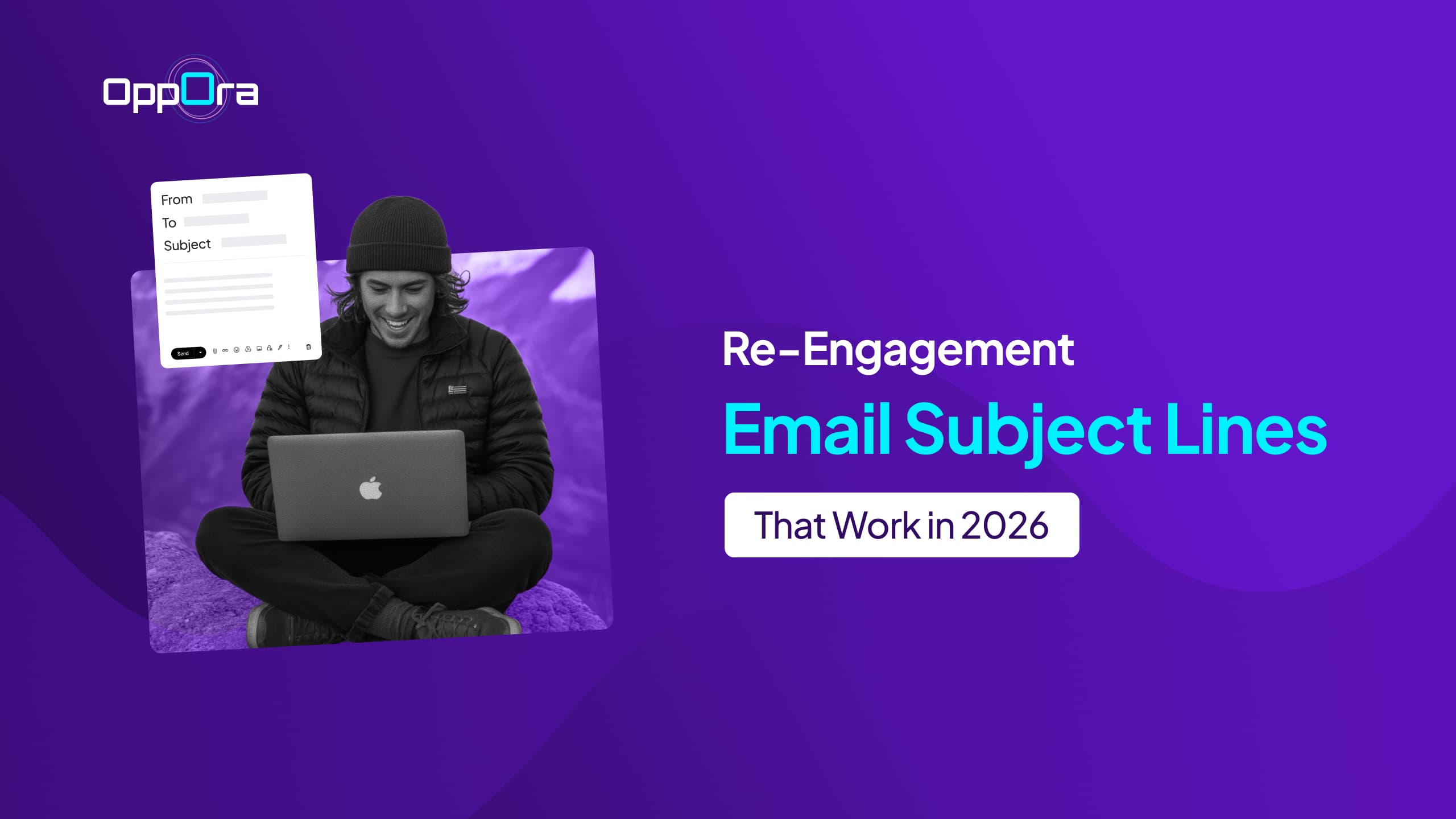
75+ Re-Engagement Email Subject Lines That Work in 2026
Manasa Goli
Published May 22, 2026
6 min
Complete Agentic Email Outreach
AI agents find and enrich prospects, personalize emails, follow up, handle replies, and book meetings automatically.
Claim Your FREE Credits
Your subscribers are not ignoring your emails because your product is bad.
Most of the time, they simply stopped noticing you.
Their inbox is crowded, your old messaging feels familiar, and your subject line gives them no reason to click anymore.
That is exactly why re-engagement campaigns matters.
But here’s the catch: even the best re-engagement email fails if the subject line doesn’t spark curiosity, urgency, relevance, or emotion.
In this guide, you’ll learn:
- What makes re-engagement subject lines work today
- 75+ high-performing re-engagement email subject lines
- Mistakes that quietly kill open rates
- Psychological triggers behind successful re-engagement campaigns
- How AI can help personalize re-engagement emails at scale
Why Re-Engagement Email Subject Lines Matter More in 2026
Email inboxes are smarter now.
Providers like Gmail and Outlook track engagement patterns aggressively. If subscribers stop opening your emails, future campaigns become less visible over time.
That means your re-engagement campaign is not just about winning back users.
It is also about protecting deliverability.
And the first thing subscribers see is your subject line.
A weak subject line gets ignored instantly.
A strong one creates enough curiosity to earn one more chance.
That single open can restart the relationship.
What Makes Re-Engagement Email Subject Lines Work
Before jumping into examples, it helps to understand why some re engagement email subject lines consistently outperform others.
The best ones usually do at least one of these things:
- Create curiosity
- Trigger emotion
- Make readers feel noticed
- Offer a benefit
- Introduce urgency
- Sound conversational instead of promotional
- Reconnect around a shared experience
In 2026, overly polished marketing language performs worse than natural human messaging.
People open emails that feel relevant, personal, and timely.
Not emails that sound like they came from a campaign generator.
Re-Engagement Email Subject Lines That Works
A. Curiosity-Based Subject Lines
These work because they create an information gap your reader wants to close.
- We noticed something…
- Still interested?
- You left before the good part
- Quick question for you
- Did you mean to disappear?
- This might be relevant again
- Something changed since your last visit
- You’ve been away for a while
- Guess what’s new?
- We saved this for you
These types of subject lines for re engagement emails work especially well for SaaS products, communities, and educational brands.
B. Personalized Re-Engagement Subject Lines
Personalization still works — but only when it feels natural.
- {{FirstName}}, are you still looking for this?
- We picked this for you, {{FirstName}}
- Your account is waiting
- {{FirstName}}, you might want to see this
- We miss having you around
- Your progress is still here
- Ready to continue where you stopped?
- You were close to something valuable
- Your trial ended, but this didn’t
- A fresh start, {{FirstName}}?
Modern email re-engagement subject lines work better when they reference user behavior instead of fake friendliness.
Suggested Reading:
Product Launch Email Subject Lines That Actually Get OpenedC. Humor-Based Re-Engagement Subject Lines
Humor works well when your brand voice already feels casual and conversational.
- Was it something we said?
- This is our “we miss you” email
- We’re trying not to take this personally
- Ghosting us hurts
- Should we stop emailing you?
- Awkward… it’s been a while
- We kept your seat warm
- Knock knock… still there?
- We promise this email is interesting
- You ignored us professionally
Humor should feel light, not desperate.
The goal is to reduce friction and make the email feel enjoyable to open.
D. Urgency-Driven Subject Lines
These work best when there is a real reason to act now.
- Your access expires tonight
- Last chance to stay updated
- Your account may be removed soon
- We’re closing inactive accounts
- Ends in 24 hours
- Final reminder
- Your credits are about to expire
- This won’t be available much longer
- We saved your offer until today
- Before we say goodbye…
False urgency damages trust quickly.
So only use urgency when it genuinely exists.
E. Value-Focused Re Engagement Emails Subject Lines
Sometimes the best way to reconnect is to immediately communicate value.
- New features you haven’t seen yet
- Here’s what changed since your last visit
- A simpler way to do [task]
- You asked. We improved it.
- See what’s new inside
- New tools. Less manual work.
- Better results with less effort
- Here’s what you missed
- New updates built from customer feedback
- You can now do this automatically
These subject lines work well for software companies, newsletters, and service businesses introducing meaningful updates.
Subject Lines for Re-Engagement Emails by Industry
Different industries require different emotional triggers.
What works for ecommerce may fail completely for B2B SaaS.
A. SaaS Re-Engagement Email Subject Lines
- Your workflow got easier
- You still have unused credits
- Your team activity dropped
- Come back and see what’s new
- We automated the part you hated
- Still managing this manually?
- Your dashboard misses you
- We reduced setup time dramatically
- New integrations are now live
- Your outbound system is waiting
Suggested Reading:
Email Subject Line Capitalization: Rules, Examples & Best PracticesB. Ecommerce Re Engagement Email Subject Lines
- Your favorites are back
- Still thinking about it?
- Your cart misses you
- Prices changed since your last visit
- New arrivals you might actually like
- A little something to bring you back
- Your discount expires soon
- We saved your picks
- Back in stock
- One last look?
C. Newsletter Re-Engagement Email Subject Lines
- Still want these updates?
- Should we keep sending these?
- You missed our best insights
- Want to stay subscribed?
- This week’s biggest takeaway
- We’ve changed how we write these
- Fewer emails. More value.
- Still relevant to you?
- Here’s what readers loved recently
- You can always come back later
Mistakes That Kill Re-Engagement Open Rates
A lot of re-engagement emails fail before subscribers even read them.
Usually because the subject line makes one of these mistakes.
1.Sounding Too Salesy
Subscribers who already disengaged are extremely sensitive to promotional language.
Avoid things like:
- HUGE OFFER INSIDE
- LIMITED TIME DEAL
- DON’T MISS THIS AMAZING OPPORTUNITY
These trigger skepticism instantly.
2.Overusing Fake Personalization
Adding a first name alone is no longer enough.
Modern users recognize automation immediately.
Behavior-based personalization performs much better than surface-level personalization.
3.Writing Generic Subject Lines
Subject lines like:
- We miss you
- Come back
- Check this out
…feel too vague unless supported by strong brand recognition.
Specificity almost always performs better.
How AI Is Changing Re-Engagement Emails
The biggest shift happening right now is not just AI-generated copy.
It is AI-powered timing, segmentation, and personalization.
Instead of sending one re-engagement email to everyone, companies now create dynamic sequences based on:
- User inactivity duration
- Product usage patterns
- Previous opens
- Buying intent
- CRM activity
- Website behavior
- Industry segment
That changes how re-engagement email subject lines are written too.
Now subject lines can adapt automatically based on audience intent and engagement stage.
Best Practices for Writing Re-Engagement Email Subject Lines
Before you finalize your campaign, keep these principles in mind.
1. Keep Subject Lines Short
Most high-performing subject lines stay under 50 characters.
Especially on mobile devices.
2. Focus on One Emotion
Do not combine urgency, humor, curiosity, and discounts all together.
Pick one emotional direction per email.
3. Make the Email Match the Subject Line
If the subject line creates curiosity, the email body must reward that curiosity quickly.
Otherwise subscribers lose trust.
4. Test Different Angles
The best-performing subject line often surprises marketers.
A casual conversational line may outperform a carefully optimized “high-converting” version.
A/B testing still matters.
Final Thoughts
Good re-engagement campaigns do not try to pressure subscribers into returning.
They remind people why they cared in the first place.
And that process starts with the subject line.
The best re-engagement email subject lines in 2026 feel human, relevant, and emotionally intelligent.
They sound like a continuation of a relationship — not a desperate attempt to revive one.
If you focus on relevance instead of cleverness, your open rates will usually follow.
Frequently Asked Questions
How long should subject lines for re engagement emails be?
Most subject lines for re engagement emails perform best between 30–50 characters.
Shorter subject lines are easier to read on mobile devices and create faster emotional impact.
Can AI improve re-engagement email campaigns?
Yes.
AI tools can help personalize subject lines, segment inactive users, optimize send timing, and automate follow-up sequences.
Platforms like Oppora help automate outreach workflows, follow-ups, inbox management, and AI-driven personalization at scale, making re-engagement campaigns easier to manage as your audience grows.
What are the best re engagement email subject lines?
The best re-engagement email subject lines create curiosity, urgency, or personalization without sounding overly promotional.
Do re-engagement emails improve deliverability?
Yes. Re-engagement campaigns help clean inactive audiences and improve overall sender reputation.
Summarize with AI
Share