Home
Blog
Find 500 B2B Contacts for Free Every Month with Built-In Outreach.
Home
Blog
Adam Hossain
Published March 10, 2026
9 min

Try Oppora AI
Create Self-Running Agentic Sales Workflows like N8N just by chatting with AI
Get Started for FREE
Many sales teams spend hours reaching out to prospects who were never likely to buy in the first place.
Without a structured approach, prospecting quickly becomes a cycle of sending messages, waiting for replies, and hoping something eventually converts.
That is why modern sales teams rely on clear sales prospecting techniques to guide their outreach. These methods help you identify the right companies, find the right decision-makers, and start conversations that actually lead somewhere.
In this guide, you’ll learn practical prospecting techniques that help you discover better leads, start meaningful conversations, and consistently move qualified opportunities into your sales pipeline faster.
Sales prospecting techniques are structured methods used to identify potential buyers and start meaningful conversations with them.
Instead of contacting random companies, modern prospecting focuses on research, data signals, and timing. This helps you reach businesses that are more likely to need your solution.
Today’s sales teams rely on smarter prospecting methods to find decision-makers earlier in the buying process.
When you combine the right targeting with relevant outreach, your conversations become more valuable and the chances of turning prospects into qualified opportunities increase significantly.
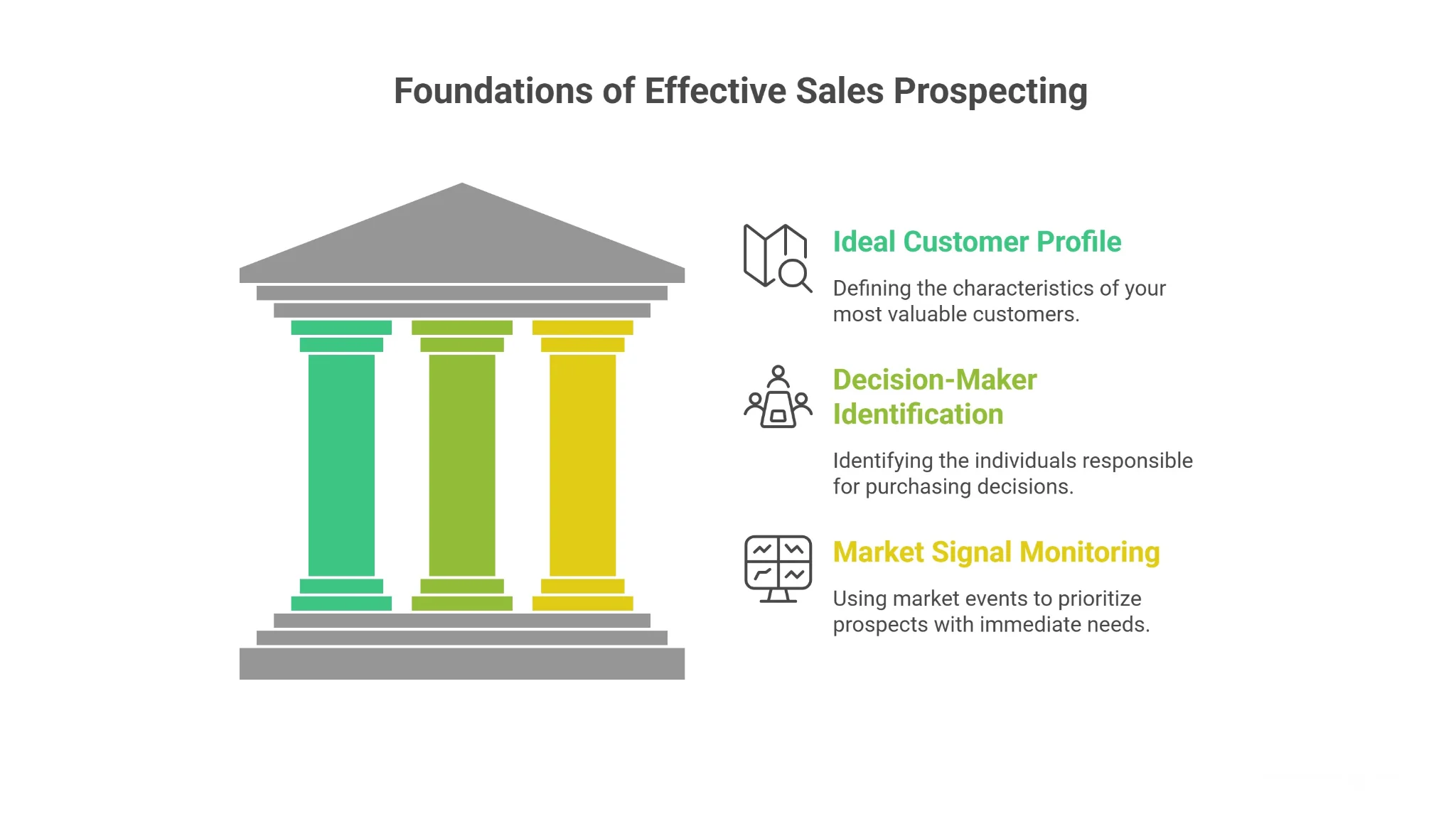
Before applying different prospecting tactics, you need a clear foundation for who you should target.
Effective sales prospecting techniques begin with understanding your ideal customers, their challenges, and the people responsible for solving those problems.
When you define the right companies and identify decision-makers early, your outreach becomes far more relevant. This preparation helps you focus on prospects who are more likely to engage and eventually become customers.
Strong prospecting starts with clarity about who benefits most from your product.
An ideal customer profile (ICP) describes the type of company that gains the most value from what you offer. This usually includes factors such as industry, company size, growth stage, budget capacity, and geographic location.
When you clearly define these characteristics, your prospecting becomes far more focused. Instead of contacting hundreds of random companies, you concentrate on organizations that closely resemble your best existing customers.
This improves response rates and increases the chances that your outreach leads to real opportunities.
Reaching the right person is just as important as targeting the right company.
Many outreach attempts fail because messages are sent to employees who are not involved in purchasing decisions. To improve results, you should identify leaders, managers, or department heads responsible for solving the problem your product addresses.
These individuals often influence budgets, evaluate solutions, and guide the final buying decision.
When your outreach reaches the people who actually care about the problem, conversations move forward much faster.
Timing often determines whether a prospect engages or ignores your outreach.
Market signals help you identify companies that may already be looking for solutions. Examples include funding announcements, leadership changes, product launches, rapid hiring, or geographic expansion.
These events often indicate new priorities, growing teams, or operational challenges.
By monitoring these signals, you can prioritize prospects who are more likely to have an immediate need, making your outreach feel timely, relevant, and far more effective.
Once your targeting foundation is clear, the next step is applying practical prospecting methods that consistently generate opportunities.
Different sales prospecting techniques help you discover potential buyers, start conversations, and build a reliable pipeline of leads.
The following techniques focus on repeatable actions sales teams can use daily. When applied consistently, these approaches help you identify qualified prospects, engage the right decision-makers, and create conversations that move prospects closer to becoming customers.
One of the most effective sales prospecting techniques is focusing your outreach on companies that closely match your ideal customer profile.
Instead of contacting a large number of random businesses, you concentrate on organizations that share the same characteristics as your best existing customers.
These characteristics often include industry, company size, revenue range, growth stage, and geographic location. When these factors align, the chances that a company needs your solution increase significantly.
ICP targeting also helps you prioritize quality over quantity.
Rather than sending hundreds of messages hoping for a few responses, your outreach becomes more intentional and relevant to the businesses you contact.
As a result, conversations start more naturally and prospects are more open to learning about what you offer.
LinkedIn has become one of the most valuable platforms for modern sales prospecting.
It allows you to identify decision-makers, understand company structures, and gather useful insights before reaching out to potential buyers.
Before sending a message, you can review a prospect’s role, career history, and recent activity. This context helps you tailor your outreach so it speaks directly to their responsibilities and challenges.
LinkedIn also reveals information about the company itself. You can explore recent hires, growth trends, company announcements, and employee roles.
These insights make your outreach feel informed rather than generic.
When prospects see that you understand their role and business environment, they are far more likely to respond and engage in a meaningful conversation.
Trigger event prospecting focuses on reaching out when something important happens inside a company.
These events often indicate that the business may be actively looking for new solutions.
Common trigger events include funding rounds, leadership changes, rapid hiring, new product launches, mergers, or market expansion. Each of these situations can create new operational needs or challenges.
For example, a company that recently raised funding may be investing in new tools to support growth. A new department head may also evaluate existing systems and consider alternative solutions.
By paying attention to these signals, you approach prospects at a moment when your message feels relevant and timely.
This greatly increases the likelihood of engagement.
Warm introductions are one of the most powerful ways to start a sales conversation.
Instead of contacting someone without context, a mutual connection introduces you to the prospect.
This shared connection immediately builds credibility and trust. The prospect is more likely to listen because someone they already know has made the introduction.
Warm introductions can come from colleagues, existing customers, partners, or professional networks. Even a simple referral message can open the door to a meaningful conversation.
Because trust already exists at the start, discussions move forward much faster compared to traditional cold outreach.
For many sales professionals, referrals and introductions remain one of the most reliable ways to generate high-quality opportunities.
Cold email prospecting allows you to reach decision-makers directly and start conversations at scale.
When done well, it helps you connect with companies that may not yet know about your product but are already facing problems you can solve.
The key to effective cold emailing is relevance.
Instead of sending generic messages, personalize your outreach by referencing the company, the prospect’s role, or a challenge their team may be experiencing.
However, preparing cold outreach can take time. Finding the right companies, identifying decision-makers, and collecting verified email addresses often slows sales teams down before they even send the first message.
Tools like Oppora help simplify this process by helping you quickly identify relevant prospects and access verified contact data, making it easier to move from research to outreach faster.
Content-driven prospecting focuses on engaging people who are already researching problems related to your product or service.
When prospects read blog posts, download guides, or attend webinars, they are actively looking for information that helps them solve a challenge.
This creates a natural opportunity for sales conversations.
Instead of starting outreach from zero, you can connect with people who have already interacted with your content. Their interest signals that the topic is relevant to their current priorities.
Sales teams often collaborate with marketing teams to identify these engaged prospects.
For example, someone who downloads a guide about improving sales pipelines may be open to discussing tools or strategies that support that goal.
Because the conversation starts around a topic the prospect already cares about, it feels helpful rather than intrusive.
Industry communities and professional groups can be powerful places to discover relevant prospects.
Platforms such as LinkedIn groups, Slack communities, forums, and niche industry spaces often bring together professionals who share similar challenges.
Participating in these spaces helps you understand what people are currently discussing and struggling with.
Instead of immediately pitching your product, you can contribute insights, answer questions, or share useful resources that add value to the conversation.
Over time, this builds credibility and trust within the community.
When members begin recognizing your expertise, they are more open to connecting privately and exploring how your solution may help solve their challenges.
Account-based prospecting focuses on targeting specific companies rather than individual leads.
In this approach, sales and marketing teams collaborate to identify high-value accounts that closely match the ideal customer profile.
Once these accounts are selected, teams research the organization and identify multiple stakeholders involved in the buying process.
Instead of sending isolated outreach messages, communication becomes coordinated across different channels and contacts within the same company.
This strategy increases visibility inside the organization and helps create stronger engagement.
Because outreach is tailored to the company’s context, it often leads to deeper conversations and higher-value opportunities.
Social listening prospecting involves monitoring conversations across social platforms and industry spaces.
When professionals discuss challenges related to your product category, these conversations reveal potential opportunities to start relevant discussions.
Sales teams can track keywords, topics, or industry discussions on platforms like LinkedIn, forums, and professional communities.
If someone shares a problem, asks a question, or discusses a new initiative, you can join the conversation with helpful insights or suggestions.
This approach allows you to engage prospects at the exact moment they are thinking about the problem.
Instead of interrupting their day with an unexpected message, you are contributing to a conversation they have already started.
Referral-based prospecting focuses on generating new opportunities through existing relationships.
Satisfied customers, professional contacts, and partners can introduce you to people in their network who may benefit from your solution.
These introductions often carry immediate credibility because the recommendation comes from someone the prospect already trusts.
You can encourage referrals after successful projects, positive customer experiences, or long-term partnerships. A simple request for an introduction can often open doors that cold outreach cannot.
Since trust already exists, referral conversations usually progress faster and lead to higher-quality opportunities compared to traditional prospecting methods.
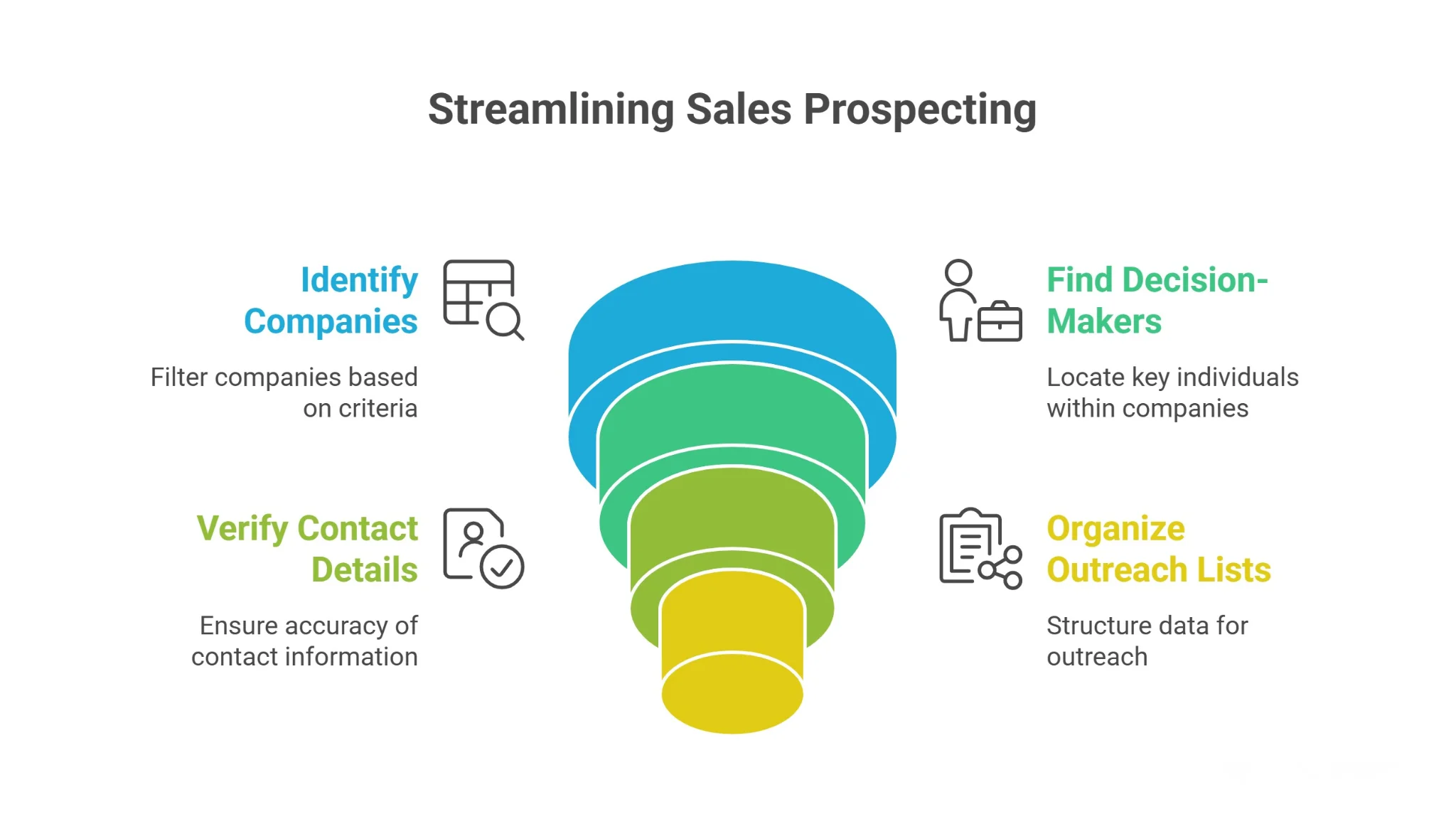
Even with strong prospecting strategies, sales teams often spend a large portion of their time on manual research.
Finding the right companies, identifying decision-makers, verifying contact details, and organizing outreach lists can quickly slow down the prospecting process.
This is where tools that streamline prospect research and outreach workflows become valuable.
Platforms like Oppora help sales teams move from prospect discovery to conversation much faster by organizing data, identifying contacts, and supporting outreach in a more structured way.
A major challenge in sales prospecting is quickly identifying companies that match your ideal customer profile.
Instead of manually searching across multiple platforms, prospecting tools allow you to filter companies using criteria such as industry, company size, location, or job titles.
This makes it easier to discover organizations that closely match the types of businesses most likely to benefit from your solution.
You can also identify relevant decision-makers within those companies, such as founders, department heads, or senior managers responsible for solving the problem your product addresses.
With clearer targeting, sales teams spend less time researching and more time engaging qualified prospects.
Once prospects are identified, the next step is turning that information into meaningful outreach.
Instead of manually collecting contact details and organizing spreadsheets, prospecting platforms can move verified contact data directly into outreach workflows.
This reduces friction between lead discovery and engagement.
Sales teams can quickly launch personalized email campaigns, follow-up sequences, or multi-channel outreach strategies.
By connecting prospect data with outreach tools, teams can focus more on building relationships and starting conversations rather than spending hours managing lists.
Strong sales prospecting techniques help you focus on the right companies, reach the right decision-makers, and start conversations that lead to real opportunities.
When prospecting becomes structured and data-driven, sales teams spend less time chasing unqualified leads and more time engaging prospects who are likely to convert.
Combining proven prospecting methods with the right tools can make this process even more efficient.
Platforms like Oppora help simplify prospect research, identify decision-makers faster, and turn prospect data into outreach campaigns, allowing sales teams to move from finding leads to starting conversations with far less manual effort.
Sales prospecting strategies should be reviewed at least once every quarter. Markets, buyer behavior, and competition change frequently. Regular updates help you refine targeting, adjust messaging, and adopt new prospecting techniques that keep your outreach relevant and effective.
Important prospecting metrics include reply rate, meeting booking rate, email open rate, conversion rate from lead to opportunity, and pipeline value generated. Tracking these metrics helps you understand which prospecting methods work best and where your outreach process needs improvement.
Results can vary depending on the industry and outreach strategy. Some prospecting methods generate responses within days, while others may take weeks to build momentum. Consistent outreach, proper targeting, and personalized messaging usually lead to more predictable results over time.
Common mistakes include targeting the wrong companies, contacting non-decision-makers, sending generic outreach messages, and ignoring timing signals. Many teams also stop prospecting too early. Successful prospecting requires consistent effort, relevant messaging, and a clear understanding of the ideal customer profile.
Automation can improve prospecting efficiency when used correctly. Tools can help identify prospects, verify contact information, and manage outreach sequences. This allows sales teams to focus more on conversations and relationship building rather than spending hours on manual research and list management.
Summarize with AI
Share