Home
Blog
Find 500 B2B Contacts for Free Every Month with Built-In Outreach.
Home
Blog
Manasa Goli
Published March 7, 2026
7 min
Try Oppora AI
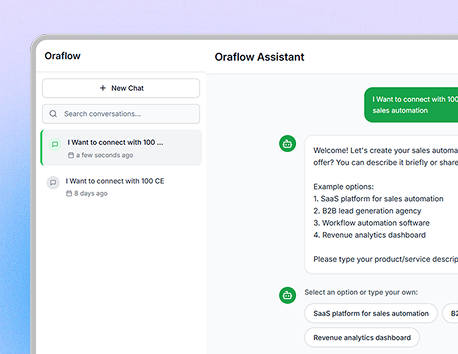
Create Self-Running Agentic Sales Workflows like N8N just by chatting with AI
Get Started for FREE
Modern B2B sales isn’t about reaching more companies. It’s about reaching the right companies first.
Many outbound teams still treat their total addressable market as a single list. They build a prospect database, upload it into their outreach tool, and start sending campaigns.
The result?
Low response rates, wasted effort, and sales teams spending time on accounts that were never a good fit.
This is where ABM segmentation changes the game.
Instead of targeting every potential company equally, account based marketing focuses on identifying and prioritizing the highest-value accounts — the companies most likely to convert and generate long-term revenue.
In this guide, we’ll explore:
ABM segmentation is the process of dividing your target market into groups of accounts based on characteristics that indicate revenue potential, intent, or strategic value.
Unlike traditional lead segmentation that focuses on individuals, account based marketing segmentation focuses on companies as the primary unit of targeting.
Instead of asking:
“Which leads should we contact?”
ABM teams ask:
“Which companies deserve the most attention from sales and marketing?”
Accounts are typically segmented based on factors such as:
Once segmented, companies are prioritized into tiers, allowing teams to allocate effort accordingly.
For example:
This structured prioritization ensures that sales teams focus their time where it matters most.
Without proper account segmentation, ABM becomes inefficient.
Sales teams often end up treating all prospects the same, which leads to poor resource allocation.
Here are the key reasons segmentation matters.
Not every account has the same revenue potential.
For example:
A 1000-employee SaaS company likely represents a far larger opportunity than a 10-person startup.
ABM segmentation allows companies to prioritize accounts that could deliver the largest contracts and highest lifetime value.
High-value accounts deserve deep research and tailored outreach.
If your sales team is handling 500 accounts equally, meaningful personalization becomes impossible.
By segmenting accounts, teams can allocate more effort to Tier 1 strategic accounts.
When companies target accounts that truly match their ideal customer profile (ICP), engagement increases significantly.
This improves:
In other words, segmentation improves efficiency across the entire sales funnel.
Effective account based marketing segmentation combines multiple signals rather than relying on a single attribute.
Here are the most common segmentation factors used by high-performing teams.
Firmographics describe company-level attributes.
Common examples include:
For example:
A cybersecurity company may segment accounts as:
This ensures outreach focuses on companies with clear product relevance.
Technographics analyze the technology stack used by companies.
This is particularly valuable for SaaS companies whose products integrate with other tools.
Behavioral segmentation focuses on signals that indicate interest or buying readiness.
Examples include:
Accounts showing these behaviors often indicate active buying intent.
Some accounts are important not just for revenue, but for strategic reasons.
Examples include:
Landing a single strategic account can unlock credibility and new market opportunities.
Once accounts are segmented, the next step is prioritization.
A common model is the three-tier ABM approach.
These are the highest-value accounts with strong ICP fit and high potential deal size.
Sales teams invest significant effort here.
Typical strategy:
Example:
An enterprise SaaS company targeting Fortune 1000 companies.
These accounts strongly match the ICP but may not require fully personalized outreach.
Strategy:
These accounts broadly match the ICP but have lower individual deal value.
Strategy:
This tiered system ensures that sales teams allocate time proportionally to opportunity value.
Let’s consider a B2B SaaS company selling workflow automation software.
Their segmentation model may look like this:
Strategy:
Highly personalized outreach from senior sales reps.
Strategy:
Semi-personalized campaigns targeting operations leaders.
Strategy:
Educational campaigns focused on efficiency and productivity.
This structured account segmentation strategy ensures the company invests its effort where ROI is highest.
While segmentation sounds simple in theory, it becomes extremely difficult at scale.
Outbound teams face challenges such as:
Without the right tools, segmentation often becomes manual spreadsheet work, which limits scalability.
Executing account based marketing segmentation often sounds straightforward in theory. In reality, it can quickly become complicated.
Sales and marketing teams need to identify the right companies, gather reliable data, evaluate account potential, and prioritize which accounts deserve immediate attention. When done manually, this process often turns into hours of spreadsheet work and fragmented research across multiple tools.
This is where Oppora helps simplify the workflow.
Oppora.ai enables teams to identify, analyze, and prioritize the most relevant accounts before launching outbound campaigns. Instead of targeting a broad list of companies, teams can build structured account segments aligned with their ideal customer profile (ICP).
Here’s how Oppora supports effective ABM segmentation.
Effective account segmentation begins with identifying companies that closely match your ideal customer profile.
Oppora’s Company Discovery allows teams to search and filter companies using criteria such as industry, company size, and location. This helps businesses quickly identify organizations that align with their target market.
Instead of manually researching hundreds of companies, teams can build targeted account lists that serve as the foundation for their ABM strategy.
Once potential accounts are identified, the next step is understanding which ones offer the highest value.
Oppora’s Company Enrichment feature provides additional insights about companies, helping teams better evaluate their relevance and potential. With enriched firmographic data, businesses can segment accounts more effectively and categorize them into priority tiers such as Tier 1 strategic accounts, Tier 2 growth accounts, and broader Tier 3 segments.
This level of insight helps sales teams focus on accounts with the strongest potential for conversion and long-term value.
Segmentation is only useful when it leads to clear prioritization.
Oppora’s Smart Lead Scoring helps teams evaluate which accounts should receive immediate attention. By analyzing factors related to company fit and account characteristics, the platform helps identify high-value opportunities within large account lists.
This ensures that sales teams focus their efforts on accounts that are most likely to convert instead of spreading resources across low-potential prospects.
Account-based marketing doesn’t stop at identifying the right companies. Success also depends on reaching the right people within those organizations.
Oppora helps teams discover key decision-makers within prioritized accounts, enabling more targeted and relevant outreach. This makes it easier to connect with the stakeholders who are most likely to influence purchasing decisions.
With the right segmentation framework in place, outbound teams can move from broad targeting to focused account-based strategies.
By combining company discovery, data enrichment, account scoring, and decision-maker identification, Oppora enables teams to build structured ABM segments and prioritize outreach more effectively.
Instead of sending campaigns to thousands of loosely qualified prospects, businesses can focus their efforts on high-value accounts that align closely with their ideal customer profile.
Even with a strong account based marketing strategy, teams often struggle with segmentation. Here are some common mistakes to avoid:
1. Treating all accounts equally Not every account has the same value. Failing to prioritize high-value accounts leads to wasted sales effort and weaker results.
2. Relying only on firmographic data Using only company size or industry for account segmentation can be limiting. Effective ABM segmentation also considers technology stack, growth signals, and buying intent.
3. Ignoring buying signals Accounts that show engagement or research activity often have higher purchase intent. Ignoring these signals can cause teams to miss high-potential opportunities.
4. Using outdated or incomplete data Poor data quality can lead to targeting the wrong accounts or reaching the wrong decision-makers.
5. Overcomplicating segmentation Creating too many segments makes execution difficult. A simple Tier 1, Tier 2, and Tier 3 model is often more effective.
Avoiding these mistakes helps teams build more focused account segments and prioritize the accounts most likely to convert.
ABM segmentation helps teams move from broad outreach to focused, high-value targeting. Instead of treating every company the same, businesses can prioritize accounts based on factors like firmographics, technology stack, buying signals, and strategic value.
By organizing accounts into clear tiers, sales teams can invest more effort in high-value opportunities while maintaining scalable outreach for broader segments.
However, identifying and prioritizing the right accounts can be difficult without the right data. Platforms like Oppora help teams discover relevant companies, enrich account insights, and prioritize high-value accounts more efficiently.
When done right, account based marketing segmentation allows outbound teams to focus on the companies most likely to convert, leading to stronger pipelines and better revenue outcomes.
ABM segmentation should be reviewed regularly, ideally every quarter, to ensure that account data, market conditions, and buying signals remain accurate. Updating segments helps teams prioritize the most relevant opportunities.
An Ideal Customer Profile (ICP) defines the type of companies that are the best fit for your product, while ABM segmentation organizes those companies into priority groups based on factors like revenue potential, strategic value, and engagement signals.
Yes. ABM segmentation can be especially valuable for small teams because it helps them focus limited resources on the most promising accounts instead of pursuing a large number of low-value prospects.
The number varies by company, but typically Tier 1 includes a small number of strategic accounts, Tier 2 includes a moderate number of high-fit accounts, and Tier 3 contains a larger group of scalable ICP accounts.
Summarize with AI
Share