Home
Blog
Find 500 B2B Contacts for Free Every Month with Built-In Outreach.
Home
Blog
Stephen Parker
Published January 27, 2026
8 min
Try Oppora AI
Create Self-Running Agentic Sales Workflows like N8N just by chatting with AI
Get Started for FREE
Cold email still works. Most B2B teams fail at it because they send the wrong emails to the wrong people and stop too early. The issue isn’t email. It’s poor targeting, weak messaging, and broken follow-ups.
When done with structure, b2b email lead generation is still one of the most reliable ways to start conversations and create pipelines. This guide breaks down the benefits, the exact execution process, practical tactics that drive replies, common mistakes to avoid, and clear answers to the questions teams usually get stuck on.
Email works because it gives control. Control over targeting, timing, and follow-ups.
When used with structure, email becomes predictable instead of random. That’s why many teams still rely on it for email marketing for b2b lead generation. There are no algorithms deciding reach and no rising ad costs blocking visibility. Results depend on execution, not luck.
Below are the core reasons email continues to work for B2B teams.
Email reaches decision-makers directly in their inbox, without relying on ads or algorithms. With the right targeting, relevant messages get seen faster and create immediate opportunities for conversation.
Practical impact
B2B buying takes time. Email supports long cycles through follow-ups and re-engagement, allowing teams to stay visible until prospects are ready to respond or move forward.
Common use cases
Email is low-cost compared to ads or calling. Once a campaign works, it can scale to more leads without increasing spend at the same rate.
Operational advantages
Email performance is easy to track through replies and conversions. This feedback helps teams quickly refine messaging and improve b2b email lead generation without guesswork.
Trackable signals
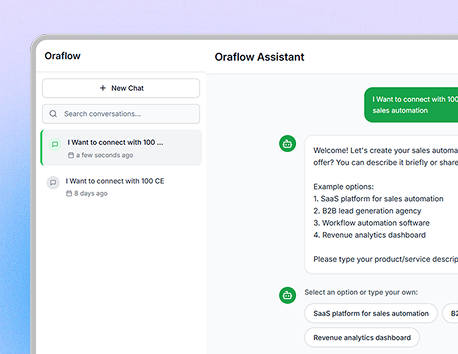
If you want to automate the end-to-end process of b2b email lead generation, you can use Oppora.ai . Oppora is an AI-powered sales platform that turns email outreach into a fully automated system. Instead of manually configuring different tools, you simply tell Oppora:
Oppora handles the rest by finding leads, verifying emails, building campaigns, sending emails, replying automatically, and even booking meetings. Everything is connected through a built-in CRM or your existing CRM.
Below is a step-by-step guide to setting up your b2b lead generation email marketing using Oppora.
With Oppora, B2B email marketing becomes completely streamlined. No more juggling multiple tools or manual tasks. Set up the system once, and Oppora handles everything:
Scale to 5,000 emails per day with 50 connected mailboxes, all while maintaining deliverability and ensuring email campaigns run efficiently. Oppora is a fully integrated system that automates B2B email lead generation from start to finish.
Ready to automate your email marketing and turn leads into booked meetings effortlessly? Try Oppora today and let AI handle the heavy lifting!
Once your outreach system is running, results don’t improve by sending more emails. They improve when targeting, timing, and message intent get sharper.
These tactics focus on decisions that directly affect replies in real inboxes. Used together, they help teams generate more leads through b2b email marketing without increasing volume or damaging deliverability.
Each tactic below is based on patterns seen in live campaigns, not theory.
Industry and title filters don’t tell you when to reach out. Buying signals do.
For example, a company that just started hiring SDRs, raised funding, or changed tools is actively solving problems.
Emailing them at that moment consistently outperforms emailing a similar company with no recent activity. Timing beats list size.
Using a name isn’t personalization. Referencing a real situation is.
A line like “Saw you’re expanding your sales team in Q2” gives the reader a reason to care. It shows intent.
This works better than adding a first name to a generic pitch because it answers the unspoken question: Why are you emailing me now?
Inbox decisions are fast. Long emails slow them down.
High-performing emails focus on one problem and one outcome. For example, asking a single question about a known bottleneck gets more replies than explaining your product, features, and pricing in the first touch. Curiosity opens conversations. Details come later.
B2B deals don’t move through one inbox.
If only one person sees your email, progress stalls. Reaching two or three relevant roles, such as a manager and an operator, creates internal visibility.
Even if only one replies, the message travels inside the account, increasing response likelihood.
Inbox placement is earned, not assumed.
Sending high volume from a new domain signals risk to email providers. Gradual warm-up builds trust.
Teams that scale from low volume see higher reply rates and fewer spam issues than teams that rush volume early and burn domains.
Cold emails feel less cold when there’s familiarity.
A profile view or light LinkedIn interaction before or after an email increases recognition. When the email arrives, it feels less random. This support touch doesn’t replace email, it improves how the email is received.
Automation doesn’t fix weak outreach. It multiplies it.
If a message works when sent manually, automation helps scale it safely. If it doesn’t work, automation just sends bad emails faster. Validate targeting and messaging first. Automate only once replies are consistent.
Most outreach fails for simple reasons. Not because email doesn’t work, but because execution breaks early. These mistakes show up fast as low replies, spam issues, or complete silence. Each one is avoidable.
Broad targeting creates irrelevant emails. Reaching out to “SaaS founders” without size, stage, or trigger leads to mixed or zero responses. Clear ICPs give every email a reason to exist.
Scaling weak copy only scales failure. A single message sent to hundreds of prospects feels automated and gets ignored. Even basic segmentation improves replies compared to one generic email.
Good copy fails if emails don’t reach inboxes. Unverified emails, cold domains, and sudden volume spikes trigger spam filters. Deliverability issues are often mistaken for messaging problems.
Most replies come later. Stopping after one follow-up leaves interest untapped. Many prospects respond only after multiple touches once the message feels familiar.
Email isn’t a one-off effort. Running a single campaign and moving on kills momentum. Teams that treat b2b email lead generation as a repeatable system see steadier results.
By now, one thing should be clear. Results don’t come from shortcuts or volume. They come from structure. Teams that succeed treat b2b email lead generation as a repeatable process built on relevance, consistency, and follow-through.
That means reaching the right companies, sending messages that fit the moment, and following up without guessing. When replies are handled on time and outreach runs as a system, email stays predictable and effective.
If managing targeting, follow-ups, and replies feels harder than it should, tools like Oppora.ai can help turn email outreach into a structured system instead of a manual grind.
Most teams start seeing replies within 2–4 weeks. Faster results come from clear targeting and consistent follow-ups. Delayed results usually point to weak targeting or poor deliverability, not the channel itself.
Four to six touches work best. Many prospects reply after the third or fourth email. Stopping early leaves interest on the table, while too many follow-ups without context reduce trust.
Yes, when done correctly. Email still works because it’s direct and controllable. Poor results usually come from generic messaging, bad data, or lack of follow-through not because email is outdated.
Targeting matters first. Good copy can’t fix irrelevant outreach. Once targeting is right, short and clear copy helps start conversations. Relevance always beats clever wording.
Yes, at a small scale. Manual outreach can work for testing and validation. Automation becomes useful when volume increases and consistency, follow-ups, and reply handling need to run without manual effort.
Summarize with AI
Share