Home
Blog
Find & Send Cold Emails to 500 Unique Prospects Every Month for FREE.
Home
Blog
Adam Hossain
Published March 5, 2026
15 min
Try Oppora AI
Create Self-Running Agentic Sales Workflows like N8N just by chatting with AI
Get Started for FREE
If you’re still sending one cold email and hoping for a reply, you’re making outreach harder than it needs to be.
Cold outreach works best when it follows a structured cold email sequence, not a single message. People are busy. They miss emails. They forget to reply. A sequence keeps the conversation alive without feeling pushy.
When each email adds context, value, and a clear reason to respond, your chances of getting replies increase significantly.
In this guide, you’ll learn how cold email sequences work — and get 15 practical templates you can start using immediately to generate real conversations and new opportunities.
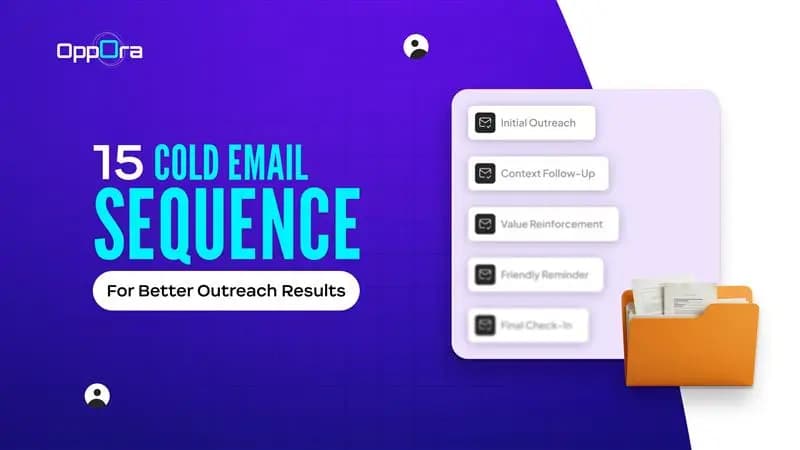
Cold email sequences work best when each message has a clear purpose. Instead of sending random follow-ups, successful outreach follows a structured approach where every email builds on the previous one.
Understanding this structure helps you create sequences that feel natural, provide value at each step, and increase the chances of starting meaningful conversations.
The best sequences are not long. They are intentional. Each email has a clear purpose, builds slightly on the previous one, and moves the conversation forward without overwhelming the reader.
Think of it like a staircase. Every step is small, but together they create momentum.
Your first email sets the tone.
This is not where you explain everything about your product or company. It’s where you introduce a relevant reason for reaching out and show that you understand the prospect’s world.
Keep it short. Make it specific. Focus on their situation, not your features.
A strong first email usually includes:
Your goal is not to close a deal. It’s to start a conversation.
Many prospects won’t reply to the first message. That’s normal.
Your second email should not repeat the first one. Instead, add context. Clarify your intent. Gently remind them why this conversation might matter.
You can reference your earlier email and briefly expand on the idea you mentioned. This keeps the thread alive while reinforcing relevance.
The key here is tone. You’re not chasing. You’re continuing.
When done well, this email often triggers replies from people who simply missed the first message.
By the third email, you need to strengthen the “why.”
This is where you highlight a practical benefit, share a short example, or reference a similar result you’ve achieved. Keep it outcome-focused rather than feature-heavy.
Help the prospect visualize what changes if they say yes to a conversation.
You’re still not pushing a sale. You’re helping them see potential upside in taking 15 minutes to talk.
That shift from explanation to outcome makes a big difference in response rates.
At this stage, simplicity wins.
Your fourth email should acknowledge that people are busy and may not have had time to respond. A short, respectful nudge works better than a long follow-up.
You can keep it to just a few lines. Restate your core question. Make it easy to reply.
There’s no pressure here. Just visibility.
Often, this reminder brings your email back to the top of their inbox at the right moment.
The final email closes the loop.
Instead of pushing harder, you reduce pressure. You can ask whether it makes sense to connect now or later, or whether you should step back for the time being.
Clear endings increase replies because they simplify the decision.
Sometimes, the “last” email is the one that finally gets a response — not because it’s aggressive, but because it respects the prospect’s time and gives them an easy way to answer.
Now that you understand the structure behind a strong cold email sequence, it’s time to put it into action.
Below, you’ll find 15 practical cold email sequence templates designed for different outreach goals from sales and partnerships to networking and re-engagement. Each one follows the structure you just learned, so you can adapt them quickly without overthinking the process.
Use them as starting points, customize them to your audience, and start more meaningful conversations immediately.
If you want to start conversations fast, this simple sequence keeps things short and clear.
It works best when you’re reaching out to a new, targeted list and want to reduce friction from the very first touch.
Subject: Quick question, {{FirstName}}Hi {{FirstName}},
I came across {{Company}} and noticed you’re focused on {{specific detail}}.
We help teams like yours improve {{specific outcome}} without {{common pain point}}.
Would you be open to a quick 10-minute chat this week?
— {{YourName}}
Subject: Re: Quick question
Hi {{FirstName}},
Just wanted to follow up in case my last email got buried.
Would it make sense to explore this briefly?
— {{YourName}}
Subject: Should I close the loop?
Hi {{FirstName}},
Not sure if this is a priority right now.
Should I circle back later, or does it make sense to connect soon?
— {{YourName}}
You want to introduce your product or service to a targeted prospect list.
Early-stage outbound campaigns and new prospect lists.
Short introductions lower resistance and make replying feel easy.
If your audience clearly struggles with a specific challenge, this sequence helps you lead with that problem instead of your product.
It shifts the focus away from pitching and toward understanding. When prospects feel seen, they are more likely to respond.
Subject: Quick question about {{problem}}
Hi {{FirstName}},
I’ve been speaking with {{industry}} teams, and many mention struggling with {{specific problem}}.
Is this something you’re currently dealing with at {{Company}}?
— {{YourName}}
Subject: Re: {{problem}}
Hi {{FirstName}},
Following up here.
We’ve helped similar teams reduce {{problem}} by improving {{specific outcome}}.
Would it be helpful to share how they approached it?
— {{YourName}}
Subject: Close the loop?
Hi {{FirstName}},
If {{problem}} isn’t a priority right now, no worries.
Should I reconnect later, or leave it here for now?
— {{YourName}}
You’re targeting an industry or role facing a clear, common problem.
B2B sales, consulting services, agencies, or solution-based outreach.
Prospects engage more when your message reflects their real-world challenges rather than generic offers.
If you want to stand out in crowded inboxes, lead with an observation instead of an offer.
This sequence works by sharing a relevant insight about the prospect’s industry, market shift, or growth pattern. Instead of selling immediately, you position yourself as someone who understands what’s changing. That naturally opens the door for conversation.
Subject: Noticed this in {{industry}}
Hi {{FirstName}},
I’ve been seeing more {{industry}} teams struggle with {{specific shift or trend}} lately.
Curious how {{Company}} is approaching this right now?
— {{YourName}}
Subject: Re: {{industry}} trend
Hi {{FirstName}},
Following up with a quick thought.
Some teams are responding by focusing on {{strategy}}, which has helped them improve {{specific outcome}}.
Would it make sense to exchange notes briefly?
— {{YourName}}
Subject: Worth a quick chat?Hi {{FirstName}},
Happy to share more context if helpful.
Should we explore this, or is it not a priority right now?
— {{YourName}}
You’ve noticed a meaningful trend or shift affecting your target audience.
SaaS founders, consultants, agencies, and thought-leadership outreach.
Insight-driven emails spark curiosity and build credibility before you ever pitch.
If you already have something genuinely useful to share, lead with value first.
This sequence works by offering a guide, report, checklist, or relevant article that helps the prospect solve a problem or understand a topic better. Instead of asking for time immediately, you give them something practical. That lowers resistance and builds trust naturally.
Subject: Thought this might help
Hi {{FirstName}},
We recently put together a short guide on {{specific topic}} for {{industry}} teams.
It breaks down how to improve {{specific outcome}} without {{common pain point}}.
Would you like me to send it over?
— {{YourName}}
Subject: Re: Resource on {{topic}}
Hi {{FirstName}},
Just checking back.
Happy to share the guide if it would be useful for you or your team.
— {{YourName}}
Subject: Close the loop?
Hi {{FirstName}},
Totally fine if now’s not the right time.
Should I send it, or circle back later?
— {{YourName}}
You have a relevant resource that directly supports your prospect’s goals or challenges.
Content-led outreach, educational campaigns, and authority-building strategies.
Providing value upfront makes the conversation feel helpful rather than sales-driven.
If you have proven results, use them.
This sequence works by showing how you helped someone similar achieve a measurable outcome. Instead of talking about features, you focus on transformation. When prospects see that others like them succeeded, it becomes easier to imagine similar results.
Subject: How we helped {{similar company}}
Hi {{FirstName}},
We recently worked with a {{industry}} company similar to {{Company}} and helped them improve {{specific metric}} by {{result}}.
Would you be open to seeing how they approached it?
— {{YourName}}
Subject: Re: {{similar company}} results
Hi {{FirstName}},
Sharing quick context.
They focused on {{strategy}} and saw measurable improvement within {{timeframe}}.
Would it make sense to explore whether this could apply to you as well?
— {{YourName}}
Subject: Should I close this out?
Hi {{FirstName}},
Happy to send the full case study if helpful.
Or should I reconnect another time?
— {{YourName}}
You have a relevant case study with clear outcomes and measurable impact.
B2B sales, agencies, consulting services, and high-ticket offers.
Real examples reduce skepticism and build instant credibility.
Cold emails feel much warmer when there’s shared context.
This sequence uses a mutual connection, industry similarity, or common reference point to make the outreach feel more natural. When prospects see familiar context, the message feels less like a random pitch and more like a relevant introduction.
Subject: {{MutualConnection}} suggested I reach out
Hi {{FirstName}},
I was speaking with {{MutualConnection}} recently and your name came up while discussing {{topic}}.
Thought it might make sense to connect and exchange ideas around {{specific area}}.
Would you be open to a quick conversation?
— {{YourName}}
Subject: Re: {{MutualConnection}}
Hi {{FirstName}},
Just following up here.
{{MutualConnection}} mentioned that {{Company}} is doing interesting work around {{topic}}, so I thought the conversation could be valuable.
Would a short chat make sense sometime this week?
— {{YourName}}
Subject: Should I circle back later?
Hi {{FirstName}},
Totally understand if now isn’t the right time.
Should I reconnect another time, or leave it here for now?
— {{YourName}}
You can reference a shared connection, industry peer, or mutual community.
Warm outbound campaigns, partnerships, and network-based outreach.
Familiar context reduces skepticism and makes prospects more open to replying.
Not every cold email is about selling. Sometimes the goal is collaboration.
This sequence focuses on exploring partnerships, integrations, or co-marketing opportunities with companies that serve a similar audience. Instead of pitching a product, you highlight the potential mutual benefit of working together.
Subject: Possible collaboration idea
Hi {{FirstName}},
I’ve been following {{Company}} and noticed you work closely with {{target audience}}.
We serve a similar group and thought there might be an opportunity to collaborate or share value with our audiences.
Would you be open to exploring this briefly?
— {{YourName}}
Email 2 — Context Follow-UpSubject: Re: Collaboration idea
Hi {{FirstName}},
Just following up in case this slipped through.
I think a simple partnership around {{idea — webinar, integration, content}} could be valuable for both teams.
Would you be open to discussing it?
— {{YourName}}
Subject: Should I circle back later?
Hi {{FirstName}},
No worries if now isn’t the right time.
Should I reconnect later, or leave this for now?
— {{YourName}}
You want to explore collaboration opportunities with companies serving the same target audience.
SaaS partnerships, co-marketing campaigns, integrations, and business development outreach.
Partnership conversations feel more balanced because both sides benefit.
Events create a natural reason to reach out again.
This sequence works best when you’ve met someone at a conference, webinar, workshop, or networking event. Referencing the shared event makes the message immediately familiar and relevant, which increases the chances of getting a response.
Email 1 — Initial OutreachSubject: Great connecting at {{EventName}}
Hi {{FirstName}},
It was great seeing you at {{EventName}}. I enjoyed the discussion around {{topic mentioned at event}}.
Would you be open to continuing that conversation sometime this week?
— {{YourName}}
Subject: Re: {{EventName}}Hi {{FirstName}},
Just checking in after the event.
Happy to exchange ideas around {{topic}} if that’s useful for you.
— {{YourName}}
You collected contacts from a webinar, conference, or networking event.
Webinar follow-ups, conference connections, and post-event relationship building.
A shared event creates instant context and makes outreach feel more personal.
Sometimes the best way to start a conversation is by creating curiosity instead of explaining everything upfront.
This sequence works by asking simple questions that make the recipient curious enough to reply. Instead of sending long explanations, you invite the prospect to explore the idea through a short conversation.
Subject: Quick question
Hi {{FirstName}},
Quick question — are you currently exploring ways to improve {{specific outcome}} at {{Company}}?
Curious to hear how you’re approaching it.
— {{YourName}}
Subject: Re: Quick question
Hi {{FirstName}},
Just wanted to check if this is something on your radar right now.
Happy to share a quick idea if helpful.
— {{YourName}}
You want to spark interest without sending long emails.
Product discovery, early sales conversations, and exploratory outreach.
Questions naturally invite replies and reduce the pressure to respond.
Short emails often get the fastest replies.
This sequence focuses on asking a simple, direct question that the recipient can answer in seconds. Instead of explaining too much, you open the door to a quick conversation that can naturally expand later.
Subject: Quick question, {{FirstName}}
Hi {{FirstName}},
Quick question — who usually handles {{specific process}} at {{Company}}?
Trying to understand if this might be relevant for your team.— {{YourName}}
Email 2 — Follow-UpSubject: Re: Quick question
Hi {{FirstName}},
Just checking if you’re the right person to ask about this.
If not, could you point me in the right direction?
— {{YourName}}
You want to start a conversation with minimal friction.
General outbound outreach, quick prospect discovery, and early-stage conversations.
A simple question makes responding easy and lowers the effort required to reply.
Starting with a relevant industry observation can immediately capture attention.
This sequence works by highlighting a shift, trend, or challenge happening in the prospect’s industry. Instead of pitching a solution right away, you open a conversation around something they are likely already noticing.
Subject: Seeing this trend in {{industry}}
Hi {{FirstName}},
I’ve been noticing more {{industry}} companies facing challenges around {{trend or shift}} recently.
Curious how {{Company}} is navigating this right now.
— {{YourName}}
Subject: Re: {{industry}} trend
Hi {{FirstName}},
Just wanted to check if this is something your team is currently thinking about.
Happy to share a quick perspective if helpful.
— {{YourName}}
You’ve identified a clear trend or change affecting your target market.
Thought-leadership outreach, SaaS founders, consultants, and strategic sales conversations.
Relevant observations show awareness and position you as someone who understands the market.
Not every prospect is ready to talk immediately.
This sequence focuses on staying helpful and visible while giving the prospect time to consider the conversation. Instead of pushing for a meeting, you share small insights or helpful ideas that keep the relationship warm.
Subject: Thought this might be useful
Hi {{FirstName}},
I came across an idea around improving {{specific outcome}} and thought it might be relevant for {{Company}}.
Happy to share it if helpful.
— {{YourName}}
Subject: Quick follow-up
Hi {{FirstName}},
Just sharing a quick insight that some teams are using to improve {{specific area}}.
Thought it might be useful for your team as well.
— {{YourName}}
A prospect showed interest earlier but hasn’t taken the next step yet.
Longer sales cycles, high-value deals, and relationship-based outreach.
Consistent, helpful communication builds trust over time without feeling pushy.
Sometimes prospects respond once and then go silent.
This sequence helps restart the conversation without sounding pushy or frustrated. Instead of asking why they stopped replying, you simply reconnect and make it easy for them to continue the discussion if the topic is still relevant.
Subject: Should we revisit this?
Hi {{FirstName}},
We spoke briefly earlier about {{topic}}, so I wanted to check back in.
Is this still something you’re exploring at {{Company}}?
— {{YourName}}
Subject: Quick check
Hi {{FirstName}},
Just wanted to see if it makes sense to continue the conversation.
Happy to reconnect whenever the timing works for you.
— {{YourName}}
A prospect previously replied but stopped responding later.
Reviving inactive leads and restarting paused conversations.
Low-pressure outreach makes it easier for prospects to re-engage.
Many emails go unanswered simply because people are busy.
This sequence focuses on gentle reminders that bring the conversation back into the prospect’s inbox without adding pressure. The messages are short, respectful, and easy to respond to.
Subject: Just checking in
Hi {{FirstName}},
Wanted to quickly follow up on my previous message about {{topic}}.
Let me know if this is something worth discussing.
— {{YourName}}
Subject: Quick nudge
Hi {{FirstName}},
Just bringing this back to the top of your inbox.
Would it make sense to explore this briefly?
— {{YourName}}
You want to follow up after sending an earlier outreach email.
General outreach campaigns and recovering missed replies.
Short reminders increase visibility without overwhelming the reader.
Sometimes the best way to get a response is to close the conversation politely.
A breakup email signals that you won’t continue following up, which often prompts prospects to reply if they were simply busy or unsure how to respond earlier. The tone should stay respectful and pressure-free.
Hi {{FirstName}},
Subject: Should I close the loop?
I haven’t heard back, so I’m guessing this isn't a priority right now.
Should I close the loop for now, or would you prefer I check back later?
— {{YourName}}
Subject: Last message from me
Hi {{FirstName}},
I’ll stop reaching out after this message.
If improving {{specific outcome}} ever becomes a priority, feel free to reach out anytime.
— {{YourName}}
The prospect hasn’t replied after several follow-ups.
Ending outreach sequences while leaving the door open for future conversations.
Removing pressure often motivates prospects to respond.
As outreach grows, managing every email manually becomes difficult.
Tracking follow-ups, replying to leads, and organizing conversations quickly starts consuming hours every week.
That’s where outreach automation becomes valuable. Instead of handling every step manually, tools like Oppora allow you to structure the entire email outreach process so campaigns run continuously in the background.
Here’s how the typical workflow looks.
Before sending outreach emails, your sending infrastructure needs to be prepared.
This helps protect deliverability and keeps your campaigns running smoothly.
✅ Connect your Gmail or Outlook mailboxes
✅ Warm up new domains automatically
✅ Gradually increase sending volume
✅ Maintain healthy sender reputation
Once inboxes are warmed up, your outreach campaigns can run safely at scale.
After your email infrastructure is ready, the next step is identifying the right prospects.
Lead discovery tools help you build targeted lists using filters such as role, industry, company size, or location.
With the right filters, outreach becomes far more relevant and response rates improve.
Once you have a list of leads, you can build structured cold email sequences.
This usually involves setting up the first email, adding follow-ups, and scheduling sending intervals.
✅ Write the initial outreach email
✅ Add follow-up messages to the sequence
✅ Schedule delays between emails
✅ Track opens, replies, and engagement
After launching the campaign, emails are sent automatically based on the schedule you define.
As replies start coming in, managing conversations manually can slow teams down.
Automation helps categorize responses, suggest replies, and move interested prospects into the next step of the sales process.
✅ Detect reply intent automatically
✅ Send responses from your inbox
✅ Book meetings with interested leads
✅ Sync contacts and conversations to your CRM
This keeps your outreach pipeline organized while reducing manual work.
If you want to remove even more manual work, you can connect every step into a single automated workflow.
With drag-and-drop workflow builders, you can combine lead discovery, campaign sending, and reply management into one continuous system.
Once the workflow is created, it keeps running automatically.
✅ Drag-and-drop workflow builder
✅ Connect lead search, outreach, and replies
✅ Run campaigns continuously without daily setup
✅ Let the system repeat the process on a loop
Instead of restarting campaigns manually, your outreach engine keeps running while you focus on conversations and closing deals.
Cold outreach becomes far more effective when emails follow a structured sequence instead of relying on a single message. Each step in the sequence adds context, builds familiarity, and increases the chances of starting a real conversation.
The templates in this guide give you practical starting points you can adapt for different outreach goals, whether you’re generating leads, building partnerships, or reconnecting with prospects.
As your campaigns grow, managing sequences manually becomes difficult. Tools like Oppora help automate lead discovery, email sequences, and replies so your outreach runs continuously while you focus on meaningful conversations and closing opportunities.
Most effective cold email sequences include 3 to 5 emails sent over 7–14 days. This gives prospects enough chances to see your message without feeling overwhelmed. Shorter sequences reduce fatigue while still keeping your outreach visible in the inbox.
Use subject lines that reference the prospect’s company, role, or a specific challenge. Instead of generic phrases, mention something relevant to their business. Personalized subject lines increase open rates because recipients feel the message was written specifically for them.
Most outreach campaigns work well with 2–3 day gaps between emails. This keeps your message visible without feeling aggressive. Gradually increasing the spacing in later emails also helps maintain a natural communication rhythm.
No. Early emails should focus on starting a conversation rather than pushing for a meeting. Asking for insights, opinions, or quick feedback often works better. Once interest is shown, then suggesting a meeting becomes more natural.
Focus on relevance, simplicity, and clear value. Short emails, personalized context, and a single question usually perform best. Also test different subject lines, messaging angles, and timing to discover what resonates most with your audience.
Summarize with AI
Share