Home
Blog
Find 500 B2B Contacts for Free Every Month with Built-In Outreach.
Home
Blog
Adam Hossain
Published March 8, 2026
6 min
Try Oppora AI
Create Self-Running Agentic Sales Workflows like N8N just by chatting with AI
Get Started for FREE
Cold email outreach starts with one simple requirement: reaching the right inbox.
If you cannot find the correct email address, even the best outreach message will never be seen. That is why learning how to find emails for cold emailing quickly and accurately is an essential skill for anyone doing outbound sales, partnerships, or lead generation.
The good news is that finding business emails does not have to be complicated.
With the right research methods, email discovery tools, and verification practices, you can build reliable prospect lists in minutes. In this guide, you will learn practical ways to locate verified emails and create stronger cold outreach campaigns.
Cold outreach only works when your message reaches the right person.
You might write a great email, but if it lands in the wrong inbox or bounces completely, the opportunity disappears before the conversation even starts.
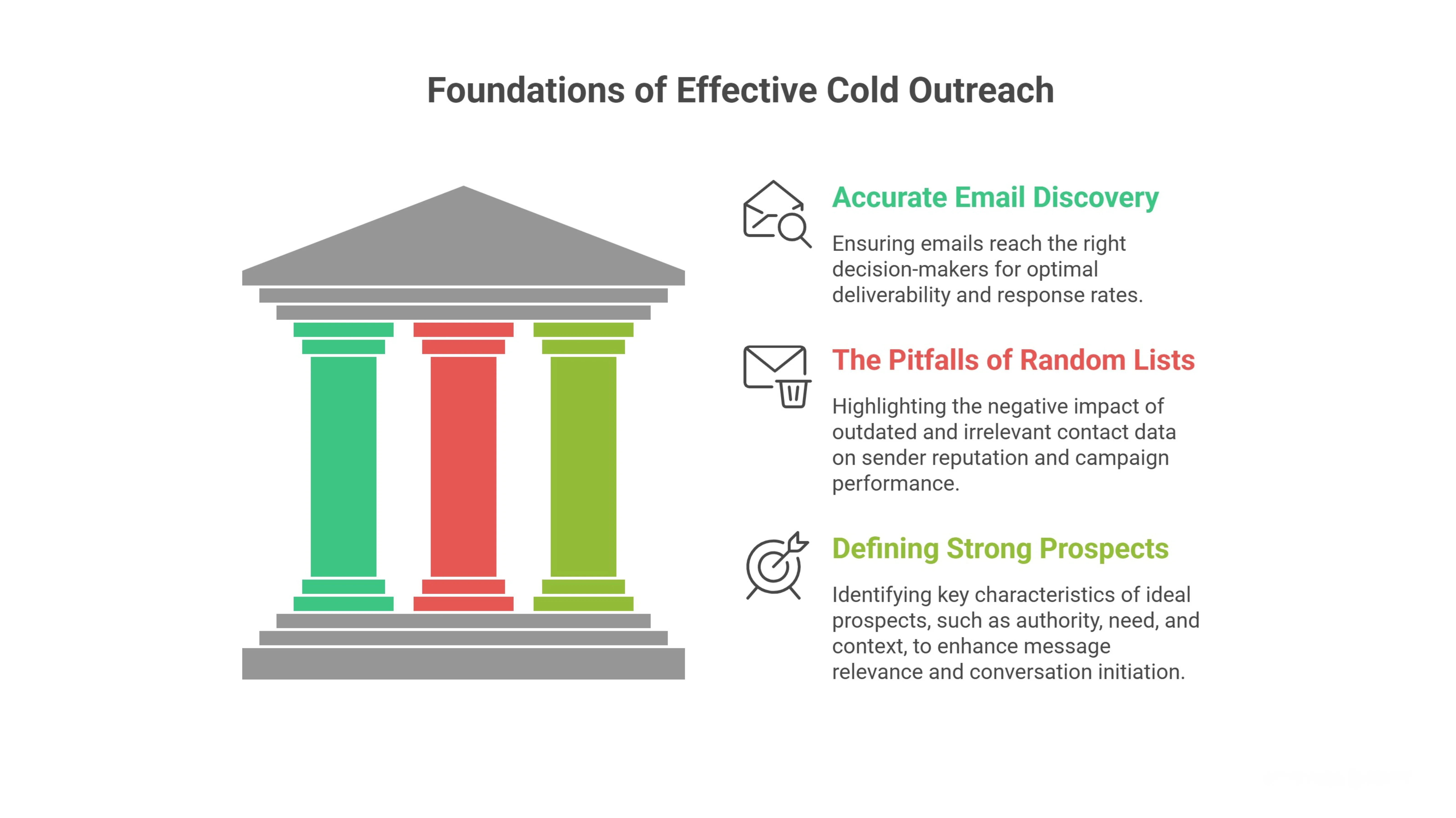
That is why accurate email discovery is one of the most important steps in building successful outbound campaigns.
When your contact data is clean and targeted, your emails reach real decision-makers. This improves deliverability, increases response rates, and helps your outreach feel relevant instead of random.
Many teams try to speed up prospecting by buying or scraping large email lists.
At first, this might seem like a shortcut to reaching more people.
In reality, these lists often contain outdated contacts, generic inboxes, or people who have nothing to do with your offer.
When emails repeatedly bounce or recipients mark them as spam, your sender reputation can quickly decline.
As a result, even legitimate emails may start landing in spam folders.
Instead of helping outreach, random lists usually damage campaign performance and waste time.
A strong prospect is someone who actually has the authority, need, and context to consider your offer.
This usually means targeting specific job roles such as founders, marketing leaders, sales heads, or department decision-makers within relevant companies.
Industry fit, company size, and business needs also play an important role when defining your ideal prospect.
When outreach focuses on the right people, the message becomes more relevant and conversations start naturally.
Rather than sending hundreds of random emails, you build smaller but higher-quality prospect lists that produce better responses and meaningful opportunities.
Before using specialized tools, many business emails can be discovered through simple research methods.
Manual prospecting may take a little more effort, but it helps you understand your target companies and identify the right people to contact. This approach also works well when you are researching a small list of high-value prospects.
By combining platforms like LinkedIn, company websites, and search engines, you can often uncover accurate contact information or identify the email format used within a company.
LinkedIn is one of the most reliable places to identify the right people inside a company.
Start by searching for the company name and then open the company profile to explore its employees. From there, you can filter by job roles such as founder, CEO, marketing director, sales manager, or partnership lead.
These roles usually represent decision-makers who are responsible for evaluating new tools, services, or partnerships.
Even if the email address is not publicly visible, LinkedIn helps you collect key information like the person’s full name, job title, and company domain.
Once you have these details, it becomes much easier to locate or estimate the correct email address.
Company websites are another valuable source of contact information.
Many businesses list email addresses on pages like “Contact,” “About Us,” or “Team.” Some companies also publish employee profiles where individual contact details are shared.
Even if a specific email address is not visible, these pages often reveal the company’s email format.
For example, you might find a support email or a team member’s address that shows the pattern used across the organization.
This small detail can help you predict the emails of other employees within the same company.
Google search operators can uncover email addresses that appear in public documents, press releases, or web pages.
Instead of performing a simple search, you can combine names, domains, and keywords to narrow the results.
For instance, searching phrases like “name + email” or “site:company.com email” can sometimes reveal hidden contact details.
These searches may surface PDFs, conference speaker pages, blog posts, or directories where the email is listed publicly.
With a few strategic queries, Google can often reveal information that is not immediately visible on the company website.
Most companies follow predictable email structures.
Common formats include [email protected], [email protected], or [email protected].
If you discover one employee’s email address, you can often use that format to estimate the addresses of other employees in the same organization.
For example, if a company uses [email protected] for one team member, it is likely the same structure applies across the company.
This technique helps you generate possible email addresses quickly, especially when combined with verification tools to confirm accuracy.
Manual research works well for small prospect lists.
But when you want to scale outreach and find hundreds of decision-makers quickly, using a structured prospecting system becomes much more efficient.
This is where Oppora AI helps streamline the entire email discovery process. Instead of switching between multiple tools, you can find prospects, verify emails, and prepare outreach campaigns from one place.
Oppora provides access to a large B2B contact database that helps you quickly identify relevant companies and decision-makers.
You can search prospects using filters like:
✅ Industry and business category
✅ Company size and revenue stage
✅ Geographic location
✅ Job roles such as founders, marketers, or sales leaders
This allows you to quickly build a targeted list of potential contacts that match your ideal customer profile.
Once you identify potential companies, you can refine the list further to focus only on the most relevant decision-makers.
Oppora allows deeper filtering such as:
✅ Department and job title targeting
✅ Company growth stage or hiring signals
✅ Technology usage or company attributes
This level of filtering helps ensure that your outreach focuses on people who are more likely to benefit from your product or service.
Sending emails to invalid addresses can damage deliverability and waste outreach effort. Though emails that you find through Oppora are verified, if there are any instances when you already have emails and need to verify them, you can use Oppora’s in-built email verification by importing your list and verifying them in one go.an contact data.
Key benefits include:
✅ Real-time verification before outreach
✅ Reduced bounce rates during campaigns
✅ Cleaner prospect lists imported from other sources
Finding emails is only one part of the process.
Once prospects are identified, Oppora helps organize them into outreach workflows so campaigns can start immediately.
You can:
✅ Organize contacts into prospect lists
✅ Prepare personalized outreach campaigns
✅ Connect outreach with CRM or sales pipelines
This connection between prospect discovery and campaign execution makes cold outreach far more efficient.
Finding the right email address is the foundation of successful cold outreach.
When your emails reach the correct decision-makers, your campaigns become more relevant, conversations start faster, and response rates improve. By combining manual research, smart search techniques, and reliable verification practices, you can build prospect lists that actually convert.
As your outreach grows, tools that bring discovery, verification, and outreach into one workflow can save significant time.
If you want to simplify this process, Oppora helps you find verified prospects, organize contacts, and move them directly into outreach workflows so your cold email campaigns can run much
How long does it usually take to build a reliable cold email prospect list?
The time required depends on your research method and the number of prospects. Manual research may take longer but provides high accuracy. Using structured databases and automation tools can significantly reduce the time and help you build targeted prospect lists in minutes.
What is the difference between email discovery and email verification?
Email discovery refers to the process of finding potential email addresses for a person or company. Email verification happens afterward and checks whether the discovered email address is valid, active, and safe to send emails to without causing bounce issues.
Should you focus on company emails or personal emails for cold outreach?
Company emails are generally preferred for professional outreach because they are tied directly to the recipient’s business role. They also appear more credible and are more likely to reach the intended decision-maker compared to generic personal email addresses.
Can small prospect lists perform better than large email lists?
Yes. Smaller, well-researched prospect lists often perform better than large untargeted lists. When emails are sent to highly relevant contacts with personalized messaging, response rates usually improve and conversations become more meaningful.
What tools help organize prospects after you find their emails?
After discovering emails, many teams organize contacts using CRM systems or outreach platforms. These tools help track prospects, manage outreach sequences, monitor responses, and maintain a structured pipeline for follow-ups and future communication.
Summarize with AI
Share