Home
Blog
Find 500 B2B Contacts for Free Every Month with Built-In Outreach.
Home
Blog
Adam Hossain
Published March 31, 2026
9 min
Try Oppora AI
Create Self-Running Agentic Sales Workflows like N8N just by chatting with AI
Get Started for FREE
Sales today moves fast, and staying consistent across every touchpoint is harder than ever.
You’re expected to research leads, write personalized messages, follow up at the right time, and still close deals without delays.
That’s exactly where using ChatGPT for sales changes the game.
Instead of spending hours on repetitive tasks, you can generate emails, scripts, and insights in seconds while keeping your outreach relevant and human. This means less manual work and more time focused on conversations that actually convert.
In this guide, you’ll discover how to use ChatGPT across your entire sales process to work smarter, engage better, and close faster.
Sales today is no longer just about pitching it’s about timing, relevance, and consistency at every stage.
But when everything depends on speed and personalization, small inefficiencies quickly turn into lost opportunities. That’s why many teams are now using ChatGPT for sales to stay competitive and efficient.
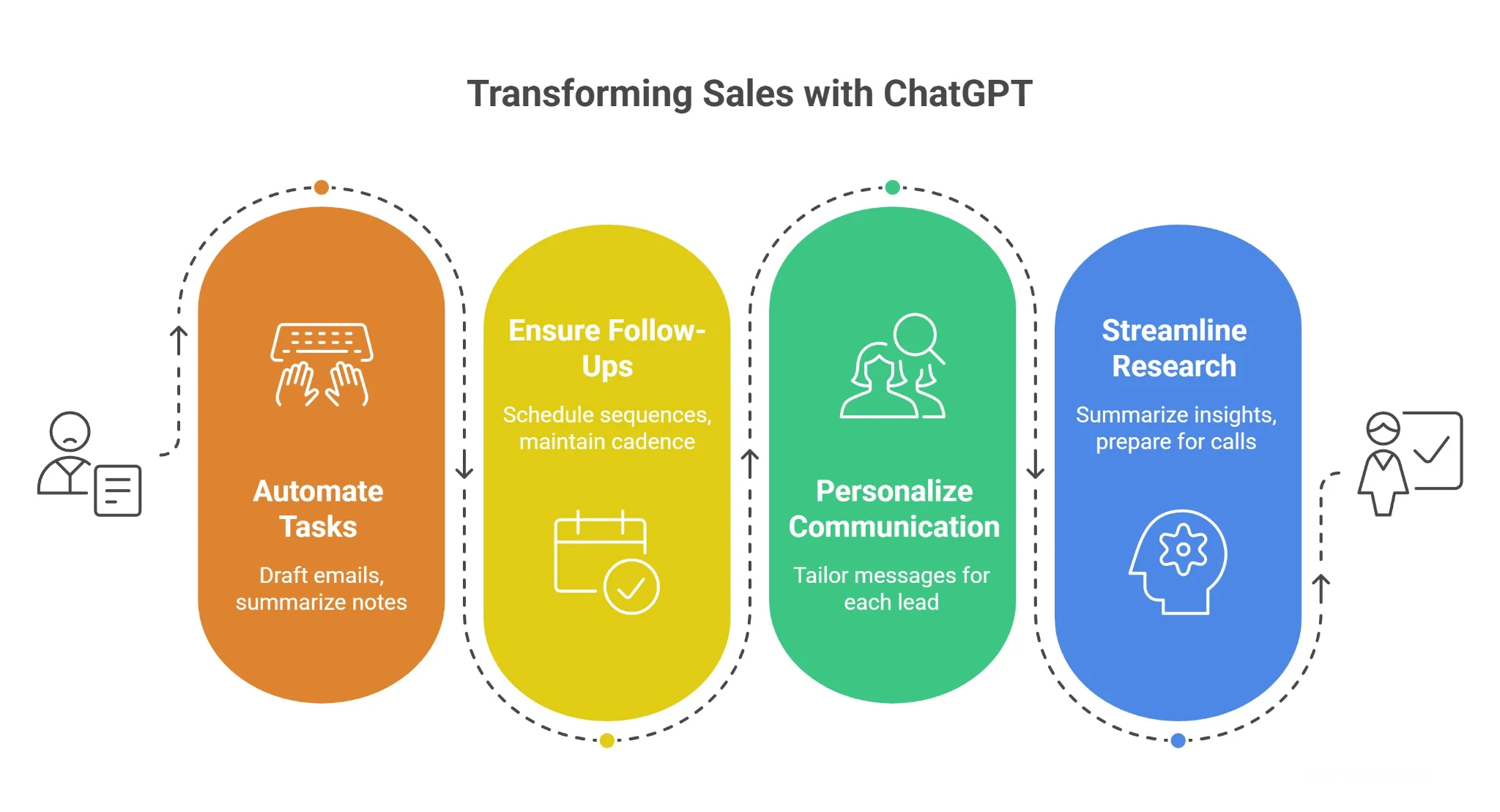
Sales reps often spend hours on administrative work writing emails, logging CRM notes, and researching leads. ChatGPT can automate much of this, drafting messages, summarizing notes, and even creating templates for outreach. This frees reps to focus on activities that directly impact revenue, like building relationships and closing deals.
Missed or delayed follow-ups can lead to lost opportunities. ChatGPT can automatically draft and schedule follow-up sequences, ensuring prospects stay engaged over time. By maintaining a steady cadence, your team never misses a touchpoint, increasing the likelihood of conversion and keeping your pipeline active.
Personalized outreach drives higher engagement, but manually tailoring messages for dozens of leads is time-consuming. ChatGPT generates customized emails and scripts based on lead information, role, and industry. This ensures that every message is relevant and meaningful, without adding extra work for your sales team.
Understanding a lead, their company, or industry is essential for effective outreach. ChatGPT summarizes research quickly, providing actionable insights that help reps prepare for calls, meetings, and targeted campaigns. With ready-to-use intelligence at their fingertips, teams can make smarter, faster decisions throughout the sales cycle.
By integrating ChatGPT into daily sales workflows, teams can work smarter, stay organized, and focus on what really drives growth.
Now that you understand why AI matters in modern sales, the next step is knowing where it actually fits into your workflow.
The best uses for ChatGPT for sales go beyond just writing emails it supports everything from lead research to follow-ups and insights.
In the next section, you’ll explore 10 practical ways you can use ChatGPT to simplify tasks, improve engagement, and close deals faster with less manual effort.
ChatGPT streamlines the research process by quickly summarizing company details, industries, leadership teams, and key challenges. Sales reps can input a prospect’s name or company, and in seconds, receive actionable insights that would normally take hours to compile. This prepares teams for discovery calls with confidence and relevance.
If you are preparing for outreach, you can paste the company website, LinkedIn page, or company name into ChatGPT and ask it to identify what the business does, who it serves, who its competitors are, and what challenges that company may be facing before your first call.
As your sales process grows, generic prompts start to feel limiting. Custom GPTs allow you to train AI on your ICPs, past deals, messaging, and product details. This means every output aligns with your business context instead of starting from scratch.
You can use these tailored GPTs for specific sales tasks like prospect research, meeting prep, and personalized outreach, ensuring consistent execution while saving time across your entire sales workflow.
If your team already knows which industries, roles, and pain points convert best, you can build a custom GPT around that data so whenever you add a new account, it can prepare research, messaging angles, and meeting notes in the same format your team already uses.
Crafting engaging, personalized messages is easier with ChatGPT. Reps can generate cold emails, follow-up sequences, and targeted prospecting cadences that feel custom for each lead. This automation saves time while boosting response rates, helping teams maintain engagement without manually writing dozens of messages.
If you are reaching out to a founder, marketer, or sales leader, you can give ChatGPT their role, company context, and likely pain points, then ask it to write a first email and follow-up sequence that matches that buyer’s priorities instead of sending the same template to everyone.
During calls or after responses, ChatGPT can instantly suggest polished rebuttals to common objections. This real-time feedback functions like a personal coach, allowing reps to refine messaging on the fly. By addressing concerns professionally and persuasively, sales conversations become more effective and confident.
If a prospect says your pricing is too high or they are already using another tool, you can paste that objection into ChatGPT and ask it to rewrite your response in a way that is clearer, calmer, and more value-driven before you reply.
Sales teams can simulate prospect interactions or role-play scenarios using ChatGPT. By practicing discovery calls, pitch flows, and pricing discussions with customizable personas, reps sharpen their skills, anticipate questions, and enter real meetings fully prepared. This reduces uncertainty and improves overall sales performance.If you have an upcoming call with a finance leader or operations head, you can ask ChatGPT to act like that buyer persona and challenge your pitch with realistic objections so you can practice your answers before the actual conversation.
After calls or meetings, sales reps often spend significant time taking notes and drafting follow-up emails. ChatGPT can quickly summarize transcripts, highlight key points, and generate actionable next steps. This ensures every follow-up is timely, accurate, and personalized, saving hours of manual effort while keeping prospects engaged. |
After a discovery call, you can paste your raw notes or transcript into ChatGPT and ask it to organize the discussion into key pain points, agreed next steps, and a follow-up email draft you can review and send right away.
By analyzing CRM data alongside AI-generated insights, ChatGPT helps sales teams prioritize prospects effectively. It can score leads based on criteria like job role, engagement behavior, and overall fit, allowing reps to focus on high-value opportunities. This data-driven approach improves conversion rates and ensures time is spent on the most promising leads.
If you have a list of inbound leads with company size, role, industry, and engagement history, you can give that information to ChatGPT and ask it to rank which leads match your ICP most closely and explain why those should be prioritized first.
Creating tailored proposals, pitch decks, and RFP responses can be time-consuming. ChatGPT drafts structured content that aligns with a prospect’s pain points, business needs, and industry context. This helps sales teams produce high-quality, persuasive documents quickly while maintaining consistency and relevance.
If a prospect shares their requirements in a call or document, you can give those details to ChatGPT and ask it to turn them into a proposal draft, presentation outline, or response structure that reflects the client’s priorities more clearly.
Effective communication within the team is crucial for alignment. ChatGPT converts raw notes and updates into organized internal briefs or summary emails. This ensures that AEs, marketing, and product teams are on the same page, improving collaboration and speeding up decision-making processes.
If you have updates from calls, emails, and Slack messages across one account, you can ask ChatGPT to combine them into one internal brief so your sales, marketing, and product teams all understand the current situation quickly.
Before reaching out, you need clarity on who you’re targeting and why.ChatGPT helps you quickly analyze your Ideal Customer Profile using past data and insights. It also breaks down a prospect’s business, challenges, and context so your messaging feels relevant. This improves targeting accuracy and increases your chances of converting leads into customers.
If you already know your best-fit customers, you can give ChatGPT those patterns and then ask it to study a new segment, explain how similar it is to your current customers, and highlight the business problems you should mention in your outreach.
Together, these advanced use cases highlight how ChatGPT goes beyond content creation, supporting the entire sales cycle, improving efficiency, and enabling reps to focus on meaningful, high-impact activities.
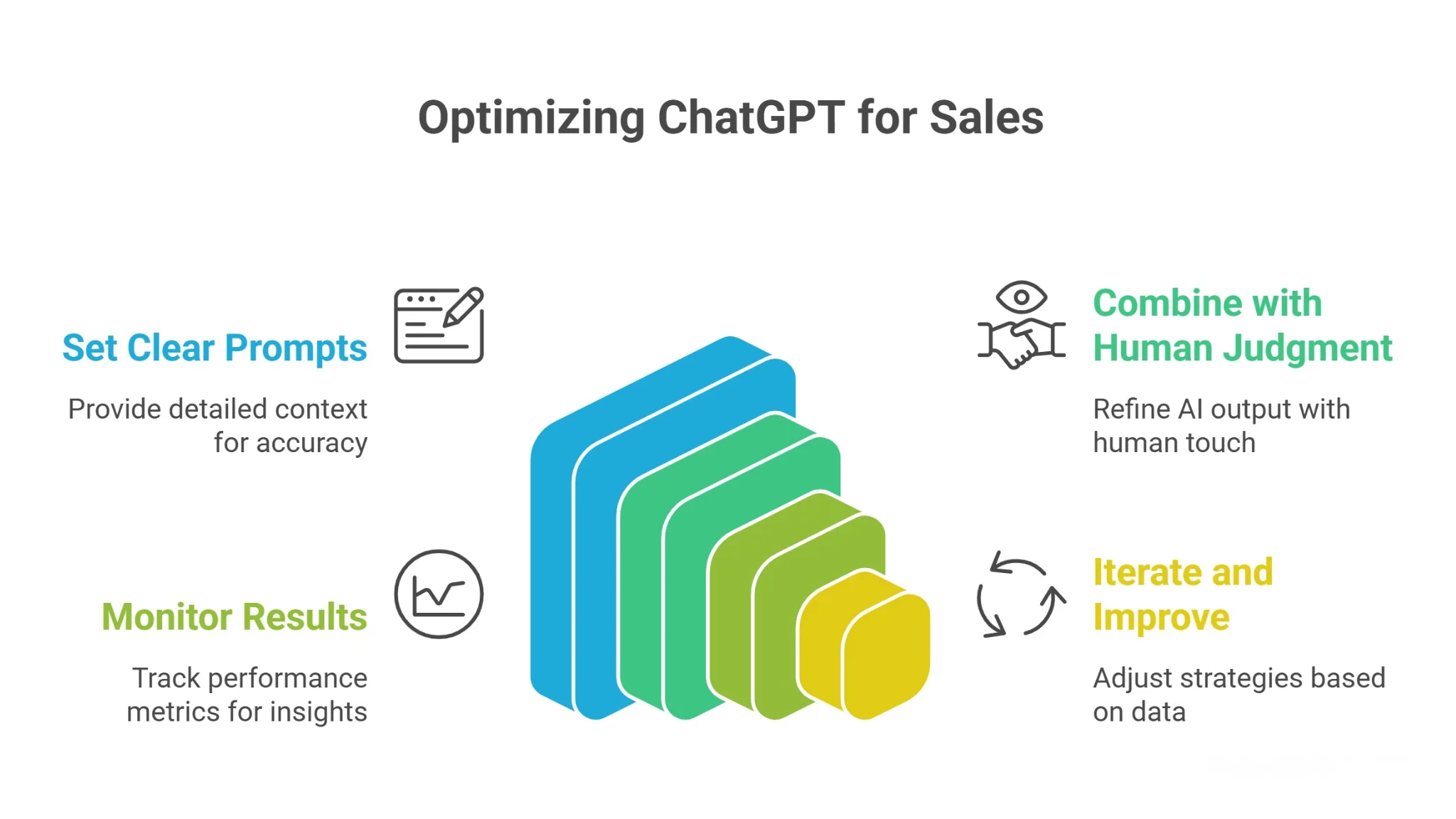
Now that you’ve seen the best uses for ChatGPT for sales, it’s important to use it the right way.
AI can speed up your workflow, but the real results come when you combine it with the right strategy and human touch.
The quality of ChatGPT’s output depends on what you give it.
Instead of vague instructions, provide clear details like your target audience, product value, tone, and goal. The more context you include, the more relevant and actionable the response will be, saving you time on edits.
ChatGPT can generate content quickly, but it doesn’t fully understand relationships or emotions.
You should always review and refine the output to match your voice and intent. Adding your perspective ensures your communication feels authentic and builds stronger trust with prospects.
Using ChatGPT for sales is not a one-time setup it’s an ongoing process.
Track metrics like open rates, replies, and conversions to understand what’s working. Then adjust your prompts, messaging, and workflows based on performance so you continuously improve results and maximize your sales efficiency.
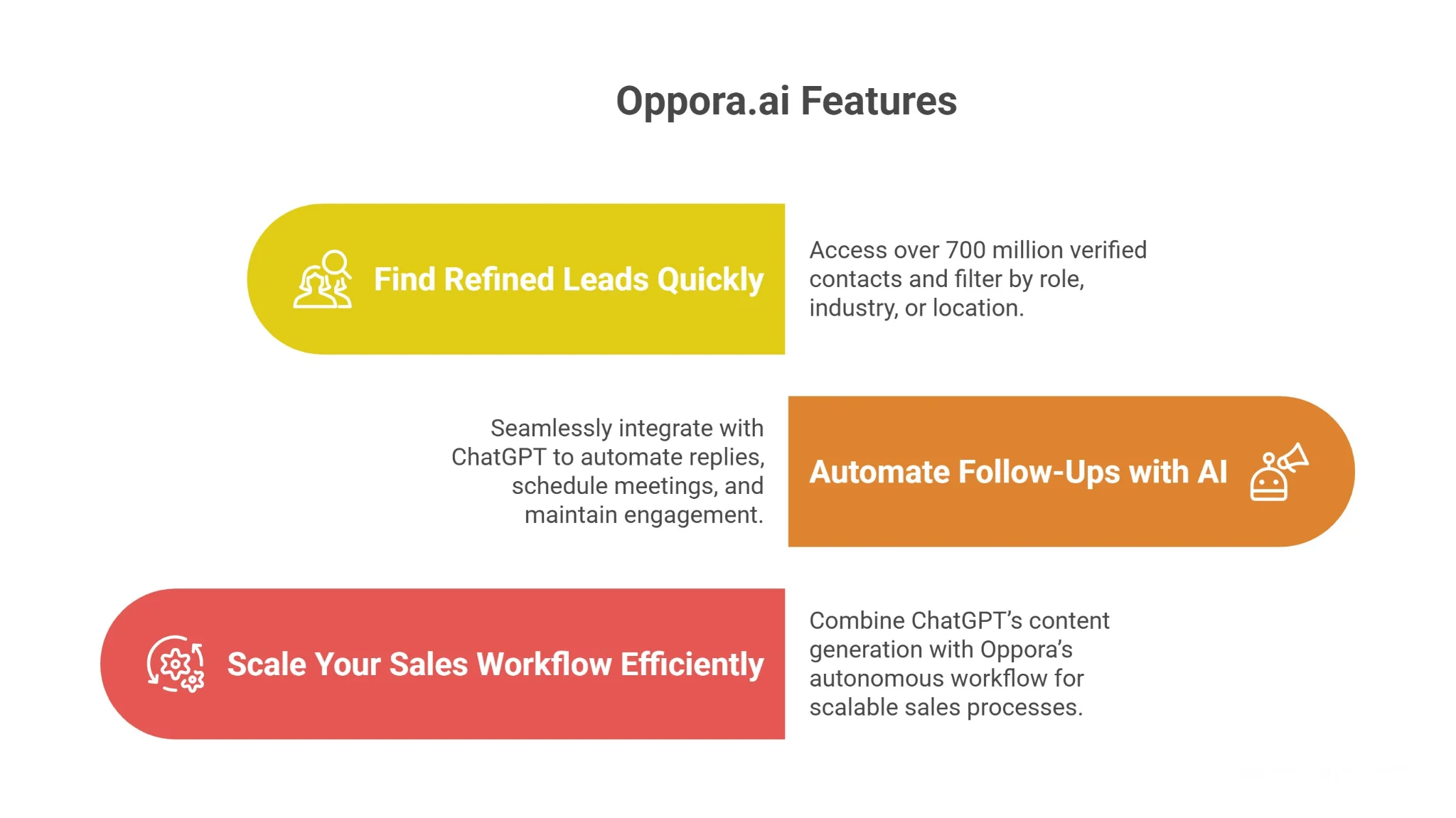
ChatGPT is excellent for generating ideas, drafting emails, or creating sales content, but it stops short when it comes to executing real-world sales tasks. Sales teams need more than messages they need action. That’s where Oppora.ai steps in.
By combining ChatGPT’s content capabilities with agentic AI features, Oppora transforms insights into automated, data-driven sales processes that generate leads, maintain engagement, and close deals efficiently.
Oppora’s Lead Finder gives you instant access to over 700 million verified contacts. You can advance filter leads by role, industry, or location, ensuring your ChatGPT-crafted outreach lands in front of the right prospects. This precision helps you avoid wasted effort, improve response rates, and start every conversation with confidence, making the first touchpoint count.
Following up consistently is crucial, yet time-consuming. Oppora integrates seamlessly with ChatGPT to automate replies, schedule meetings, and maintain engagement without manual intervention. Your leads never go cold, and your team can focus on high-value conversations instead of repetitive tasks, allowing for smarter allocation of your sales resources.
Combining ChatGPT’s content generation with Oppora’s autonomous workflow allows teams to scale their sales processes without sacrificing personalization or precision. From initial outreach to follow-ups and meeting scheduling, every step is handled automatically. This unified approach ensures actionable follow-through at every stage, turning AI insights into tangible revenue results.
This integration represents the best use of ChatGPT for sales where creative content meets real-world execution, empowering teams to sell smarter, faster, and more effectively.
ChatGPT empowers sales teams to automate repetitive tasks, craft personalized outreach, and uncover actionable insights, freeing reps to focus on building relationships and closing deals.
By integrating AI throughout the sales cycle, teams can increase efficiency, improve targeting, and drive better conversion rates. When paired with Oppora.ai, this potential expands—offering access to verified leads, automated multi-channel outreach, and seamless CRM updates.
Together, they create a smart, scalable sales workflow that saves time while maximizing results. Explore how Oppora can complement ChatGPT in your sales process and start accelerating your pipeline today.
Yes, ChatGPT can work alongside CRMs, email automation platforms, and analytics tools through APIs or integrations, allowing seamless workflows while enhancing lead engagement, messaging, and follow-up efficiency.
ChatGPT itself does not store personal data permanently. Always ensure data shared with AI tools complies with privacy regulations and consider using secure platforms for sensitive sales information.
Absolutely. ChatGPT can draft emails, messages, and proposals in multiple languages, maintaining tone and personalization, which helps teams reach global prospects effectively.
Start by tracking metrics like email open rates, response rates, and follow-up efficiency on AI-assisted tasks. Gradually expand usage while comparing performance with traditional methods.
Yes. AI can automate content creation and analysis, but human review ensures messaging aligns with brand voice, maintains empathy, and addresses nuanced objections that AI might miss.
Summarize with AI
Share