Home
Blog
Find & Send Cold Emails to 500 Unique Prospects Every Month for FREE.
Home
Blog
Adam Hossain
Published February 19, 2026
12 min
Try Oppora AI
Create Self-Running Agentic Sales Workflows like N8N just by chatting with AI
Get Started for FREE
Most B2B cold emails never get opened.
And the ones that do? Many never get a reply.
Not because cold email is dead — but because most messages feel generic, rushed, and self-centered. If you want consistent replies, you need structure, context, and relevance. You need emails that sound like they were written specifically for the person reading them.
In this guide, you’ll get 15 proven B2B cold email templates you can adapt immediately. More importantly, you’ll understand why they work — so you can increase open rates, start real conversations, and turn cold outreach into predictable pipeline.
Before you improve your reply rate, you need to understand what’s quietly killing it.
Most cold emails don’t fail because of subject lines. They fail because of how they’re positioned from the very first sentence.
You’ve seen these emails before.
“Hi {{First Name}}, we help companies grow revenue with our innovative solution…”
The problem isn’t the offer. It’s the lack of context.
If your email could be sent to 5,000 people without changing a word, it doesn’t feel personal. Decision-makers instantly recognize bulk outreach. When your message doesn’t reflect their industry, role, recent activity, or business priorities, it feels like noise — and noise gets ignored.
Relevance is what earns attention. Without it, you lose before the second line.
Another common mistake is pitching before earning interest.
Cold outreach isn’t a product demo. It’s the start of a conversation.
When your first email pushes for a 30-minute call, shows pricing, or aggressively lists features, it creates resistance. The recipient hasn’t decided if they even care yet.
Instead of asking for commitment, you should spark curiosity. Show that you understand a problem. Suggest an outcome. Make the next step feel small and easy.
When you sell too early, you force a decision. When you lead with insight, you invite a reply.
Even a well-written email fails if it reaches the wrong person at the wrong time.
If you’re messaging every VP in a company without understanding who owns the specific problem you solve, replies will stay low. The same happens when you ignore trigger events like funding rounds, hiring spikes, or leadership changes.
Good cold email is less about clever writing and more about precise targeting.
When segmentation improves, messaging works harder — and replies follow naturally.
Now that you know what hurts reply rates, let’s talk about what actually drives them.
High-performing B2B cold emails are not creative accidents. They follow a clear structure designed to reduce friction, build trust, and spark curiosity — in under 120 words.
Here’s what that structure looks like.
Your first line determines whether the rest of the email gets read.
Strong opening lines are grounded in context, not compliments. They reference something real — a recent funding round, a hiring push, a product launch, a podcast appearance, or a clear business signal.
Instead of saying, “I came across your company,” you might say you noticed they’re hiring five SDRs in Q1 or expanding into a new region.
That small shift shows you did your homework.
When the reader feels seen rather than targeted, attention increases naturally.
After context, you need a clear reason to continue reading.
The best cold emails focus on outcomes, not features. They don’t explain how the product works. They explain what changes after using it.
Think in terms of metrics.
Increase qualified demos by 30 percent.
Reduce response time by 40 percent.
Book 12 extra meetings per month without hiring.
Specific outcomes feel tangible. Vague promises feel risky.
If your message helps the reader picture a concrete result inside their own business, you’ve moved from interruption to opportunity.
Trust matters, especially when you’re reaching out cold.
But credibility doesn’t mean attaching five case studies and writing a long company backstory. That overwhelms the reader and kills momentum.
Instead, use one sharp proof point.
Mention a recognizable client. Share a short before-and-after metric. Reference a relevant industry.
One line of social proof is usually enough to lower skepticism and keep the email light.
Your goal is not to close a deal. It’s to start a conversation.
That’s why your call-to-action should feel easy.
Avoid asking for 30 minutes immediately. Instead, ask if they’re open to a quick chat, interested in seeing how it works, or the right person to speak with.
Low-pressure questions reduce resistance and increase replies.
When the next step feels small, saying yes becomes simple.
Now let’s move from theory to execution.
Below are practical templates you can adapt immediately. Keep them short. Adjust the context. Personalize the first line.
The structure stays consistent — relevance, outcome, light proof, low-friction CTA.
This works when your value proposition is clear and specific.
Subject: Quick question about {{company}}
Hi {{First Name}},
I’ll keep this brief.
We help {{ICP type}} increase {{specific outcome}} by {{measurable result}} without {{common pain point}}.
Recently, we worked with {{similar company or industry}} and helped them {{short result statement}}.
Would it make sense to explore this for {{company}}?
Open to a quick 15-minute chat next week?
Best,
{{Your Name}}
Use this when the pain point is obvious and costly.
Subject: Noticed something about {{company}}
Hi {{First Name}},
Many {{role title}} I speak with are struggling with {{specific challenge}} — especially when {{context or trigger}}.
It usually leads to {{negative consequence}}.
We built a way to help teams {{desired improvement}} while reducing {{risk or inefficiency}}.
Curious — is this something you’re currently optimizing at {{company}}?
If yes, happy to share how others approached it.
Looking forward to your thoughts,
{{Your Name}}
This works best when you’re reaching out after a visible business signal.
Subject: Congrats on {{trigger event}}
Hi {{First Name}},
Saw that {{company}} recently {{funding round / expansion / hiring push / product launch}}.
That usually means {{new pressure, growth goal, or operational shift}}.
We’ve helped companies in a similar stage {{achieve measurable outcome}} by fixing {{specific gap}} early.
Thought it might be relevant given your current momentum.
Would it be worth a short conversation to compare notes?
Congrats again on the momentum,
{{Your Name}}
When prospects don’t know you, they look for signals.
Social proof reduces skepticism fast because it shows that others have already trusted you — and seen results.
Subject: Helping {{similar company type}} improve {{specific metric}}
Hi {{First Name}},
We recently worked with {{recognizable company or similar role}} to solve {{specific challenge}}.
Within {{timeframe}}, they were able to {{clear measurable outcome}} without {{common obstacle}}.
Given your focus on {{related initiative}}, I thought this might be relevant.
Would it make sense to explore if similar results are possible at {{company}}?
Happy to share more details,
{{Your Name}}
Keep proof tight. One strong result is more persuasive than a long client list.
Sometimes the best way to start a conversation is to create an open loop.
Curiosity works when you hint at value without fully unpacking it.
Subject: Quick idea for {{company}}
Hi {{First Name}},
While looking at {{company}}, I noticed something interesting regarding {{specific area}}.
There may be an opportunity to improve {{desired outcome}} without increasing {{cost or effort}}.
Not sure if it’s on your radar — but worth a quick chat?
Curious to hear your take,
{{Your Name}}
The key is restraint. Spark interest, then let the conversation unfold.
When you share a connection, credibility increases instantly.
Subject: {{Mutual Connection}} suggested I reach out
Hi {{First Name}},
I was speaking with {{Mutual Connection}} recently, and your name came up while discussing {{relevant topic or challenge}}.
They mentioned you’re focused on {{specific initiative}} at {{company}}.
We’ve been helping similar teams {{achieve measurable result}} without {{common bottleneck}}.
Thought it made sense to connect directly.
Open to a brief conversation to see if this is relevant on your end?
Appreciate the connection,
{{Your Name}}
Sometimes shorter wins.
Especially when your goal is simply to start a thread.
Subject: Quick question
Hi {{First Name}},
Are you currently working on improving {{specific metric or process}} at {{company}}?
We’ve helped {{similar companies}} increase {{clear outcome}} by {{measurable result}}.
If it’s a priority this quarter, happy to share what’s working.
Worth exploring?
Thanks in advance,
{{Your Name}}
This format reduces friction because it feels conversational, not sales-driven.
This works well when you can spot visible improvement opportunities.
Subject: Noticed this on {{company}}’s {{channel}}
Hi {{First Name}},
I was reviewing {{website / outreach / hiring page / funnel step}} and noticed {{specific observation}}.
There may be an opportunity to {{clear improvement idea}} which could help increase {{desired outcome}}.
We’ve helped others fix similar gaps and saw {{short measurable impact}} within {{timeframe}}.
Would you be open to a quick breakdown of what we’re seeing?
Happy to walk you through it,
{{Your Name}}
The key here is specificity. Vague audits feel automated. Precise observations feel valuable.
Lead with a perspective instead of a pitch.
Subject: Seeing this trend in {{industry}}
Hi {{First Name}},
We’re noticing that many {{industry}} teams are struggling with {{emerging challenge}} due to {{market shift or operational change}}.
The teams adapting fastest are focusing on {{new approach or strategy}}, which is helping them {{specific result}}.
Curious how you’re thinking about this at {{company}}.
If helpful, I can share what’s working across our client base.
Would value your perspective,
{{Your Name}}
Insights position you as a peer, not a vendor.
When proof matters more than persuasion, keep it concise.
Subject: How {{similar company}} achieved {{result}}
Hi {{First Name}},
Recently, we worked with {{similar company or role type}} facing {{specific challenge}}.
Within {{timeframe}}, they were able to {{clear measurable outcome}} by adjusting {{key lever or strategy}}.
Thought this might be relevant given your focus on {{related initiative}}.
Would it make sense to share the short breakdown?
Happy to send the breakdown,
{{Your Name}}
Short snapshots build trust without overwhelming the reader.
Most replies come after the second or third touch.
The key is to follow up without sounding pushy.
Subject: Re: {{original subject}}
Hi {{First Name}},
Just wanted to circle back in case this got buried.Given your focus on {{specific initiative}},
I still believe there’s an opportunity to {{clear outcome}} without adding extra overhead.Happy to share a short overview if it’s relevant.
Should I close the loop, or is this worth a quick look?
Just let me know either way,
{{Your Name}}
Keep it light. Keep it respectful.
This works when previous emails haven’t received a response.
It often triggers replies because it removes pressure.
Subject: Should I step aside?
Hi {{First Name}},
I haven’t heard back, which usually means timing isn’t right or this isn’t a priority.Totally understand.
Before I close the file, just wanted to check — is improving {{specific metric}} something you’re exploring this quarter?
If not, I won’t clutter your inbox further.
Appreciate the clarity either way.
All the best regardless,
{{Your Name}}
Simple. Direct. Non-confrontational.
Instead of asking for time, offer something useful.
Subject: Thought this might help
Hi {{First Name}},
We recently put together a short breakdown on {{relevant topic or trend}} that’s helping {{industry}} teams improve {{specific result}}.
Given what you’re building at {{company}}, I thought you might find it useful.
Happy to send it over if you’re interested.
|
No pitch — just sharing value.
Hope it’s helpful,
{{Your Name}}
This lowers defenses and builds goodwill first.
If you’re unsure about the right contact, ask directly.
Subject: Quick redirectHi
{{First Name}},
Not sure if you’re the right person to speak with regarding {{specific challenge}} at {{company}}.
We’re helping teams improve {{clear outcome}} and wanted to reach out to whoever owns this area.
Would you be able to point me in the right direction?
Appreciate the help.
Appreciate your guidance,
{{Your Name}}
This approach often opens internal doors.
Use this when you’re not selling directly, but exploring alignment.
Subject: Exploring collaboration
Hi {{First Name}},
I’ve been following {{company}}’s work in {{specific area}} and see potential overlap with what we’re building around {{your focus}}.
We’ve helped similar organizations {{achieve measurable impact}}, and I believe there may be a partnership opportunity worth discussing.
Open to a short conversation to explore synergy?
Looking forward to exploring this,
{{Your Name}}
Partnership emails work best when they feel strategic, not transactional.
Personalization improves replies.
Over-personalization kills scale.
The goal isn’t to write a research report on every prospect. It’s to add just enough relevance to show the email was meant for them — not for everyone.
Here’s how you do that without slowing down your outreach.
Business signals are your shortcut to relevance.
Look for visible triggers like funding announcements, new hires, product launches, geographic expansion, or aggressive hiring in a specific department. These signals usually indicate shifting priorities or internal pressure.
Mentioning one concrete signal in your opening line instantly separates you from generic senders.
For example, referencing a recent hiring push for SDRs makes your outreach feel timely if you’re selling something related to pipeline or sales efficiency.
One signal is enough.
Personalization is not just about the company. It’s about the person.
A VP of Sales cares about pipeline predictability and quota attainment.
A Head of Marketing focuses on lead quality and CAC.
A Founder thinks about growth and runway.
When your message reflects the metrics they’re responsible for, it feels relevant by default.
If you speak to their outcomes instead of your features, replies increase naturally.
Long personalized paragraphs often feel forced.
Instead of writing five customized sentences, write one strong contextual line and move forward.
The structure stays consistent. Only the opening adapts.
When personalization is short, specific, and outcome-driven, you maintain efficiency without losing authenticity.
Templates help you start conversations.
But scaling cold email requires more than good copy.
If you want consistent pipeline, you need a system that connects targeting, messaging, sending, replying, and CRM tracking into one structured workflow. That’s where Oppora fits naturally into the process.
Instead of manually stitching tools together, you build once and let the system execute continuously.
Most teams start with copy.
Smart teams start with targeting logic.
Before writing a single email, define who you want to reach based on firmographics, role titles, industry, growth stage, and trigger events.
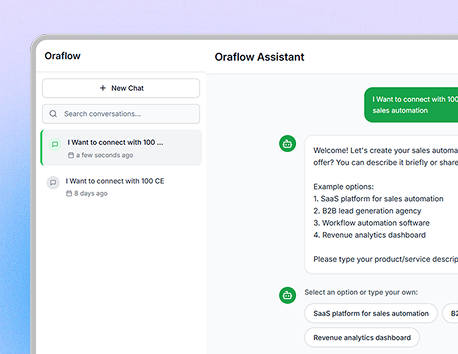
With Oppora’s AI Sales Planner (OraFlow), you describe what you sell and who you target. The system maps out a structured outreach plan before execution begins.
This ensures your messaging aligns with clear segmentation not random lead lists.
When targeting improves, templates perform better automatically.
Scaling requires consistent lead flow.
Oppora uses waterfall data sourcing with access to 120M+ verified contacts, enrichment providers, and built-in real-time verification.
That means you’re not just collecting emails you’re identifying the right decision-makers, enriching their data, verifying deliverability, and organizing them before outreach begins.
Clean data protects your sender reputation and increases response rates.
Without it, even great emails fail.
One email rarely closes a deal.
You need structured sequences with contextual variation — follow-ups that evolve based on timing and interaction.
Oppora’s 8 AI Sales Agents coordinate this automatically.
Instead of manually writing spintext variations, each line is uniquely generated. The workflow connects lead discovery, email writing, follow-ups, LinkedIn outreach, and reply handling into one continuous system.
You design the flow once. The agents keep executing it.
Scaling too fast can burn domains.
Oppora includes domain warm-up, inbox rotation (up to 50 mailboxes), and sender identity matching like Gmail-to-Gmail or Outlook-to-Outlook.
These safeguards reduce spam risk and improve open rates without manual monitoring.
Growth without control damages reputation. Structured sending protects it.
Replies are where most workflows break.
Oppora’s AI Reply Agent handles incoming messages directly from your inbox. It answers questions, qualifies interest, routes warm leads, and books meetings automatically.
No manual triage. No lost opportunities.
Every reply is categorized and moved to the next logical step.
Outreach only works when data flows back into your system.
Oppora syncs contacts, replies, meetings, and deals into HubSpot, Salesforce, Pipedrive, or its built-in CRM.
That creates a feedback loop.
You see what segments respond. You refine targeting. You improve messaging.
And your outreach becomes smarter over time not just bigger.
Cold email still works.
But only when it’s structured, relevant, and intentional.
You’ve seen why most outreach fails, what strong email structure looks like, and 15 templates you can adapt to different situations. The real advantage, however, comes from combining smart targeting with consistent execution.
When your messaging is context-driven, your follow-ups are strategic, and your workflow is systemized, replies stop feeling random.
They become predictable.
Focus on relevance. Keep it simple. Build a system that runs consistently — and your outbound pipeline will grow steadily over time.
Keep it between 75–125 words. Your goal is to start a conversation, not explain everything. Short emails reduce cognitive load, increase readability, and improve reply rates. If your email needs scrolling on mobile, it’s probably too long.
Typically, 3–5 touchpoints work best. Space them across 10–14 days. If there’s no response after that, pause outreach. You can always re-engage later with a new angle or trigger-based message.
For well-targeted campaigns, 5–15% reply rates are common. Highly personalized, niche outreach can exceed that. If you’re below 3%, review your targeting, subject lines, and relevance of your opening lines.
It’s usually better to avoid links in the first message. Links can reduce deliverability and increase skepticism. Focus on sparking interest first. Share case studies, decks, or resources after the prospect engages.
Yes — when done correctly. Buyers still rely on email for business communication. However, generic mass outreach is declining in effectiveness. Context-driven, highly targeted emails supported by structured workflows continue to generate consistent pipeline.
Summarize with AI
Share