Home
Blog
Find 500 B2B Contacts for Free Every Month with Built-In Outreach.
Home
Blog
Stephen Parker
Published April 28, 2026
12 min
Try Oppora AI
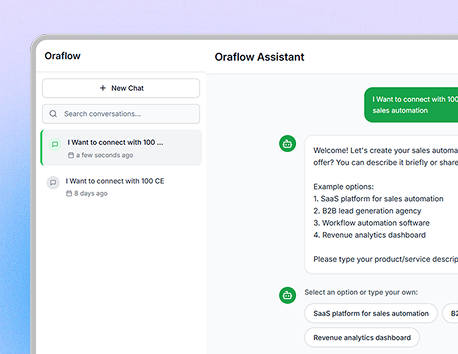
Create Self-Running Agentic Sales Workflows like N8N just by chatting with AI
Get Started for FREE
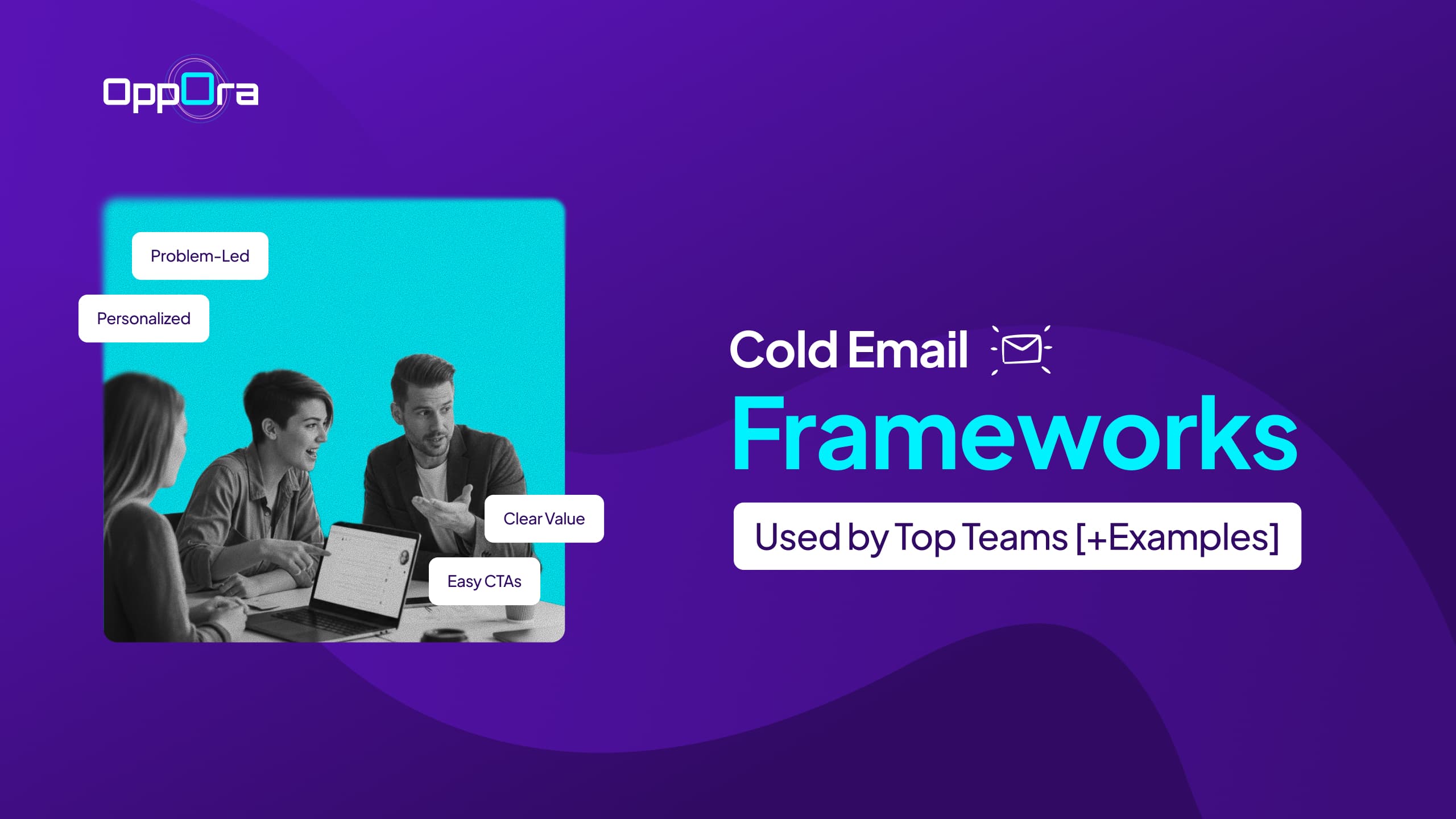
Cold emails still work but most teams struggle to make them consistently work.
That usually comes down to one thing: no clear cold email framework guiding your outreach. Without structure, every email feels like guesswork. With the right framework, your messaging becomes repeatable, testable, and easier to scale.
That’s why top teams rely on proven cold email frameworks instead of writing from scratch every time.
In this guide, you’ll learn:
Now that you know why randomness doesn’t work in outreach, let’s look at what top teams do differently.
They don’t rely on creativity alone, they rely on structured cold email frameworks that make results predictable.
When multiple people are sending cold emails, inconsistency becomes a silent problem.
One SDR writes long emails.Another keeps them too short.Someone else experiments every day with no clear direction.
A solid cold email framework fixes this by giving everyone a shared structure to follow.
This doesn’t limit creativity.It ensures every email still hits the key elements that drive replies.
Over time, your team starts sounding aligned and that builds trust with prospects.
Personalization is critical, but doing it manually for every email quickly becomes exhausting.
This is where cold email frameworks help you move faster without sounding robotic.
Instead of writing from scratch, you plug personalization into a proven structure.
For example, you only customize:
Everything else flows naturally from the framework.
You save time, but your emails still feel thoughtful and relevant.
Most cold emails fail not because of bad offers, but because of poor structure.
They ramble.They jump between ideas.They confuse the reader.
A strong cold email framework keeps your message focused and easy to follow.
It guides you through:
When your message feels clear, your chances of getting a reply increase significantly.
Scaling cold outreach isn’t just about sending more emails it’s about sending better emails at scale.
Without frameworks, scaling creates chaos.With frameworks, scaling becomes systematic.
You can:
This is why high-performing teams treat cold email frameworks like systems, not templates.
Once the system works, scaling becomes a matter of execution, not guesswork.
Suggested Reading:
12 Cold Email Prospecting Templates for Sales OutreachNow that you understand what makes a framework effective, the next step is using ones that are actually repeatable in real outreach.
Top teams rely on structured cold email frameworks that can be reused, tweaked, and scaled not just one-off ideas.
Here are 12 proven cold email frameworks you can directly apply.
AIDA is one of the most widely used cold email frameworks that guides the reader step-by-step from attention to action.
It works best when you want to keep your messaging structured while naturally leading to a reply.
Framework Structure:
Template:
“{personalized opener}
{relevant observation about their situation}
{specific result you help achieve}
{low-friction CTA}”
PAS focuses on highlighting a clear problem and making it feel urgent before offering a solution.
This cold email framework works well when your ICP already feels the pain you’re addressing.
Framework Structure:
Template:
“{problem your ICP faces}
{why this becomes a bigger issue over time}
{how you solve it}
{quick CTA}”
BAB helps you show a clear before-and-after transformation to the prospect.
It’s effective when you want the reader to visualize what better outcomes look like.
Framework Structure:
Template:
“{current situation}
{better outcome they want}
{how you help them get there}
{CTA}”
STAR uses storytelling to make your outreach more relatable and credible.
It works especially well when you have case studies or real examples to share.
Framework Structure:
Template:
“{who you worked with}
{problem they faced}
{what you did}
{result achieved}
{CTA}”
This framework is simple and direct, making it ideal for B2B communication.
It builds trust quickly by combining relevance with proof.
Framework Structure:
Template:
“{problem}
{your approach}
{proof or result}
{CTA}”
This framework starts with a natural opener before transitioning into a relevant problem.
It works well when you want to sound human and conversational instead of salesy.
Framework Structure:
Template:
“{specific compliment}
{problem they likely face}
{simple question}”
This framework uses timing as the main advantage in your outreach.
It works best when there’s a clear event that makes your email immediately relevant.
Framework Structure:
Template:
“{trigger event}
{why this creates a challenge/opportunity}
{how you help}
{CTA}”
This framework leverages shared context to reduce friction.
It works best when you have even a small connection or overlap with the prospect.
Framework Structure:
Template:
“{mutual connection reference}
{why you’re reaching out}
{how you help similar people}
{CTA}”
This is one of the simplest cold email frameworks focused on sparking curiosity.
It works well for busy prospects who prefer short and easy-to-answer emails.
Framework Structure:
Template:
“{quick context}
{curiosity-based question}”
This framework flips the usual approach by offering value before asking anything.
It helps you build trust early, especially with skeptical prospects.
Framework Structure:
Template:
“{valuable insight}
{why it applies to them}
{offer to share more}”
This framework speaks directly to outcomes and business impact.
It works best when you’re targeting senior stakeholders or decision-makers.
Framework Structure:
Template:
“{result you help achieve}
{specific metric or improvement}
{timeline or clarity}
{CTA}”
This framework focuses on consistency instead of one-time outreach.
It helps you stay visible and increase reply chances through structured follow-ups.
Framework Structure:
Sequence Template:
Suggested Reading:
How to Nurture Cold Leads With Automated Email SequencesNow that you have multiple frameworks, the real advantage comes from using the right one for the right audience.
Because the truth is a great cold email framework can still fail if it doesn’t match how your ICP thinks, buys, or responds.
Top teams don’t just pick frameworks randomly. They align them with context, intent, and decision-making behavior.
Here’s how that looks in practice.
SaaS buyers are usually problem-aware and constantly evaluating tools.
They don’t need long explanations they need clarity, relevance, and quick value.
That’s why these cold email frameworks tend to work best:
What works here is speed and precision.
Your email should quickly show:
Anything vague or overly long usually gets ignored.
Staffing and recruiting outreach is highly timing-driven.
Roles open, pipelines change, and urgency shifts quickly.
So your framework needs to reflect timing + relevance.
Best-performing frameworks here include:
The key here is making your outreach feel immediately useful.
Instead of pitching services, you position yourself as someone who:
Enterprise stakeholders think differently.
They are less interested in features and more focused on:
That’s why generic frameworks fail here.
Top teams rely on:
Your messaging needs to feel grounded and specific.
Instead of “we help companies grow,” you show:
Clarity and proof matter more than creativity.
Modern outbound rarely happens on just one channel.
You might start with email, follow up on LinkedIn, and continue across touchpoints.
That’s where combining cold email frameworks becomes powerful.
The best frameworks here are:
The goal isn’t to repeat the same message everywhere.
It’s to create a connected experience across channels.
Each touchpoint should:
When done right, your outreach feels natural not repetitive.
Now that you know how to choose the right cold email framework, the next challenge is execution.
Because writing one good email is easy. Repeating that success across hundreds or thousands of prospects is where most teams struggle.
This is where tools like Oppora.ai come in not to replace frameworks, but to help you apply and scale them consistently.
A cold email framework only works if it reaches the right person.
If your targeting is off, even the best messaging will fall flat.
Oppora.ai helps you start with the right foundation by giving access to a large pool of verified contacts and letting you filter based on your ICP.
Instead of guessing who to reach out to, you can:
This makes your frameworks feel more accurate because they’re applied to the right audience.
Personalization is where most frameworks either succeed or fail.
But doing it manually at scale quickly becomes unsustainable.
Oppora.ai allows you to plug personalization into your cold email frameworks using AI variables.
So instead of writing every email from scratch, you:
This keeps your outreach personal without slowing your team down.
Most results in cold outreach don’t come from the first email.
They come from consistent follow-ups.
Oppora helps you turn your frameworks into full sequences that run automatically.
You can:
Once set up, your outreach runs in the background while maintaining consistency.
Suggested Reading:
Best Time to Send Cold Emails by Day, Hour, and Time ZoneTiming can make or break your outreach.
Even a strong cold email framework can fail if sent at the wrong moment.
Oppora helps you identify signals that indicate when a prospect is more likely to respond.
These could include:
By combining timing with the right framework, your emails feel more relevant and timely.
As outreach scales, managing responses becomes another challenge.
Replies get scattered, follow-ups get missed, and conversations lose context.
Oppora simplifies this by bringing everything into one place.
You can:
This ensures that once your cold email frameworks start generating replies, you can handle them without losing momentum with ai reply agent.
At this point, you might feel like using a cold email framework is enough to improve results.
But here’s the catch, frameworks don’t fail, execution does.
Many teams adopt cold email frameworks but still struggle because they use them the wrong way.
Let’s look at the most common mistakes that quietly hurt your reply rates.
Frameworks are meant to guide your thinking, not replace it.
A common mistake is copying a framework exactly as it is and sending it to every prospect.
The structure might be right, but the message feels generic.
Your prospect can immediately tell:
A good cold email framework should adapt to the person you’re reaching out to.
Even small touches like referencing their role, company activity, or recent updates can make a huge difference.
AI makes writing faster, but it can also make emails sound the same.
Many teams rely too heavily on AI to generate full emails without refining them.
The result usually looks like:
The problem isn’t AI itself it’s how it’s used.
Strong teams use AI to:
But they still guide the message with human context and intent.
Not every prospect thinks the same way.
Yet many teams pick one cold email framework and use it across all audiences.
This creates a mismatch between message and mindset.
For example:
Using the wrong framework for the wrong ICP reduces relevance.
Instead, you should match frameworks based on:
That’s how top teams keep their outreach effective across segments.
Most replies don’t come from the first email.
They come from follow-ups.
But many teams treat follow-ups as an afterthought.
Common issues include:
A strong follow-up should move the conversation forward.
It can:
When your follow-ups are thoughtful, your entire cold email framework becomes more effective.
Cold outreach starts to work the moment it stops feeling random.
Once you start using the right cold email framework, your emails become easier to write, easier to test, and much easier to improve over time.
You’re no longer guessing what to say you’re following a structure that’s already proven to work.
But the real advantage shows up when you try to scale.
Because writing one good email is simple, but applying multiple cold email frameworks across different audiences, with proper personalization and timing, quickly becomes difficult to manage manually.
That’s where having the right system in place starts to matter.
If you’re looking to turn these frameworks into something repeatable and scalable, exploring how Oppora.ai fits into your workflow can be a practical next step.
A cold email framework is a structured way to write outreach emails using a proven format instead of starting from scratch each time, helping you communicate your message clearly and increase the chances of getting replies.
Cold email frameworks help you stay consistent, improve messaging quality, and scale outreach faster by removing guesswork and making your emails easier to test and optimize.
There is no single best cold email framework, as the right one depends on your audience and goal, with frameworks like PAS working well for pain-driven messaging and AIDA helping with structured outreach.
You choose the right cold email framework by aligning it with your ICP, their challenges, and how they make decisions, ensuring your message feels relevant and increases response chances.
Cold email frameworks can improve reply rates by making your messaging clearer and more structured, but results depend on personalization, targeting, and timing of your outreach.
Summarize with AI
Share