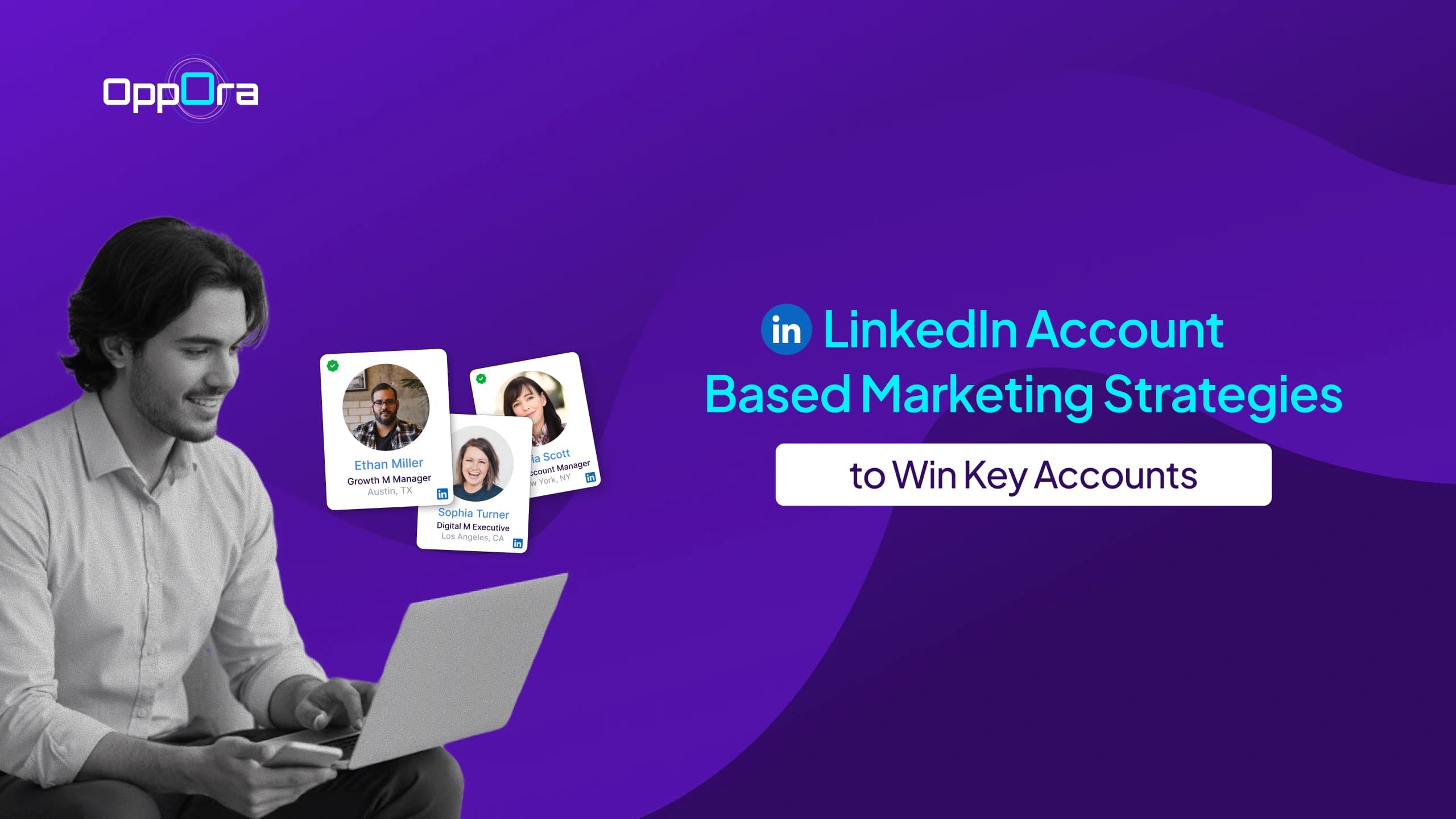
12 LinkedIn Account Based Marketing Strategies to Win Key Accounts
Stephen Parker
Published July 10, 2026
11 min
Complete Agentic Email Outreach
AI agents find and enrich prospects, personalize emails, follow up, and handle replies with your meeting link.
Claim Your FREE Credits
Winning high-value B2B accounts on LinkedIn is not about sending more connection requests.
It is about reaching the right companies, building trust with the right people, and showing up before your competitors do.
That is where LinkedIn account based marketing becomes powerful.
Instead of chasing random leads, you focus your sales and marketing efforts on a clear list of target accounts that actually fit your business.
In this guide, we will cover:
- Why LinkedIn ABM works so well for B2B growth
- How to build the right foundation first
- 12 LinkedIn account based marketing strategies to win key accounts
Why LinkedIn Account Based Marketing Delivers Better B2B Results
Most B2B deals do not happen because one person liked your message.
They happen when several people inside the same company understand your value, trust your brand, and feel confident enough to move the conversation forward.
That is why LinkedIn account based marketing works so well.
It helps you stop chasing individual leads and start building influence inside the companies you actually want to win.
Instead of treating LinkedIn as a simple outreach channel, ABM turns it into a focused B2B sales strategy for reaching the right accounts, engaging multiple decision-makers, and moving better-fit opportunities into your sales pipeline.
Reach the Entire Buying Committee Instead of One Prospect
In most high-value B2B deals, one person rarely makes the final decision alone.
There may be a founder, department head, finance person, technical evaluator, end user, and sometimes even an external advisor involved.
With LinkedIn ABM, you can identify and engage multiple people from the same target account instead of relying on one contact.
This gives you more visibility inside the company.
When different stakeholders see your posts, receive thoughtful messages, or notice your profile, your brand starts feeling familiar before a meeting is even booked.
Build Relationships Before the Sales Conversation
Cold outreach on LinkedIn becomes harder when the first interaction feels random.
LinkedIn gives you a way to warm up key accounts before asking for time on their calendar.
You can comment on their posts, react to company updates, share useful insights, and connect around topics they already care about.
This makes your first message feel less like an interruption.
By the time you start a direct sales conversation, they may already recognize your name, understand your point of view, or associate you with a specific problem they are trying to solve.
That is why your LinkedIn connection message should feel natural, relevant, and connected to the relationship you are trying to build.
Align Sales and Marketing Around Shared Target Accounts
Traditional lead generation often separates sales and marketing.
Marketing brings in leads, and sales tries to qualify them later.
Account based marketing on LinkedIn brings both teams around the same target accounts from the beginning.
Marketing can create content that speaks to those accounts.
Sales can use that engagement data to start better conversations.
Together, both teams focus on quality accounts, stronger timing, and pipeline growth instead of disconnected activity.
Build a Strong Foundation Before Starting Your LinkedIn ABM Strategy
LinkedIn account based marketing works best when you know exactly who you are trying to reach.
Without that clarity, even the best outreach, content, and engagement can turn into scattered activity.
Before you start sending connection requests or building campaigns, you need a strong foundation that keeps your strategy focused on the right accounts.
Define Your Ideal Customer Profile (ICP)
Your Ideal Customer Profile helps you decide which companies are actually worth targeting.
Think about the accounts that are most likely to need your solution, afford it, and benefit from it long term.
Your ICP can include details like:
- Industry
- Company size
- Revenue range
- Location
- Team structure
- Growth stage
- Current pain points
- Tools they already use
The goal is not to target every company that could buy from you.
The goal is to identify the companies where your solution makes the most sense.
When your ICP is clear, every part of your LinkedIn ABM strategy becomes easier.
You know who to search for, what content to create, and which conversations are worth starting.
Prioritize Target Accounts by Revenue Potential
Not every target account deserves the same level of attention.
Some accounts may be a perfect fit but have smaller deal potential.
Others may take longer to win, but the revenue impact can be much higher.
That is why you should prioritize your account list before outreach begins.
You can group accounts into tiers based on revenue potential, strategic value, buying readiness, or how closely they match your ICP.
Your highest-value accounts should get deeper research, more personalized outreach, and stronger sales-marketing coordination.
Lower-priority accounts can still be part of your campaigns, but they should not take the same manual effort.
Identify Decision-Makers and Key Influencers
Once you know which accounts matter most, the next step is mapping the people inside them.
You need to identify decision-makers, budget owners, users, champions, and influencers.
LinkedIn makes this easier because you can see roles, team structures, recent posts, job changes, and company activity.
This helps you understand who can approve the deal, who can block it, and who can help build internal interest.
The stronger your contact map is, the less dependent you become on one person replying.
12 LinkedIn Account Based Marketing Strategies to Win More High-Value Accounts
Once your foundation is clear, the next step is execution.
LinkedIn account based marketing is not about running one campaign and hoping the right people respond.
It is about reaching the right accounts, building trust with stakeholders, and keeping every touchpoint connected.
Here are 12 practical strategies to win more high-value accounts.
1. Using Oppora AI to Scale Your LinkedIn Account Based Marketing
LinkedIn ABM becomes difficult when you start managing more accounts, more stakeholders, and more follow-ups.
Oppora.ai helps you bring those moving parts into one connected workspace.
You can use it to:
- Build and enrich target account lists
- Find verified decision-makers inside each company
- Add company and contact enrichment before outreach
- Manage accounts, campaigns, replies, and meetings in one place
- Create AI-powered personalization for LinkedIn and email outreach
- Coordinate LinkedIn, email, and CRM activity without switching tools
- Use automation workflows to keep repetitive ABM tasks moving
This matters because ABM is not just lead generation.
You are managing relationships across accounts, buying committees, and different stages of interest.
With Oppora, you can set up workflows that find leads, verify contact data, personalize messages, send outreach, handle replies, and sync activity with your CRM.
That makes it easier to scale LinkedIn ABM without spreadsheets, manual reminders, and disconnected tools.
2. Focus on High-Value Accounts Instead of High Lead Volume
Traditional prospecting often pushes you to chase more leads.
But LinkedIn ABM works better when you focus on fewer, higher-value accounts.
To do this well:
- Start with accounts that closely match your ICP
- Look for companies with strong revenue potential
- Prioritize accounts where your solution solves a clear problem
- Separate high-priority accounts from lower-intent opportunities
- Give your best accounts deeper research and stronger personalization
The goal is not to reach every possible buyer.
The goal is to spend more time with companies that can create real pipeline impact.
When your account list is smaller and more focused, every message becomes more relevant.
3. Research Every Account Before Making First Contact
Your first message should never feel like it was sent to a random list.
Before reaching out, study the company and the people inside it.
Look at:
- Company updates
- Recent hiring activity
- Funding or expansion news
- Product launches
- Leadership changes
- Posts from key stakeholders
- Pain points connected to your solution
This research helps you understand what is happening inside the account.
It also gives you a natural reason to start the conversation.
Instead of sending a generic pitch, you can connect your message to something specific the company is already doing or discussing.
That small shift makes your outreach feel more thoughtful.
4. Connect With Multiple Stakeholders Across the Buying Committee
A single contact is rarely enough to win a high-value B2B account.
Most deals involve several people, including decision-makers, influencers, technical evaluators, end users, and budget owners.
So your LinkedIn ABM strategy should include multiple stakeholders from each target account.
You can:
- Connect with senior decision-makers
- Engage department leaders who feel the pain directly
- Follow users who may influence the buying decision
- Identify champions who can support the conversation internally
- Build visibility across the account before the sales call
This reduces your dependency on one person.
It also helps your brand become familiar across the company.
When the account is ready to talk, more people already know who you are.
5. Strengthen Your Personal Brand to Build Trust
Your LinkedIn profile supports every ABM touchpoint.
When someone sees your comment, connection request, or message, they may check your profile before replying.
Make sure your profile clearly shows:
- Who you help
- What problem you solve
- Why your experience is relevant
- What kind of insights you share
- How your solution connects to their business goals
Then support your profile with useful content.
You can share lessons, industry observations, customer problems, practical tips, and opinions your target accounts would care about.
You do not need to post every day.
But you do need to look credible when prospects visit your profile.
Trust often starts before the first reply.
6. Personalize Every Outreach Using Account-Specific Insights
Personalization is more than using someone’s name.
In LinkedIn account based marketing, personalization should connect your message to the account’s real situation.
Use insights like:
- A recent company update
- A hiring trend
- A role-specific challenge
- A post the prospect shared
- A market shift affecting their team
- A problem common in their industry
Keep your message short and clear.
A strong outreach message should quickly explain:
- Why you are reaching out
- Why it matters to this account
- What useful next step you are suggesting
This makes the message feel relevant instead of automated.
When prospects feel understood, replies become more likely.
7. Warm Up Prospects Through Consistent LinkedIn Engagement
You do not always need to start with a direct message.
LinkedIn gives you many ways to become familiar before asking for a meeting.
You can warm up target accounts by:
- Following company pages
- Reacting to relevant posts
- Leaving thoughtful comments
- Sharing useful perspectives
- Congratulating prospects on milestones
- Engaging with company announcements
The key is to be genuine.
Do not comment just to appear in their notifications.
Add something useful, ask a smart question, or connect their post to a broader business problem.
When you later send a message, your name may already feel familiar.
That makes outreach feel less cold.
8. Use Buying Signals to Reach Accounts at the Right Time
Timing can change the success of your ABM campaign.
A great-fit account may ignore you when the problem is not urgent.
But the same account may respond when there is a clear trigger.
Watch for buying signals such as:
- New hiring plans
- Funding announcements
- Leadership changes
- Expansion into new markets
- New tool adoption
- Team restructuring
- Posts about challenges your solution solves
These signals help you reach out when the account is more likely to care.
Your message can connect directly to what is happening now.
That makes your outreach feel timely instead of forced.
9. Keep Every Target Account Organized Throughout the Sales Cycle
ABM gets messy when information lives in different places.
You may have LinkedIn conversations, email threads, CRM notes, research details, and follow-up reminders spread across tools.
To stay organized, track:
- Account priority
- Key stakeholders
- Role and influence level
- Engagement history
- Pain points
- Buying signals
- Messages sent
- Replies received
- Next steps
This gives you a clear account view.
It also helps sales and marketing stay aligned.
When everyone sees the same account context, follow-ups become sharper and handoffs become smoother.
10. Automate Repetitive ABM Tasks Without Losing Personalization
Automation should support your ABM strategy, not replace the human part.
Do not automate generic spam.
Instead, automate the tasks that slow your team down.
This can include:
- Account list building
- Contact enrichment
- Email verification
- CRM updates
- Follow-up reminders
- Campaign scheduling
- Engagement tracking
- Reporting
Your effort should stay focused on research, strategy, message quality, and relationships.
When automation handles the repetitive work, you can spend more time on high-value conversations.
That is how you scale ABM without making it feel robotic.
11. Coordinate LinkedIn, Email, and CRM Outreach
LinkedIn is powerful, but it should not work alone.
Some prospects are active on LinkedIn.
Others respond better by email.
Your CRM keeps the full account history organized.
A coordinated ABM motion can look like this:
- Engage with a prospect on LinkedIn
- Send a personalized connection request
- Follow up with a relevant email
- Track every interaction in your CRM
- Continue outreach based on engagement and response
- Keep sales and marketing aligned around the same account
This creates a smoother experience for the prospect.
It also prevents duplicate outreach, missed follow-ups, and disconnected messaging.
When each channel supports the others, your account based marketing on LinkedIn becomes much stronger.
12. Measure Account Engagement and Optimize for Pipeline Growth
LinkedIn ABM should not be measured only by likes, views, or connection acceptance rates.
Those numbers can help, but they do not show the full business impact.
Track metrics that connect to pipeline, such as:
- Account-level engagement
- Stakeholder replies
- Meetings booked
- Opportunities created
- Deal movement
- Revenue influenced
- Best-performing messages
- Best-performing account segments
This helps you understand what is actually working.
You can see which accounts are warming up, which messages create replies, and which industries move faster.
Over time, your strategy becomes sharper.
Instead of guessing, you use real account engagement to improve targeting, timing, personalization, and pipeline growth.
Common LinkedIn Account Based Marketing Mistakes That Cost You Target Accounts
LinkedIn account based marketing can help you win better accounts, but only when the strategy stays focused.
Small mistakes can quickly turn a thoughtful ABM motion into another generic outreach campaign.
Here are the mistakes you should avoid.
Targeting Too Many Accounts at Once
ABM is not about building the biggest account list.
If you target too many companies, your research becomes weak and your messaging becomes generic.
Start with a focused account list of high-value accounts where your solution clearly fits.
Relying on a Single Contact Within Each Company
One contact is not enough for most B2B deals.
If that person does not reply, leaves the company, or lacks authority, the opportunity can go cold.
Build relationships with multiple stakeholders across the buying committee.
Sending Generic Connection Requests and Messages
Generic outreach makes your message easy to ignore.
Avoid copy-paste connection requests that sound like every other sales pitch.
Use account-specific insights to show why the conversation is relevant right now.
Treating LinkedIn as Your Only ABM Channel
LinkedIn is powerful, but it should not work alone.
Some prospects may engage on LinkedIn but prefer email for serious conversations.
Connect LinkedIn, email, and CRM activity so every touchpoint supports the next one.
Tracking Vanity Metrics Instead of Revenue Impact
Likes, views, and connection acceptance rates can be helpful signals.
But they do not prove your ABM strategy is working.
Track account engagement, meetings booked, opportunities created, and pipeline influenced.
Conclusion
LinkedIn account based marketing works best when you stop chasing random leads and start focusing on the accounts that truly matter.
With the right foundation, you can identify high-value companies, understand the buying committee, build trust through LinkedIn engagement, and coordinate every touchpoint across your sales process.
The real advantage comes from being specific.
Specific accounts.Specific people.Specific messages.Specific timing.
That is how you turn LinkedIn from a networking platform into a serious ABM channel.
And as your target account list grows, managing everything manually can become difficult.
That is where a platform like Oppora.ai can help.
You can build account lists, enrich contacts, personalize outreach, coordinate LinkedIn and email, and keep your CRM updated from one place.
So your ABM strategy stays focused, organized, and scalable without losing the human touch.
Frequently Asked Questions
What is LinkedIn account based marketing?
LinkedIn account based marketing is a B2B strategy where you use LinkedIn to target specific high-value companies, connect with the right stakeholders, and build trust through personalized engagement and outreach.
How is account based marketing on LinkedIn different from traditional lead generation?
Traditional lead generation focuses on getting more leads, while LinkedIn ABM focuses on winning the right accounts. You start with target companies first, then reach the people who influence the buying decision.
Is LinkedIn Account Based Marketing suitable for small businesses?
Yes, LinkedIn ABM works well for small businesses because it helps you focus your time on fewer, better-fit accounts instead of wasting effort on low-quality leads.
What are the best tools for account based marketing with LinkedIn?
Useful tools include LinkedIn Sales Navigator, a CRM, enrichment tools, and outreach software. Oppora.ai can also help you build account lists, enrich contacts, personalize outreach, and coordinate LinkedIn, email, and CRM activity.
How do you measure the success of a LinkedIn ABM campaign?
Measure LinkedIn ABM by account engagement, stakeholder replies, meetings booked, opportunities created, pipeline influenced, and revenue from your target accounts.
Summarize with AI
Share