Home
Blog
Find 500 B2B Contacts for Free Every Month with Built-In Outreach.
Home
Blog
Adam Hossain
Published April 8, 2026
14 min
Try Oppora AI
Create Self-Running Agentic Sales Workflows like N8N just by chatting with AI
Get Started for FREE
Most outbound GTM strategies don’t fail because of effort—they fail because of poor timing, generic messaging, and unclear targeting.
You might be reaching out consistently, but without the right signals and structure, it rarely turns into real pipeline.
The good news is, outbound today is no longer about volume—it’s about precision and speed.
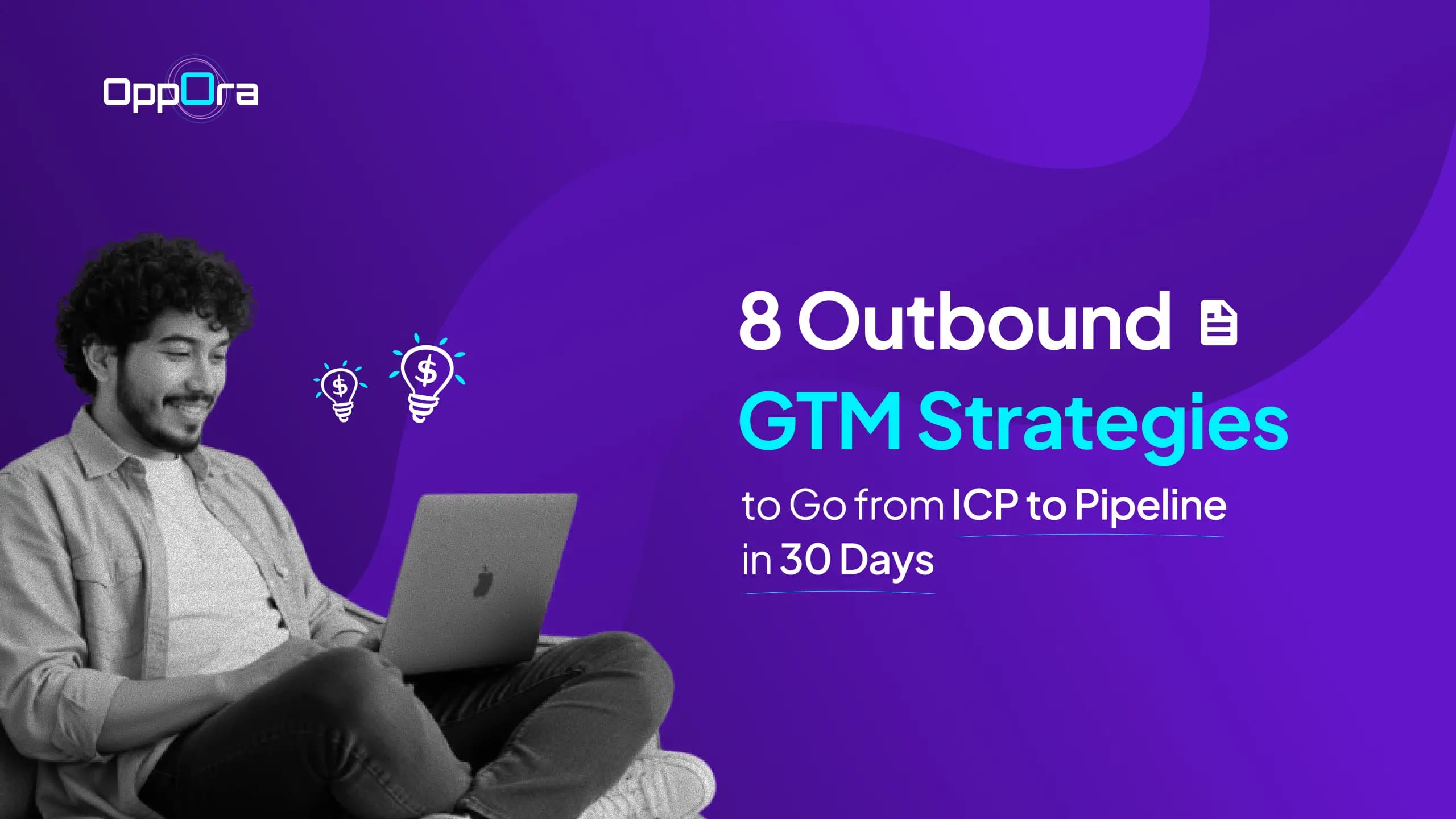
In this guide, you’ll learn how to turn your ideal customer profile into a predictable pipeline in just 30 days.
Here’s what we’ll cover:
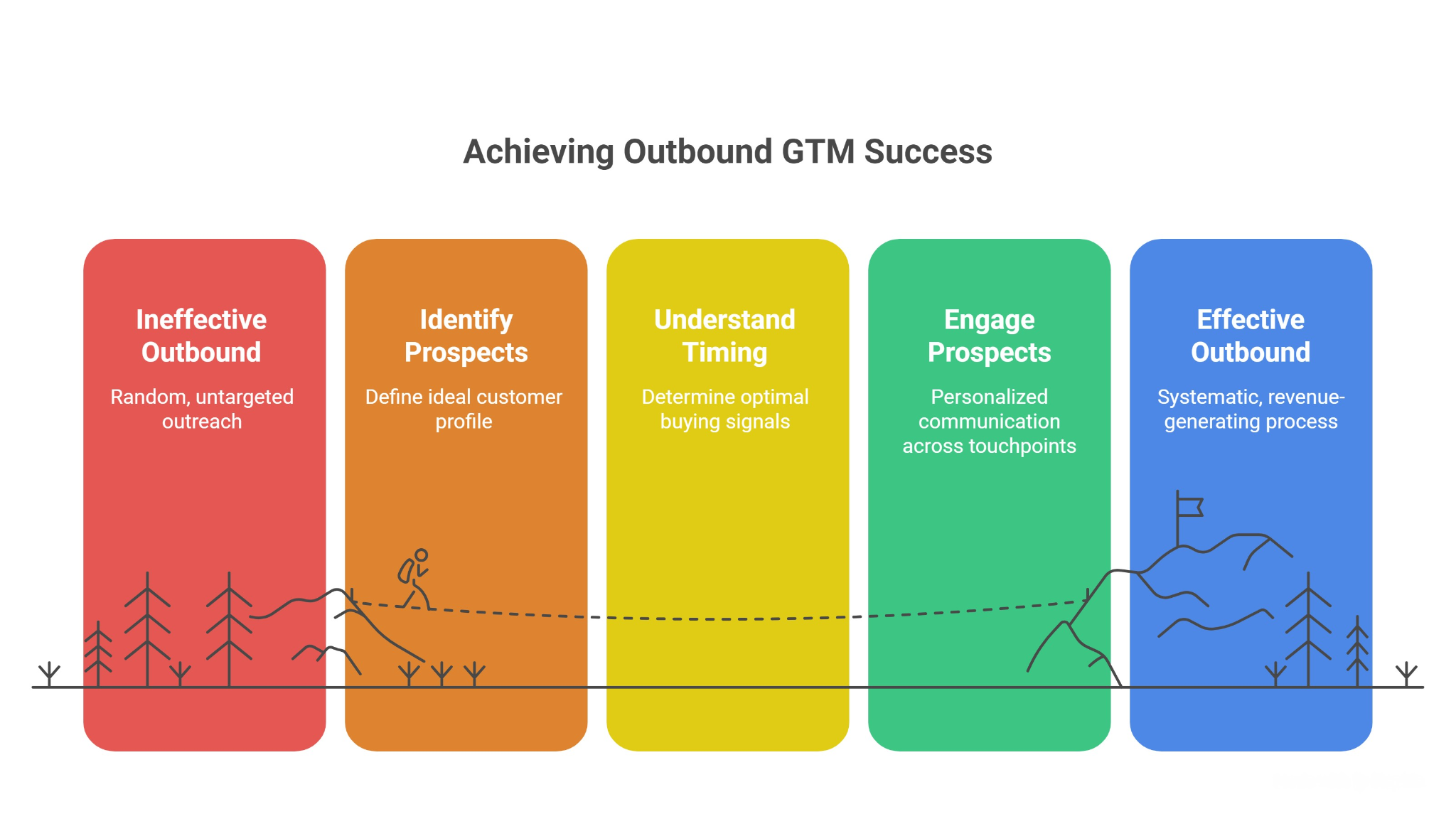
Outbound GTM is often misunderstood as just sending cold emails or running sequences, but that’s only a small part of the picture.
At its core, outbound GTM is a systematic way to identify, reach, and convert the right prospects at the right time.
It’s not about blasting messages to a large list and hoping something sticks.
Instead, it’s about building a repeatable process where every step from targeting to messaging to follow-ups is intentional and connected.
Think of it like this: outbound GTM is the bridge between your ideal customer profile and actual revenue.
You define who you want to reach, understand when they are most likely to buy, and then engage them with relevant, personalized communication across multiple touchpoints.
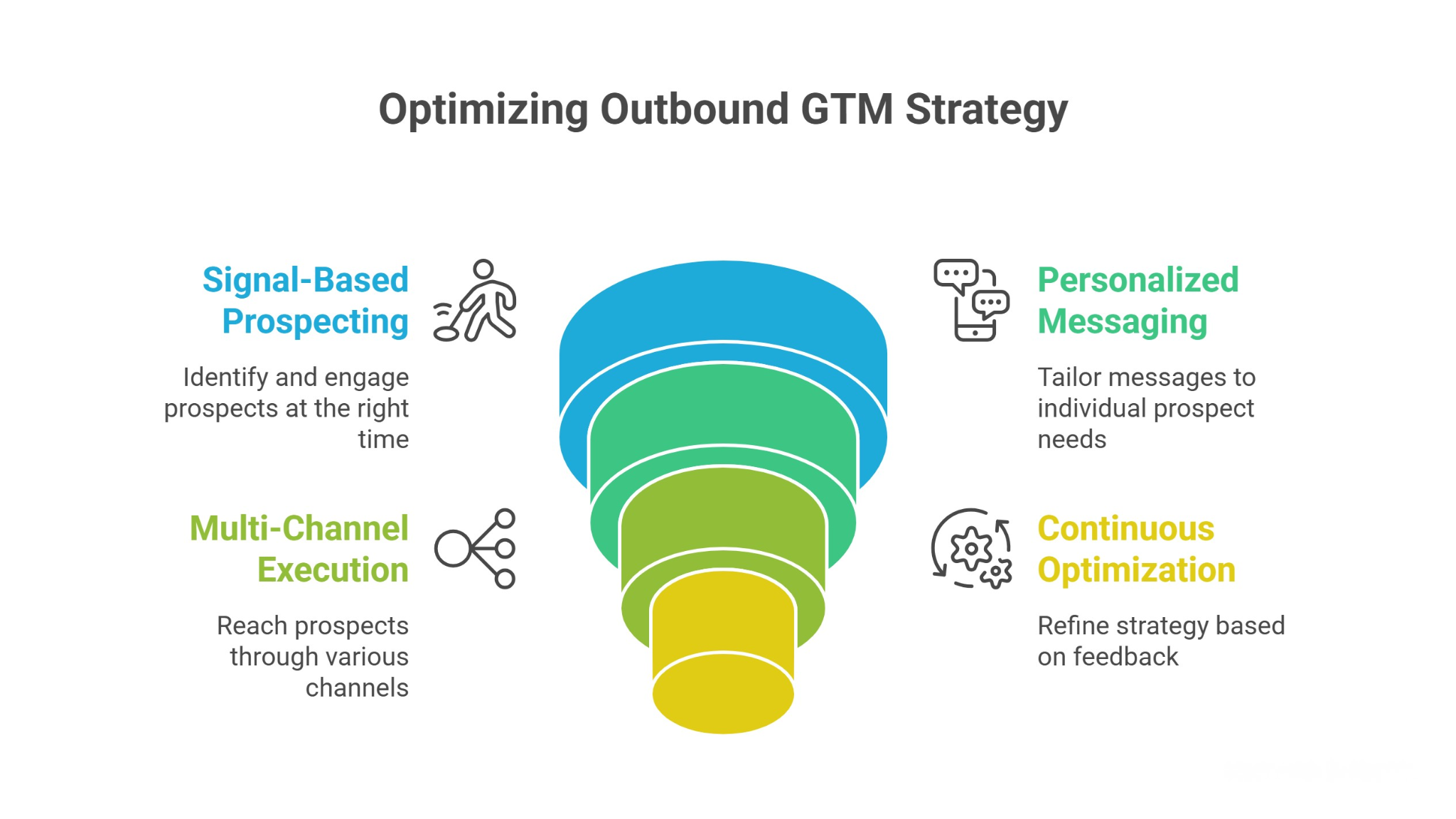
Now that you understand what outbound GTM really means, the next step is breaking down what actually makes it work.
A high-performing outbound strategy isn’t built on one tactic.
It’s a combination of multiple components working together as a system.
When these pieces align, outbound stops feeling random and starts becoming scalable.
Everything starts with your ICP, but not in the generic way most teams define it.
Saying “B2B SaaS companies with 50–200 employees” is not enough to drive real outbound results.
Your ICP needs to be actionable, meaning it should guide who you target and why they are likely to buy now.
This includes factors like:
A strong ICP helps you avoid wasted effort and ensures every outreach has a higher probability of conversion.
Even the perfect ICP won’t convert if your timing is off.
This is where signals come in.
Signals are events or behaviors that indicate a prospect might be ready to engage, such as hiring activity, funding announcements, or increased LinkedIn engagement.
Instead of reaching out randomly, you prioritize accounts based on these signals.
This allows you to connect with prospects when they are already thinking about solving a problem.
Timing is often the difference between being ignored and getting a reply.
Personalization is no longer optional, but doing it manually doesn’t scale.
You need a way to combine relevance with efficiency.
This means going beyond just adding a first name or company name.
Your messaging should reflect:
The goal is to make every message feel intentional, even when you’re reaching out to hundreds of prospects.
When personalization is done right, it increases both response rates and trust.
Relying on a single channel limits your chances of getting noticed.
Prospects today are active across multiple platforms, and your outreach should reflect that.
A strong outbound strategy combines channels like:
This creates multiple touchpoints and reinforces your message over time.
Instead of one-off interactions, you build familiarity and credibility with each touch.
Multi-channel execution increases visibility and improves overall conversion rates.
Outbound GTM is not a set-it-and-forget-it process.
It requires constant iteration based on real feedback.
Every reply, open rate, and conversion gives you insights into what’s working and what’s not.
You should continuously refine:
Small improvements compound quickly in outbound.
The teams that succeed are the ones that treat outbound as an evolving system, not a fixed playbook.
Over time, this creates a strong feedback loop that makes your pipeline more predictable and efficient.
Now that you understand the building blocks of outbound GTM, the next step is execution.
This is where most teams get stuck—not because they lack ideas, but because they don’t know how to translate strategy into consistent pipeline.
The following strategies are designed to help you move fast, stay focused, and start generating results within weeks, not months.
Most outbound efforts fail because teams rely on static lists.
You build a list once, and then keep reaching out to the same prospects without considering what’s changed.
Instead, you should create ICP segments based on triggers.
These triggers could include:
When you segment your ICP based on these events, your outreach becomes timely and relevant.
You’re no longer just targeting the right companies—you’re targeting them at the right moment.
This shift alone can significantly improve response rates and pipeline quality.
Not all signals are equal, and relying on a single trigger can still lead to weak prioritization.
This is where signal stacking becomes powerful.
Instead of acting on one signal, you combine multiple signals to identify high-intent accounts.
For example, a company that:
is far more likely to be in a buying phase than one with just a single signal.
By stacking signals, you create a prioritization layer within your ICP.
This helps you focus your time and effort on accounts that are most likely to convert, instead of spreading yourself too thin.
Finding the right prospects from scratch can be time-consuming.
A faster approach is to look at who is already buying from your competitors.
These companies have already validated the problem you’re solving, which makes them high-probability targets.
You can identify competitor customers through:
Once you have this list, you can position your outreach around differentiation.
Instead of introducing a new idea, you’re offering a better alternative.
This reduces friction in conversations and helps you move prospects through the pipeline faster.
Personalization works best when it’s based on real, recent context.
LinkedIn is one of the richest sources of this context.
By analyzing a prospect’s activity, you can understand:
This allows you to craft messages that feel highly relevant and timely.
For instance, referencing a recent post or comment shows that your outreach is not random.
It signals effort and intent, which immediately sets you apart from generic outreach.
When you consistently use LinkedIn activity for personalization, your messages feel more human and less like automation—while still being scalable.
If you rely on just one channel, you limit your chances of getting noticed.
Your prospects are not sitting in one place they’re checking emails, scrolling LinkedIn, and engaging across platforms throughout the day.
That’s why combining email and LinkedIn creates a stronger, more consistent presence.
Instead of sending one email and waiting, you can:
This builds familiarity over time.
When a prospect sees your name in multiple places, your outreach no longer feels cold—it feels intentional.
Multi-channel touchpoints increase visibility, improve trust, and significantly boost reply rates without increasing volume.
Personalization is powerful, but doing it manually slows you down.
You can’t research hundreds of prospects every day and still move fast.
This is where AI changes the game.
Instead of writing static templates, you can generate dynamic messages that adapt to each prospect.
AI can help you:
The key is that your outreach doesn’t feel templated.
Every message feels like it was written specifically for that person, even when you’re operating at scale.
This allows you to maintain quality while increasing output, which is critical for building pipeline quickly.
One of the biggest mistakes in outbound is overplanning.
Teams spend weeks building perfect lists, writing perfect sequences, and trying to get everything right before launching.
But outbound works best when you move fast and learn quickly.
Instead of launching one large campaign, start with small, testable batches.
For example:
This approach gives you real feedback quickly.
You don’t waste time guessing—you validate what works based on actual responses.
Small campaigns reduce risk and help you iterate faster, which is essential when your goal is to build pipeline in 30 days.
Your first few replies are more valuable than any assumption you make upfront.
They tell you exactly how your market is reacting to your messaging.
Instead of sticking to your original script, use these responses to refine your approach.
Look for patterns like:
Even negative replies are useful.
They show you what’s not working and where you need to adjust.
By continuously refining your messaging based on real feedback, you improve performance with every iteration.
This turns outbound into a learning system, not just an execution task.
Once you start seeing positive signals, the next step is to scale.
But scaling doesn’t mean doing more of everything—it means doing more of what’s already working.
If a specific:
is generating replies, focus your efforts there.
Increase volume gradually while maintaining quality and personalization.
At the same time, eliminate what’s not working to avoid wasting resources.
Scaling in outbound is about focus, not expansion.
When you double down on proven strategies, you accelerate pipeline growth and make your outbound GTM more predictable.
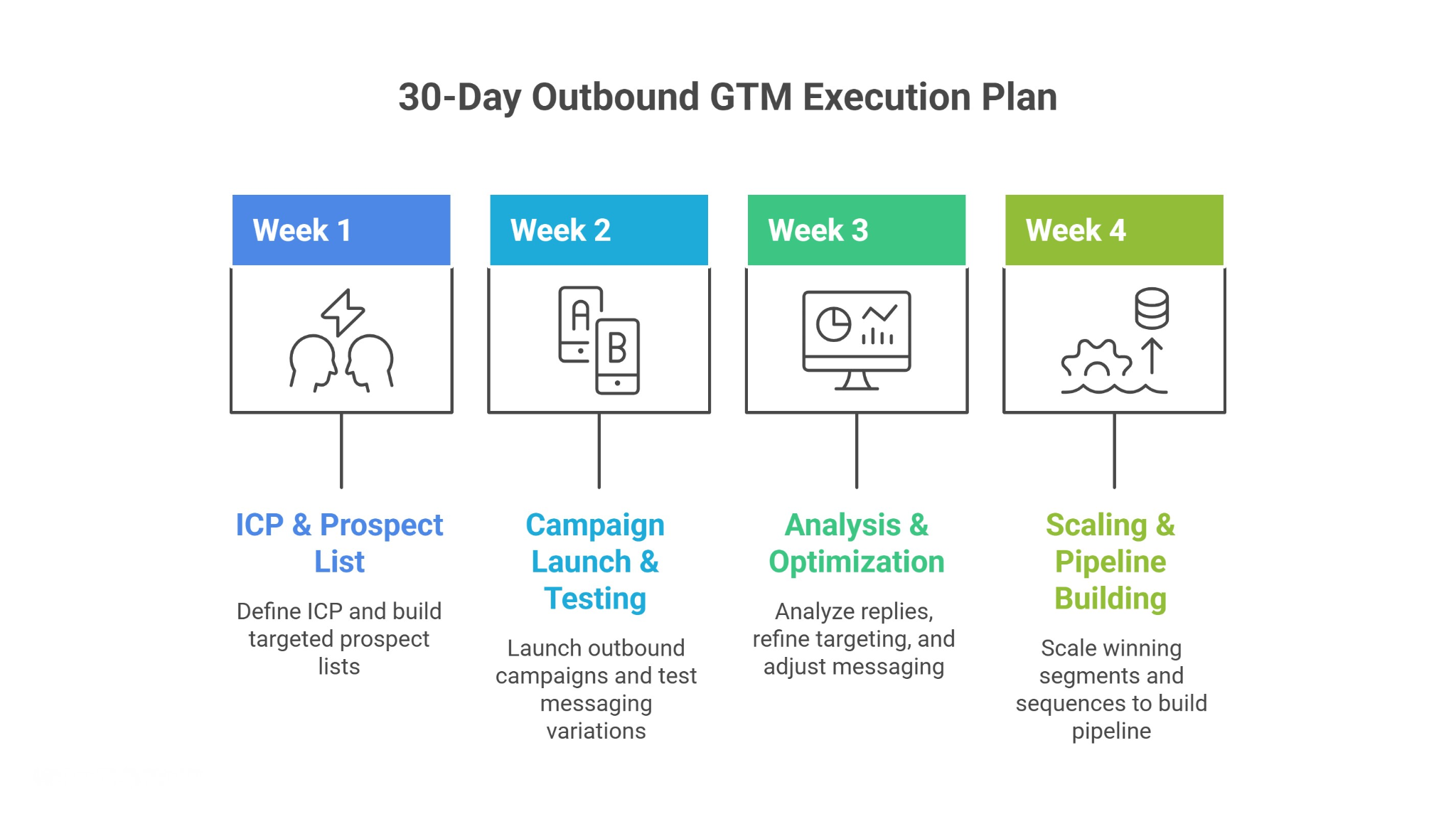
At this point, you understand the strategy and the tactics.
Now the real question is—how do you put everything together and start generating pipeline quickly?
The key is to avoid overcomplicating things and focus on execution in short, focused cycles.
This 30-day plan is designed to help you move from zero to a predictable outbound motion, without getting stuck in planning mode.
The first week is all about clarity and focus.
If you get this part wrong, everything that follows will feel inefficient.
Start by defining a sharp, actionable ICP.
Don’t just describe your ideal customer—identify who is most likely to buy right now.
Focus on:
Once your ICP is clear, move quickly into building your prospect list.
Instead of creating one large list, segment it based on triggers and intent signals.
Your goal by the end of Week 1 should be to have:
This sets the foundation for everything that follows.
Now that you have your list, it’s time to move into execution.
This is where many teams slow down—but speed matters here.
Launch small, controlled outbound campaigns instead of trying to perfect everything.
For each segment:
The goal is not perfection—it’s learning.
You want to start conversations and gather feedback as quickly as possible.
During this week, you should aim to:
By the end of Week 2, you should start seeing:
This is where your outbound motion starts becoming real.
By Week 3, you’ll have enough data to make informed decisions.
This is where outbound starts shifting from guessing to optimizing.
Go beyond surface-level metrics and analyze actual responses.
Look for:
Use these insights to refine both your targeting and messaging.
You might realize that:
Make adjustments quickly.
Refine your lists, rewrite underperforming messages, and double down on what’s getting traction.
By the end of Week 3, your outbound should feel more focused and efficient, with clearer direction on where to invest your effort.
Now comes the scaling phase.
At this point, you’re no longer experimenting—you’re expanding what works.
Identify your top-performing:
Then increase volume strategically.
Instead of broadening your targeting, go deeper into the segments that are already responding.
This ensures you maintain quality while increasing output.
During this week, you should:
By the end of 30 days, you should have:
This creates a strong foundation you can continue to scale beyond the initial 30 days.
At this stage, you might notice something.
The strategy is clear, but execution involves multiple moving parts prospecting, enrichment, messaging, sending, follow-ups, and replies.
Managing all of this manually can slow you down and limit how fast you scale.
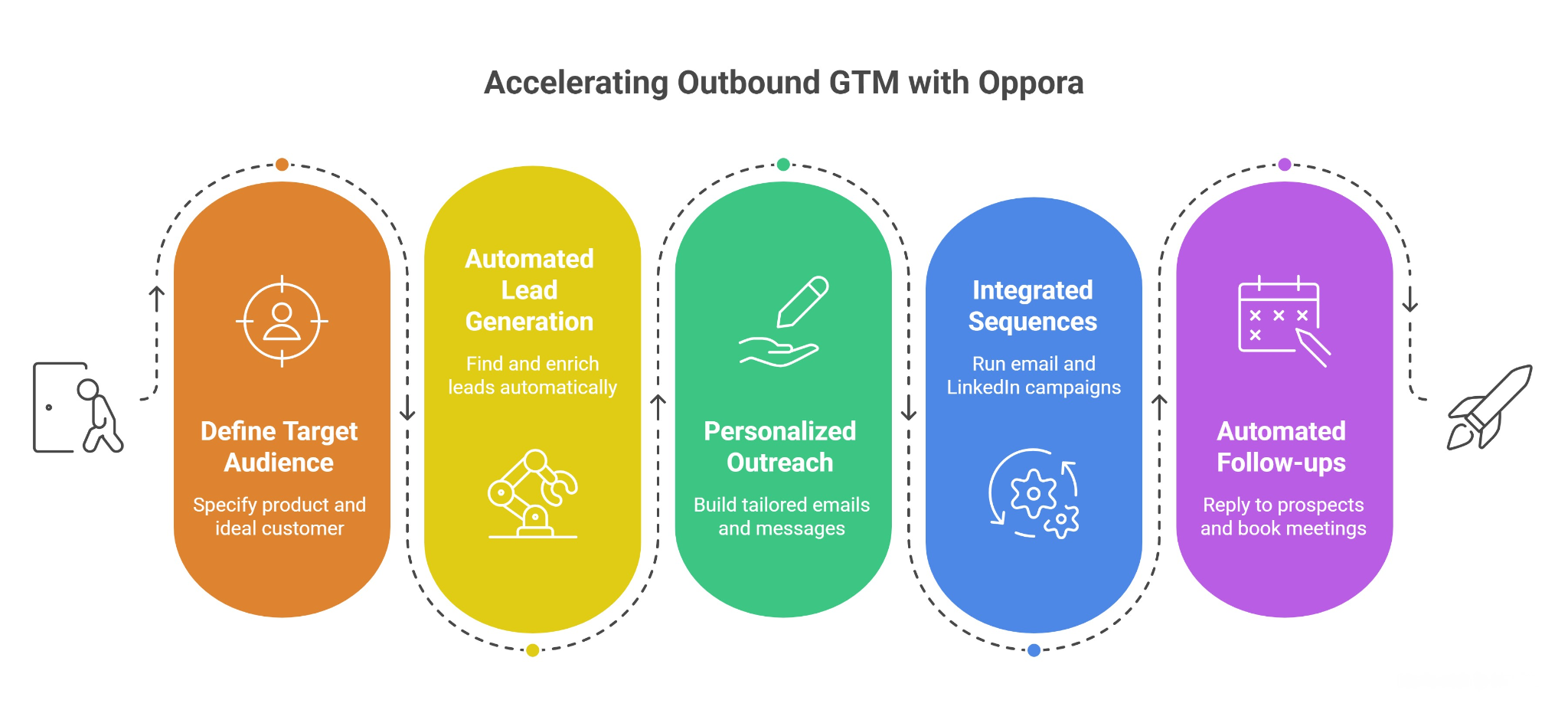
That’s exactly where Oppora comes in.
Oppora is an AI outbound sales agent that helps you go from defining your ICP to generating pipeline without managing every step manually.
Instead of doing prospecting, writing emails, sending campaigns, and replying separately, Oppora connects everything into one continuous system.
Here’s what it helps you do:
Instead of managing outbound as a set of tasks, Oppora helps you build a system that keeps running in the background.
So while you focus on refining strategy and closing deals, your outbound engine keeps generating pipeline consistently.
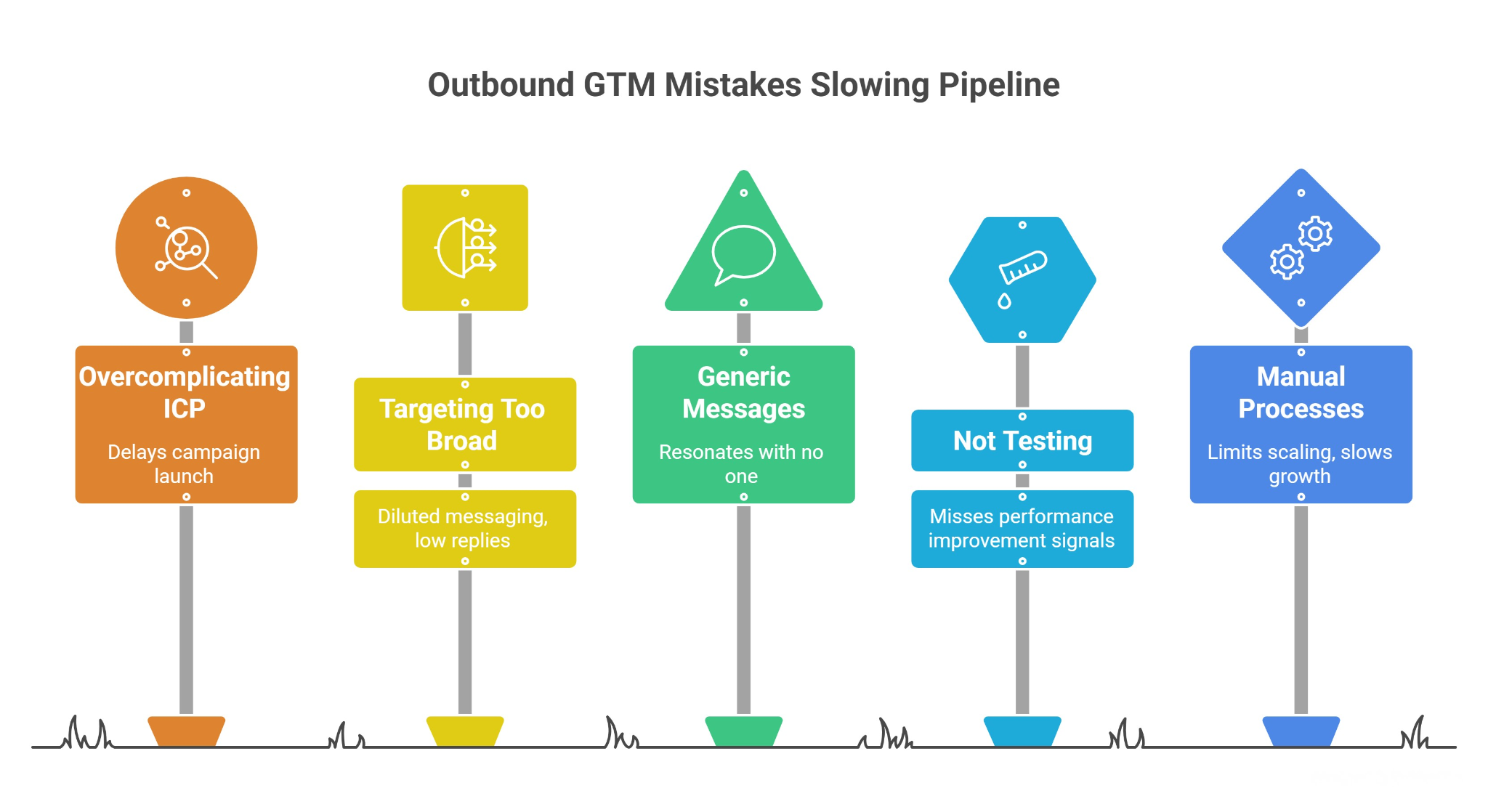
Even with the right strategy, outbound can fail if you fall into common execution traps.
Most teams don’t struggle because outbound doesn’t work they struggle because they approach it the wrong way.
If your pipeline feels slower than expected, chances are one of these mistakes is holding you back.
It’s easy to spend weeks refining your ICP, adding more filters, and trying to make it perfect.
But the more you overthink it, the longer you delay actual outreach.
Your ICP doesn’t need to be perfect—it needs to be good enough to start.
Clarity comes from execution, not endless planning.
Start with a focused ICP, launch campaigns, and refine based on real responses instead of assumptions.
Trying to target everyone within your ICP is a common mistake.
Not all prospects are equally likely to convert at the same time.
Without prioritization, your outreach becomes diluted and less effective.
This is where signals matter.
Focus on prospects showing intent—those hiring, growing, or actively engaging in your space.
A smaller, high-intent list will always outperform a large, generic one.
Generic outreach is one of the fastest ways to get ignored.
If your message looks like it could be sent to anyone, it won’t resonate with anyone.
Prospects can instantly recognize templated, low-effort emails.
Your messaging needs to reflect context:
Even small layers of personalization can make a big difference in response rates.
Outbound is not a one-time setup—it’s an ongoing process of learning and improving.
If you launch campaigns and don’t actively test or iterate, performance will plateau.
You should constantly experiment with:
The faster you test, the faster you learn what works.
And the faster you learn, the faster your pipeline grows.
Manual outbound might work in the beginning, but it quickly becomes a bottleneck.
Researching leads, writing emails, sending follow-ups, and managing replies one by one is not sustainable.
As volume increases, consistency drops.
This leads to missed opportunities and slower pipeline growth.
To scale effectively, you need systems that handle repetitive tasks while maintaining quality.
Outbound GTM works best when it’s treated as a system, not a series of isolated activities.
If you want to go from ICP to pipeline faster, focus on a few key principles:
When you combine these elements, outbound stops feeling unpredictable.
It becomes a repeatable engine that consistently generates pipeline and growth.
And if you want to skip the manual work of stitching all of this together, tools like Oppora can help you turn this entire process into a self-running outbound system.
Instead of managing every step, you set your ICP and workflow once—and let AI handle prospecting, outreach, and follow-ups in the background.
If you’re looking to move faster and build pipeline without the usual bottlenecks, it’s worth exploring how Oppora fits into your outbound GTM.
A good starting range is 200–500 high-quality, signal-based prospects. This allows you to test messaging, gather meaningful response data, and iterate quickly without overwhelming your system or sacrificing personalization quality.
A healthy reply rate typically ranges between 5% to 15%, depending on your targeting and personalization quality. Highly targeted, signal-based campaigns with strong messaging can exceed this range, especially in niche B2B markets.
Most effective outbound sequences include 4–7 touchpoints spread over 10–20 days. This usually combines email and LinkedIn interactions, ensuring enough follow-ups without becoming overly aggressive or spammy.
No. With the right systems and automation, even a solo founder or small team can run outbound efficiently. The key is having structured workflows and tools that reduce manual effort while maintaining consistency and personalization.
You should scale once you see consistent positive signals—such as steady reply rates, booked meetings, and clear messaging resonance. At that point, expand volume within the same high-performing ICP segments instead of broadening your targeting too quickly.
Summarize with AI
Share