12 Practical Agentic AI Examples for Business Automation
Manasa Goli
Published May 22, 2026
6 min
Complete Agentic Email Outreach
AI agents find and enrich prospects, personalize emails, follow up, handle replies, and book meetings automatically.
Claim Your FREE Credits
Most businesses already use AI in some way.
Maybe you use AI tools to write emails, summarize meetings, or generate reports. But in most cases, people still have to manually manage the workflow, move data between tools, and decide what happens next.
That’s where agentic AI changes things.
Instead of helping with only one task, agentic AI systems can plan, make decisions, take actions, and continue workflows automatically with minimal human involvement.
In this guide, we’ll cover:
- What agentic AI actually means
- How agentic AI helps businesses automate work
- Practical agentic AI examples across different industries
- Why businesses are moving toward autonomous AI workflows
- How Oppora.ai uses agentic AI for sales automation
What Is Agentic AI?
Agentic AI is a type of AI system that can independently plan, make decisions, and execute tasks to achieve a goal.
Unlike traditional AI tools that only respond to prompts or complete one-time actions, agentic AI can handle entire workflows with minimal human involvement.
For example, instead of simply writing an email, an agentic AI system can:
- Find leads
- Verify contact information
- Write personalized outreach
- Send follow-ups
- Handle replies
- Update the CRM automatically
This makes agentic AI feel less like a simple assistant and more like an autonomous worker that can continuously execute tasks across different business operations.
How Agentic AI Helps Businesses Automate Work
Most businesses lose time on repetitive manual tasks.
Teams constantly switch between tools, update records, send follow-ups, assign tasks, and monitor workflows manually every day.
Agentic AI helps automate these processes by connecting actions together into self-running workflows.
Instead of requiring constant supervision, AI agents can continue executing tasks based on goals, conditions, and real-time data.
This helps businesses:
- Reduce repetitive work
- Improve operational speed
- Scale processes without hiring large teams
- Minimize human errors
- Keep workflows running continuously
That’s why many companies are now moving from basic AI tools toward fully automated AI systems.
Practical Agentic AI Examples for Business Automation
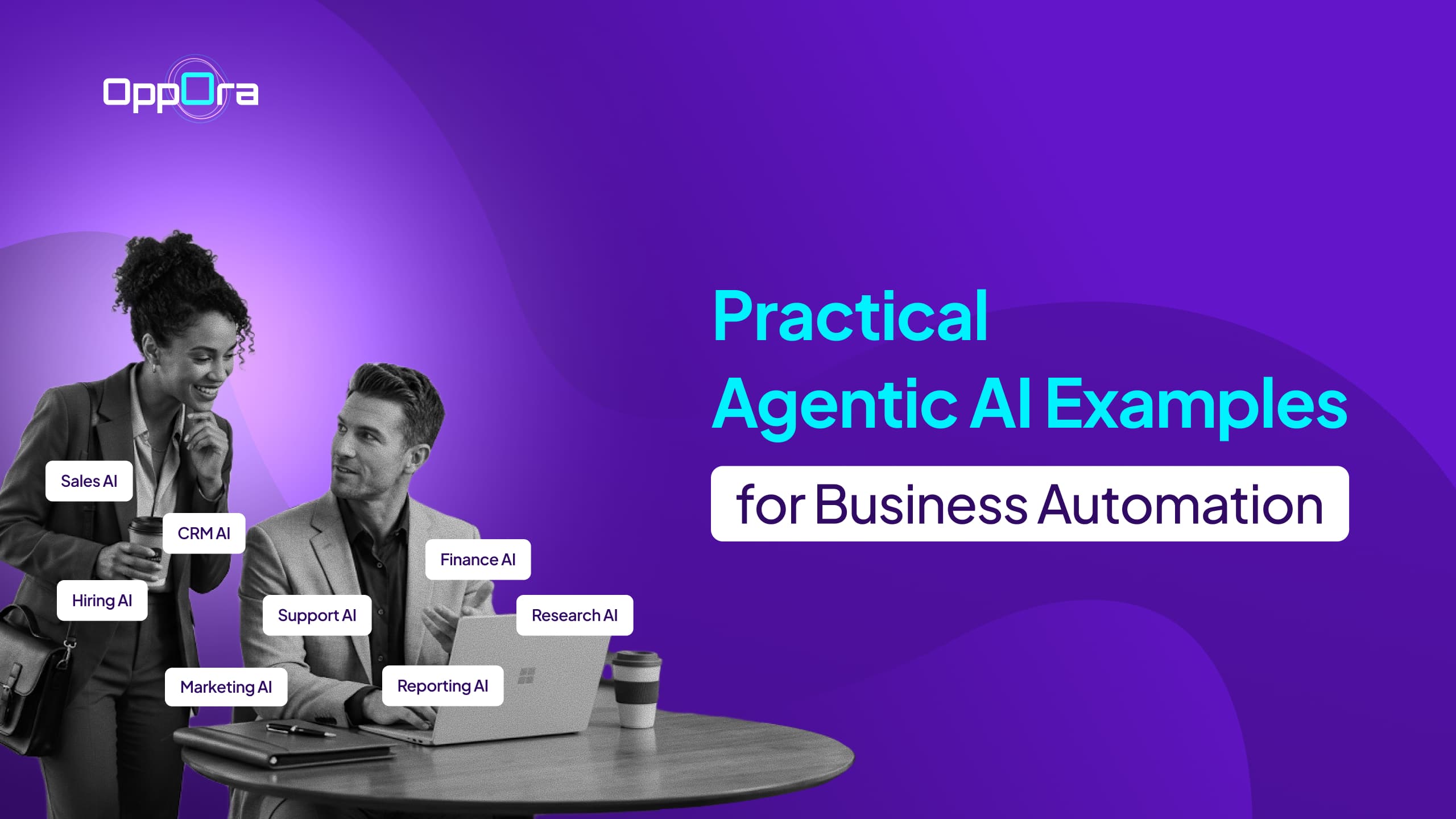
Agentic AI is no longer just a future concept. Businesses are already using AI agents to automate repetitive tasks, manage workflows, and reduce manual work across different departments.
From sales and recruiting to finance and customer support, these AI systems can handle multi-step processes with minimal human involvement.
Below are some practical agentic AI examples businesses are actively using today.
1. AI Sales Outreach Agents
AI sales outreach agents automate the outbound sales process by handling prospecting, email outreach, follow-ups, and lead management automatically.
For example, an AI sales agent can find SaaS founders on LinkedIn, verify their email addresses, write personalized cold emails, send follow-ups automatically, respond to interested leads, and book meetings into the sales team’s calendar without manual work.
2. Customer Support AI Agents
Customer support AI agents help businesses handle support conversations, resolve common issues, and improve response times automatically.
For example, an AI support agent can answer refund requests, reset customer passwords, route technical problems to the right department, and update ticket statuses without requiring human agents for every interaction.
3. AI Recruiting and Hiring Agents
AI recruiting agents automate different parts of the hiring process, helping companies save time while managing large numbers of applicants.
For example, a recruiting AI agent can scan resumes, shortlist qualified candidates, send interview invitations, coordinate schedules, and follow up with applicants automatically throughout the hiring process.
4. AI Marketing Campaign Agents
AI marketing agents help businesses automate campaign creation, optimization, and performance tracking across multiple channels.
For example, a marketing AI agent can launch email campaigns, test different subject lines, optimize ad targeting, pause low-performing ads, and increase spending on campaigns generating better conversions automatically.
5. AI CRM and Lead Management Agents
AI CRM agents help businesses keep customer and lead data clean, updated, and organized automatically.
For example, an AI CRM agent can enrich lead information, update contact records, remove duplicate entries, track sales activity, and organize pipelines without sales teams manually updating the CRM every day.
6. AI Finance and Invoice Processing Agents
AI finance agents automate repetitive financial tasks like invoice processing, payment tracking, and expense management.
For example, a finance AI agent can read invoices, extract payment information, approve recurring expenses, send overdue payment reminders, and flag suspicious transactions for human review automatically.
7. AI Research and Competitive Intelligence Agents
AI research agents help businesses continuously monitor competitors, market trends, and industry changes without manual research work.
For example, an AI research agent can track competitor pricing pages, monitor product launches, summarize industry news, and alert teams whenever important market changes happen.
Suggested Reading:
10 Best Outbound Lead Generation Tools Tested for Real Results8. AI Workflow and Team Coordination Agents
AI workflow agents help businesses automate internal coordination tasks and improve operational efficiency.
For example, an AI workflow agent can schedule meetings, assign tasks after calls, send reminders to team members, update project boards, and notify managers about delayed work automatically.
9. AI Inventory and Supply Chain Agents
AI inventory agents help businesses manage stock levels, supplier coordination, and demand forecasting more efficiently.
For example, an inventory AI agent can predict stock shortages, monitor warehouse inventory, place supplier orders automatically, and adjust inventory planning based on seasonal demand trends.
10. AI HR and Employee Onboarding Agents
AI HR agents automate onboarding and employee management workflows to reduce repetitive HR work.
For example, an HR AI agent can collect employee documents, assign onboarding tasks, schedule training sessions, explain company policies, and answer common HR questions automatically.
11. AI E-commerce Personalization Agents
AI e-commerce agents help online stores personalize customer experiences and improve retention automatically.
For example, an e-commerce AI agent can recommend products based on browsing behavior, send abandoned cart reminders, offer personalized discounts, and launch retention campaigns for inactive customers.
12. AI Data Analysis and Reporting Agents
AI reporting agents help businesses automate data collection, reporting, and performance analysis across different systems.
For example, an AI reporting agent can collect sales, marketing, and finance data from multiple tools, generate dashboards, identify trends, and send weekly performance reports automatically.
Why Businesses Are Moving Toward Agentic AI
Businesses are no longer looking for AI tools that only assist with isolated tasks.
They want systems that can continuously execute workflows, reduce operational overhead, and help teams scale without adding more manual work.
That’s why agentic AI is becoming a major shift in business automation.
Instead of employees managing every step manually, AI agents can coordinate actions, make decisions, and keep workflows running automatically in the background.
This helps businesses:
- Save time on repetitive processes
- Reduce dependency on large operational teams
- Improve execution speed
- Minimize human errors
- Scale workflows more efficiently
For lean teams especially, agentic AI creates the ability to operate faster without constantly increasing headcount.
How Oppora Uses Agentic AI for Sales Automation
Most sales tools still require teams to manage outreach manually.
You still have to find leads, verify emails, write sequences, send follow-ups, manage replies, and update the CRM yourself.
Oppora uses agentic AI to automate this entire outbound workflow through connected AI sales agents that work together continuously.
Instead of handling one isolated task, Oppora’s AI agents can:
- Find and enrich leads
- Verify contact information
- Write personalized emails
- Send outreach automatically
- Handle replies from your inbox
- Book meetings
- Sync everything into the CRM
This helps businesses create self-running outbound workflows instead of relying on constant manual sales execution.
Final Thoughts
Agentic AI is changing how businesses automate work.
Instead of using disconnected AI tools for individual tasks, companies are now building AI systems that can plan, execute, and manage workflows with minimal human involvement.
From sales outreach and recruiting to customer support and operations, businesses are using agentic AI to reduce manual work, improve efficiency, and scale faster.
As AI technology continues evolving, the biggest advantage will not come from simply using AI tools.
It will come from building autonomous workflows that can continuously operate, adapt, and help businesses grow with less operational effort.
Frequently Asked Questions
What industries benefit the most from agentic AI?
Industries with repetitive workflows benefit the most, including sales, customer support, recruiting, finance, SaaS, e-commerce, healthcare, and marketing.
Is agentic AI different from workflow automation?
Yes. Traditional workflow automation follows fixed rules, while agentic AI can make decisions, adapt workflows dynamically, and handle multi-step tasks more autonomously.
Does agentic AI replace employees completely?
No. Agentic AI is mainly used to automate repetitive and operational tasks. Human teams are still needed for strategy, decision-making, relationship building, and oversight.
Summarize with AI
Share