Clay vs Apollo: Full Comparison + Best Pick for You
Stephen Parker
Published April 20, 2026
10 min
Complete Agentic Email Outreach
AI agents find and enrich prospects, personalize emails, follow up, and handle replies with your meeting link.
Start Your 7-Day Free Trial
You’ve probably come across both Clay and Apollo while looking for a reliable sales automation or lead generation tool.
And at first glance, they can feel similar.
But once you start digging into their features, pricing, and workflows, the differences become much more obvious and important for your use case.
In this guide, we’ll break down the Clay vs Apollo comparison in a way that actually helps you decide.
Here’s what you’ll learn:
- How Clay and Apollo differ in core functionality
- Which tool performs better for automation and outreach
- Pricing differences and real value for money
- When to choose Apollo vs Clay and when to look beyond both
Clay vs Apollo: An Overview of Both Platforms
Before you dive into a full clay vs apollo comparison, it’s important to understand what each tool is actually built to do.
While both help with lead generation and outreach, they take very different approaches.
What is Clay?
Clay is a data enrichment and workflow automation tool built for flexibility.
Instead of giving you a fixed system, it lets you create custom workflows by combining multiple data sources and APIs.
You can:
- Pull and enrich data from different providers
- Build logic-based workflows
- Customize how leads are processed and qualified
This makes Clay powerful, but it comes with a learning curve if you’re new to automation tools.
What is Apollo?
Apollo is an all-in-one sales platform designed for simplicity and speed.
It combines a large lead database with built-in outreach and tracking tools.
With Apollo, you can:
- Find leads from its database
- Run email campaigns
- Track engagement and performance
Compared to Clay, Apollo is easier to start with, especially if you want a ready-to-use system without heavy setup.
Key Features Comparison: Clay vs Apollo
Now let’s break down the clay vs apollo comparison with real, decision-making data — not just feature descriptions.
Suggested Reading:
Apollo.io vs. Oppora.ai: The Best AI Sales Automation Platform for Smarter Selling in 2025Pricing Breakdown: Clay vs Apollo
Pricing is where the apollo vs clay decision often becomes clearer.
Both tools follow very different pricing models, which directly impacts how you use them at scale.
Clay Pricing Overview
Clay’s pricing is based on actions and data credits, not just users.
From the current structure:
- Free plan with limited actions and credits
- Paid plans start around $167/month and go up to $446/month+
- Pricing scales based on how many actions (workflows) and data enrichments you run
What this means for you:
You’re paying for usage and flexibility, not just access.
If you run complex workflows or heavy enrichment, costs can increase quickly.
But if you need deep customization, this model makes sense.
Apollo Pricing Overview
Apollo follows a more traditional per-user pricing model.
Here’s how it’s structured:
- Free plan available with limited credits
- Paid plans start at $49/user/month
- Higher tiers go up to $79 and $119 per user/month
With Apollo, you’re mainly paying for:
- Access to its database
- Outreach features
- Number of users on your team
This makes it easier to predict costs, especially for growing teams.
Pricing Comparison Between Clay and Apollo
Here’s where the real difference in the clay vs apollo comparison shows up.
If you want flexibility and control, Clay’s pricing aligns with that.
If you prefer predictable costs and a simpler setup, Apollo is easier to manage.
Strengths of Apollo vs Clay
Now that you’ve seen features and pricing, let’s break down where each tool actually shines.
Because in the apollo vs clay debate, it’s not about which is better overall it’s about what fits your workflow.
Why Apollo is Good for Large Sales Teams
Apollo is built for structure and scale.
If you’re managing a team, you need something that’s easy to onboard and quick to execute.
Apollo gives you that with:
- A shared lead database
- Standardized outreach workflows
- Built-in tracking and reporting
This makes it easier to align teams and maintain consistency across campaigns without heavy setup.
Suggested Reading:
5 Best Apollo.io Alternatives for B2B Lead GenerationWhy Clay is Good for Flexibility & Custom Workflows
Clay is ideal if your process doesn’t fit into a fixed system.
Instead of following predefined workflows, you can build your own logic from scratch.
You can:
- Combine multiple data sources
- Create custom enrichment flows
- Automate highly specific use cases
This level of flexibility is where Clay stands out in any clay vs apollo comparison.
Apollo’s Lead Enrichment & AI-Powered Outreach
Apollo’s biggest strength is its all-in-one approach.
You get lead data, enrichment, and outreach in one platform.
It also includes:
- AI-assisted email writing
- Sequencing and follow-ups
- Performance tracking
This makes it a strong choice if you want to move fast without stitching tools together.
Suggested Reading:
10 Best Clay Alternative & Competitors for AI Outreach & Lead EnrichmentClay’s Tailored Experience & Versatile Features
Clay feels more like a toolkit than a product.
You can shape it around your workflow instead of adapting your process to the tool.
From enrichment to automation, everything is customizable.
But that also means you need time to build and optimize your setup before seeing results.
Why Oppora is a Better Option for Sales Automation
By now, you’ve seen how both tools perform.
But there’s still a gap neither Clay nor Apollo fully solves, end-to-end automation without constant manual effort.
This is where Oppora.ai changes the game.
Oppora's AI-Driven Workflow Automation
Most tools give you features.
Oppora gives you AI agents that actually execute the workflow for you.
Instead of manually handling each step, Oppora’s system:
- Finds leads
- Enriches data
- Writes emails
- Sends outreach
- Replies to prospects
All of this runs as a connected workflow you set up once.
After that, it keeps running without daily input.
Pricing Advantage and Flexible Credit System
Pricing is where Oppora becomes easier to justify compared to both tools.
Clay starts at around $167/month, and Apollo starts at $49/user/month.
Oppora, on the other hand, offers:
- Free plan ($0/month)
- Paid plans starting at $34/month, giving 10,000 email credits, excluding catch-all emails
- Scaling plans at $79/month
- Flexible Add-on starting at $7
- Unlimited Cold Emails using Multi-inbox rotation
Instead of splitting costs across different features, Oppora uses one unified pricing system.
You also get separate credits for each task, and optional add-ons.
This means you don’t end up overpaying just to unlock one feature.
Seamless Multi-Channel Outreach
Oppora doesn’t limit you to just email.
You can run outreach across:
Everything works together in one flow, so your outreach feels consistent instead of scattered.
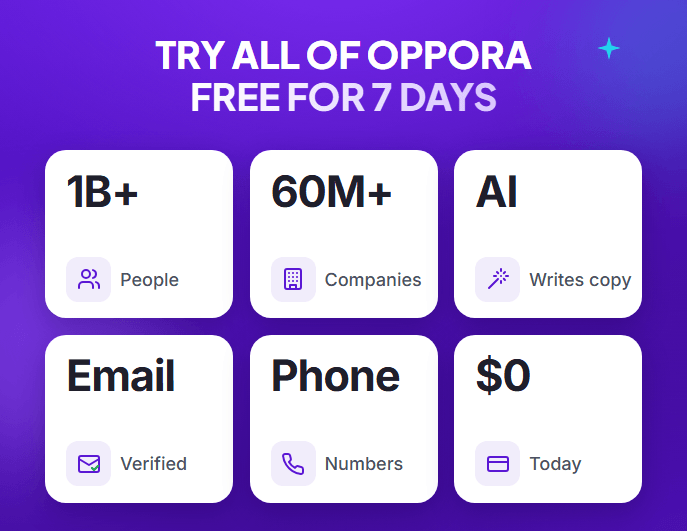
1B+ Verified Lead Database
Data quality is where most outreach fails.
Oppora solves this with access to hundreds of millions of verified contacts, combined with real-time enrichment and validation.
This means:
- Cleaner lead lists
- Better targeting
- Higher reply rates
You spend less time fixing data and more time closing deals.
AI Reply Handling and Meeting Booking
Most tools stop at sending emails.
Oppora goes further by handling replies automatically.
Its AI can:
- Respond to incoming emails
- Qualify leads
- Handle objections
- Book meetings directly into your calendar
So instead of just starting conversations, Oppora helps you close the loop without manual follow-ups.
Real User Feedback: Reddit Discussions & Pain Points
So far, we’ve looked at features and pricing.
But what really matters is how these tools perform when real users actually rely on them for outreach and lead generation.
Here’s what Reddit discussions reveal about the apollo vs clay debate.
Apollo vs Clay: Which One Performs Better for Outreach?
Users consistently point out a tradeoff between speed and control.
- Apollo works well for quick campaign launches
- Clay performs better when workflows are fully optimized
- Results in Clay depend heavily on how well you set things up
The pattern is clear.
Apollo helps you move fast, while Clay rewards deeper customization.
Clay vs Apollo: Which is More Cost-Effective for Lead Generation?
https://www.reddit.com/r/b2bmarketing/comments/1qxrn2d/clayio_vs_apollo_whats_best_any_other/
Cost-effectiveness varies based on usage.
- Apollo is easier to budget with predictable pricing
- Clay can become expensive if credits are not managed well
- ROI from Clay improves only when workflows are optimized
So the “cheaper” option depends on how you actually use the tool.
Clay vs Apollo for B2C Outreach: Which is More Effective?
https://www.reddit.com/r/LeadGeneration/comments/1j2l49b/apollo_vs_clay_for_b2c/
For B2C use cases, simplicity often wins.
- Apollo is better for volume-based campaigns
- Clay works well for niche targeting and segmentation
- Many users feel Clay is overkill for typical B2C outreach
If your workflow is straightforward, Apollo tends to be enough.
How Does Clay Compare to Apollo in Terms of Data Accuracy?
https://www.reddit.com/r/coldemail/comments/1ou21ho/is_clay_better_than_apolloio_interms_of_data/
Data quality is one of the biggest discussion points.
- Apollo provides decent but sometimes outdated data
- Clay can deliver better accuracy by combining sources
- Results depend on how well enrichment workflows are built
Clay has higher potential, but not without effort.
User Experiences: Apollo vs Clay for Sales Teams and B2B Marketing
https://www.reddit.com/r/coldemail/comments/1ljgipa/apollo_vs_clay/
For teams, usability becomes critical.
- Apollo is easier to adopt across teams
- Clay requires more technical understanding
- Larger teams often prefer structured tools like Apollo
Ease of onboarding plays a big role here.
Affordable Alternatives to Apollo and Clay: What Do Users Recommend?
https://www.reddit.com/r/GrowthHacking/comments/1kr9b04/affordable_alternative_to_clay_apollo/
Many users are actively looking beyond both tools.
- Pricing flexibility is a common concern
- Users want automation without heavy setup
- There’s demand for tools that reduce manual effort
This highlights a clear shift.
People don’t just want features anymore they want systems that actually run outreach end-to-end.
Conclusion
Choosing between Apollo and Clay really comes down to how you prefer to work.
Apollo gives you structure and speed, making it easier to launch campaigns without much setup. Clay, on the other hand, offers flexibility and control but requires more time and effort to get the best results.
But both tools still depend heavily on manual involvement at different stages.
That’s where Oppora stands apart.
Instead of giving you features to manage, it builds a system that handles your outreach from start to finish, from finding leads to replying and booking meetings.
If your goal is to scale outbound without constantly managing it, Oppora.ai is worth exploring.
Frequently Asked Questions (FAQs)
What is the main difference between Clay vs Apollo?
The main difference in Clay VS Apollo is how they handle outbound workflows. Clay is a flexible data enrichment and automation tool where you build custom workflows using multiple data sources, while Apollo is an all-in-one sales platform with a built-in database and ready-to-use outreach features, making it faster to get started.
Which is better: Apollo vs Clay for beginners?
For beginners, Apollo is the better choice because it offers a simple interface, built-in lead database, and ready-made email sequences, whereas Clay requires more setup and technical understanding to build workflows from scratch.
How do Apollo vs Clay automation capabilities compare?
In terms of apollo vs clay automation capabilities, Clay is more advanced with support for APIs, conditional logic, and multi-step workflows, while Apollo focuses on simpler automation like email sequences and follow-ups, making it easier but less flexible.
Is Apollo.io better than Clay for lead generation?
Yes, Apollo.io is generally better for quick lead generation because it provides access to 275M+ contacts and allows you to start outreach immediately, whereas Clay depends on external data sources and requires setup before generating leads.
Which tool has better data accuracy: Clay or Apollo?
Clay can offer better data accuracy if configured properly since it combines multiple data sources, while Apollo provides consistent but sometimes outdated data from its internal database, making accuracy dependent on use case and setup.
Summarize with AI
Share