10 Best Clay Alternative & Competitors for AI Outreach & Lead Enrichment
Stephen Parker
Published April 20, 2026
19 min

Complete Agentic Email Outreach
AI agents find and enrich prospects, personalize emails, follow up, and handle replies with your meeting link.
Start Your 7-Day Free Trial
If you are looking for a Clay alternative, the right choice depends on what you actually want to replace.
Clay is powerful for data enrichment, AI research, waterfall workflows, signals, and GTM orchestration. But not every team needs that level of flexibility.
You may want simpler enrichment, built-in prospecting, or a platform that can handle outreach after your leads are found.
In this guide, you will compare 10 Clay alternatives across:
- Data enrichment and prospecting
- AI automation and outreach
- Ease of use and workflow flexibility
- Pricing and scalability
For end-to-end AI outbound, Oppora.ai stands out. For data-focused use cases, Cognism, Apollo, or SyncGTM may fit better, while Persana AI, SyncGTM, and Bitscale offer more Clay-like workflow flexibility.
How We Evaluated the Best Clay Alternatives
We compared each platform using current product documentation, pricing pages, supported integrations, user feedback, and the specific Clay capabilities sales teams are most likely to replace.
Rather than ranking tools only by database size or feature count, we looked at how well each option supports the workflows you may actually need.
1. Lead and Company Data
We compared contact coverage, enrichment depth, email and phone verification, and the availability of firmographic and technographic data.
2. Waterfall Enrichment and AI Research
We looked at whether each platform supports multiple data providers, conditional enrichment, and AI-powered research similar to Claygent-style workflows.
3. Prospecting
We evaluated how easily you can search for companies and contacts, filter by ICP criteria, use intent or buying signals, and prospect through LinkedIn.
4. Outreach Automation
We compared email sequences, LinkedIn execution, personalization, follow-ups, reply handling, and meeting-booking capabilities.
This helped distinguish tools that mainly enrich data from platforms that can continue the workflow into actual sales execution.
5. Ease of Use
We considered initial setup, workflow complexity, and how much technical or RevOps knowledge you may need to operate the platform effectively.
6. Pricing and Scalability
Finally, we compared starting plans, credit structures, rollover policies, additional usage costs, and feature gates.
The goal was not to find one universal winner, but to show which platform fits each type of Clay replacement use case.
Best Clay Alternatives at a Glance
Before you compare each platform in detail, it helps to see where the main Clay alternatives fit.
Some focus on enrichment and data quality. Others combine prospecting with outreach, while a few are built around workflow automation similar to Clay.
Your best option depends on how much of your current sales workflow you want to replace.
- Oppora.ai works well when you want prospecting, enrichment, outreach, replies, and meeting workflows handled in one platform.
- SyncGTM or Bitscale make more sense when you want a Clay-style enrichment and workflow experience without moving to a basic prospecting database.
- Apollo.io is a strong fit when you want lead data, filtering, and sequencing together without building complex enrichment workflows.
- Cognism or ZoomInfo are better suited to teams where verified data, sales intelligence, compliance, or enterprise requirements are the bigger priority.
- Lusha or Hunter.io are simpler choices when you mainly need contact discovery, LinkedIn prospecting, or email verification rather than another full GTM orchestration platform.
Common Issues People Face with Clay
Before you decide whether Clay fits your workflow, it helps to understand where users typically struggle.
Many teams start using it expecting a smooth, all-in-one solution.
But once they scale usage, certain limitations start to show up, especially around usability, pricing, and automation depth.
Let’s break down the most common issues people report.
Common Limitations of Clay
One of the biggest complaints is that Clay isn’t as intuitive as it looks at first.
You often need time to understand how workflows, tables, and integrations actually work together.
For many users, this creates a steep learning curve that slows down early adoption.
Users highlight the unintuitive interface and learning curve challenges.
High Pricing and Value Concerns
Clay’s pricing is another frequent concern, especially for startups and small teams.
As your usage grows, costs can increase quickly due to credit-based consumption.
This makes it harder to predict monthly spending or scale comfortably.
Users discuss rising costs and actively look for cheaper alternatives.
Lack of Customization and Flexibility
While Clay offers flexibility in theory, users often feel limited in practice.
Certain workflows require workarounds instead of straightforward customization.
This becomes frustrating when your outreach strategy needs quick changes.
Users mention limitations in adapting workflows to specific use cases.
Data Accuracy and Integration Issues
Data quality plays a huge role in outbound success, and this is where some users face challenges.
Inconsistent or outdated data can affect targeting and campaign performance.
Integration gaps can also create friction when syncing with other tools.
Users talk about data reliability concerns and integration gaps.
Need for Better AI-Powered Automation
Clay does offer AI features, but users often expect deeper automation.
Instead of fully autonomous workflows, many processes still require manual intervention.
This reduces the overall efficiency teams are aiming for.
Users discuss the need for more advanced, hands-free AI workflows.
10 Best Clay Alternatives for AI Outreach & Lead Enrichment
The tools below solve different parts of the Clay use case. Some stay close to enrichment and orchestration, while others take you further into prospecting, outreach, and sales execution.
1. Oppora.ai — Best Clay Alternative for End-to-End AI Outbound Automation
Oppora.ai is built for you when enrichment is only one step of outbound. It connects prospecting, enrichment, outreach, replies, meetings, and CRM activity within one automated workflow.
Key features:
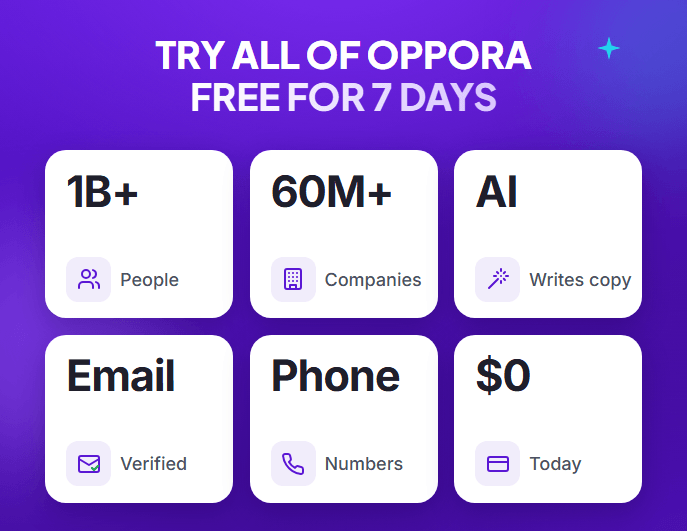
- 1B+ verified leads: Search a database of more than 1 billion prospects and identify relevant decision-makers.
- 60M+ companies: Discover accounts using company data, real-time search, and 22 buying signals.
- 50+ enrichment data points: Find emails and phone numbers, enrich records, verify contacts, and automatically qualify prospects.
- AI workflow builder: Connect specialized agents for finding, enriching, scoring, verifying, emailing, and managing replies.
- Multi-channel outreach: Run personalized email and LinkedIn campaigns with built-in warmup and rotation across up to 50 mailboxes.
- Reply Ora + CRM sync: Handle replies based on intent, share calendar links, and sync opportunities with HubSpot, Salesforce, or Pipedrive.
Clay vs Oppora.ai
Pricing:
- Free: $0/month
- Pro: $34/month
- Max: $79/month
- Enterprise: Starts at $499/month
- Credits: Separate Data, AI, Phone, and Recipient credit pools prevent one activity from consuming every allowance.
- Flexibility: Paid plans support credit rollover, while mini plans start from $7 for specific needs.
Best for: Startups, agencies, SDR teams, and outbound teams wanting fewer manual handoffs.
Main limitation: Clay remains stronger when highly customized enrichment orchestration is your main priority.
Review: Oppora currently holds a 4.5/5 rating from 27 G2 reviews. Recent reviewers highlight verified work emails, easy setup, and prompt-based workflow creation.
2. Apollo.io — Best for Prospecting Data + Built-In Sequencing
Apollo.io is a strong Clay alternative when you want to move quickly from finding prospects to contacting them. You can search B2B contacts, enrich records, build sequences, call prospects, and sync activity with your CRM from one platform.
Key features:
- B2B prospecting database: Find decision-makers using company, role, seniority, location, intent, and other advanced filters.
- Waterfall enrichment: Search Apollo first, then supported third-party providers for missing emails or phone numbers.
- Email sequences: Create automated multi-step outreach with emails, calls, LinkedIn tasks, and follow-ups.
- Built-in dialer: Call prospects, record outcomes, and automatically sync activity with your CRM.
- CRM enrichment: Update Salesforce or HubSpot records with demographic, firmographic, and technographic data.
Clay vs Apollo.io
Apollo now supports waterfall enrichment, but Clay still gives you more flexibility when you want to build highly customized enrichment logic across multiple sources.
Pricing:
- Free: $0
- Basic: $49/user/month billed annually
- Professional: $79/user/month billed annually
- Organization: $119/user/month billed annually
- Credits: Enrichment, phone, export, and other data actions can consume credits depending on usage.
Best for: SMB and mid-market sales teams wanting prospecting, enrichment, and outreach in one platform.
Main limitation: Clay remains stronger for deeply customized enrichment and data orchestration.
Review: Apollo.io has a 4.7/5 rating on G2, with users often praising its prospecting database and filtering capabilities.
Suggested Reading:
Clay vs Apollo: Full Comparison + Best Pick for You3. Persana AI — Best for AI Enrichment + Personalized Outreach
Persana AI combines multi-source enrichment, AI research, buying signals, and personalized outbound workflows. It is closer to Clay than a traditional prospecting database because you can build enrichment-driven workflows around prospect data.
Key features:
- 100+ data providers: Run email and phone waterfall enrichment across multiple data sources.
- Quantum AI Research Agent: Research prospects and companies using AI before outreach.
- Intent and buying signals: Track job changes, hiring activity, company news, funding, and other sales triggers.
- AI personalization: Generate prospect-specific messaging using enriched account and contact data.
- Outbound integrations: Send enriched leads to tools such as Smartlead, Instantly, Salesloft, and Outreach.
Clay vs Persana AI
Pricing:
- Free: 50 credits
- Starter: $68/month billed annually
- Growth: $151/month billed annually
- Pro: $400/month billed annually
- Credits: Email finding uses 1 credit, while phone numbers use 10 credits.
- Rollover: Paid plans include credit rollover.
Best for: Lean GTM teams wanting Clay-style enrichment with stronger AI research and personalization.
Main limitation: Persana announced on March 30, 2026 that its platform would be sunset as the team joined Rox. Its pricing page is still online, but you should verify current availability before treating it as an active Clay alternative.
Review: Persana AI has a 4.6/5 rating on G2, with users highlighting enrichment automation and integrations.
4. SyncGTM — Best Clay-Like Alternative for Waterfall Enrichment
SyncGTM is built for you when waterfall enrichment is the main Clay capability you want to replace. It combines multi-provider data, AI research, signals, and GTM workflows in one workspace.
Key features:
- 20+ vendor waterfall enrichment: Search multiple providers sequentially for verified work emails and mobile numbers.
- AI research agents: Extract custom company information such as pricing, use cases, technologies, and competitive insights.
- 50+ enrichment actions: Add firmographics, technographics, funding data, contact details, and buying signals to your records.
- CRM automation: Enrich and sync records with HubSpot and Salesforce while using matching logic to reduce duplicates.
- Outbound integrations: Push qualified prospects directly into sequencers such as Smartlead and Instantly.
Clay vs SyncGTM
Pricing:
- Solo: $529/year with 12,000 credits
- Growth: $1,069/year with 30,000 credits
- Pro: $2,689/year with 96,000 credits
- Business: $7,009/year with 300,000 credits
- Credits: A verified email costs 1 credit, while a mobile number costs 12 credits.
- Flexibility: Unused credits roll over, and one-time top-up packs are available without changing plans.
Best for: RevOps and GTM teams that want Clay-style waterfall enrichment with different workflow and credit economics.
Main limitation: SyncGTM is newer than Clay, so its ecosystem and independent user-review footprint are still limited.
Review: Capterra currently lists no verified user reviews for SyncGTM, so there is not yet enough independent feedback to assess long-term user experience.
5. Cognism — Best for Verified and Compliance-Focused B2B Data
Cognism is a strong Clay alternative when your priority is reliable B2B contact data rather than building complex enrichment workflows. It is particularly useful for teams prospecting across Europe and other compliance-sensitive markets.
Key features:
- Verified contact data: Access business emails and mobile numbers validated through automated and human verification.
- Diamond Data®: Use phone-verified mobile numbers designed to improve your chances of reaching the correct decision-maker.
- Compliance-focused prospecting: Records are screened against 15 global Do-Not-Call lists, with GDPR-focused data practices.
- Intent and sales signals: Identify accounts using hiring, funding, job-change, and intent information.
- CRM enrichment: Enrich and maintain CRM records or deliver Cognism data through APIs and bulk integrations.
Clay vs Cognism
If your reason for replacing Clay is primarily data accuracy and compliance, Cognism may fit better. Clay remains stronger when you want to design sophisticated multi-provider workflows yourself.
Pricing:
- Standard: Custom quote with 5 seats included.
- Pro: Custom quote with advanced mobile verification and intent features.
- Credits: One credit is used when you reveal, enrich, or export a new contact.
- Add-ons: CRM Enrichment and Data-as-a-Service can be added based on your requirements.
Best for: Mid-market and enterprise teams prioritizing verified contact data, mobile numbers, and compliance.
Main limitation: Cognism provides less workflow-building flexibility than Clay.
Review: Cognism has a 4.5/5 rating on G2, with users frequently highlighting prospecting and contact enrichment.
Suggested Reading:
10 Best Cognism Alternatives (Compared by Pricing & Features)6. ZoomInfo — Best for Enterprise Sales Intelligence and Intent Data
ZoomInfo is suited to larger sales teams that need centralized B2B intelligence rather than highly customized enrichment workflows. You can use contact data, account insights, intent signals, and CRM enrichment to identify and prioritize buying opportunities.
Key features:
- Contact and company intelligence: Find decision-makers using business emails, direct dials, company details, and advanced targeting filters.
- Buyer intent signals: Identify accounts actively researching topics related to your product, category, or market.
- Org charts: Understand reporting structures and identify the people involved in purchasing decisions.
- Technographic data: See which technologies target companies use to improve segmentation and outreach relevance.
- CRM enrichment: Enrich and refresh account, contact, and lead records across connected sales systems.
Clay vs ZoomInfo
Clay gives you more control when you want to combine multiple providers and build custom enrichment logic. ZoomInfo is better suited when you want centralized sales intelligence, intent data, and account-level insights at enterprise scale.
Pricing:
- Custom pricing: ZoomInfo does not publish standard self-service pricing for its core enterprise platform.
- Quote-based plans: Pricing can vary based on users, products, data access, integrations, and contract requirements.
- Practical consideration: You generally need to contact ZoomInfo directly to understand the total cost for your specific setup.
Best for: Larger GTM organizations that need account intelligence, intent signals, and enterprise integrations.
Main limitation: ZoomInfo offers less open-ended workflow flexibility than Clay, while pricing can be harder to evaluate upfront.
Review: ZoomInfo has a 4.5/5 rating on G2, with users often highlighting its contact intelligence, filtering, and account data.
7. Seamless.AI — Best for Real-Time Contact Discovery
Seamless.AI is a practical Clay alternative when you mainly want to find decision-makers and their contact details quickly. Its real-time search engine helps you build prospect lists without creating complex enrichment workflows.
Key features:
- 1.3B+ business contacts researched: Search a large prospect pool using more than 100 filters for roles, companies, seniority, revenue, and other criteria.
- Emails and direct dials: Find AI-verified business emails, mobile numbers, and direct phone lines.
- Chrome extension: Discover and enrich contacts while browsing LinkedIn, company websites, and other professional pages.
- Buyer Intent: Identify companies showing active interest in relevant topics and combine those signals with verified contacts.
- CRM enrichment: Add missing contact data and push prospect information into connected CRM workflows.
Clay vs Seamless.AI
Pricing:
- Free: Includes 50 credits.
- Pro: Starts with 10,000 annual credits.
- Paid plans: Pricing is customized around team size, usage, and required features.
- Credits: Can support prospecting, enrichment, Buyer Intent, and automation depending on your plan.
Best for: Sales teams that prioritize fast prospect discovery over custom enrichment logic.
Main limitation: Clay remains stronger for sophisticated multi-provider enrichment and workflow orchestration.
Review: Seamless.AI has a 4.4/5 rating on G2, with users commonly highlighting prospecting and contact discovery.
Read Seamless.AI reviews on G2
8. Lusha — Best for Simple LinkedIn Prospecting
Lusha is a simpler Clay alternative for you if prospecting mainly happens through LinkedIn or Sales Navigator. It helps you reveal contact details, build prospect lists, and move leads into your CRM or outreach sequences without building complex enrichment workflows.
Key features:
- LinkedIn prospecting extension: Reveal contact data directly from LinkedIn profiles, Sales Navigator, company websites, Gmail, and supported CRMs.
- Verified contact lookup: Access business emails, direct dials, and mobile numbers while researching prospects.
- Prospecting database: Search and filter contacts before saving relevant prospects into lists or tables.
- CRM integrations: Push enriched contacts directly into platforms such as Salesforce, HubSpot, and Pipedrive.
- Built-in sequences: Add prospects directly to outreach sequences from the browser extension.
Clay vs Lusha
Pricing:
- Free: Up to 40 credits per month.
- Starter: G2 currently lists plans starting at $37.45.
- Pro: G2 currently lists plans starting at $52.45.
- Credit usage: Revealing an email costs 1 credit, while a phone number costs 10 credits.
- Rollover: Monthly unused credits can accumulate up to twice your plan allowance; annual credits expire at the end of the annual cycle.
Best for: SDRs, founders, recruiters, and small teams prospecting primarily through LinkedIn.
Main limitation: You get far less flexibility for multi-provider enrichment and custom workflow automation than Clay.
Review: Lusha has a 4.3/5 rating on G2, with users often highlighting its ease of use, LinkedIn integration, and contact discovery.
Suggested Reading:
11 Lusha Alternatives for 2026: Better Data, Pricing & Accuracy9. Hunter.io — Best Affordable Alternative for Email Finding and Verification
Hunter.io is a simpler Clay alternative when your main goal is finding and verifying professional email addresses. You can discover companies, find contacts, verify emails, and run lightweight cold email sequences without building complex enrichment workflows.
Key features:
- Domain Search: Find professional email addresses associated with a company or domain.
- Email Finder: Search for a specific person's work email using their name and company.
- Email Verifier: Check whether addresses are valid and deliverable before adding them to outreach.
- Bulk tools: Find or verify large email lists through CSV uploads or API workflows.
- Sequences: Run cold email campaigns directly inside Hunter, with prospect discovery and signals included on outreach plans.
Clay vs Hunter.io
Hunter is not a one-to-one Clay replacement. It makes more sense when you mainly need to find emails, validate them, and run straightforward outreach.
Pricing:
- Free: $0 with 600 annual credits.
- Starter: $34/month billed annually.
- Growth: $104/month billed annually.
- Scale: $209/month billed annually.
- Credits: 1 credit finds an email, while verification uses 0.5 credit on all-in-one plans.
Best for: Small teams with existing prospect lists that mainly need email discovery and verification.
Main limitation: Hunter lacks Clay's deeper enrichment, provider orchestration, and custom research workflows.
Review: Hunter has a 4.4/5 rating on G2, with users frequently highlighting ease of use and email verification accuracy.
10. Bitscale — Best Workflow-First Alternative for Teams That Still Want Clay-Like Control
Bitscale is a close Clay alternative if you still want grid-based enrichment and workflow automation rather than a basic prospecting database. It combines multi-source data, AI research, buying signals, CRM enrichment, and outbound execution in one workflow-driven platform.
Key features:
- 100+ data sources: Enrich contacts and companies using multiple providers for emails, phone numbers, firmographics, and other GTM data.
- Waterfall enrichment: Run providers sequentially and pay when a provider returns a valid result rather than for failed lookups.
- BitAgent AI research: Research websites, competitors, funding, hiring activity, technologies, and other custom data points automatically.
- Buying signals: Track intent, hiring, funding, competitor engagement, and other signals to prioritize relevant accounts.
- CRM and outbound workflows: Sync with HubSpot or Salesforce and connect enriched leads to platforms such as Smartlead and Instantly.
Clay vs Bitscale
Pricing:
- Free: $0 with 200 lifetime credits.
- Growth: $349/month with 15,000 credits.
- Booster: $799/month with 50,000 credits.
- Enterprise: Custom pricing and credit volume.
- Rollover: Paid plans can roll unused credits up to 3× the plan allowance.
Best for: SDR, RevOps, and outbound teams that still want Clay-like workflow control.
Main limitation: Clay remains more mature for highly customized and complex orchestration.
Review: Bitscale has a 4.8/5 rating on G2, with users frequently highlighting enrichment simplicity, data quality, and pricing.
How to Choose the Right Clay Alternative
The best Clay alternative depends on which part of your current workflow you actually want to replace.
Instead of comparing every tool feature by feature, start with the job you need the platform to handle.
Choose an Enrichment-First Platform If...
Choose this type of platform when data quality and enrichment are the main priorities.
You should focus on:
- Waterfall enrichment across multiple providers
- Better contact and company data completeness
- CRM enrichment and record updates
- Email and phone verification
SyncGTM fits teams that want Clay-style waterfall enrichment, while Cognism makes more sense when verified contact data and compliance matter more than custom workflow logic.
Choose a Prospecting + Outreach Platform If...
This category works well when you want to find prospects and contact them without building complex workflows first.
Look for:
- A searchable lead database
- ICP and company filters
- Contact enrichment
- Built-in email sequences
Apollo.io is a strong example because you can move from prospect search to enrichment and outreach within the same platform.
Choose an AI Outbound Platform If...
Choose an AI outbound platform when you want more of the sales process to run automatically after lead discovery.
Your workflow may include:
- Lead discovery and research
- AI personalization
- Email and LinkedIn sequences
- Automated follow-ups
- Reply handling
- Meeting booking
Oppora.ai fits this use case because it connects prospecting, enrichment, outreach, replies, meetings, and CRM activity in one workflow.
Choose a Lightweight Data Tool If...
You may not need another full GTM platform at all.
If your main requirements are finding emails, phone numbers, verifying contacts, or prospecting through LinkedIn, simpler tools can reduce setup and operational overhead.
Hunter.io works well for email discovery and verification, while Lusha is better suited to fast LinkedIn-based prospecting.
Choose an Enterprise Intelligence Platform If...
Larger sales organizations often need more than basic contact enrichment.
You may require:
- Large-scale contact intelligence
- Buyer intent signals
- Account-level insights
- Enterprise CRM integrations
ZoomInfo is better suited to this type of centralized enterprise sales intelligence workflow.
The key is simple: do not compare platforms purely by database size. Compare how many steps of your actual outbound workflow the platform can replace or improve.
When Should You Stay With Clay Instead of Switching?
Switching away from Clay is not always the right move. If your current setup already supports the workflows your team needs, replacing it may create more work than value.
Stay with Clay if:
- You rely on complex enrichment waterfalls: Clay is well suited to workflows that combine multiple providers and conditional enrichment steps.
- Your RevOps or GTM team wants granular control: You can design detailed workflows around your own data sources, logic, and enrichment rules.
- You frequently build custom enrichment logic: Clay gives you flexibility to research, transform, qualify, and route data in different ways.
- Claygent and AI research are central to your process: If your team depends heavily on AI-powered account research, moving away may require rebuilding those workflows elsewhere.
- Your sales stack is already deeply connected to Clay: Switching can mean recreating integrations, tables, prompts, and automations that already work.
Consider switching if:
- You use only a small part of Clay: Paying for workflow flexibility makes less sense if you mainly need contact data and basic enrichment.
- Setup and maintenance take too much time: A simpler platform may reduce operational work for SDRs and smaller teams.
- You mainly need prospecting and outreach: Tools with built-in databases and sequencing can provide a shorter path from lead search to contact.
- You need deeper execution after enrichment: Reply handling, meeting booking, LinkedIn outreach, and autonomous follow-ups may matter more than enrichment flexibility.
- Your usage and pricing no longer align: A different credit structure may better match how your team actually uses the platform.
The better choice is not automatically the platform with more features. It is the one that removes the most friction from the workflow you already run.
Conclusion
There is no single best Clay alternative for every team. The right choice depends on which part of Clay you are actually trying to replace.
You may need stronger enrichment, more reliable data, simpler workflow automation, faster prospecting, built-in outreach, or a platform that handles the complete outbound process.
If your current challenge is spending too much time building and connecting workflows before outreach can even begin, Oppora.ai is worth considering.
It brings prospecting, enrichment, personalized outreach, reply handling, meeting workflows, and CRM execution into one platform.
That makes it a practical option when you want fewer handoffs between tools and more of your outbound workflow running from one connected system.
The best decision is the one that simplifies your sales process without removing the capabilities your team actually relies on.
Frequently Asked Questions
What is the best Clay alternative?
The best Clay alternative depends on what you want to replace. Oppora.ai is strong for end-to-end AI outbound, Apollo.io for prospecting and sequencing, and SyncGTM for waterfall enrichment.
What is the best Clay alternative for AI outreach?
Oppora.ai is a strong option for AI outreach because it connects lead discovery, enrichment, personalization, outreach, reply handling, meetings, and CRM updates in one workflow.
What is the best Clay alternative for waterfall enrichment?
SyncGTM and Bitscale are strong options for waterfall enrichment. Both support multi-source data workflows and give you a Clay-like way to enrich and organize prospect data.
Is Apollo.io a good alternative to Clay?
Yes. Apollo.io is a good Clay alternative if you mainly need a lead database, advanced filters, enrichment, sequencing, calling, and CRM integrations without complex workflow setup.
Can one platform replace a Clay + Smartlead stack?
Yes, depending on your workflow. Oppora.ai combines prospecting, enrichment, outreach, replies, and sales automation, which can reduce the need for separate enrichment and sequencing tools.
Summarize with AI
Share