Cognism vs Lusha: Which B2B Data Tool Is Right for Your Sales Team?
Manasa Goli
Published September 29, 2026
17 min

Complete Agentic Email Outreach
AI agents find and enrich prospects, personalize emails, follow up, handle replies, and book meetings automatically.
Claim Your FREE Credits
Choosing a B2B data platform can look simple until you compare what you actually get for your credits, where the data is strongest, and how much your sales team will use it.
Cognism and Lusha both help you find business contacts, enrich prospect data, and build targeted lists, but they approach pricing, verification, coverage, and prospecting differently.
So, which one fits your sales workflow?
In this guide, you’ll compare Cognism vs Lusha across:
- Pricing and credit usage
- Database size and data accuracy
- Prospecting features and integrations
- Phone and email data
- Customer ratings and reviews
- Pros and cons
- Different sales-team use cases
- The type of workflow each platform suits best
Cognism vs Lusha: Which One Is More Suitable for Your Sales Team?
The answer depends less on which platform has more contacts and more on what your team needs to do with those contacts.
If your sales team spends most of its time prospecting into European markets, working with phone numbers, and maintaining compliant B2B data, Cognism deserves close attention.
If you want a lower barrier to entry, a free plan, a large contact database, and a straightforward credit system, Lusha gives you a different starting point.
The difference becomes clearer when you look at the numbers.
These numbers are useful, but they should not be treated as a substitute for checking whether the platform covers your target market and provides the fields your SDRs actually need.
What Is Cognism?
Cognism is a B2B sales intelligence and prospecting platform built around contact and company data, with a particularly strong focus on European markets, verified mobile numbers, data freshness, and compliance.
Its current offering is structured around Standard and Pro packages. Both packages include five user seats, while Pro adds capabilities such as on-demand verification, premium mobile coverage, company hierarchies, API access, and intent data.
That makes Cognism more than a simple email finder.
You can use it to identify companies, find decision-makers, enrich records, research accounts, and connect prospect data with your existing sales workflow.
Cognism Key Features
The main capabilities include:
- Company and contact search
- Phone-verified mobile numbers
- Email addresses
- Company and firmographic data
- Company hierarchies
- CRM enrichment
- CSV enrichment
- API access
- Intent data
- Buying signals
- LinkedIn prospecting workflows
- Browser extension
- Data verification
- Compliance controls
One of Cognism's more useful published data points is its freshness metric.
The company says 95% of senior-level contacts are refreshed every 30 days. It also says its phone-verified mobile numbers are validated using human checks and AI processes.
For a sales team, that matters because a database can have millions of records and still become less useful when people change jobs, companies restructure, or contact information becomes outdated.
Cognism also emphasizes compliance for teams selling into regulated or privacy-sensitive markets. Its current materials state that its records are scrubbed across 15 global Do-Not-Call lists and positioned around GDPR and CCPA compliance.
Cognism Data Accuracy
Cognism does not publish the same regional accuracy breakdown as Lusha, but it does provide specific figures and details about its data verification process.
According to Cognism:
- Email accuracy: 97%
- Phone accuracy: 87%
- European senior-contact refresh rate: 95% every 30 days
- Mobile verification: Diamond Data
- Data verification: AI, automated checks, and human validation
Cognism also says its database is continuously checked using automated systems, AI and human verification. These figures come from Cognism's own data-quality measurements rather than an independent head-to-head benchmark.
That distinction is important when comparing
Cognism Pricing
Cognism does not operate like a typical self-serve SaaS product where you simply choose a $49 or $99 monthly plan and enter your card details.
Its current sales intelligence packages are sold through a customized pricing model.
The published structure gives you:
- Standard: 10,000 credits per user annually
- Pro: 12,000 credits per user annually
- Five seats included in the core packages
- Additional options based on team requirements
- Pro features such as on-demand verification, premium mobile coverage, company hierarchies, API access, and intent data
Cognism's CRM enrichment product is separately positioned and currently starts at $12,000/year, according to its official enrichment page.
So, when comparing Cognism with Lusha, you should not look only at the subscription price.
You also need to calculate how many contacts your team expects to reveal and whether you need phone numbers, enrichment, intent data, API access, or additional capabilities.
Data note: Ratings, review counts, pricing, and product details can change over time. Contact and company data may come from publicly available and other permitted sources, so coverage and accuracy can vary by market and individual record. Check the provider’s current information before making a purchase decision.
Cognism Pros
Strong European data positioning: Cognism places significant emphasis on European B2B coverage and says 95% of its senior-level European contacts are refreshed every 30 days.
Phone-verified mobile data: This is one of its central differentiators for teams that rely heavily on calling.
Compliance focus: The platform is positioned around GDPR and CCPA-compliant data handling, which can matter significantly for teams operating across Europe.
Advanced sales intelligence: Pro includes capabilities such as intent data, company hierarchies, API access, and on-demand verification.
CRM and workflow integration: Cognism supports integrations and enrichment workflows designed to keep prospecting data connected to your existing revenue stack.

Cognism Cons
Pricing is not fully transparent: Cognism does not present a simple self-serve pricing structure where you can choose a plan and immediately calculate the total cost for your team. Capterra currently lists Cognism at $1,000 per feature per month, while also showing a “Get Price” option, so actual pricing can depend on the features and package you need.
Data quality is generally well reviewed, but not perfect: Capterra users frequently praise Cognism's contact data, particularly its emails and phone numbers. However, some reviewers report missing or outdated contact details.
CRM limitations come up in reviews: Some users say that not all Cognism information can be transferred into their CRM. For example, a Capterra reviewer specifically mentioned that some data could not be pulled into Salesforce, requiring manual cross-checking.
Renewal and account-management concerns have also been reported: One Capterra reviewer reported difficulties with subscription renewal and payment controls. This is an individual user experience, not evidence that all Cognism customers face the same issue.
What Is Lusha?
Lusha takes a more accessible approach to B2B contact intelligence.
The platform provides contact and company data, prospecting, enrichment, buying signals, browser-based prospecting, and integrations with sales systems.
One of its biggest differences is that Lusha publishes a much more concrete picture of the size of its database.
Its current data page reports:
- 290M+ verified contacts
- 29M+ companies
- 165M+ verified emails
- 98% email accuracy
- 86% phone accuracy
- 239 countries
- 26 buying signals
- 99.95% uptime SLA
Lusha also says it is used by more than 280,000 GTM teams.
These are Lusha's own published figures, so they should be treated as vendor-reported metrics rather than an independent industry benchmark.
Lusha Key Features
Lusha includes:
- Contact search
- Company search
- Verified email discovery
- Phone number discovery
- Browser extension
- CRM enrichment
- API access
- Company intelligence
- Buying signals
- Prospect list building
- Lookalike functionality
- Data enrichment
- CRM integrations
The platform currently promotes 26 live buying signals, including events such as funding, hiring activity, and executive changes.
That means Lusha has moved beyond being simply a tool for finding email addresses.
It increasingly combines contact data with signals that can help you decide when to contact an account.
Lusha Data Accuracy
This is one area where Lusha publishes specific numbers that are useful for comparison.
According to Lusha:
- Email accuracy: 98%
- Phone accuracy: 86%
- North America email accuracy: 98%
- EMEA email accuracy: 97%
- APAC email accuracy: 96%
- LATAM email accuracy: 95%
Lusha has also published its own 2026 US data tests.
One July 2026 test covered 125 real US contacts across different metropolitan areas and company sizes. Lusha reported that work email was resolved 100% of the time in every segment tested, while mobile-phone hit rates ranged between 96% and 100%.
Again, these are Lusha's tests rather than an independent head-to-head benchmark.
That distinction is important when writing the comparison.
Lusha Pricing
Lusha uses a straightforward credit model.
The current structure is:
- 1 credit = verified email address
- 5 credits = phone number
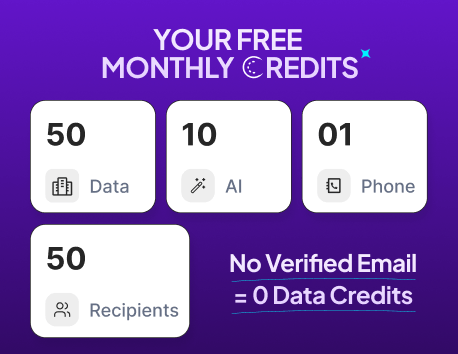
- 40 credits/month = Free plan
- Browser extension included
- CRM integrations available on the Free plan
This gives you a much easier way to estimate usage.
Suppose your SDR wants to find email addresses for 100 prospects.
That requires:
100 prospects × 1 email credit = 100 credits
Now suppose the same SDR wants both email and phone data:
100 email credits + 500 phone credits = 600 credits
That difference becomes important for phone-heavy outbound teams.
A tool can appear affordable until you calculate how quickly your team consumes credits.
Suggested Reading:
Lusha vs ZoomInfo: Data Quality, Features & Cost BreakdownLusha Pros
Transparent self-serve pricing: Lusha offers a free plan and publishes pricing for its Starter, Pro, and Premium plans, so teams can see the starting cost before contacting sales.
Strong contact data coverage: Lusha says it has 290M+ verified contacts, 29M+ companies, and 165M+ verified emails, giving sales teams a large database for prospecting.
Buying intent and sales signals: Lusha provides 26 buying signals, including funding events, hiring activity, leadership changes, and job changes, helping teams identify accounts showing potential buying activity.
CRM and workflow integration: Lusha supports integrations with platforms such as Salesforce, HubSpot, Pipedrive, Zoho, Bullhorn, Outreach, and Salesloft, along with workflow tools such as Zapier and Make.
Compliance and data security: Lusha is positioned around GDPR and CCPA compliance and lists certifications including SOC 2 Type II, ISO 27001, and ISO 27701.
Data note: Ratings, review counts, pricing, and product details can change over time. Contact and company data may come from publicly available and other permitted sources, so coverage and accuracy can vary by market and individual record. Check the provider’s current information before making a purchase decision.
Lusha Cons
Credit-based pricing can become expensive: Lusha charges credits when users reveal contact information. An email costs 1 credit, while a phone number costs 5 credits, so teams doing large-scale prospecting can use credits quickly.
Data coverage can vary: While Lusha publishes 98% email accuracy and 86% phone accuracy, Capterra reviewers report issues with outdated, incomplete, or inaccurate contact information in some cases.
Some users report technical issues: Capterra reviews mention occasional problems with the Chrome extension, incomplete results, and bugs when applying multiple filters.
Customer support concerns appear in reviews: Some recent Capterra reviewers have reported slow or unresponsive customer support when dealing with account or technical issues. This reflects individual user experiences rather than all Lusha customers.
Data note: Ratings, review counts, pricing, and product details can change over time. Contact and company data may come from publicly available and other permitted sources, so coverage and accuracy can vary by market and individual record. Check the provider’s current information before making a purchase decision.
Cognism vs Lusha: Feature-by-Feature Comparison
Now that you know how each platform approaches the market, the more useful comparison is what happens when you put them side by side.
Database Size and Coverage
Lusha gives you a clear headline number: 290M+ verified contacts and 29M+ companies.
Cognism's current positioning is less focused on a single headline database figure.
Instead, it emphasizes data quality, European coverage, phone verification, freshness, and compliance.
This creates an important distinction.
If your buying decision starts with:
“How many contacts are available?”
Lusha provides a straightforward number.
If your question is:
“How reliable is the contact information in the specific market I sell into?”
You need to test both databases against your ICP.
For example, compare 100–200 known accounts across:
- Job title
- Company
- Work email
- Direct phone
- Company size
- Industry
- Location
- Current employment status
That gives you a more meaningful benchmark than comparing database sizes alone.
Email and Phone Data
This is one of the biggest practical differences between the platforms.
Lusha publishes 98% email accuracy and 86% phone accuracy.
Cognism focuses heavily on phone-verified mobiles and says its numbers go through human and AI validation processes. It also reports that 95% of senior contacts are refreshed every 30 days.
So your evaluation should depend on how your SDRs do prospecting.
If your team primarily sends cold emails, test:
- Email availability
- Email verification
- Bounce rates
- Job-title accuracy
- Domain accuracy
If your team relies on cold calling, test:
- Mobile availability
- Direct-dial coverage
- Number accuracy
- Geographic coverage
- Current employment status
Intent and Buying Signals
Both platforms have moved beyond basic contact databases.
Cognism's Pro offering includes intent data and advanced company intelligence.
Lusha currently promotes 26 buying signals, including funding, hiring and executive changes.
The practical difference is how you intend to use those signals.
If you already have an account-based sales process, intent and company signals can help your reps prioritize accounts.
If your team simply needs contact details for outbound lists, these features may not justify paying more.
Cognism vs Lusha Pricing: What Will You Actually Pay?
Price comparison is tricky because the platforms do not use identical pricing structures.
Data note: Ratings, review counts, pricing, and product details can change over time. Contact and company data may come from publicly available and other permitted sources, so coverage and accuracy can vary by market and individual record. Check the provider’s current information before making a purchase decision.
Cognism's current published package structure confirms 10,000 annual credits for Standard and 12,000 for Pro, with five seats included.
Lusha's official pricing page confirms the 1-credit email and 5-credit phone structure, along with its 40-credit free plan.
The More Useful Calculation
Rather than asking only:
“Which tool is cheaper?”
Ask:
“How much usable prospect data does my team need every month?”
Suppose you need 5,000 prospects.
If those prospects require email only, Lusha's credit consumption is:
5,000 × 1 = 5,000 credits
If you also reveal a phone number for every prospect:
5,000 × 6 = 30,000 credits
That is a six-times difference in credit consumption.
For a phone-heavy SDR team, this calculation can be more important than the advertised monthly subscription price.
Cognism vs Lusha: Data Quality, Not Just Database Size
This is where a serious comparison should go beyond marketing numbers.
A database with 290M contacts sounds impressive.
But your sales team doesn't need 290M contacts.
It needs the right 5,000 contacts with usable information.
That means you should evaluate:
Cognism's published freshness metric is 95% of senior contacts refreshed every 30 days.
Lusha publishes 98% email accuracy and 86% phone accuracy, along with regional email accuracy figures.
Those metrics measure different things.
That is why you should not turn them into a simplistic “98% beats 95%” calculation.
Freshness and accuracy are not the same metric.
Cognism vs Lusha Reviews and Ratings
Reviews can tell you how customers experience the products, but they also need context.
Current G2 data shows:
Capterra currently lists Cognism at 4.7/5 from 263 reviews and Lusha at 4.0/5 from 398 reviews.
Data note: Ratings, review counts, pricing, and product details can change over time. Contact and company data may come from publicly available and other permitted sources, so coverage and accuracy can vary by market and individual record. Check the provider’s current information before making a purchase decision.
What Users Say About Cognism
Positive review themes include:
- Contact-data quality
- Ease of prospecting
- CRM integrations
- Mobile data
- European coverage
- Customer support
Capterra reviews also include users who say Cognism helped them prospect more efficiently and connect with relevant decision-makers.
Negative themes include:
- Incorrect contact information
- Some outdated records
- Regional coverage differences
- Pricing concerns
- Certain CRM limitations
G2 similarly lists inaccurate data and incorrect numbers among recurring negative themes.
What Users Say About Lusha
Lusha's G2 review themes frequently include:
- Contact information
- Ease of use
- Prospecting
- Enrichment
- Browser extension
The negative themes include:
- Data inaccuracies
- Incorrect information
- Credit-related concerns
The useful takeaway is not that reviews prove one database is universally more accurate.
Instead, they tell you where users tend to experience value and friction.
Suggested Reading:
Lusha vs Apollo: Pros, Cons & Hidden Costs You Should KnowCognism vs Lusha for Different Sales Teams
Your team's workflow should influence the decision more than a generic feature checklist.
For EMEA Sales Teams
Cognism's European data positioning, phone verification, freshness claims, and compliance focus make these areas worth testing closely if Europe is your primary market. Cognism specifically positions its database around European revenue teams.
Lusha also has broad EMEA coverage and currently reports 97% email accuracy for EMEA.
The best test is therefore not simply “Who covers Europe?”
It is:
Which platform produces more usable contacts for your exact countries, industries, and job titles?
For Small Sales Teams
Lusha's free plan gives smaller teams an easy way to test the platform.
The current free tier includes 40 credits per month.
Cognism takes a more sales-led approach, so a smaller team needs to consider whether its expected prospecting volume and market requirements justify a more customized engagement.
For Enterprise Revenue Teams
Enterprise teams should look beyond contact search.
Evaluate:
- API access
- CRM enrichment
- Governance
- Data freshness
- Compliance
- User management
- Intent signals
- Company hierarchies
- Integration capabilities
Cognism's Pro offering includes API access, company hierarchies, premium mobile coverage, on-demand verification and intent data.
Lusha also provides APIs, CRM integrations, enrichment and company intelligence.
For Phone-First SDR Teams
Phone-heavy teams should test the mobile data before signing.
Cognism emphasizes phone-verified mobile numbers and validation through human and AI processes.
Lusha reports 86% phone accuracy, but each revealed phone number consumes five credits under its current pricing model.
That makes both data quality and credit economics important.
For Email-First Outbound Teams
If your team mostly sends cold email, email availability and verification may matter more than direct-dial coverage.
Lusha currently reports 98% email accuracy.
Cognism emphasizes verified data and freshness rather than publishing an equivalent universal email-accuracy percentage in the sources reviewed here.
So your team should run a controlled sample before comparing the two.
Cognism vs Lusha: Integrations and Sales Workflow
The platform should fit into your existing process rather than forcing SDRs to manually move information between systems.
Cognism supports CRM enrichment and integrations designed around sales prospecting and data workflows. G2 reviewers specifically mention integrations with systems such as Salesforce and LinkedIn among the platform's strengths.
Lusha also supports CRM integrations, browser-based prospecting and enrichment workflows.
The key question is what happens after you find the prospect.
If your workflow looks like:
Find lead → export CSV → verify email → write email → launch sequence → monitor replies → update CRM
then a data provider only solves the first part of the process.
That distinction becomes important when you compare these platforms with broader AI sales systems.
What About an AI Sales Platform Instead of Just a Data Provider?
Cognism and Lusha primarily solve the data and intelligence problem.
But your sales team may have a second problem:
What happens after you find the prospect?
That is where a platform such as Oppora takes a different approach.
Oppora is positioned around eight AI sales agents that work together across prospecting, enrichment, outreach, replies, qualification, meeting booking, and CRM synchronization.
Its materials describe the workflow as:
Find → enrich → score → write → send → reply → CRM
Instead of requiring you to manually operate every step, the workflow is configured and then executed by the AI agents.
Oppora also says it uses waterfall sourcing with 120M+ verified contacts, multiple enrichment providers, real-time email verification, and optional data-provider API connections.
That makes the comparison slightly different.
This does not make Oppora a direct replacement for every Cognism or Lusha use case.
If you only need a high-quality B2B database, a dedicated data provider may be exactly what you need.
If your bigger problem is the number of tools and manual steps between finding a lead and booking a meeting, an end-to-end sales workflow becomes a different category of comparison.
Final Thoughts
Cognism and Lusha solve a similar problem, but they approach B2B data from different angles. Cognism puts significant emphasis on European coverage, phone verification, data freshness, compliance, and advanced sales intelligence.
Lusha combines a large published database with transparent credit usage, broad geographic coverage, and a free entry point.
The right comparison is therefore not simply about which platform has more contacts or higher review scores. Look at your market, prospecting volume, phone usage, required integrations, and cost per usable contact.
Then test both platforms against your actual ICP. That gives you a practical answer based on the data your sales team can use, rather than a generic feature checklist.
Frequently Asked Questions
Is Lusha cheaper than Cognism?
There is no simple universal answer because Cognism uses customized pricing while Lusha uses a credit-based model.
Lusha is easier to test because it offers a free plan with 40 credits per month.
For a serious comparison, calculate your expected monthly contact and phone usage rather than comparing subscription prices alone.
How many contacts does Lusha have?
Lusha currently reports 290M+ verified contacts, 29M+ companies and 165M+ verified emails. It says its database covers 239 countries.
Does Cognism provide phone numbers?
Yes. Phone-verified mobile data is one of Cognism's central product capabilities. The company says these numbers are validated through human checks and AI processes.
How accurate is Lusha?
Lusha currently publishes 98% email accuracy and 86% phone accuracy. It also reports regional email accuracy of 98% in North America, 97% in EMEA, 96% in APAC and 95% in LATAM.
These are vendor-reported figures, so your own target-market test is still important.
How should you compare Cognism and Lusha before buying?
Use the same 100–200 target accounts on both platforms.
Then compare valid emails, mobile numbers, current job titles, company information, geographic coverage, duplicate records and cost per usable contact.
That will tell you more about fit than comparing headline database sizes.
Summarize with AI
Share