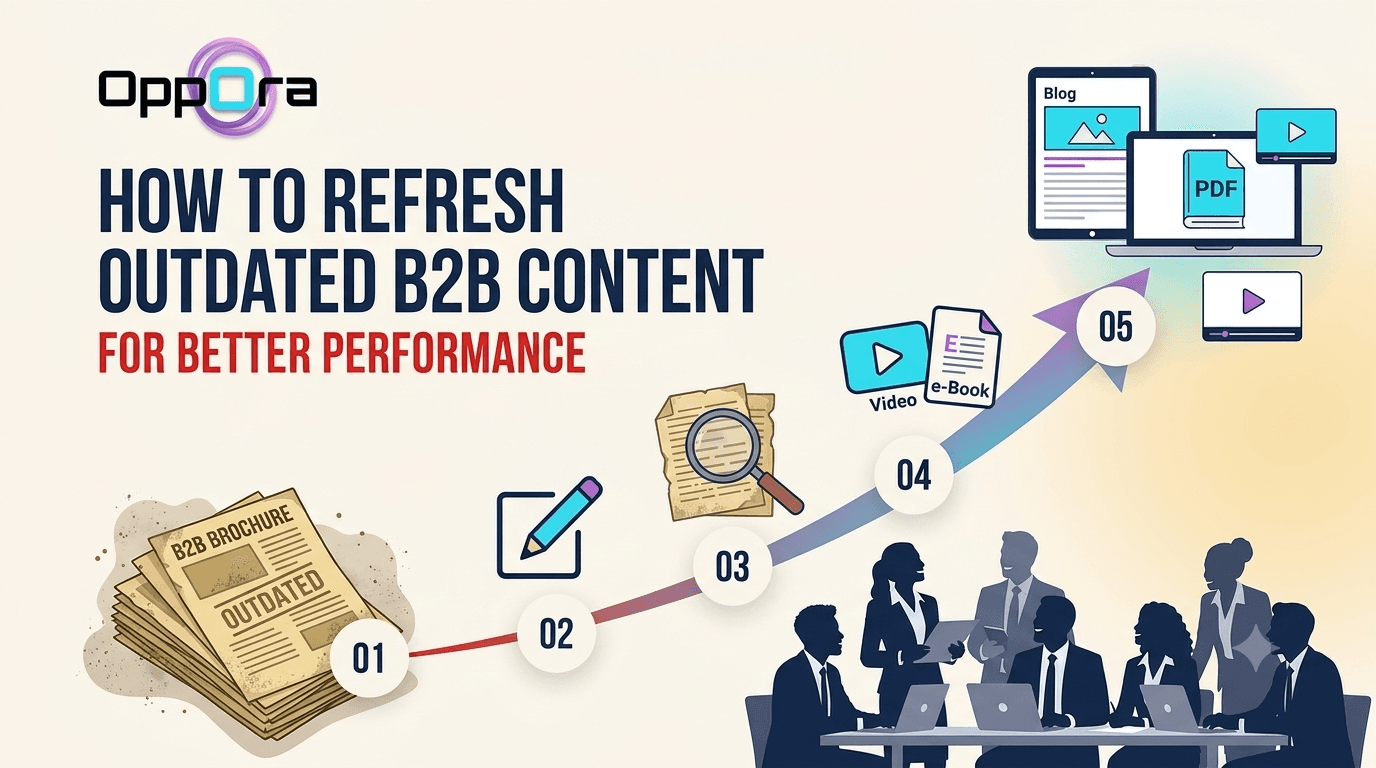
How to Refresh Outdated B2B Content for Better Performance
Adam Hossain
Published July 28, 2026
3 min
Complete Agentic Email Outreach
AI agents find and enrich prospects, personalize emails, follow up, and handle replies with your meeting link.
Start Your 7-Day Free Trial
For queries where recent information matters, search engines like Google often prioritize fresh content. This means B2B content that was performing exceptionally well some time ago can quietly lose its ranking and engagement.
One common reason is that the content has become outdated and no longer matches the latest market trends or search intent. Now the question is what you can do about such content.
Well, there is no need to discard it or put effort into creating a new piece. Instead, you can take necessary steps to refresh old B2B content for better performance. This blog post will guide you on how this can be done.
Approach to Refreshing Outdated B2B Content for Enhanced Performance
Below, we have mentioned an effective approach that can be followed for refreshing outdated B2B content.
1. Audit Content that Needs Updating
First of all, you have to perform a thorough content audit to ultimately identify which pieces need to be refreshed on a priority basis. There is no need to update every old or outdated B2B article. Instead, your focus should be on those pieces that have the greatest potential to recover performance.
Start by reviewing your website’s Google Search Console to determine which content has experienced a decline in:
- Organic traffic
- Rankings
- Click-through rate
- Conversions
When done, start reviewing the content while paying close attention to outdated information, broken links, and references to old services or industry trends. Auditing will make it easier for you to refresh B2B content with the highest performance potential on priority.
2. Increase Content Depth
B2B content is usually more comprehensive than B2C content. The reason is that it addresses longer buying cycles, multiple decision-makers, and complex operational and financial needs. So, if your outdated piece lacks content depth, expand it by adding relevant and valuable information.
To do so, here is the approach you should follow:
- Review your competitors' content to understand what headings or points they have covered that your content didn’t.
- Add the missing sections along with relevant examples, case studies, and guidance.
- Also, add relevant FAQs.
While expanding outdated B2B content, make sure every addition serves a purpose and looks contextual. Do not add unnecessary paragraphs or points simply to increase length. This act may damage the performance further instead of improving it.
3. Update Stats and Examples
Statistics and real-world examples can quickly become outdated. This is especially true for B2B content where trends, technologies, and strategies evolve rapidly. So, to refresh outdated content, it is essential to update stats, examples, and case studies.
For instance, if you have previously added some survey or research reports, replace them with the latest data from credible sources. Also, update percentages, market data, benchmarks, and other numerical information that may no longer be accurate or relevant.
Moreover, swap examples with more recent case studies that better reflect the main topic and also align with the target audience.
Updating statistics, examples, and other outdated information in your B2B content will significantly boost its credibility as well as performance.
4. Refresh Existing Content with Better Wording
Not every sentence of your old B2B content will be outdated, right? Some paragraphs may still be accurate but could benefit from clearer wording or a more polished tone. In such cases, you can rewrite them while preserving their original meaning.
For this, you can get help from an AI rewriting tool. It will automatically rewrite paragraphs with improved wording and sentence structure. Based on your specific needs, the tool can even tailor B2B content tone in different writing styles, i.e., Formal, Creative, Friendly, and more.
It is important to ensure that your rewritten content is not only fresh, but also readable. This is because even recently updated and accurate B2B content may fail to perform well if it is difficult to read for the audience.
To assess readability, you can use an online proofreader. It highlights hard-to-read sentences in the given content for quick and easy fixing.
5. Optimize On-page SEO Elements
Refreshing outdated B2B content for better performance also requires optimizing on-page SEO elements. Search behavior changes over time as Google continues to roll out updates.
This increases the chances that the keywords you previously targeted may no longer match the current search intent. So, re-evaluate both primary and secondary keywords and then naturally use them in headings, sub-headings, and the main body.
Also, update the title tag and meta description without changing the primary meaning. Add internal links to recently published B2B articles while fixing broken links. Where possible, add the latest visuals such as images, charts, graphs, etc., to give content a new look.
So, these are a few steps you can take to refresh outdated B2B content for enhanced performance in SERPs.
Wrapping It Up
If your B2B content has become outdated and is not performing well, there is no need to worry. With the right updates, you can make it valuable and competitive again. Simply auditing your old content, expanding it with relevant information, updating statistics/examples, and on-page SEO elements can significantly improve the overall performance. This blog post has covered all these steps in proper detail.
Summarize with AI
Share