How to Write BASHO Emails That Actually Get Replies
Manasa Goli
Published April 7, 2026
8 min
Complete Agentic Email Outreach
AI agents find and enrich prospects, personalize emails, follow up, and handle replies with your meeting link.
Claim Your FREE Credits
Ever sent a cold email that felt “personal”… but still got ignored?
You added their first name. Maybe even mentioned their company. And yet — no reply, no interest, just silence.
That’s because most outreach today feels templated, even when it’s technically personalized. People can sense when an email was written for many, not for them.
This is exactly where BASHO emails stand out. They don’t try to scale first — they try to connect first.
And that’s why they consistently get replies when generic cold emails don’t.
In this guide, you’ll learn:
- What a BASHO email actually is (and why it works)
- Why these emails outperform traditional cold outreach
- The key elements that make someone reply
- A step-by-step way to write your own BASHO emails
- Real examples you can learn from and adapt
Let’s start with the basics.
What Is a BASHO Email?
Before you try to write one, it helps to understand what makes a BASHO email different from regular cold outreach.
A BASHO email is a highly personalized cold email built around a specific trigger or insight about the recipient.
It’s not based on a template. It’s based on context.
Instead of saying:
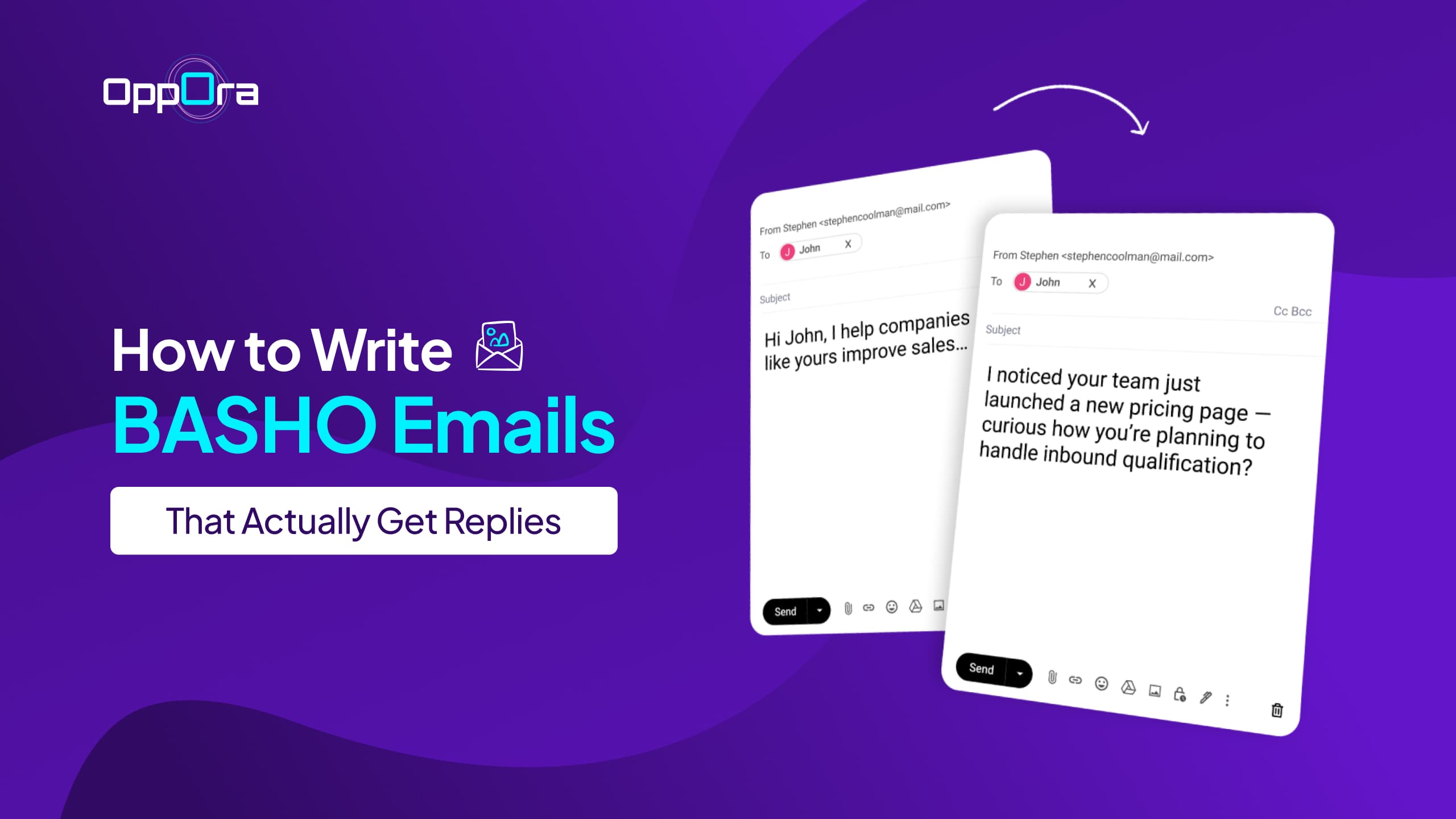
“Hi John, I help companies like yours improve sales…”
A BASHO email sounds more like:
“I noticed your team just launched a new pricing page — curious how you’re planning to handle inbound qualification?”
See the difference?
You’re not pitching immediately. You’re starting a conversation based on something real and relevant to them.
At its core, a BASHO email focuses on:
- One person, not a segment
- One insight, not a generic pitch
- One conversation, not a campaign
That’s why these emails feel natural when someone reads them. They don’t look like outreach — they feel like a thoughtful message.
And that’s exactly what makes people respond.
Why BASHO Emails Get More Replies
Now that you know what a BASHO email is, let’s quickly understand why it works so well.
Most decision-makers get flooded with cold emails every day. So anything that looks templated gets ignored instantly.
BASHO emails break that pattern.
Here’s why they get replies:
1. They feel personal: You reference something specific, which shows real effort and grabs attention.
2. They start with relevance: Instead of pitching, you talk about what matters to them right now.
3. They create curiosity: A simple, thoughtful question makes the reader stop and think.
4. They reduce resistance: No hard selling — just a natural, easy-to-reply message.
5. They sound human: They feel like a real conversation, not marketing automation.
When done right, it doesn’t feel like outreach. It feels like someone genuinely reaching out — and that’s why people reply.
Key Elements of a High-Converting BASHO Email
Now that you know why BASHO emails work, let’s break down what actually makes one effective.
1. Deep Personalization (Not Just First Name)
Anyone can add a first name. That’s not personalization anymore.
What matters is referencing something specific — a recent launch, hiring trend, or content they shared.
That’s what makes your email feel intentional.
2. A Strong Trigger or Context
Every BASHO email starts with a reason.
It could be a funding round, new feature launch, or team expansion.
This context is what makes your message relevant right now.
3. Clear Value Proposition
Once you have their attention, be clear about why you’re reaching out.
Don’t over-explain.
Just connect your idea to their situation in one simple line.
4. Short, Conversational Format
BASHO emails don’t try to impress.
They’re short, easy to read, and feel like a quick message — not a pitch.
If it looks long, it won’t get read.
5. Soft CTA
Avoid pushing for a meeting immediately.
Instead, ask something simple and low-pressure.
A question works best because it naturally invites a reply.
Step-by-Step: How to Write a BASHO Email
Now let’s make this practical.
Instead of just explaining the steps, here’s how each part looks with examples so you can visualize it clearly.
Step 1: Find a Real Trigger
Start with something specific about the person or company.
This is what makes your email relevant.
Examples:
- “Noticed you recently launched your new pricing page…”
- “Saw you’re hiring 5 SDRs right now…”
- “Came across your LinkedIn post on outbound scaling…”
These signals show why you’re reaching out now, not randomly.
Step 2: Personalize the First Line
Turn that trigger into a strong, specific opening.
Avoid generic lines. Make it feel like it was written only for them.
Examples:
- “Noticed you just rolled out a new pricing page — curious how you're handling inbound qualification.”
- “Saw your team is expanding SDR hiring pretty aggressively — that’s usually a fun phase.”
This is what makes them stop scrolling.
Step 3: Connect It to a Problem or Idea
Now add a simple observation or thought.
You’re not pitching yet — just showing you understand their situation.
Examples:
- “Usually when teams scale outbound fast, consistency becomes hard to maintain.”
- “Most teams struggle to convert pricing page traffic without proper qualification.”
This builds relevance without sounding salesy.
Step 4: Add a Clear Value Line
Now introduce how you can help — in one line.
Keep it tied directly to what you just said.
Examples:
- “We’ve been helping teams automate outbound workflows without losing personalization.”
- “We help companies capture and qualify high-intent inbound leads better.”
No long explanation. Just one clear idea.
Step 5: Keep It Short and Conversational
Now combine everything into a simple flow.
Example email:
“Noticed you’re hiring multiple SDRs right now — exciting phase.
Usually when teams scale outbound quickly, maintaining personalization gets tricky.
We’ve been helping teams automate outreach without making it feel templated.
Curious — how are you currently handling personalization at scale?”
Step 6: End With a Soft Question
Always close with something easy to reply to.
No pressure, no hard ask.
Good examples:
- “Curious how you’re approaching this today?”
- “Is this something you’re thinking about right now?”
- “Open to sharing how you’re handling this?”
When you look at the full flow, it’s simple:
- Start with something real
- Add a thoughtful observation
- Introduce one relevant idea
- End with a natural question
That’s it.
And the more you practice this with real triggers, the easier it becomes to write emails that actually get replies.
5 BASHO Email Examples That Get Replies
Now that you know the structure, let’s look at how real BASHO emails come together.
Each example follows the same flow — trigger, context, value, and a soft question.
Example 1: Product Launch Trigger
“Noticed you just launched your new pricing page — looks clean.
Usually, that’s when inbound starts picking up but qualification becomes tricky.
We’ve been helping teams convert more of that traffic without adding manual effort.
Curious — how are you handling inbound qualification right now?”
Example 2: Hiring Trigger
“Saw you’re hiring multiple SDRs right now — exciting phase.
Most teams hit consistency issues when outbound scales this fast.
We’ve been helping teams maintain personalization without increasing workload.
How are you managing outbound quality today?”
Example 3: LinkedIn Content Trigger
“Came across your post on outbound not working like it used to — completely agree.
A lot of teams are struggling because messaging still feels templated.
We’ve been experimenting with more context-driven outreach that’s been working well.
Are you testing anything new on that front?”
Example 4: Funding / Growth Trigger
“Saw you recently raised your round — congrats.
Usually, outbound becomes a big focus right after, but scaling it without burning domains is tough.
We’ve been helping teams set up safer outbound systems that scale cleanly.
Is outbound a priority for you right now?”
Example 5: Website / Messaging Trigger
“Was going through your website — your positioning around [specific angle] stood out.
One thing I’ve seen is that strong messaging doesn’t always translate into replies in outbound.
We’ve been helping teams align their outreach with their positioning better.
Curious — how are you approaching messaging in cold emails today?”
If you notice closely, none of these feel like a pitch.
They all start with something real, add a simple insight, and end with a question.
That’s what makes them easy to read — and easy to reply to.
How to Scale BASHO Emails Without Losing Personalization
By now, one thing is clear — BASHO emails work because they’re deeply personal.
But here’s the real challenge.
1. The real problem: BASHO doesn’t scale manually
Writing one great BASHO email is easy.
Writing 50 a day? That’s where things break.
You can’t manually research every prospect, find triggers, and craft unique emails forever. At some point, it either slows you down or turns into templated outreach again.
And once it feels templated, reply rates drop.
2. Introduce structured personalization
The solution isn’t to stop personalizing.
It’s to structure it.
Instead of random research, you define repeatable inputs:
- What triggers to look for (hiring, funding, launches)
- What signals matter (role, industry, stage)
- What angles to connect (problem → idea → value)
Now, you’re not starting from scratch every time.
You’re building a system that guides personalization without removing it.
This is what makes scaling possible.
3. Using AI + data signals smartly
This is where AI actually helps — not by writing generic emails, but by handling the heavy lifting.
You can use AI to:
- Pull relevant data points about each prospect
- Identify meaningful triggers automatically
- Generate first lines based on real context
But the key is this:
AI should enhance personalization, not replace thinking.
If you feed it the right signals, it can create emails that still feel human — just faster.
How Oppora.ai helps
This is exactly where tools like Oppora.ai come in — not as another email sender, but as a system for scaling personalized outreach.
Instead of you doing everything manually, it handles the workflow end-to-end.
Here’s how it helps:
- Automates research: Finds leads, enriches data, and identifies relevant triggers without manual effort
- Generates personalized lines: Creates unique, context-driven email lines instead of generic templates
- Keeps outreach human-like at scale: Every email feels individually written, even when you’re reaching out in volume
Behind the scenes, Oppora’s AI agents handle everything from finding prospects to sending emails and even replying — so you’re not stuck doing repetitive work.
When done right, scaling BASHO isn’t about sending more emails.
It’s about maintaining the quality of personalization while increasing reach.
And with the right structure and systems in place, that’s completely possible.
Final Thoughts
BASHO emails aren’t complicated.
But they do require a shift in how you think about outreach.
Instead of trying to reach more people, you focus on being more relevant to each person. Instead of pitching quickly, you start conversations thoughtfully.
That’s what makes the difference.
The good part is, once you understand the structure — trigger, context, value, and a soft question — it becomes repeatable.
And when you combine that with the right systems, you don’t have to choose between personalization and scale.
You can have both.
At the end of the day, people don’t reply to perfect emails.
They reply to emails that feel real, relevant, and written just for them.
Frequently Asked Questions
Are BASHO emails scalable for outreach campaigns?
Traditionally, BASHO emails were hard to scale because of manual research. However, with modern tools like AI-driven outreach platforms, you can automate research and personalization while still keeping emails highly relevant.
How long does it take to write a BASHO email?
Manually, it can take 5–15 minutes per prospect due to research. With the right systems or tools, this can be reduced to under a minute while maintaining quality personalization.
How many BASHO emails should you send per day?
Quality matters more than quantity. Even sending 20–50 well-crafted BASHO emails can outperform hundreds of generic emails because of higher reply rates.
Summarize with AI
Share