How to Scale Contact Discovery for B2B Sales Without Breaking Budget
Stephen Parker
Published June 2, 2026
19 min
Complete Agentic Email Outreach
AI agents find and enrich prospects, personalize emails, follow up, and handle replies with your meeting link.
Start Your 7-Day Free Trial
Finding more B2B contacts sounds simple until the costs start stacking up.
You pay for lead databases, enrichment tools, email verification, outreach software, and hours of manual research.
Still, many contacts bounce, some leads are irrelevant, and your sales team spends more time fixing lists than starting conversations.
That is why learning How to Scale Contact Discovery for B2B Sales Without Breaking Budget matters.
In this guide, you’ll learn how to:
- Reduce wasted prospecting costs
- Find better-fit B2B contacts
- Use verified data before outreach
- Scale contact discovery without adding tool overload
Why Scaling B2B Contact Discovery Gets Expensive
At first, contact discovery feels like a simple numbers game.
You find more leads, add more contacts, and give your sales team a bigger list to work with. But once you start scaling, the real cost is not just the tool subscription.
It is the time your team loses, the bad data they clean, the bounced emails they deal with, and the extra platforms you add just to make the process work.
That is where contact discovery quietly becomes expensive.
Manual prospect research wastes sales time
Manual research may work when you need 50 contacts.
But when you need hundreds or thousands of prospects, it quickly becomes slow and repetitive. Your team has to search LinkedIn, visit company websites, check job titles, confirm email formats, and copy everything into a spreadsheet.
That is a lot of effort before a single email is even sent.
The bigger problem is that your sales team ends up doing data work instead of sales work. Instead of talking to leads, testing messaging, or booking meetings, they spend hours building lists from scratch.
And when every rep follows their own research process, the quality becomes inconsistent too.
Suggested Reading:
9 Best AI Prospecting Agent to Automate Lead DiscoveryGeneric lead databases often create more cost than value
A large lead database can look attractive because it promises volume.
But volume does not always mean useful contacts. You may get thousands of names, but many of them may not match your market, buyer persona, company size, region, or timing.
So you pay for a bigger list, then spend more time filtering it down.
That means your actual cost per useful contact becomes much higher than it looks on the pricing page. A cheap database can become expensive if only a small portion of the contacts are actually relevant.
This is why scaling contact discovery is not just about finding more people.
It is about finding the right people faster.
Bad contact data leads to bounced emails and wasted outreach
Bad data creates a second layer of cost.
When emails are outdated, invalid, or guessed incorrectly, your outreach campaigns suffer. You get more bounces, lower deliverability, weaker sender reputation, and fewer real conversations.
Even worse, your team may think the campaign failed because of the message.
But sometimes the real issue is the contact list itself. If the wrong people are receiving the emails, or the emails are not reaching inboxes at all, even the best campaign will struggle.
Clean data protects your budget before outreach begins.
Using too many disconnected tools increases hidden costs
Many teams try to fix contact discovery by adding more tools.
One tool finds companies. Another finds emails. Another verifies them. Another enriches data. Another sends campaigns. Soon, your team is paying for multiple subscriptions and moving data between platforms manually.
That creates hidden costs.
You lose time switching tools, cleaning exports, removing duplicates, and checking which data source is accurate. As your team grows, this process becomes harder to manage and easier to break.
To scale contact discovery without breaking budget, you need fewer gaps in the workflow.
The goal is not just to buy more data. It is to build a cleaner system where contacts are found, verified, enriched, and prepared for outreach with less manual work.
Build a Clear Contact Discovery Strategy Before Spending Money
Once you understand why contact discovery becomes expensive, the next step is not to buy another tool immediately.
You first need a clear strategy.
Without it, you may collect thousands of contacts but still struggle to find people who are actually worth reaching out to.
A strong contact discovery strategy helps you answer four questions:
- Which companies should you target?
- Who should you contact inside those companies?
- Which accounts should you prioritize first?
- What makes a contact valuable enough for outreach?
When these answers are clear, your budget goes toward better leads instead of bigger but weaker lists.
Define your ideal customer profile first
Before you search for contacts, define the type of company you actually want to reach.
Your ideal customer profile should include details such as:
- Industry
- Company size
- Location
- Revenue range
- Team size
- Growth stage
- Tools they use
- Problems they are likely facing
This step matters because not every company is worth adding to your sales list.
A company may look interesting, but if they do not match your offer, budget, or buying needs, they will only increase your prospecting cost.
A clear ICP keeps your contact discovery focused from the beginning.
Focus on the right buyer personas and decision-makers
After you know which companies to target, you need to identify the right people inside those companies.
This is where many teams waste money.
They collect contacts based on job titles alone, without checking whether those people can influence or approve a purchase.
Instead, you should focus on people who match your sales motion.
That can include:
- Founders
- CEOs
- Sales leaders
- Marketing heads
- HR leaders
- Operations managers
- Department heads
- Procurement or finance decision-makers
The right buyer persona depends on what you sell.
When you target the correct decision-makers, your outreach becomes more relevant and your cost per qualified contact becomes easier to control.
Use buying signals to prioritize high-value accounts
Even if a company fits your ICP, timing still matters.
Some companies are more likely to respond because they are already showing signs of change or growth.
These signs are called buying signals.
Common buying signals include:
- Recent hiring
- New funding
- Leadership changes
- Market expansion
- New product launches
- Technology changes
- Increased demand in their category
Buying signals help you avoid treating every account equally.
Instead of reaching out to random companies, you can prioritize accounts that are more likely to need your solution now.
That makes your contact discovery process sharper and more budget-friendly.
Choose quality contacts over large random lead lists
Large lead lists can feel productive at first.
But if most contacts are irrelevant, outdated, or unverified, the list becomes expensive very quickly.
You spend more time cleaning the data, removing poor-fit leads, checking emails, and fixing outreach problems.
A better approach is to focus on contact quality.
A quality contact should usually meet these conditions:
- They match your target buyer persona
- They work at a company that fits your ICP
- Their email is verified
- Their role is relevant to your offer
- Their company shows some level of priority or intent
This is the real foundation of How to Scale Contact Discovery for B2B Sales Without Breaking Budget.
You are not trying to collect the biggest list possible.
You are building a repeatable system that helps your team find the right contacts, at the right companies, without wasting budget on poor-fit data.
How to Scale Contact Discovery to 10,000+ Leads Using Oppora AI?
Once your ICP and buyer personas are clear, the next challenge is execution.
You do not want your team spending days searching profiles, checking websites, finding emails, verifying contacts, and building spreadsheets manually.
That is where Oppora AI helps you scale contact discovery with a more connected workflow.
Instead of using separate tools for lead search, enrichment, verification, and outreach preparation, you can find, enrich, verify, and organize contacts in one place.
Oppora.ai is built around AI sales agents that support full-cycle outbound workflows, from finding leads to syncing activity with your CRM.
Finding Contacts Across a 1B+ Contact Database
To scale contact discovery, you first need enough data coverage.
If your database is too small, your team quickly runs into the same prospects, limited markets, and missing decision-makers.
That makes scaling harder, especially when you want to reach new industries, regions, or account segments.
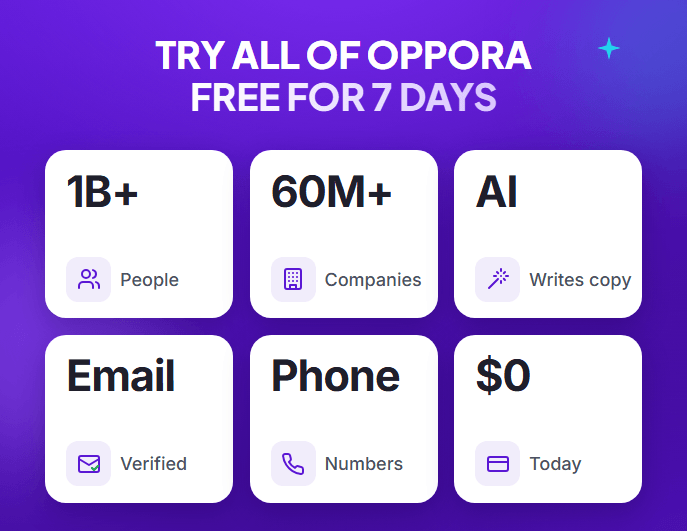
Oppora.ai gives you access to a 1B+ contact database, helping you search across a much larger pool of potential B2B buyers.
This is useful when you want to build lists across:
- Different industries
- Multiple locations
- Specific company sizes
- Target job titles
- New market segments
- Account-based prospecting campaigns
Instead of starting from a blank spreadsheet, you can begin with a large searchable database and narrow it down based on your actual ICP.
That makes it easier to move from a small list of prospects to thousands of relevant contacts without adding hours of manual research.
Filter Companies and Leads With 20+ Filters and Buying Signals
Scaling contact discovery does not mean collecting every contact you can find.
You still need filters.
With Oppora.ai, you can narrow your search by company and lead-level criteria, so your team focuses on better-fit prospects from the beginning.
You can filter based on details such as:
- Industry
- Location
- Company size
- Revenue range
- Job title
- Seniority
- Department
- Buying signals
- Company characteristics
Buying signals are especially useful because they help you prioritize accounts that may be more ready for outreach.
Instead of treating every company equally, you can focus on accounts that show stronger signs of relevance or timing.
This helps your team build lists with more intent and less waste.
Get Enriched Data Like LinkedIn, Website, Revenue Range, Company Size, and Industry
A name and email address are not enough for strong B2B prospecting.
Your sales team also needs context.
Oppora.ai helps enrich contacts with useful company and lead data, so your team can understand who they are reaching out to before the campaign begins.
This enriched data can include:
- LinkedIn profile
- Company website
- Industry
- Revenue range
- Company size
- Location
- Role or department
- Other business details
This matters because enriched data improves segmentation and personalization.
Your team can create better lists, write more relevant messages, and avoid sending the same generic email to everyone.
Suggested Reading:
How to Enrich LinkedIn Lists With Verified Work Emails at ScaleDiscovering Verified Work Emails Automatically
One of the biggest contact discovery costs comes from unverified emails.
If your team sends campaigns to bad addresses, you waste credits, damage deliverability, and reduce the value of the entire outreach campaign.
Oppora.ai helps reduce this problem by supporting email discovery and verification inside the same workflow.
That means your team can find work emails and verify them before they are used in outreach.
This helps you avoid:
- Invalid email addresses
- High bounce rates
- Poor sender reputation
- Wasted outreach effort
- Manual email checking
When you are trying to scale contact discovery, verified email data becomes one of the most important parts of the process.
Identifying Multiple Stakeholders Within Target Companies
In B2B sales, one contact is often not enough.
Most deals involve more than one person. You may need to reach the user, the manager, the budget holder, and the final decision-maker.
Oppora.ai helps you discover multiple stakeholders inside the same target company, so you can build stronger account-level prospect lists.
This can include people like:
- Founders
- CEOs
- Sales leaders
- Marketing leaders
- HR leaders
- Operations heads
- Department managers
- Finance or procurement contacts
This gives your team more ways to enter an account.
If one person does not respond, you still have other relevant contacts to approach with a tailored message.
Building Prospect Lists Without Manual Research
The biggest advantage of using Oppora AI is that your team does not need to build every list manually.
You can define your target market, apply filters, find relevant contacts, enrich their profiles, verify work emails, and prepare outreach-ready lists faster.
This helps your sales team spend less time on repetitive research and more time on actual revenue work.
A scalable contact discovery process should help you:
- Find more relevant leads
- Reduce manual research
- Improve contact accuracy
- Build segmented prospect lists
- Prepare campaigns faster
- Lower wasted prospecting spend
That is how contact discovery becomes more than lead collection.
It becomes a repeatable system for finding the right people, at the right companies, without stretching your sales budget.
Suggested Reading:
How to Build a Prospect List Without Manual Research — Try Oppora.ai in LiveWhat Does the Contact Discovery Workflow Look Like Inside Oppora?
Now that you know what Oppora.ai can help you do, let’s make the workflow easier to visualize.
Think of it as a repeatable contact discovery system.
You define who you want to reach, Oppora.ai helps you find the right accounts, identify decision-makers, enrich contact data, verify emails, and prepare lists for outreach.
Instead of jumping between spreadsheets and separate tools, you can keep the process more organized from the beginning.
Step 1: Define Your ICP and Target Market
The workflow starts with your ideal customer profile.
You need to tell Oppor.ai what kind of companies you want to target.
This can include details like:
- Industry
- Location
- Company size
- Revenue range
- Business type
- Target market
- Growth stage
This step keeps your contact discovery focused.
Instead of searching broadly, you start with a clear market and reduce the chance of collecting poor-fit contacts.
Step 2: Generate a List of Target Accounts
Once your ICP is clear, the next step is to find companies that match it.
Oppora.ai helps you generate a list of target accounts based on your selected filters and search criteria.
These accounts become the foundation of your prospecting list.
You can use this step to build lists for:
- One specific industry
- A new geographic market
- A niche customer segment
- Account-based sales campaigns
- Different service or product offers
This helps you move from guesswork to structured account discovery.
Step 3: Identify Decision-Makers Across Those Accounts
After you have the right companies, you need to find the right people inside them.
This is where contact discovery becomes more useful.
Oppora.ai helps identify relevant decision-makers and stakeholders across your target accounts, so your team is not stuck searching each company manually.
Depending on your offer, you may look for:
- Founders
- CEOs
- Sales leaders
- Marketing heads
- HR managers
- Operations leaders
- Department heads
- Finance or procurement contacts
This gives your team a stronger starting point for outreach.
You are not just finding companies. You are finding the people most likely to care about your offer.
Step 4: Enrich Contacts With Verified Work Emails
Once the right contacts are identified, the next step is enrichment.
Oppora.ai can enrich lead and company data, then help verify contact details before outreach. Its positioning includes lead discovery, enrichment, real-time email verification, and waterfall sourcing from verified contacts.
This can help you collect useful details such as:
- Work email
- LinkedIn profile
- Company website
- Industry
- Company size
- Revenue range
- Role or department
This step is important because outreach quality depends on data quality.
If the email is wrong or the company details are missing, your campaign becomes harder to personalize and easier to waste.
Step 5: Filter and Segment High-Priority Prospects
After enrichment, you should not send every contact into the same campaign.
You need to segment them.
Oppora.ai helps you organize prospects based on fit, role, company type, or priority level.
You can segment contacts by:
- Buyer persona
- Industry
- Company size
- Location
- Seniority
- Buying signal
- Outreach angle
- Account priority
This helps your team send more relevant messages.
A founder, HR leader, and sales director may all belong to the same target market, but they should not receive the exact same email.
Step 6: Export Outreach-Ready Contact Lists
Once your contacts are filtered and verified, you can prepare them for outreach.
At this stage, your list should be cleaner and more useful than a raw database export.
An outreach-ready contact list should include:
- Relevant companies
- Correct decision-makers
- Verified work emails
- Enriched company details
- Clear segmentation
- Priority tags or notes
This makes it easier for your team to launch campaigns without spending extra hours cleaning spreadsheets.
Oppora also supports syncing contacts, replies, meetings, and deals into CRM tools like HubSpot, Salesforce, Pipedrive, or its built-in CRM.
Step 7: Repeat the Process Across New Markets and Segments
The real value comes when the workflow becomes repeatable.
Once you build a contact discovery process for one market, you can repeat it across new segments.
You can create lists for:
- New industries
- New locations
- Different buyer personas
- Separate product lines
- Different company sizes
- New account-based campaigns
This is how you scale without starting from zero every time.
You keep the same structure, adjust the filters, and build new prospect lists with less manual effort.
That is what makes Oppora.ai useful for teams trying to scale contact discovery without breaking budget.
You are not just buying leads once.
You are creating a repeatable workflow that helps you find, enrich, verify, segment, and prepare contacts whenever your sales team needs a new pipeline source.
How Does Oppora Help Reduce Contact Acquisition Costs?
Once you have a repeatable workflow, the next question is simple.
How does it actually reduce the cost of finding contacts?
The answer is not only about paying less for data. It is about removing waste from the entire prospecting process.
Oppora.ai helps reduce contact acquisition costs by cutting manual work, improving data quality, and keeping contact discovery, enrichment, verification, and outreach preparation inside one connected system.
Its AI sales agents are designed to handle key outbound steps like finding leads, enriching data, verifying contacts, sending outreach, replying, and syncing activity to your CRM.
Eliminating Hours of Manual Research
Manual contact discovery is expensive because your team pays for it with time.
Every hour spent searching LinkedIn, checking company websites, copying names, guessing email formats, and cleaning spreadsheets is an hour not spent on selling.
Oppora.ai reduces that manual work by helping your team find and prepare prospect lists faster.
Instead of doing everything one contact at a time, your team can:
- Define the target market
- Search for matching companies
- Find relevant decision-makers
- Enrich contact details
- Verify work emails
- Prepare lists for outreach
This makes contact discovery less dependent on repetitive research.
Your sales team can focus more on conversations, follow-ups, and meetings instead of building lists from scratch.
Increasing Contacts Found Per Prospecting Session
A common reason contact acquisition becomes expensive is low output.
Your team may spend hours prospecting but only find a small number of usable contacts.
That creates a high cost per valid lead.
Oppora.ai helps increase the number of relevant contacts your team can find in each prospecting session because the process is more structured.
You are not jumping between tools or searching blindly.
You can start with your ICP, apply filters, use buying signals, identify decision-makers, and enrich the data in a cleaner flow.
This means each prospecting session can produce more outreach-ready contacts.
And when your team finds more valid contacts in less time, your cost per qualified contact starts to drop.
Reducing Dependence on Multiple Data Vendors
Many B2B teams use separate tools for different parts of contact discovery.
One tool finds companies.
Another tool finds emails.
Another verifies those emails.
Another enriches data.
Another sends outreach.
This setup may look flexible, but it often creates extra cost.
You pay for multiple subscriptions, manage different credit systems, export and import data, and spend time fixing gaps between tools.
Oppora.ai helps reduce this dependency by combining lead search, enrichment, verification, and outbound workflow support under one platform.
It also uses one pricing structure for different tasks, separate task-based credits, and add-on packs when you need extra capacity without upgrading the full plan.
That gives your team more control over spend.
You are not forced to keep adding tools just to complete one contact discovery workflow.
Improving Prospecting Efficiency Across the Sales Team
Contact acquisition cost is not only a software cost.
It is also a team efficiency cost.
If every sales rep builds lists differently, your process becomes hard to scale. One rep may use outdated contacts. Another may skip verification. Another may target the wrong persona.
That creates inconsistent outreach and weaker results.
Oppora.ai gives your team a more repeatable prospecting system.
Everyone can follow the same basic process:
- Define the ICP
- Find target accounts
- Identify decision-makers
- Enrich contacts
- Verify emails
- Segment prospects
- Prepare lists for outreach
This improves consistency across the team.
It also makes it easier to measure what is working because your contact discovery process is not scattered across different spreadsheets and tools.
When your team works from cleaner data and a shared workflow, you reduce wasted effort and improve the chances of turning discovered contacts into real sales conversations.
Best Practices for Scaling Contact Discovery Sustainably
Scaling contact discovery is not just about finding more leads.
You also need to protect data quality, outreach performance, and your sales team’s time as the volume increases.
If your process is messy at 500 contacts, it will become even harder at 5,000 or 10,000 contacts.
That is why sustainable scaling needs a few clear rules.
Start With Account-Based Prospecting
Instead of searching for random contacts, start with the accounts you actually want to win.
Account-based prospecting helps you focus on companies that match your ICP first, then find the right people inside those companies.
This keeps your contact discovery process more targeted.
You can build account lists based on:
- Industry
- Company size
- Location
- Revenue range
- Growth stage
- Buying signals
- Market segment
Once you have the right accounts, you can identify multiple decision-makers and influencers inside each company.
This gives your outreach more structure and reduces wasted effort on poor-fit contacts.
Focus on Verified Contact Data
Verified data is one of the most important parts of scaling contact discovery.
When your team works with unverified emails, every campaign carries more risk.
Bad emails can lead to:
- Higher bounce rates
- Lower deliverability
- Wasted outreach credits
- Poor sender reputation
- Fewer real conversations
Before any contact enters your outreach campaign, the email should be checked.
This does not just protect your campaign performance.
It also helps you understand the real value of your contact discovery process because you are measuring usable contacts, not just raw leads.
Segment Prospects Before Outreach
A large contact list is only useful when it is organized properly.
If you send the same message to every prospect, your outreach will feel generic.
Before launching campaigns, segment your contacts based on who they are and why they may care.
You can segment prospects by:
- Job title
- Department
- Seniority
- Industry
- Company size
- Location
- Pain point
- Buying signal
- Outreach angle
This helps you write more relevant emails.
A founder may care about growth and revenue. A sales leader may care about pipeline. An operations manager may care about efficiency.
Segmentation makes sure each group receives a message that matches their priorities.
Continuously Refresh Contact Databases
Contact data does not stay accurate forever.
People change jobs, companies restructure teams, emails become inactive, and decision-makers move into new roles.
If your team keeps using old contact lists, your outreach quality will drop over time.
That is why you should refresh your data regularly.
This can include:
- Re-verifying emails
- Updating job titles
- Removing inactive contacts
- Checking company changes
- Updating LinkedIn profiles
- Replacing outdated records
A fresh database helps your team avoid wasted outreach.
It also keeps your contact discovery engine more reliable as you scale into new markets and segments.
Measure Cost Per Qualified Contact
Do not only look at how many contacts you found.
Look at how many qualified, verified, relevant contacts your team can actually use.
Your cost per qualified contact should consider:
- Tool cost
- Data credits used
- Manual research time
- Email verification cost
- Number of valid contacts found
- Number of meetings or replies generated
This gives you a more honest view of your prospecting spend.
A cheap list is not really cheap if most contacts are invalid or irrelevant.
A slightly smaller but cleaner list can often create better results because your team spends less time fixing data and more time starting conversations.
Common Mistakes That Increase Contact Discovery Costs
Even with the right tools, contact discovery can still become expensive if the process is not controlled.
Most teams do not overspend because they are trying to find leads.
They overspend because they chase the wrong leads, trust poor data, and measure the wrong outcomes.
Here are the common mistakes to avoid.
Targeting everyone instead of a specific market
Trying to reach everyone usually leads to poor results.
When your targeting is too broad, your team collects contacts from companies that may never need your solution.
This creates more work during list cleaning, segmentation, and outreach.
Instead, narrow your focus before you start searching.
You should be clear on:
- Which industries you want to target
- What company size fits your offer
- Which locations matter
- What roles are involved in the buying process
- What signals make an account worth prioritizing
A smaller, focused market is easier to scale than a large random one.
Buying oversized lead lists without checking quality
Big lead lists can look like a shortcut.
But if the contacts are outdated, irrelevant, or poorly matched, the list becomes expensive very quickly.
You may pay less per contact upfront, but your real cost increases when your team has to remove bad-fit leads, verify emails, and rebuild the list manually.
Before buying or importing any list, check whether the contacts match your ICP, buyer personas, and outreach goals.
Sending unverified contacts directly into outreach campaigns
Unverified contacts can hurt your entire outbound process.
If too many emails bounce, your sender reputation may suffer, and future emails may struggle to reach the inbox.
That means you are not only wasting contacts.
You are also weakening the performance of future campaigns.
Always verify work emails before adding them to outreach sequences.
Measuring volume instead of valid contacts and meetings booked
More contacts do not always mean more pipeline.
If your team only tracks list size, it may look like contact discovery is working even when the data is poor.
A better approach is to measure:
- Valid contacts found
- Qualified contacts added
- Bounce rate
- Reply rate
- Meetings booked
- Cost per qualified contact
This gives you a clearer view of whether your contact discovery process is actually helping sales.
Conclusion
Scaling contact discovery does not have to mean buying more tools, hiring more researchers, or paying for oversized lead lists.
The better approach is to build a smarter system.
You need a clear ICP, the right buyer personas, verified contact data, useful enrichment, and a repeatable workflow your sales team can use again and again.
That is how you find more relevant contacts without letting prospecting costs grow out of control.
If your team wants to scale contact discovery without manual research, Oppora.ai can help you move faster.
With Oppora.ai, you can discover contacts, enrich lead data, verify work emails, build segmented prospect lists, and prepare outreach-ready campaigns in one connected platform.
So instead of spending hours fixing lists, your team can focus on what matters most.
Starting better sales conversations with the right people.
FAQs
How do you scale contact discovery for B2B sales without breaking budget?
You scale contact discovery without breaking budget by defining your ICP first, using verified contact data, filtering prospects by fit and buying signals, reducing manual research, and avoiding disconnected tools that increase hidden costs.
Why does B2B contact discovery get expensive?
B2B contact discovery gets expensive when sales teams rely on manual research, buy low-quality lead lists, use unverified emails, or pay for multiple tools to find, enrich, verify, and organize contacts.
What is the best way to find B2B contacts at scale?
The best way to find B2B contacts at scale is to start with target accounts, identify the right buyer personas inside those companies, enrich the data, verify work emails, and segment contacts before outreach.
Why is verified contact data important for B2B sales?
Verified contact data helps reduce bounce rates, protect sender reputation, improve outreach deliverability, and make sure your sales team is contacting real people at the right companies.
How does Oppora help with B2B contact discovery?
Oppora helps teams discover contacts, enrich lead data, verify work emails, filter prospects, and build outreach-ready lists in one connected workflow, so sales teams can reduce manual research and control contact acquisition costs.
Summarize with AI
Share