Reverse Email Lookup Tools Compared: Find and Enrich B2B Contacts in 2026
Manasa Goli
Published September 16, 2026
14 min

Complete Agentic Email Outreach
AI agents find and enrich prospects, personalize emails, follow up, handle replies, and book meetings automatically.
Claim Your FREE Credits
If you have an email address but don't know who is behind it, a reverse email lookup can help turn that single data point into a useful contact record.
For example, you may receive an email from [email protected] but have no name, job title, LinkedIn profile, or company information attached to it.
A reverse email lookup tool can search its database and public sources to identify the person and enrich the record.
This is especially useful for sales and marketing teams. Instead of manually searching Google, LinkedIn, company websites, and other sources, a reverse lookup can bring several pieces of information together in one place.
In this guide, we'll compare the best reverse email lookup tools, what information they provide, how they work, their pricing, and which type of user each tool is best suited for.
What Is a Reverse Email Lookup?
A reverse email lookup starts with an email address instead of a person's name.
Traditional email finding usually works like this:
Name + Company → Email Address
Reverse email lookup works in the opposite direction:
Email Address → Person + Company + Additional Information
Depending on the provider and the availability of data, a lookup may return:
- Full name
- Job title
- Company name
- Company website or domain
- Location
- LinkedIn or other public social profiles
- Company information
- Email verification status
- Additional contact or professional data
For example:
Input: [email protected]
Possible result: Alex Morgan → VP of Sales → Acme Technologies → New York → LinkedIn profile
The important point is that not every lookup will return every field. Results depend on whether the email address is associated with publicly available or proprietary data.
How Does Email Lookup Reverse Search Work?
A reverse email lookup service generally matches an email address against one or more data sources.
A simplified process looks like this:
Email address entered
↓
Database matching
↓
Public web/source matching
↓
Identity and company matching
↓
Contact enrichment
↓
Result returned
Some platforms use proprietary databases containing millions or hundreds of millions of professional records. Others rely more heavily on publicly available information.
The need for better contact data is also tied directly to the value of email outreach. Litmus' 2025 research found that 35% of companies reported $10–$36 in return for every $1 spent on email, while another 30% reported $36–$50.
Example
Suppose a salesperson receives:
[email protected]
Instead of immediately replying, they run the address through a reverse email lookup tool.
The tool may identify:
The salesperson can then check whether Jane is actually the right person to speak with before continuing the conversation.
Best Reverse Email Lookup Tools in 2026
The best reverse email lookup tool depends on whether you need a simple identity search, B2B contact enrichment, or a complete prospecting workflow.
For sales teams, pricing, database size, enrichment depth, and what you can do after finding a contact are more useful comparison points than a simple feature checklist.
Pricing and available credits can change by plan, billing cycle, or region. Database figures represent providers' stated coverage and should not be interpreted as guaranteed unique or currently active contacts.
1. Oppora.ai

Oppora takes a different approach to reverse email lookup and B2B contact enrichment. Rather than using an email address only to identify a person, its prospecting workflow can use contact and company data as part of a broader outbound process.
Oppora's Prospect Finder provides access to 700M+ leads, while its platform combines contact discovery, email search, email verification, company enrichment, lead scoring, and outbound automation.
Key Features
- Lead Search: Find companies and people using filters, AI Search, and prospecting workflows.
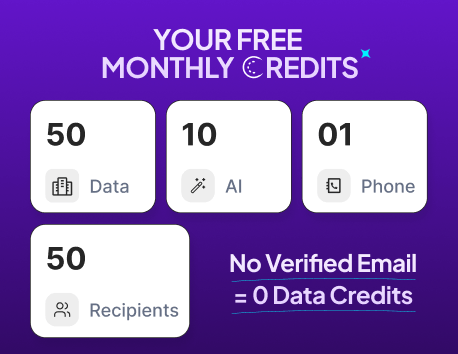
- Email Search: Find professional email addresses with 1 data credit per email.
- Email Verification: Verify emails for 1 data credit when a recent verification is unavailable.
- Company Enrichment: Enrich company records for 1 data credit.
- Phone Search: Find phone numbers using 1 phone credit.
- AI Search: Search for companies or people using natural-language prompts for 1 AI credit per search.
- Lead Scoring: Score prospects using AI and defined qualification criteria.
- LinkedIn Extension: Find prospect and company information while browsing LinkedIn.
- Outreach Automation: Automate prospecting, email outreach, follow-ups, and replies.
- AI Sales Agents: Use AI agents for prospect finding, enrichment, scoring, personalization, and outreach.
Pricing
Oppora has a Free plan at $0/month, which includes 500 Email Search credits, 500 Email Verify credits, and 500 monthly recipients.
The Pro plan starts at $34/month and includes up to 5,000 emails/day, 25 email accounts, 5,000 monthly email-search credits, and unlimited email verification.
The Max plan is $79/month and increases the limits to 10,000 emails/day and 50 email accounts, along with a dedicated account manager.
Pros
- 700M+ lead database
- Combines prospecting, enrichment, verification, and outreach
- Free plan available
- AI-powered sales workflows
- Useful for solopreneurs and B2B sales teams
Cons
- More focused on B2B sales than consumer identity searches
- Broader platform can be more than you need for a one-off email lookup
Best for
B2B teams that want reverse email research connected to prospecting, enrichment, qualification, and outbound sales.
Suggested Reading:
How to Build a Prospect List Without Manual Research — Try Oppora.ai in Live2. Hunter

Hunter is focused heavily on professional email discovery and verification. Its Reverse Email Lookup can start with an email address and return information such as the person's name, job title, company, location, and available public social profiles.
Hunter says its database contains 100M+ professional email addresses, making it one of the more established options for professional email research.
Key Features
- Email Finder: Find professional emails using a person's name and company/domain; 1 credit per email found.
- Domain Search: Find emails associated with a company/domain; 1 credit per email revealed.
- Bulk Email Finder: Find emails from contact lists in bulk.
- Email Verification: Verify email deliverability for 0.5 credit per verification.
- Bulk Domain Search: Find up to 10 emails per domain for 1 credit.
- Lead Enrichment: Enrich saved leads with additional information.
- B2B Database: Discover companies and prospects using industry, location, keyword, and other filters.
- Sequences: Send automated cold-email campaigns with tracking and A/B testing.
- Browser Extension: Find professional emails while browsing websites.
- API: Access Hunter's email-finding and verification capabilities programmatically.
Pricing
Hunter has a Free plan with 50 credits/month.
Its Starter plan costs $34/month when billed monthly and includes 2,000 searches and 500 verifications. Higher plans increase the monthly search and verification limits.
Pros
- Strong focus on professional email data
- Reverse lookup and verification in one platform
- Free plan available
- API access
- Simple interface
Cons
- Credit limits can become restrictive for larger prospecting campaigns
- Primarily focused on email intelligence rather than a complete sales workflow
Best for
Sales and marketing teams that mainly need professional email discovery, reverse lookup, and verification.
3. Apollo.io

Apollo is a broader sales intelligence platform that combines contact data, company intelligence, prospecting, and sales engagement.
Rather than being built specifically as a reverse email lookup service, Apollo is useful when an email address is only the starting point for researching a potential B2B prospect.
Key Features
- Contact Database: Search B2B contacts and company records using prospecting filters.
- Email Search: Access verified email data for 1 credit per email.
- Phone Search: Access verified phone numbers for 8 credits per phone number.
- Lead Enrichment: Enrich contact/company records using 1–8 credits, depending on the data.
- AI Research: Research prospects and generate insights for 1 credit per AI run.
- AI Lead Scoring: Score and prioritize prospects using AI.
- Sequences: Run automated multichannel sales sequences; paid plans include unlimited sequences.
- Email Warmup: Includes deliverability tools and email warmup on paid plans.
- CRM Enrichment: Automatically enrich CRM records.
- Intent Data: Track buying intent with up to 12 intent topics on Organization.
- Workflow Automation: Automate prospecting, enrichment, and sales workflows.
- Dialer: Built-in calling with credits applying to usage.
Pricing
Apollo offers a Free plan with limited access to its prospecting and engagement features.
Paid plans start at approximately $49/user/month when billed annually, with higher tiers adding more advanced prospecting and engagement capabilities.
Pros
- Large B2B contact database
- Strong prospecting filters
- Contact and company intelligence
- Sales engagement included
- CRM integrations
Cons
- More complex than a dedicated reverse email lookup tool
- Some advanced capabilities require higher-tier plans
- Credit and usage limits can vary by plan
Best for
Sales teams that want reverse email research as part of a larger prospecting and sales engagement platform.
Suggested Reading:
Cognism vs ZoomInfo: Which B2B Data Provider Is Better in 2026?4. Pipl

Pipl is designed around identity resolution and people data rather than traditional B2B prospecting.
It can be useful when the objective is to connect an email address or other identifier with information about an individual.
Key Features
- People Search: Search for people using identity and personal information.
- Identity Resolution: Connect information from multiple sources to build a more complete identity profile.
- Email Lookup: Use email addresses to identify associated people and information.
- Phone Lookup: Search identities using phone numbers.
- Social Profiles: Match people with available social and online profiles.
- Location Data: Connect identities with available geographic information.
- API: Integrate identity-resolution and search capabilities into other applications.
- Identity Verification: Use identity data for verification and fraud-related use cases.
Pricing
Pipl does not follow the same straightforward self-service pricing model as tools such as Hunter or Oppora. Pricing is generally custom, depending on the organization's requirements, data access, and usage.
Pros
- Strong identity-resolution focus
- Broader people-data use cases
- Useful for organizations with identity-related requirements
Cons
- Pricing is less transparent
- Not primarily designed for everyday B2B outbound prospecting
- May be excessive for simple email lookups
Best for
Organizations that need broader identity intelligence rather than a standard B2B prospecting database.
5. Epieos

Epieos is designed for quick investigations using email addresses and other identifiers. It can surface publicly available signals associated with an email address.
It is particularly useful when you want to investigate an address before deciding whether it deserves further research.
Key Features
- Email OSINT: Investigate an email address across multiple online services.
- Email Checker: Check whether an email is associated with supported online services.
- Phone Checker: Investigate phone numbers across supported sources.
- Google Search: Investigate identities and accounts through Google-related data.
- LinkedIn: Available on the €29.99/month Osinter plan.
- Social/Online Account Checks: Supports services including GitHub, Facebook, Dropbox, Gravatar, Substack, Trello, Notion, and others.
- Full-Access Requests: 30 full-access requests/month on the Osinter plan.
- API Access: Available on the Enterprise plan.
- Enterprise Modules: Custom request limits, private modules, and additional credits.
Pricing
Epieos provides free searches, with additional functionality available through paid options. Because its model differs from large B2B databases, it is better suited to individual searches than large-scale prospecting.
Pros
- Useful for quick investigations
- Free search option
- Simple for individual lookups
- Can surface public account signals
Cons
- Not designed as a full B2B prospecting database
- Limited enrichment compared with sales intelligence platforms
- Less suitable for large-scale sales workflows
Best for
Quick email investigations and basic identity research.
6. BeenVerified

BeenVerified is primarily a people-search platform, making it different from the B2B-focused tools in this list.
It can search for people using identifiers such as names, phone numbers, email addresses, and addresses.
Key Features
- People Search: Search for people using names and other identifying information.
- Reverse Phone Lookup: Search for information associated with a phone number.
- Reverse Email Lookup: Search for people or information connected to an email address.
- Address Search: Find information associated with an address.
- Public Records Search: Search available public-record information.
- Username Search: Search for online profiles associated with usernames.
- Property Records: Access available property-related information.
- Vehicle Search: Search available vehicle information.
- Background Information: Compile available public information into a single report.
Pricing
BeenVerified operates primarily through a subscription model rather than a traditional B2B credit system. Pricing can vary based on the subscription option and promotional offer available at the time.
Pros
- Broad people-search functionality
- Multiple search methods
- Useful for consumer-oriented research
- Reverse email search available
Cons
- Primarily focused on U.S. people-search data
- Not designed specifically for B2B prospecting
- Subscription model may not suit occasional business users
Best for
Consumer-oriented people searches and broader personal identity research.
Quick Comparison: Which Tool Should You Choose?
This structure is much stronger for the article because every tool is evaluated on the same criteria, while the table gives readers actual numbers and pricing they can compare rather than a collection of checkmarks.
How to Choose a Reverse Email Lookup Tool
Choosing a reverse email lookup tool is not just about finding the largest database or the lowest monthly price. You should also consider the quality of the data, pricing model, verification capabilities, and what you can do with the contact after the lookup.
1. Check the Type of Data You Need
Different tools provide different levels of information from an email address. Some may return basic contact details, while B2B platforms can provide additional information for prospecting and qualification.
Look for the data your workflow actually requires:
- Full name and job title
- Company name and website
- Industry and company size
- Location
- Professional or social profiles
- Email verification status
- Company enrichment
- Additional prospect or firmographic data
If you only need basic identification, a simple lookup tool may be sufficient. For sales prospecting, deeper enrichment can provide more useful context.
2. Look at Data Freshness
B2B contact information can become outdated quickly. People change jobs, companies update their information, and email addresses can become inactive.
A large database does not necessarily mean better data if many records are outdated. Check how the provider collects, refreshes, and verifies its contact information.
Consider:
- How frequently records are updated
- Whether job changes are reflected
- How often company information is refreshed
- Whether email addresses are regularly verified
- Whether the provider indicates when information was last checked
Fresh data is especially important when lookup results will be used for outbound sales or marketing.
3. Check Email Verification
Finding an email address and confirming that it is deliverable are two different processes. A reverse lookup can identify information associated with an address, but that does not necessarily mean the mailbox is still active.
When comparing tools, check whether email verification is:
- Included with the lookup
- Charged separately
- Based on credits
- Available only on specific plans
- Available for bulk verification
- Available through an API
4. Compare Credit Systems
Monthly subscription prices can be misleading because each provider may calculate usage differently. One platform may charge credits for searches, while another may use separate credits for enrichment, verification, or contact exports.
Before comparing pricing, check:
- Number of lookup credits included
- Cost per search
- Cost per verification
- Enrichment credit usage
- Bulk search limits
- API usage limits
- Additional credit costs
Instead of comparing only the subscription price, consider the approximate cost of the actual lookups and enrichment you expect to perform.
5. Consider What Happens After Enrichment
Reverse email lookup is usually only one part of the sales process. If a tool only identifies a contact and requires separate platforms for enrichment, verification, qualification, and outreach, the overall workflow can become more complicated.
For B2B sales, look for platforms that can support a connected workflow such as:
Lookup → Enrichment → Verification → Qualification → Scoring → Outreach
Also consider whether the platform provides:
- CRM integration
- Data export
- Lead scoring
- Prospect segmentation
- Outreach automation
- Workflow automation
- API access
The best reverse email lookup tool is not necessarily the one with the biggest database. Look for a platform that provides useful and current data, transparent pricing, reliable verification, and features that fit your overall workflow.
Are Reverse Email Lookup Tools Accurate?
They can be useful, but no reverse email lookup service should be treated as an infallible source of truth.
A result can be incomplete because:
- The person changed companies
- The email address is new
- The address isn't publicly associated with the person
- The provider doesn't have the contact in its database
- The information hasn't been updated
- The address is a generic inbox such as [email protected]
For example:
[email protected]
may identify the company but not a specific employee.
Similarly, a personal Gmail address may provide little professional information.
The best approach is to cross-check important information, particularly before adding a contact to a large outreach campaign.
Conclusion
Reverse email lookup tools can make it easier to identify unknown contacts, enrich B2B records, and verify email information before starting outreach. They can also reduce the time spent researching prospects across multiple sources.
However, not every tool provides the same level of data or accuracy. Some focus mainly on identifying people, while others offer deeper company enrichment, verification, prospecting, or sales features.
When comparing reverse email lookup tools, look beyond database size and price. Consider data accuracy, freshness, verification, search limits, enrichment depth, pricing, and ease of use to choose a tool that matches your specific workflow.
Frequently Asked Questions
Can I reverse lookup an email address for free?
Yes. Some platforms offer free reverse email searches or limited monthly credits.
Can a reverse email lookup find someone's LinkedIn profile?
Some services can return public social profiles when they can associate the email with a professional identity. However, results vary by email address and data availability.
Why does a reverse email search return no results?
The address may not exist in the provider's database, may not be publicly associated with a person, or the person may have changed companies.
Is reverse email lookup the same as email verification?
No. Reverse lookup attempts to identify who an email belongs to, while verification checks whether the address is likely valid or deliverable.
Can reverse email lookup work with Gmail addresses?
Sometimes, but results are usually more limited than with professional addresses tied to a company domain. Professional email addresses generally provide stronger B2B context.
Can businesses use reverse email lookup for lead enrichment?
Yes. A professional email address can be used as the starting point for adding a contact's name, job title, company, location, and other available information to a CRM or prospecting workflow.
How often should B2B contact data be rechecked?
There isn't one universal interval because data changes at different rates across industries and companies. High-value prospect lists should be checked more frequently than dormant records, especially before large outreach campaigns.
Summarize with AI
Share