Best Email Finder Extensions for Chrome to Find B2B Contacts
Manasa Goli
Published September 16, 2026
20 min

Complete Agentic Email Outreach
AI agents find and enrich prospects, personalize emails, follow up, handle replies, and book meetings automatically.
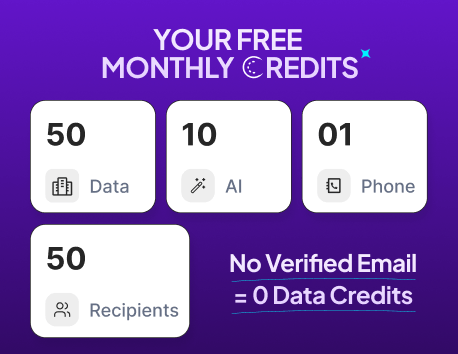
Claim Your FREE Credits
Finding the right B2B prospect is only half the job.
You may have the person's name, company, job title, and even their LinkedIn profile. But if you still need to open multiple tabs, search the company website, guess the email format, and verify the address manually, prospecting can quickly become a time-consuming task.
That is where an email finder Chrome extension can help.
Instead of leaving the page you are already working on, you can use an extension to discover business contact information while browsing LinkedIn, company websites, and other prospecting pages.
But not every extension works the same way.
Some focus only on finding emails. Others add phone numbers, enrichment, verification, CRM integrations, or even complete outreach workflows.
In this guide, you will learn:
- What you can find with an email finder extension
- What makes an email finder extension worth using
- The 10 best email finder extensions for Chrome
- How their features, pricing, and limitations compare
- How to find B2B emails directly from your browser
- What to check before choosing an email finder tool
What Can You Find With a Chrome Extension?
An email finder extension for Chrome can turn your browser into a prospecting workspace.
Instead of copying a prospect's name and company into a separate tool, you can often start with the page you are already viewing.
Depending on the tool, you may be able to find:
- Professional or business email addresses
- Direct phone numbers
- Names and job titles
- Company information
- LinkedIn contact details
- Email verification information
- Social profiles
- Lead enrichment data
- CRM-ready contact records
The exact information depends on the extension and the data sources behind it.
You can identify a decision-maker first and then use the extension to find the business contact information you need.
The bigger advantage is speed.
Instead of switching between LinkedIn, a search engine, a database, and a spreadsheet, you can keep much of the process inside your browser.
How We Evaluated the Tools
Choosing an email finder extension is not just about asking whether it can find an email.
You also need to understand how the tool finds the address, how it verifies the result, how many contacts you can access, and what happens after you find the lead.
Here are the factors worth checking.
Email accuracy and verification
A tool may find an address, but that does not automatically mean the address is safe to use.
Look for tools that verify emails or clearly indicate the confidence or verification status of the result.
This matters because sending to invalid addresses can increase bounce rates and waste your outreach credits.
Hunter, for instance, includes auto-verification across its plans, while its Email Finder uses one credit when an email is successfully found.
LinkedIn support
If most of your prospecting starts on LinkedIn, your extension should work naturally with LinkedIn.
A strong email finder extension LinkedIn workflow lets you identify the person, reveal contact information, save the lead, and continue prospecting without manually copying information between tools.
Credit limits
Look beyond the monthly subscription price.
Two tools can have similar starting prices but give you very different amounts of usable data.
Check:
- Email search credits
- Verification credits
- Phone credits
- Export limits
- Monthly recipient limits
- Whether credits roll over
- Whether different actions use the same credit pool
Bulk prospecting
If you only need five emails occasionally, a lightweight extension may be enough.
If you need hundreds or thousands of contacts, you will want bulk search, enrichment, exports, or database access.
Integrations
Your extension should fit into the rest of your workflow.
CRM integrations, CSV exports, Google Sheets, APIs, and sales engagement tools can save you from manually moving every contact after you find it.
Ease of use
The best extension is one you can use without interrupting your prospecting workflow.
You should be able to open a profile or company website, run the extension, review the available information, and save the contact with minimal effort.
10 Best Email Finder Extensions for Chrome
There is no single best tool for every B2B workflow.
Some extensions are better for finding individual contacts. Others are built for LinkedIn prospecting, bulk enrichment, phone data, or complete outbound campaigns.
Here is a quick comparison before we look at each tool in detail.
* Pricing is based on publicly listed plans checked for this article and may change.
1. Oppora

Best for: B2B prospecting and end-to-end outbound
If you want an email finder that can do more than simply reveal an address, Oppora is worth considering.
Oppora combines prospect discovery, lead enrichment, email search, verification, LinkedIn prospecting, outreach, AI replies, and CRM workflows in one platform.
Its Chrome extension can be part of that prospecting workflow, while the broader platform is designed to move from finding a prospect to contacting and managing that prospect.
Features
Oppora includes:
- Email Search
- Email Verification
- Lead Search
- LinkedIn Search
- Chrome Extension
- Bulk Email Search
- Lead Enrichment
The platform uses separate credits for activities such as email search, verification, and enrichment rather than forcing every activity into one shared credit pool.
That matters when your workflow involves more than finding an email.
You can search for leads, enrich them, verify their contact information, and then move them into an outreach workflow without stitching together several separate tools.
Pricing
Oppora has a Free plan, a Pro plan at $34/month, and a Max plan at $79/month, with Enterprise pricing available for larger requirements.
The platform also provides separate email search and verification credits. The published pricing information lists 500 email searches on Free, 5,000 on Pro, and 10,000 on Max, with higher-volume Enterprise requirements handled separately.
Oppora also offers additional credit packs, including email search credits, email verification credits, enrichment credits, and recipient add-ons.
This gives you an alternative to upgrading your entire plan just because you need additional email searches.
Pros
- Combines prospecting and outreach in one platform
- Separate credits for different prospecting activities
- Email search and verification are both available
- Supports LinkedIn prospecting
- Includes Chrome extension access
- Supports bulk email search
- Includes CRM integrations
- Supports AI-powered outreach and replies
- Unlimited campaigns and email sending on applicable plans
- Credit rollover is available on paid plans
Cons
- It can be more functionality than you need if you only want occasional email lookups.
- The broader platform requires some setup if you only need a simple finder.
- Users focused purely on contact discovery may prefer a specialized database.
Best for: If you want to move from finding B2B contacts to running the entire outbound workflow from one place, Oppora is the strongest fit in this list.
2. Apollo.io

Best for: B2B prospecting, contact data, and sales engagement
Apollo is more than an email hunter extension Chrome users can rely on for individual lookups.
It combines a large B2B contact database with prospecting, sequences, enrichment, CRM workflows, and sales engagement.
Its Chrome extension can help you find prospect emails, add contacts to Apollo lists, and add them to sequences directly from the browser.
Features
- Contact data: Email and phone numbers
- Chrome extension: Available on all plans
- Free plan: $0/month with 900 credits/year
- Basic: $49/user/month, billed annually, with 30,000 credits/year
- Professional: $79/user/month, billed annually, with 48,000 credits/year
- Organization: $119/user/month, minimum 3 seats, with 72,000 credits/year
- Email lookup: Up to 1 credit per contact
- LinkedIn prospecting: Available through the Chrome extension
- Lead enrichment: Included
Apollo also states that its data goes through a multi-step verification process, and its extension is available across its free and paid plans.
Pricing
Apollo has a Free plan.
Its Basic plan starts at $49 per user per month when billed annually, followed by Professional at $79 per user per month and Organization at $119 per user per month, with a three-seat minimum for Organization.
The Free plan includes 900 credits per year, while Basic includes 30,000 credits per year.
Pros
- Large B2B prospecting platform
- Chrome extension included
- Strong LinkedIn workflow
- Sequences included
- CRM integrations
- AI and intent features
- Free plan available
Cons
- More complex than a basic email finder
- Credits expire at the end of the billing cycle
- Pricing is per seat
- You may pay for features beyond simple email discovery
Best for: Sales teams that want contact discovery and outreach in the same platform.
3. Hunter

Best for: Straightforward email finding and verification
Hunter is one of the simpler options if your main goal is finding professional email addresses.
Its Chrome extension works directly on websites and can return email addresses associated with the domain you are browsing.
Features
- Free: $0/month with 50 credits
- Starter: $34/month
- Growth: $104/month
- Scale: $209/month
- Free searches: 50 email-finding credits/month
- Chrome extension: Find emails, names, and social profiles from websites
- Email Finder: 1 credit per successfully found email
- Email verification: Included
Hunter's Email Finder works by using a person's name and company information to find an email address. A successful Email Finder result costs one credit.
Pricing
Hunter has a Free plan with 50 credits per month.
The Starter plan is $34/month, followed by Growth at $104/month and Scale at $209/month.
The paid plans provide larger annual credit allowances along with enrichment, advanced filters, AI assistance, and additional outreach capabilities.
Pros
- Simple to understand
- Strong email-focused workflow
- Free plan
- Chrome extension
- Email verification
- Domain search
- Bulk search
- API access
Cons
- More email-focused than full sales automation platforms
- Advanced usage becomes more expensive
- Phone data is not its main focus
Best for: You need a focused email finder rather than a complete sales platform.
4. Snov.io

Best for: Lead generation combined with cold email outreach
Snov.io combines email finding, verification, prospect search, LinkedIn search, and outreach.
Its Chrome extensions can help you find leads while browsing LinkedIn and company websites.
Features
- Free Trial: 50 credits and 100 recipients
- Starter: $39/month
- Pro S: $99/month
- Chrome extension: Available for LinkedIn and company websites
- Email finder: Find business emails from websites and LinkedIn
- Email verification: Verify discovered addresses
- LinkedIn prospecting: Find prospects directly from LinkedIn
The platform uses credits across prospect search, email search, and verification, while recipients are metered separately for outreach.
Pricing
Snov.io offers a renewable Trial plan with 50 credits and 100 recipients.
Its Starter plan starts at $39/month, while Pro plans start at $99/month.
Pros
- Email finder and verifier in one platform
- Chrome extensions
- LinkedIn search
- Outreach automation
- Email warm-up
- Free trial
- Bulk verification
Cons
- Pricing gets higher as your prospecting volume grows
- Some advanced features require paid plans
- LinkedIn automation requires an additional paid slot
Best for: Users who want to find emails and immediately use them in cold outreach.
5. Lusha

Best for: Verified B2B contact and phone data
Lusha focuses on B2B contact intelligence, giving you access to verified email addresses and phone numbers through its browser extension and platform.
Its browser extension can surface contact data while you work on LinkedIn and company websites.
Features
- Free: 40 credits/month
- Starter: $49.90/month
- Starter annual: Around $37/month
- Email reveal: 1 credit
- Phone reveal: 5 credits
- Chrome extension: Available for prospecting
- Email finder: Find business emails and contact details
- LinkedIn prospecting: Find B2B contact information from LinkedIn
Lusha uses a credit-based system where a verified email reveal costs one credit and a phone number costs five credits.
Pricing
Lusha offers a Free plan with 40 credits per month.
The Starter plan is listed at $49.90/month on monthly billing, with lower effective pricing available on annual billing.
Pros
- Email and phone data
- Chrome extension
- LinkedIn support
- CRM integrations
- Buying signals
- Free plan
- Strong contact enrichment
Cons
- Phone lookups consume more credits
- Credit usage can increase quickly for phone-heavy prospecting
- More expensive than basic email-only tools
Best for: Sales teams that need both business emails and phone numbers.
6. Kaspr

Best for: LinkedIn-focused prospecting
Kaspr is particularly useful if LinkedIn is where you spend most of your prospecting time.
Its Chrome extension lets you access verified phone numbers and emails directly from LinkedIn profiles, groups, and events.
Features
- Contact database: LinkedIn-focused prospecting with verified B2B emails, phone numbers, and direct emails.
- Starter: €45/month annually or €59 monthly, with 100 phone credits/month and unlimited B2B email credits.
- Business: €79/month annually or €99 monthly, with 200 phone + 200 direct-email credits/month.
- Bulk enrichment: Up to 500 contacts per launch on Starter and 1,000 per launch on Business.
Pricing
Kaspr has a Free plan with 15 B2B email credits, five phone credits, and five direct email credits per month.
Its Starter plan is $49/month per user on annual billing, while Business is $79/month per user on annual billing.
The paid Starter plan includes unlimited B2B email credits and 1,200 phone credits per year.
Pros
- Strong LinkedIn workflow
- Chrome extension
- Unlimited B2B emails on paid plans
- Phone data
- Bulk enrichment
- CRM integrations
- Free plan
Cons
- Strongly tied to LinkedIn-based workflows
- Phone and direct-email credits are separate
- Advanced functionality requires higher plans
Best for: You mainly prospect on LinkedIn and want contact details without leaving your workflow.
7. RocketReach

Best for: Finding hard-to-reach professional contacts
RocketReach is built around contact discovery and can be useful when a straightforward name-and-domain search does not give you what you need.
Its database approach makes it suitable for looking up professional contact information across a wide range of companies and roles.
Features
- Contact database: 700M+ professional profiles, with 415M+ verified emails and 65M+ verified phones reported by current partner data.
- Contact lookup: Finds professional/personal emails, direct phone numbers, job titles, company details, and social profiles.
- Browser extension: Find contact information while browsing LinkedIn and company websites.
- Essentials: Around $69/month on monthly billing, with 1,200 exports/year on the email-focused plan.
- Pro: Around $119/month, adding phone data and additional intelligence such as technographics and org charts.
Pricing
RocketReach offers a limited free lookup option, while paid plans vary according to the number of lookups and the type of contact data you need.
Because its pricing structure and plan availability can change, check the current plan before committing to a subscription.
Pros
- Broad contact discovery
- Email and phone information
- Useful for difficult-to-find contacts
- Browser-based prospecting
- Export options
Cons
- Pricing can be harder to compare directly with credit-simple tools
- Limited free usage
- Verification depth can vary by contact
Best for: When finding the right contact matters more than having the lowest-cost email search.
8. Wiza

Best for: LinkedIn prospecting and list extraction
Wiza is designed around turning LinkedIn prospecting into a more structured contact workflow.
It can be especially useful when you are working through LinkedIn lists and want to extract professional contact information.
Features
- Database: 850M+ contacts/prospects.
- Data points: 40+ data points including revenue, funding, headcount, company and contact information.
- Real-time verification: Contact information is verified when requested rather than relying only on a static database.
- Free plan: 20 valid emails + 5 phone numbers.
- Starter: $49/month, including 100 valid emails + 100 phone numbers/month.
- Email plan: $99/month for 500 valid emails/month.
- Email + Phone: $199/month for 500 emails + 500 phone numbers/month.
- Exports: Up to 2,500 exports/month on individual paid plans.
Pricing
Wiza offers a Free plan with 20 valid emails and five phone numbers.
Its Starter plan starts at $49/month per user, while the Email plan is $99/month and the Email + Phone plan is $199/month on monthly billing.
Pros
- Strong LinkedIn workflow
- Bulk prospecting
- Email and phone data
- CRM integrations
- Free option
- AI research on higher plans
Cons
- Higher starting price than basic email finders
- Best value comes when you use it regularly
- Credits do not roll over on standard monthly plans
Best for: Teams that regularly build prospect lists from LinkedIn.
9. GetProspect

Best for: Email discovery and verification
GetProspect combines an email finder with verification, enrichment, CRM features, and integrations.
It can work well when you want more than a one-off lookup but do not need a full sales engagement platform.
Features
- Database: 18M business-email contacts, plus access to a 900M-member LinkedIn database.
- Free plan: 50 valid emails + 100 email verifications/month.
- Starter: $49/month for 1,000 valid emails + 2,000 verifications + 5 phone numbers.
- Growth: Starts at $99/month for 5,000 valid emails + 10,000 verifications + 5 phone numbers.
- Search filters: 17+ filters, including job title, industry, location, company size and more.
- Enrichment: Supports LinkedIn search, CSV enrichment, bulk email finding and reverse email lookup.
Pricing
GetProspect has a Free plan with 50 valid emails and 100 email verifications.
The Starter plan costs $49/month and includes 1,000 valid emails and 2,000 verifications. Growth plans start at $99/month for 5,000 valid emails.
Unused credits can roll over up to one monthly allowance.
Pros
- Free plan
- Email verification included
- Credit rollover
- Google Sheets integration
- API access
- Team accounts
- Bulk prospecting
Cons
- Higher-volume plans become expensive
- More useful for regular prospecting than occasional lookups
- Some advanced capabilities require higher tiers
Best for: Teams that want email finding and verification together.
10. SignalHire

Best for: Email and phone discovery from professional profiles
SignalHire is useful when you need more than an email address.
Its browser extension can retrieve contact information from profiles across LinkedIn and several other professional and social platforms.
Features
- Database: 850M+ profiles and 30M+ companies.
- Contact data: Provides verified emails, phone numbers and social profiles.
- Free plan: 5 credits, or 10 credits/month after installing the browser extension.
- Email plan: $69/month for 1,000 credits.
- Phone plan: $69/month for 435 phone credits.
- Annual plans: Start around $57/month, with up to 12,000 email credits/year or 5,400 phone credits/year depending on the package.
- Browser extension: Works across LinkedIn, Facebook, GitHub, X, Meetup and other supported sites.
Pricing
SignalHire offers a Free plan with five or 10 credits, depending on how the account is set up.
Installing the extension provides 10 free credits per month according to its pricing page.
Its Emails plan is $69/month for 1,000 credits on monthly billing.
Pros
- Email and phone discovery
- Browser extension
- LinkedIn support
- Large contact database
- Unlimited users
- CRM and ATS integrations
- Free monthly credits
Cons
- More expensive than simple email-only tools
- Credit usage depends on the type of contact information returned
- May offer more data than you need for basic email prospecting
Best for: Recruiters, sales teams, and marketers who need broader contact information.
How to Find B2B Emails With a Chrome Extension
Once you choose an email finder extension, the actual process is usually straightforward.
The important part is starting with the right prospect information.
Step 1: Find the right prospect
Start with LinkedIn, a company website, or another professional source.
Look for information such as:
- Full name
- Job title
- Company
- Company website
- LinkedIn profile
- Location
- Department
The more information you have, the easier it becomes for the tool to match the correct person.
Step 2: Open the prospect's profile or company website
If you are prospecting on LinkedIn, open the person's profile.
If you are using a domain-based finder, visit the company website.
Some extensions work directly on the page you are viewing, while others use the page as a starting point for a broader database search.
For instance, Hunter's extension can be opened on a company website to discover email addresses associated with that domain.
Step 3: Open the Chrome extension
Click the extension from your Chrome toolbar.
The tool will typically analyze the page or use the available information to search its database.
Depending on the extension, you may see:
- Name
- Job title
- Company
- Business email
- Phone number
- Verification status
- Confidence information
- Social profiles
Step 4: Review the result before saving it
Do not immediately add every result to your outreach list.
Check whether the person still works at the company.
Also check whether the email domain matches the company and whether the address has been verified.
If the tool cannot find an email, try using the person's full name and company domain as additional inputs.
This is also useful when a company's website domain differs from the domain used for employee email addresses. Hunter recommends checking this when an Email Finder result is unavailable.
Step 5: Verify the email
This step is easy to skip when you are trying to build a list quickly.
It is also one of the most important.
A business email finder can identify a likely address, but verification helps determine whether the address is deliverable.
Some tools include verification as part of the lookup.
Others provide separate verification credits.
If your chosen tool does not verify results automatically, run your list through an email verification process before sending campaigns.
Step 6: Save and organize your contacts
Once the email is verified, save the prospect to your lead list or CRM.
Depending on the tool, you may be able to:
- Export the contact
- Add it to a CRM
- Add it to a campaign
- Add it to a sequence
- Save it to a list
- Enrich it with additional information
This is where the difference between a simple email extractor Chrome plugin and a complete prospecting platform becomes clear.
An extractor may give you an email address.
A broader platform can help you take that contact into the next stage of your workflow.
Step 7: Personalize your outreach
Finding the email is not the end of prospecting.
Your next job is to make the message relevant to the person you are contacting.
Use the information you found during prospecting to understand:
- What the company does
- What the person is responsible for
- Why your offer could be relevant
- What problem you can help solve
A relevant email is more useful than sending the same generic message to every address you find.
Suggested Reading:
5 Best Apollo.io Alternatives for B2B Lead GenerationWhat Should You Look for in an Email Finder Tool?
The best tool depends on what you need to accomplish after you find an email.
Before choosing one, compare these factors.
1. Email quality
Start with the quality of the contact data.
A large database is not automatically better if too many results are outdated or inaccurate.
Look for verification, confidence indicators, or a clear explanation of how contact data is validated.
2. Search volume
Think about how many contacts you actually need each month.
If you only find a few emails occasionally, a free email finder extension may be enough.
If you build large prospect lists every week, compare the number of usable searches rather than just the monthly subscription price.
3. Credit structure
This is one of the easiest pricing details to overlook.
Some platforms use a shared pool of credits across multiple activities.
Others separate email search, verification, enrichment, phone lookup, and other actions.
Separate credits can be useful when you want better control over how your usage is allocated.
For instance, Oppora separates email search, verification, and enrichment credits, while tools such as Apollo use a broader credit system across their data activities.
4. LinkedIn compatibility
If LinkedIn is your main prospecting channel, make this a priority.
The extension should fit naturally into your LinkedIn workflow rather than requiring you to copy every prospect into another platform.
5. Bulk search
Individual searches are fine when you are researching a handful of prospects.
They become inefficient when you need hundreds of contacts.
If you regularly build lists, look for bulk email search, CSV enrichment, bulk verification, or database search capabilities.
6. Verification
Finding an email and verifying an email are two different jobs.
If the platform handles both, you can reduce the number of tools in your workflow.
If it only finds addresses, make sure it integrates with a reliable verification service.
7. CRM integrations
Think about where your contacts go after you find them.
If your team uses HubSpot, Salesforce, Pipedrive, or another CRM, native integrations can save considerable manual work.
8. Export options
CSV export may sound like a small feature.
It becomes important when you need to move contacts between prospecting tools, spreadsheets, CRMs, or outreach platforms.
9. Privacy and compliance
You are working with contact information, so responsible data handling matters.
Before installing an extension, understand what data it accesses, where the contact information comes from, and how the vendor handles personal data.
You should also make sure your outreach follows the privacy and marketing laws that apply to your business and recipients.
10. What happens after you find the email?
This is the question that can change your tool choice completely.
If you only need an occasional lookup, a simple extension may be enough.
But if your workflow is:
Find → Enrich → Verify → Personalize → Send → Follow up → Reply → Book meetings → Sync CRM
then an email finder alone may leave you doing most of the work manually.
That is where broader sales platforms become more useful.
Conclusion
The best email finder Chrome extension depends on how you prospect.
If you need simple email discovery and verification, Hunter is a strong option.
If your workflow starts on LinkedIn, Kaspr and Wiza are worth considering.
If you need a broader B2B database with sales engagement, Apollo gives you more than just contact discovery.
Snov.io and GetProspect are useful when you want email finding alongside verification and outreach capabilities.
Lusha and SignalHire make more sense when phone numbers and broader contact information are important.
And if you want to go beyond finding individual contacts and build a complete outbound workflow, Oppora takes a broader approach by combining prospecting, email search, verification, enrichment, LinkedIn outreach, email campaigns, AI replies, and CRM workflows.
The right choice ultimately comes down to what happens after you find the email.
If your goal is simply to discover a contact, choose a focused email finder extension.
If your goal is to consistently turn B2B prospects into conversations, look for a tool that can support the workflow beyond the initial email lookup.
Frequently Asked Questions
Are Chrome email finder extensions safe to use?
It depends on the extension and how it handles browser and contact data.
Before installing one, review its privacy policy, permissions, data sources, and compliance practices. You should also use contact information responsibly and follow the rules that apply to your outreach.
Can an email finder extension find personal email addresses?
Some tools can return personal as well as professional contact information.
However, the exact type of data depends on the provider, its database, and the permissions or policies governing that data. If your goal is B2B outreach, prioritize verified professional addresses.
Why can't an email finder extension find a contact?
The person may not be present in the provider's database, their company may use a different email domain, their information may be outdated, or the tool may not have enough information to identify the right person.
Try searching by the person's full name and company domain or using another data source.
Do email finder extensions work with Google Chrome on every website?
Not necessarily.
Each extension supports different websites and platforms. Some focus on company websites, while others are built specifically for LinkedIn or other professional networks.
Check the extension's supported websites before choosing it.
How many emails can I find with a free email finder extension?
There is no universal limit.
Free plans range from a handful of lookups to monthly credit allowances. For instance, Hunter currently provides 50 credits per month on its Free plan, while Lusha provides 40 credits per month and SignalHire provides a small monthly free allowance.
Should you verify an email after finding it?
Yes, especially when you are building a larger outreach list.
Verification can help identify invalid or unreachable addresses before you send campaigns, which can reduce unnecessary bounces and protect your sending reputation.
Can you use an email finder extension for bulk prospecting?
Some can.
If you need bulk prospecting, look for features such as bulk email search, CSV enrichment, bulk verification, database search, or LinkedIn list extraction.
A basic extension designed for individual lookups may not be the right choice for large-scale list building.
Summarize with AI
Share