Saleshandy vs Oppora: An Honest Comparison of Features, Deliverability, and Pricing
Stephen Parker
Published October 16, 2026
13 min

Complete Agentic Email Outreach
AI agents find and enrich prospects, personalize emails, follow up, and handle replies with your meeting link.
Start Your 7-Day Free Trial
Choosing between Saleshandy and Oppora can be tricky when both promise simpler outbound sales. The real question is whether you need a cold email platform or a more connected, AI-driven sales workflow.
Saleshandy helps you discover leads, run email sequences, and manage outreach. Oppora connects prospecting, enrichment, personalized email and LinkedIn outreach, AI-powered replies, and CRM activity in one platform.
In this Saleshandy vs Oppora comparison, you'll learn:
- How their lead generation, cold email, and AI automation features differ.
- Which deliverability tools help you protect your sending reputation.
- How pricing, credits, and campaign costs compare for real-world outreach.
Saleshandy vs Oppora: Overview and Key Differences
Both Saleshandy and Oppora help you find prospects and run outbound campaigns. However, they differ in how they handle automation, campaign management, and the work required to turn leads into meetings.
What Is Saleshandy?
Saleshandy is a B2B prospecting and cold email outreach platform that helps you find potential customers, create email sequences, and manage follow-ups.
It provides access to 852M+ contacts and 42M+ company profiles, along with advanced search filters, email verification, and waterfall enrichment.
You also get AI-assisted sequence creation, sender rotation, email warm-up, and a unified inbox for managing conversations.
Saleshandy is particularly useful for SDR teams, lead generation agencies, and businesses that want control over their outbound campaigns.
What Is Oppora.ai?
Oppora.ai is an AI-powered B2B sales platform that connects lead generation, enrichment, personalized outreach, reply management, and CRM workflows.
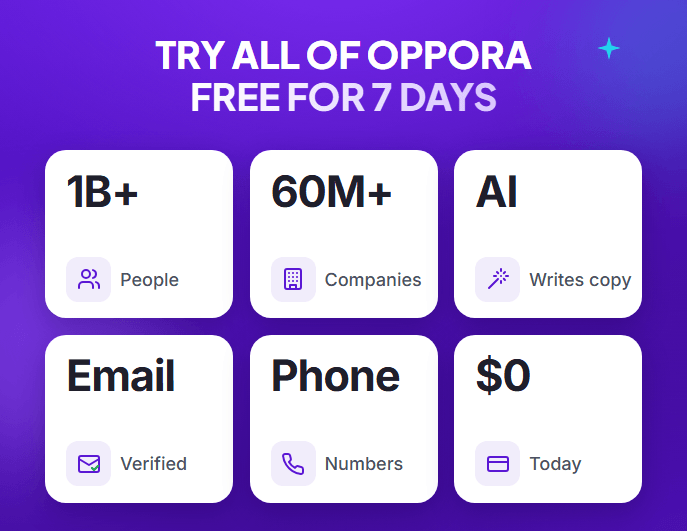
Its Finder lets you search 60M+ companies and over 1 billion people using natural-language searches or manual filters.
With its visual AI Workflow Builder and Oraflow copilot, you can automate prospect discovery, enrichment, lead scoring, and campaign execution.
Oppora also offers email and LinkedIn outreach, Reply Ora for handling responses, mailbox warm-up, and a built-in CRM.
It is designed for founders, sales teams, recruiters, and agencies that want to reduce manual prospecting and outreach work.
Saleshandy vs Oppora: Quick Comparison Table
Pricing references: Saleshandy pricing and Oppora pricing.
The key difference: Saleshandy emphasizes prospecting and outreach campaign execution, while Oppora extends automation across prospecting, lead qualification, conversations, and pipeline management.
Saleshandy vs Oppora Features: Lead Generation, Cold Email, and AI Automation
Finding prospects is only the beginning of outbound sales. You also need accurate contact information, personalized emails, automated follow-ups, and a reliable way to manage replies.
Both Saleshandy and Oppora support these activities, but they differ in how their features connect and how much work you can automate.
B2B Lead Database and Lead Generation Features
Saleshandy provides access to 852M+ B2B contacts and 42M+ company profiles, helping you discover prospects across different industries and markets.
Its lead generation capabilities include:
- Advanced search filters: Find prospects by job title, industry, company size, location, technologies, and buying signals.
- AI-powered search: Describe your target audience in natural language to discover relevant prospects.
- Lead list management: Save contacts to lists and add them directly to outreach campaigns.
Oppora provides access to 1B+ people and 60M+ companies through its Company Finder and People Finder.
Its prospecting capabilities include:
- ICP-based targeting: Define buyer personas, industries, company sizes, pain points, and buying triggers.
- AI-powered prospect discovery: Search companies and decision-makers using natural language or manual filters.
- Automated lead scoring: Evaluate prospects against your ICP through configurable AI workflows.
- Lead list management: Organize companies, contacts, and job opportunities for enrichment and outreach.
Key difference: Saleshandy focuses on searchable lead discovery, while Oppora connects ICP-based prospecting with automated lead qualification and workflows.
Email Finder, Verification, and Waterfall Enrichment
Once you've identified prospects, the next challenge is finding reliable contact information without wasting credits.
Saleshandy uses waterfall enrichment across nine data providers to retrieve contact details.
Its enrichment features include:
- Real-time email verification for discovered work addresses.
- Waterfall enrichment across multiple data sources.
- Email and phone number discovery.
- Credit-based contact data retrieval.
According to Saleshandy's published credit structure, revealing one verified work email costs 1 Lead Finder credit, while revealing an email and mobile number costs 7 credits.
Oppora also offers email discovery, verification, and enrichment through its data operations.
Its documented credit usage includes:
- Find Email: 1 data credit per address.
- Verify Email: 1 data credit, with free re-verification within 30 days.
- Find People from a list: 1, 3, or 5 credits per lead, depending on the search tier.
Oppora also supports multiple data providers and contact enrichment within automated workflows.
Key difference: Both platforms support verified contact discovery, but their credit structures and enrichment workflows differ.
Cold Email Automation and Personalized Outreach
After building your prospect list, you need to send relevant messages and follow up consistently without overwhelming your sales team.
Saleshandy offers:
- Email sequences: Create multistep campaigns with automated follow-ups.
- AI-assisted writing: Generate outreach messages and personalized email variations.
- Sender rotation: Distribute emails across connected mailboxes.
- LinkedIn outreach: Use manual tasks or supported third-party LinkedIn automation integrations.
- Campaign management: Monitor opens, replies, bounces, and prospect engagement through analytics and a unified inbox.
Oppora offers:
- AI-personalized outreach: Generate messages using buyer information, company context, and ICP details.
- Multichannel sequences: Combine email and LinkedIn outreach activities.
- Automated follow-ups: Schedule messages and manage conditional campaign steps.
- Reply Ora: Classify incoming replies, draft responses, and send replies automatically within configured guardrails.
- Unified inbox and analytics: Manage conversations and monitor campaign performance.
Key difference: Saleshandy emphasizes email sequence execution, while Oppora also uses AI to manage incoming conversations and support meeting booking.
AI Workflow Builder vs AI Sequence Copilot
Both platforms use AI, but their automation capabilities serve different purposes.
Saleshandy's AI Sequence Copilot helps you create cold email sequences from prompts.
You can use it to:
- Generate initial outreach messages and follow-ups.
- Create personalized email variations.
- Reduce manual copywriting.
- Prepare campaigns faster.
Saleshandy also provides AI-powered prospect discovery, CRM integrations, and workflow features for managing sales activities.
Oppora's Oraflow, on the other hand, helps you build connected, multi-agent sales workflows using natural-language instructions.
You can automate:
- Finding companies that match your ICP.
- Identifying relevant decision-makers.
- Enriching and verifying contact information.
- Scoring leads based on predefined criteria.
- Preparing prospects for outreach.
Its Reply Ora handles incoming conversations, while the built-in CRM manages contacts, accounts, opportunities, and tasks.
Key difference: Saleshandy's AI Sequence Copilot focuses on creating outreach sequences, whereas Oppora's Oraflow helps automate multiple stages of prospecting and lead qualification.
Practical Example: Running an Outbound Campaign for 500 Prospects
Suppose you're targeting 500 SaaS decision-makers with one initial email and two follow-ups.
That's a maximum of 1,500 emails, assuming every prospect receives all three messages.
With Saleshandy:
- Find 500 relevant decision-makers using Lead Finder.
- Retrieve and verify their email addresses.
- Create a three-step sequence using AI Sequence Copilot.
- Schedule follow-ups and distribute emails across connected mailboxes.
- Monitor responses and manage interested prospects.
With Oppora:
- Define your ICP and configure an AI prospecting workflow.
- Discover, enrich, and score relevant decision-makers.
- Add qualified contacts to a personalized outreach campaign.
- Schedule your initial emails and follow-ups.
- Use Reply Ora to manage incoming responses and guide interested prospects toward meetings.
For this scenario, Oppora would use 500 recipient credits, plus applicable data and AI credits. Follow-up emails to the same recipients do not consume additional recipient credits.
The takeaway: Both platforms can run a 500-prospect campaign. The main difference is whether you want AI assistance with individual outreach tasks or connected automation across prospecting, qualification, and response management.
Saleshandy vs Oppora Email Deliverability: Features and Performance
Even the best cold email campaign won't generate replies if your messages land in spam. That's why email deliverability matters as much as prospect quality and personalization.
Both platforms provide safeguards, but their monitoring and sending controls work differently.
Email Warm-Up and Sender Reputation Management
Email warm-up helps you gradually establish sending activity before increasing campaign volume.
Saleshandy offers:
- Email warm-up: Integrates with TrulyInbox, providing automated warm-up through a network of 10,000+ mailboxes.
- Sender health monitoring: Provides email setup scores, authentication checks, and account-level performance reports.
- Email ramp-up: Gradually increases sending volume to protect sender reputation.
Oppora offers:
- Built-in email warm-up: Supports Progressive, Steady, and Custom strategies for managing warm-up volume.
- Mailbox health score: Displays a 0–100 readiness score based on authentication, blacklist status, and sending results.
- Reputation monitoring: Checks SPF, DKIM, DMARC, and public domain blacklists.
Oppora recommends warming new mailboxes for at least 14 days, extending to 45 days for completely new domains.
Inbox Rotation, Sending Limits, and Spam Protection
Sending too many emails from one mailbox can damage its reputation. Both platforms help distribute outreach and control sending frequency.
Saleshandy provides:
- Sender rotation across connected email accounts.
- Customizable daily limits and sending intervals.
- Automatic campaign pausing when excessive bounces occur.
- Custom tracking domains and email authentication guidance.
Saleshandy's 2026 sending guidelines recommend 15 emails daily per mailbox, with provider-specific hard limits.
Oppora provides:
- Multiple sending mailboxes with individual daily sending limits.
- A default cap of 50 emails per mailbox daily.
- Optional Gmail-to-Gmail and Outlook-to-Outlook provider matching.
- Custom tracking domains, invalid-email skipping, and unsubscribe controls.
Oppora recommends 30–50 emails per mailbox daily, distributed across 2–3 mailboxes per domain.
Inbox Placement Testing and Email Verification
Beyond sending safely, you need to understand whether messages reach the inbox.
Saleshandy's Inbox Radar provides:
- Scheduled inbox placement tests across supported providers.
- Inbox, spam, tab, and undelivered classifications.
- Authentication, content, and spam-trigger diagnostics.
- Email verification and bounce monitoring.
Oppora's deliverability monitoring includes:
- Warm-up inbox-placement percentages and mailbox health reporting.
- SPF, DKIM, DMARC, and blacklist checks.
- Email discovery, verification, and invalid-address filtering.
- Campaign bounce, open, and reply analytics.
However, Oppora's documented warm-up monitoring should not be confused with a dedicated Inbox Radar-style placement testing service.
Saleshandy vs Oppora: Which Has Better Deliverability Tools?
Saleshandy has the stronger documented dedicated inbox-testing toolkit, particularly through Inbox Radar's scheduled tests and detailed diagnostics.
Oppora is well-suited to integrated deliverability management, combining built-in warm-up, mailbox health scores, verification, and sending controls within its outbound platform.
Neither platform has demonstrated superior real-world inbox placement through comparable independent testing.
Your actual results will depend on domain reputation, authentication, list quality, message content, and sending behavior.
Saleshandy vs Oppora Pricing: Plans, Credits, and Total Cost
Pricing can change how much your outbound campaigns cost as you scale. Beyond subscription fees, you need to consider lead credits, AI usage, email sending limits, and additional services.
Let's compare what you actually get with Saleshandy and Oppora in 2026.
Saleshandy Pricing Plans in 2026
Saleshandy's pricing includes three main plans, with different limits for active prospects, email volume, and lead discovery.
- Starter — 41/month(34/month billed annually): Includes 2,000 active prospects, 6,000 monthly emails, 1,500 monthly Lead Finder credits, and unlimited connected mailboxes.
- Pro — 99/month(76/month billed annually): Includes 30,000 active prospects, 100,000 monthly emails, 4,000 Lead Finder credits, CRM integrations, and up to 10 users.
- Scale — 189/month(149/month billed annually): Includes 200,000 monthly emails, 8,000 Lead Finder credits, unlimited active prospects subject to fair usage, and agency features.
Saleshandy also provides 100, 500, and 1,000 one-time AI credits across Starter, Pro, and Scale, respectively.
Oppora.ai Pricing Plans in 2026
Oppora's pricing combines prospecting, enrichment, AI workflows, and outreach within the same subscription.
Its published plans include:
- Free — $0/month: Includes 50 recipients, three mailboxes, three AI workflows, and limited data and AI credits.
- Pro — $34/month: Includes 10,000 data credits, 500 AI credits, 5,000 monthly recipients, 25 mailboxes, and 50 AI workflows.
- Max — $79/month: Includes 25,000 data credits, 1,000 AI credits, unlimited recipients and workflows, and 50 mailboxes.
- Enterprise — Starting at $499/month: Offers customized allowances for businesses requiring higher volumes.
Oppora supports unlimited campaigns and email sending, subject to recipient allowances, mailbox limits, and applicable sending safeguards.
Saleshandy vs Oppora Pricing Comparison Table
Here's how their entry-level paid plans compare.
Note: Saleshandy uses Lead Finder credits for verified contact retrieval. Oppora uses data credits across multiple prospecting and enrichment actions, so the allowances aren't directly equivalent.
Lead Generation Credits, AI Credits, and Hidden Costs
Your subscription doesn't always represent your complete outbound expense.
With Saleshandy:
- One verified work email costs one Lead Finder credit, including waterfall enrichment and verification.
- Additional 500 Lead Finder credits cost $12.50.
- Unused Lead Finder credits don't roll over under current platform plans.
- AI credits are provided as one-time allowances rather than monthly allocations.
With Oppora:
- Finding an email costs one data credit; verification costs another when required.
- Basic, Standard, and Deep AI personalization use 1, 2, and 3 AI credits per lead, respectively.
- Paid plans support credit rollover and additional credit purchases.
- Mini plans start at $7 for specific tasks without requiring a full plan upgrade.
Both platforms also require sending mailboxes, which may involve separate domain registration and email hosting expenses.
Saleshandy vs Oppora: Cost for 2,000 Prospects
Suppose you're launching a campaign with:
- 2,000 unique prospects
- Three emails per prospect (one initial email and two follow-ups)
- Five connected mailboxes
- 6,000 potential emails in total
Assume you're sourcing 2,000 new work email addresses, using standard sequences, and paying monthly.
Saleshandy Starter:
- Subscription: $41/month.
- Included Lead Finder credits: 1,500.
- Additional 500 credits: $12.50.
- Email capacity: 6,000/month, exactly matching the planned sequence volume.
- Estimated first-month platform cost: $53.50.
Oppora Pro:
- Subscription: $34/month.
- Finding 2,000 emails: 2,000 data credits, within the 10,000-credit allowance.
- Recipient usage: 2,000 of the 5,000 monthly recipients.
- Five mailboxes: Included within the 25-mailbox allowance.
- Estimated first-month platform cost: $34.
However, applying Basic AI personalization to all 2,000 prospects would require 2,000 AI credits, exceeding Oppora Pro's 500-credit allowance. Additional credits would be necessary, and their cost isn't included in this estimate.
These calculations exclude mailbox hosting, taxes, and optional services. They also assume the planned sending volume fits the billing period and safe daily sending limits.
The takeaway: Oppora has a lower base cost in this example, while Saleshandy includes verified email retrieval in one credit. Your actual expenses depend on enrichment needs, AI personalization, and campaign duration.
Saleshandy vs Oppora: Pros, Cons, and Best Use Cases
Choosing between Saleshandy and Oppora depends on how much of your outbound sales process you want to automate.
Saleshandy offers strong campaign infrastructure, while Oppora emphasizes connecting prospecting, outreach, and lead management through AI workflows.
Saleshandy Pros and Cons
Saleshandy is a practical option for teams that prioritize cold email execution and campaign management.
Pros:
- Large prospect database: Access 852M+ contacts and advanced search filters.
- Strong deliverability tools: Sender rotation, warm-up integrations, and Inbox Radar testing.
- Agency management: Dedicated client management, permissions, and campaign reporting.
- Flexible sending: Unlimited mailbox connections and configurable email sequences.
Cons:
- LinkedIn automation requires supported third-party integrations.
- Lead Finder credits and optional services can increase costs.
- End-to-end prospecting still requires more workflow configuration and oversight.
Oppora.ai Pros and Cons
Oppora is better suited to teams that want AI to handle connected sales activities rather than individual tasks.
Pros:
- AI workflows: Automates lead discovery, enrichment, scoring, and prospecting.
- Multichannel outreach: Combines personalized email and LinkedIn activities.
- Automated reply management: Reply Ora classifies responses and supports meeting booking.
- Built-in CRM: Connects contacts, opportunities, tasks, and pipeline management.
Cons:
- AI personalization and enrichment consume additional credits.
- Advanced workflows require initial configuration and testing.
- Mailbox warm-up and sender reputation still require attention.
Best for Cold Email Outreach and Lead Generation Agencies
Saleshandy is a suitable choice when your team primarily manages high-volume cold email campaigns.
Its sender rotation, inbox testing, campaign analytics, and agency client management features are particularly useful when you're handling multiple clients and need detailed control over email sequences.
Suggested Reading:
How to Set up AI Cold Email Outreach in Simple StepsBest for AI-Powered Outbound Sales Automation
Oppora makes more sense when you want to reduce repetitive work across the entire outbound process.
You can connect ICP-based lead discovery, enrichment, lead scoring, personalized outreach, and AI-managed replies. This makes it particularly relevant for founders, lean sales teams, and agencies working with limited sales operations resources.
Final Recommendation: Which Platform Fits Your Needs?
Ultimately, choose the platform that fits your team's workflow, budget, and preferred level of automation.
Suggested Reading:
12 Best Outbound Sales Tools for Faster Deals & Smarter OutreachConclusion
The Saleshandy vs Oppora comparison comes down to how you want to manage your outbound sales process.
Saleshandy is a strong choice if you prioritize cold email campaigns, sender rotation, inbox placement testing, and agency-focused campaign management.
Oppora takes a broader approach by connecting lead generation, enrichment, AI workflows, personalized outreach, automated replies, and CRM management.
Both offer deliverability safeguards, but neither can guarantee inbox placement. Your results still depend on sender reputation, verified contacts, and sending practices.
Pricing also matters beyond monthly subscriptions. Consider your lead volume, credit consumption, AI usage, and mailbox expenses before choosing.
If you mainly need cold email infrastructure, Saleshandy may suit you better. But if you're looking to automate more of your outbound sales process, Oppora.ai to see how its AI workflows fit your business needs.
FAQs
What Is the Main Difference Between Saleshandy and Oppora?
Saleshandy primarily focuses on B2B lead generation, cold email sequences, and campaign management. Oppora offers broader AI-powered outbound automation, connecting prospect discovery, enrichment, lead scoring, personalized outreach, automated replies, and CRM workflows within one platform.
Is Oppora a Good Saleshandy Alternative?
Yes, Oppora is a suitable Saleshandy alternative if you want to automate more than cold email campaigns. Its AI workflows help you discover prospects, enrich contact information, personalize outreach, manage incoming replies, and move qualified leads toward meetings.
Which Is Better for Email Deliverability, Saleshandy or Oppora?
Saleshandy offers dedicated inbox placement testing through Inbox Radar, alongside sender rotation and warm-up integrations. Oppora provides built-in warm-up, mailbox health monitoring, and verification. Neither platform guarantees better inbox placement, as performance depends on your sending practices and reputation.
Is Oppora Cheaper Than Saleshandy?
Oppora offers a free plan and Pro pricing starting at $34/month. Saleshandy's Starter plan costs $41/month or $34/month with annual billing. However, your total cost depends on lead credits, AI personalization, sending requirements, and additional services.
Which Is Better for AI Outbound Sales Automation?
Oppora is better suited for connected AI outbound automation through Oraflow, automated prospecting, lead scoring, and Reply Ora. Saleshandy offers AI-assisted sequence creation and campaign tools, making it suitable for teams that primarily want to streamline cold email outreach.
Summarize with AI
Share