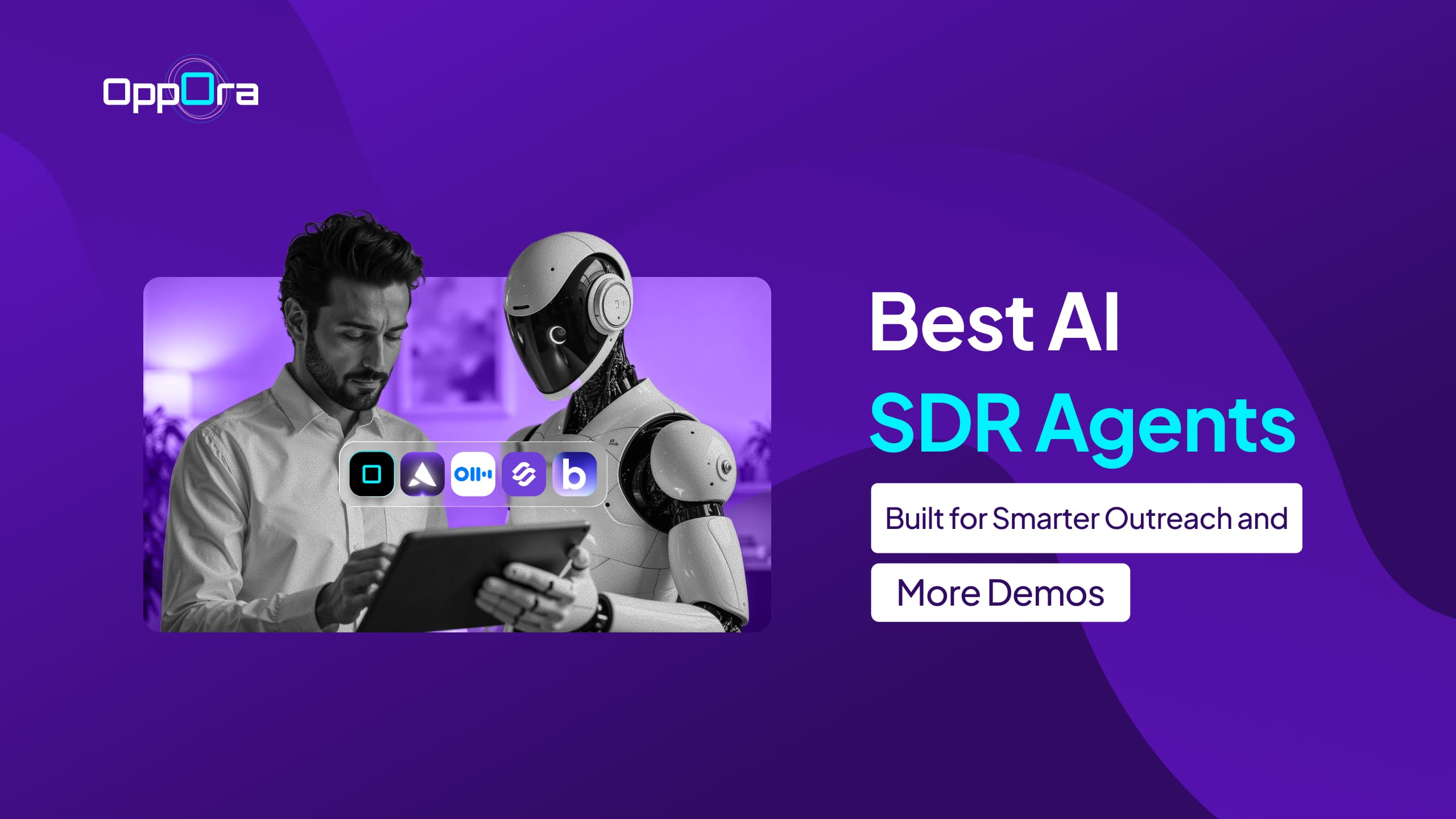
8 Best AI SDR Agents Built for Smarter Outreach and More Demos
Stephen Parker
Published May 23, 2026
16 min
Complete Agentic Email Outreach
AI agents find and enrich prospects, personalize emails, follow up, handle replies, and book meetings automatically.
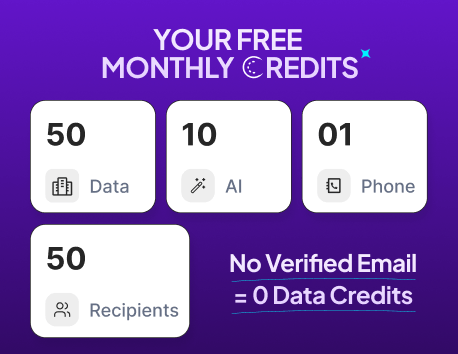
Claim Your FREE Credits
Finding the right prospects is hard enough.
Writing personalized messages, following up at the right time, qualifying replies, and booking demos can make outbound feel like a full-time machine you constantly have to feed.
That is why AI SDR agents are getting attention.
They do not just write emails. They help you find leads, personalize outreach, respond faster, and keep your pipeline moving without adding more manual work.
In this guide, you will see:
- What makes an AI SDR agent worth using
- The best tools for smarter outreach and more demos
- How to choose the right platform for your team
What We Looked for in the Best AI SDR Agents
Not every tool that says “AI SDR” can actually support your outbound workflow.
Some only help you write emails. Others automate sending, but still leave you with messy lead lists, weak personalization, and manual follow-up work.
So, to compare the best AI SDR agents, we looked at the areas that matter most when your goal is smarter outreach and more booked demos.
AI Personalization & Outreach Quality
Personalization is where many outbound campaigns either win attention or get ignored.
A good AI SDR agent should do more than insert a first name, company name, or industry into a template. It should help create messages that feel relevant to the person receiving them.
That means looking at things like:
- The prospect’s role
- Their company context
- Possible pain points
- Buying signals
- The reason you are reaching out now
The best AI SDR agents make outreach feel thoughtful without forcing you to manually research every lead.
Multi-Channel Automation Capabilities
Modern outbound rarely works through one channel alone.
You may start with email, follow up on LinkedIn, send another email later, and then route warm replies to your sales team.
That is why we looked at whether each platform supports multi-channel outreach.
The stronger tools help you manage email, LinkedIn, follow-ups, inbox activity, and sales workflows from one place. This makes your outreach easier to control and harder to lose track of.
Lead Qualification & Intent Signals
More leads do not always mean better pipeline.
You need to know who is actually worth reaching out to, who fits your ICP, and who is more likely to respond.
So we looked at how each AI SDR agent handles lead qualification.
The best platforms help you identify better-fit accounts using data, enrichment, scoring, buying signals, or behavior-based triggers.
This matters because your team should not waste time chasing contacts that were never likely to convert.
CRM Integrations, Analytics & Workflow Efficiency
An AI SDR tool should not create another place where your team has to copy and paste data.
It should fit into your existing sales workflow.
That is why CRM integrations were important in this comparison. We looked for tools that can sync leads, replies, meetings, tasks, and campaign activity with systems your team already uses.
We also considered analytics.
You should be able to see what is working, which messages are getting replies, where leads are dropping off, and which campaigns are worth scaling.
Suggested Reading:
BDR vs SDR: Roles, Responsibilities & Key DifferencesPricing, Scalability & Overall ROI
Pricing can get confusing fast in this category.
Some AI SDR agents charge by seat. Some charge by credit. Some separate lead data, enrichment, email sending, and automation into different plans.
So we looked beyond the starting price.
A tool may look affordable at first, but become expensive once you add more contacts, more inboxes, more users, or more outreach volume.
The best options give you a clear path to scale without forcing you to rebuild your workflow or buy multiple extra tools later.
9 Best AI SDR Agents for Smarter Outreach and More Demos
Now that you know what to evaluate, let’s look at the platforms that are actually trying to solve the SDR workflow from different angles.
Some focus on outbound automation. Some are stronger for website conversion. Others work better for enterprise teams with complex CRM setups.
Oppora.ai
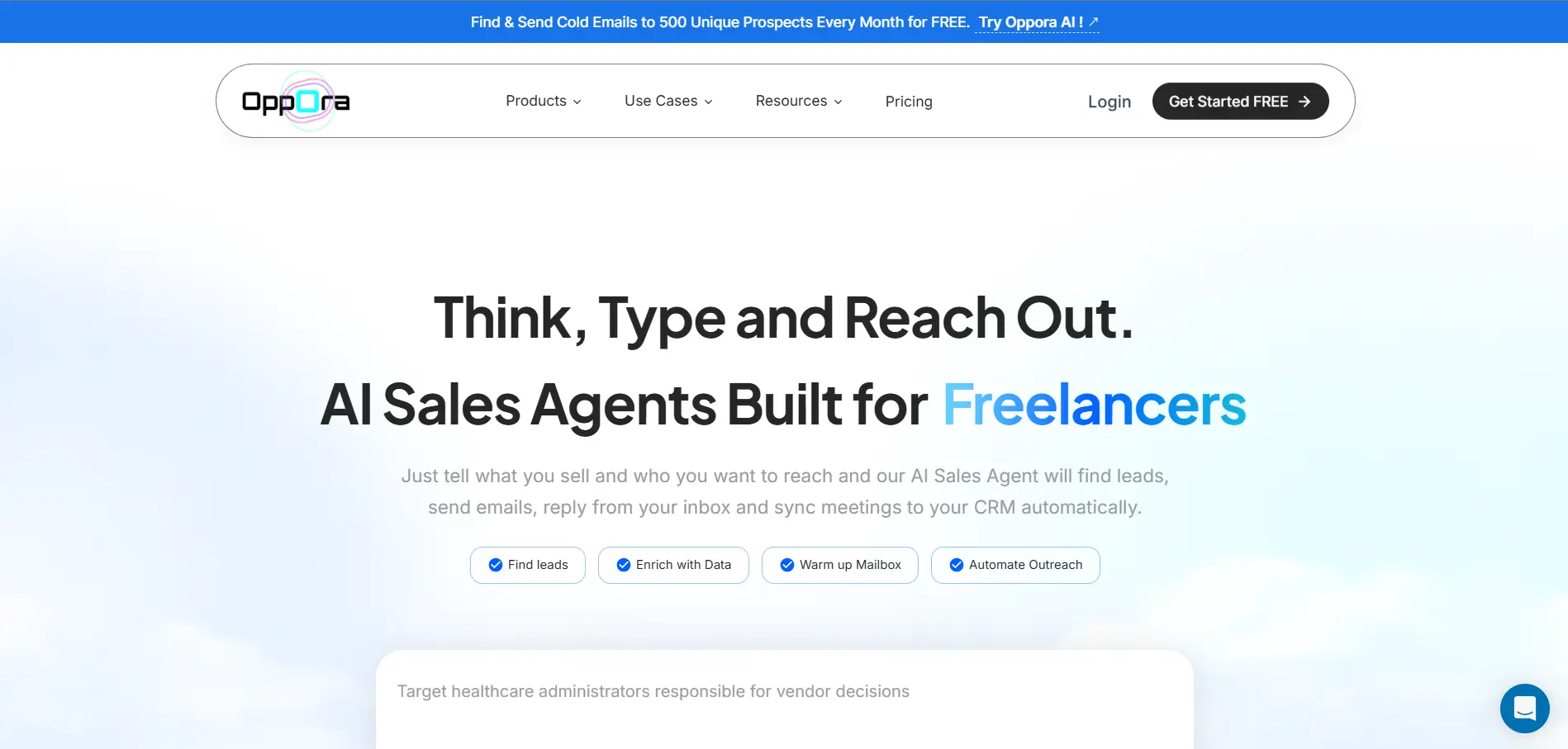
Oppora.ai is built for teams that want an AI SDR agent to handle more than one small part of outbound.
Instead of giving you separate tools for lead search, enrichment, outreach, replies, and CRM updates, Oppora uses 8 AI sales agents that work together inside one workflow.
You tell Oppora.ai what you sell and who you want to reach. Then its agents help find leads, verify contacts, personalize emails, send outreach, handle replies, book meetings, and sync activity to your CRM.
Best features
- End-to-end AI sales workflows for prospecting, enrichment, outreach, replies, and CRM sync
- 8 AI sales agents that work together instead of acting like separate tools
- Access to a 1B+ contact database for building larger prospect lists
- Verified contact data with waterfall sourcing and real-time email verification
- Email warmup, inbox rotation, and sender identity matching for better deliverability
- AI reply handling that can answer questions with its AI reply agent, qualify leads, send attachments, and book meetings
- Multi-channel outreach across email and LinkedIn
- CRM sync with tools like HubSpot, Salesforce, Pipedrive, and Oppora CRM
Best use cases
Oppora.ai is a strong fit if you want to replace multiple SDR tools with one platform.
It works especially well for founders, solopreneurs, agencies, staffing firms, IT consultancies, and lean B2B teams that need outbound but do not want to manage every step manually.
It is also useful if you already have leads and need to clean, enrich, verify, score, and organize them before outreach.
Pricing
Oppora’s pricing is structured to keep outreach, lead data, and automation in one place.
- Free plan: Available for users who want to explore the platform before upgrading
- Pro plan: Starts at $34/month
- Max plan: Starts at $79/month
- Enterprise plan: Starts at $499/month
- Mini add-on packs: You can buy extra credits without upgrading to a higher plan
- One pricing structure: Lead search, enrichment, verification, outreach, inbox rotation, campaigns, and AI workflows are included under one platform
Unlike many outreach tools, Oppora combines lead search, enrichment, verification, outreach, campaigns, inbox rotation, and AI workflows under one pricing structure. It also offers mini add-on packs, so you can buy extra credits without upgrading your full plan.
Artisan
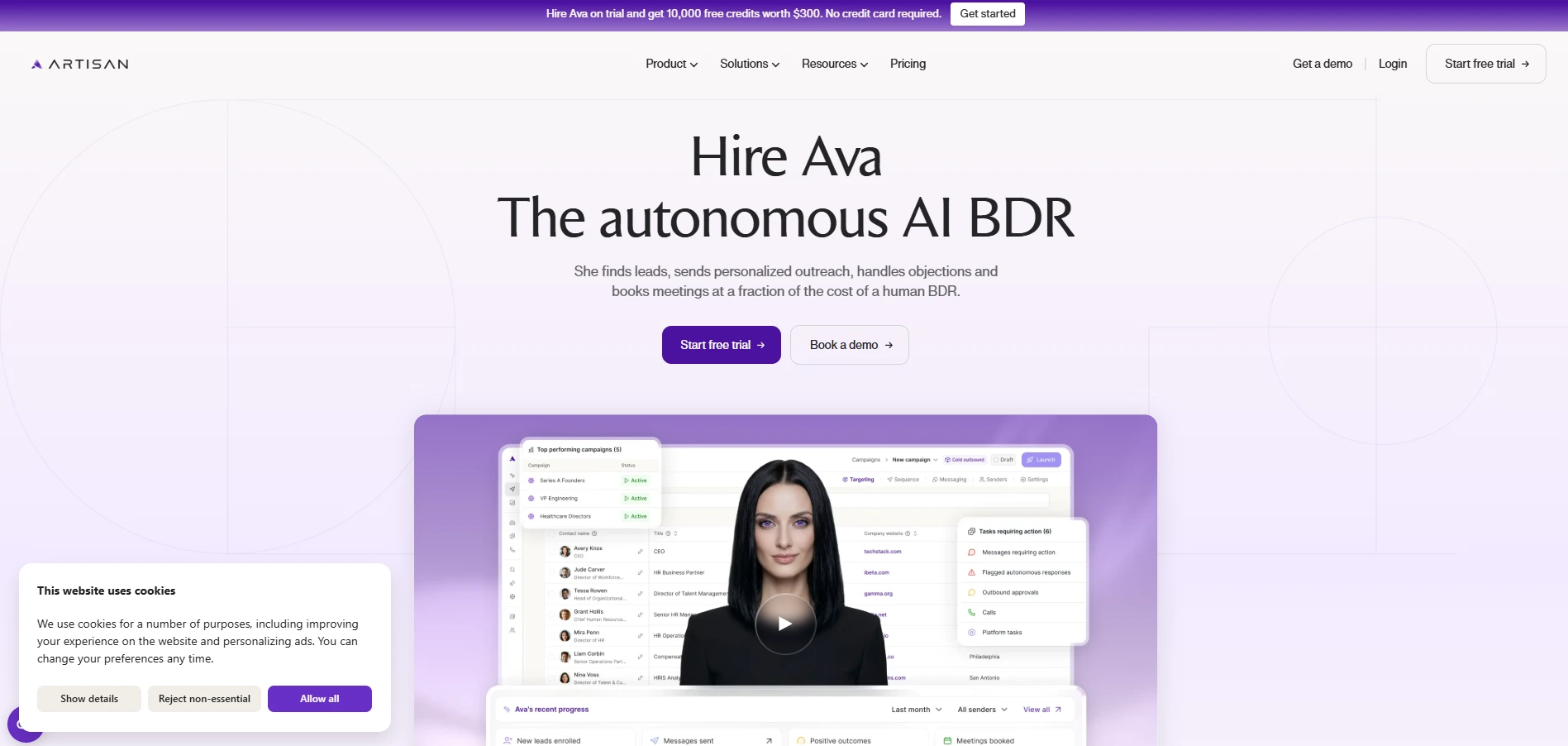
Artisan offers Ava, an autonomous AI BDR built to help teams run outbound with less manual work.
Ava can find leads, enrich data, personalize messages, launch outreach, manage replies, and book meetings. This makes it useful if you want an AI SDR agent that supports the full outbound motion instead of only writing emails.
Best features
- Autonomous AI BDR for prospecting and meeting booking
- 250M+ verified B2B contacts
- Lead enrichment from multiple data sources
- Intent signals like funding, hiring, and company changes
- Personalized email and LinkedIn outreach
- Reply handling, objection management, and lead qualification
- CRM and calendar integrations
Best use cases
Artisan works best for sales teams that already know their ICP and want to scale outbound faster.
It is also useful for teams running cold outbound, warm outbound, reactivation, upsell, or cross-sell campaigns.
Pricing
Artisan offers a free plan and paid plans based on credits.
- Free plan: $0/month
- Intern plan: Starts at $250/month, billed annually
- Employee plan: Starts at $600/month, billed annually
- Enterprise: Custom pricing
Pricing can increase based on credits, usage, and outbound volume.
Qualified Piper
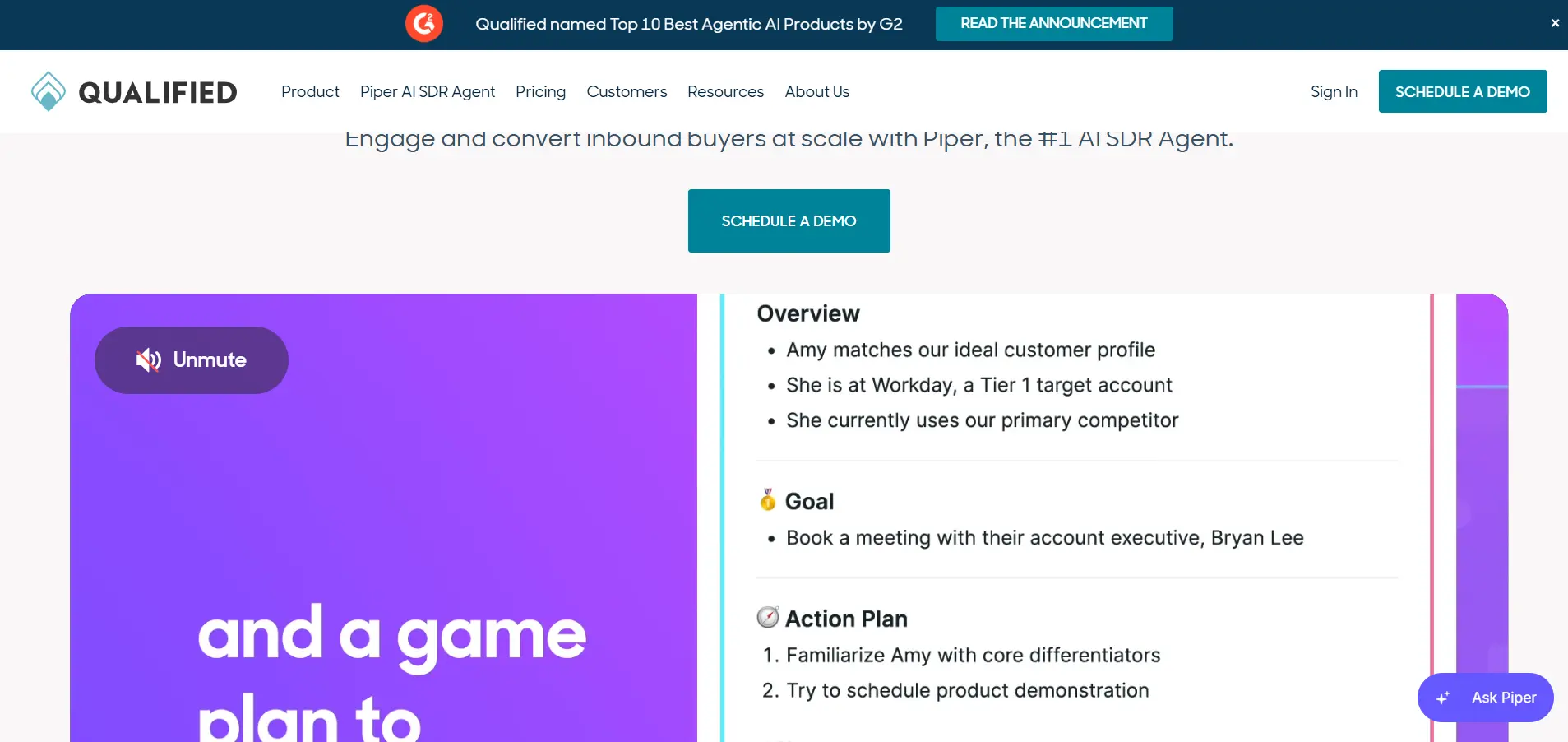
Qualified Piper is an AI SDR agent built mainly for inbound pipeline.
Instead of focusing only on cold outbound, Piper engages website visitors, follows up with interested buyers, books meetings, and routes conversations to sales teams. It works best when your website already attracts qualified traffic.
Best features
- AI conversations through chat, voice, video, and email
- Website visitor engagement and guided buyer journeys
- Automated meeting scheduling from forms, chat, and email
- Personalized follow-up emails for warm inbound leads
- Account segmentation with waterfall enrichment
- Salesforce CRM and GTM system integrations
- Reporting, analytics, routing, and workflow notifications
Best use cases
Qualified Piper is best for B2B teams that want to convert inbound demand faster.
It is especially useful for companies with strong website traffic, high-intent visitors, and sales teams that rely heavily on Salesforce.
Pricing
Qualified does not show fixed public pricing.
Its pricing page lists three plans: Premier, Enterprise, and Ultimate, with each plan requiring a demo and custom quote.
This makes Piper better suited for mid-market and enterprise teams than very small outbound teams.
Salesforce Agentforce SDR
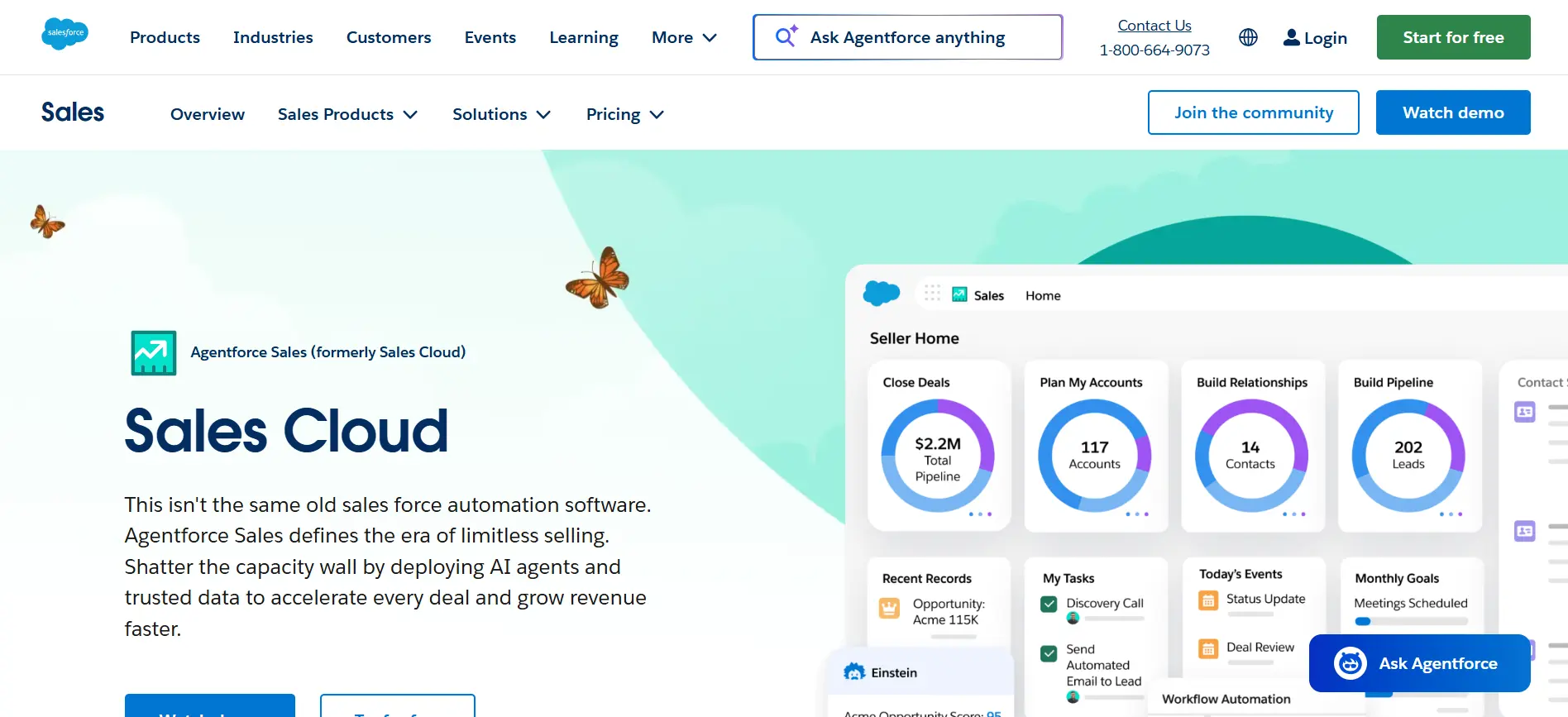
Salesforce Agentforce SDR is built for teams that already run their sales motion inside Salesforce.
It helps sales teams automate lead engagement, answer prospect questions, support nurture workflows, and move leads through Salesforce with less manual work.
Best features
- Native Salesforce ecosystem fit
- AI-powered lead nurture and sales actions
- Lead routing, scoring, and campaign management support
- CRM data, workflow, and automation inside Sales Cloud
- Flexible Agentforce usage through credits or conversations
- Strong fit with Salesforce analytics, reporting, and governance
Best use cases
Salesforce Agentforce SDR is best for enterprise teams already using Salesforce as their main CRM.
It works well when your team wants an AI SDR agent connected deeply to existing Salesforce data, lead workflows, and internal sales processes.
Pricing
Salesforce pricing depends on your edition and Agentforce usage.
- Starter Suite: Starts at $25/user/month
- Pro Suite: Starts at $100/user/month
- Enterprise: Starts at $175/user/month
- Unlimited: Starts at $350/user/month
- Agentforce 1 Sales: Starts at $550/user/month
- Flex Credits: Listed at $500 per 100K credits
- Conversations: Listed at $2 per conversation
Agentforce add-ons and exact costs can vary, so most teams need a custom Salesforce quote.
Breakout AI
Breakout AI is built more for inbound pipeline than cold outbound.
It helps revenue teams identify website visitors, understand buying signals, engage high-intent prospects, route them to reps, and book meetings from your existing demand gen motion. Breakout describes its AI SDR as connecting signals, campaigns, and your GTM stack from first signal to pipeline.
Best features
- Website visitor identification and engagement
- Signal-based buyer tracking across campaigns and site activity
- Inbound AI SDR for chat, content, and rep handoff
- Instant calendar booking for high-intent visitors
- AI blocks for FAQs, videos, reviews, comparisons, and ROI calculators
- CRM updates and rep alerts through MarkOps automation
Best use cases
Breakout works best for B2B teams that already generate strong website traffic.
It is useful when you want an AI SDR agent to convert visitors, handraisers, and campaign-engaged accounts into meetings faster.
Pricing
Breakout’s pricing is not fully self-serve.
Public third-party pricing analysis lists plans starting around $1,500/month for Starter and $2,500/month for Growth, but exact pricing can depend on volume and requirements.
UserGems AI SDR
UserGems AI SDR, called Gem-E, is built around signal-based outbound.
Instead of starting with random cold lists, it uses CRM data, job changes, website visits, intent signals, past champions, new hires, M&A activity, and other buying signals to help reps focus on warmer accounts.
Best features
- AI-powered list building and contact enrichment
- Account and contact scoring based on CRM data and signals
- Personalized email sequences, call scripts, and LinkedIn messages
- Contact-level website de-anonymization
- Intent signals and past champion tracking
- Chrome extension inside CRM and sales engagement tools
- CRM, sales engagement, reporting, and analytics integrations
Best use cases
UserGems works best for teams that want an AI SDR agent to support human SDRs, not fully replace them.
It is especially useful for teams with strong CRM data and a need to reactivate champions, prioritize warm accounts, and improve outbound timing.
Pricing
UserGems pricing starts at:
- Core: $2,750/month
- Advanced: $5,750/month
- Elite: $10,000/month
- Implementation: Starts at $3,000 one-time
Enterprise pricing is available through sales.
Otter SDR Agent
Otter SDR Agent is built for inbound website conversion.
Instead of sending cold outbound campaigns, it engages visitors on your website, qualifies interest, runs personalized product demos, and books meetings automatically. This makes it more useful for teams that already have inbound traffic and want to turn more visitors into qualified demos.
Best features
- AI voice and chat engagement for website visitors
- Pre-demo qualification based on goals, pain points, and intent
- Personalized live product demos
- RAG-based answers using product content and FAQs
- Lead scoring using custom qualification criteria
- Call summaries and transcripts
- Salesforce and HubSpot CRM syncing
- Calendar integration with tools like Calendly and Chili Piper
Best use cases
Otter SDR Agent works best for B2B teams with strong website traffic and a demo-led sales motion.
It is especially useful when you want an AI SDR agent to qualify visitors before sales gets involved.
Pricing
Otter does not list fixed public pricing for its SDR Agent.
The SDR Agent is shown as a demo-based product, while Otter’s standard Business plan starts at $19.99/user/month and Enterprise requires custom sales contact.
Saleshandy AI SDR
Saleshandy is mainly built for cold email outreach, with AI features that help teams write sequences, personalize messages, and manage high-volume sending.
It is not a fully autonomous AI SDR agent like some newer tools, but it can support SDR teams that want better email automation, deliverability, and campaign control.
Best features
- AI-powered email sequence creation
- Unlimited email accounts on outreach plans
- Active prospect and monthly email volume limits by plan
- A-Z variant testing for outbound campaigns
- Unified inbox on higher plans
- Email verification and lead finder credits
- Inbox placement testing and deliverability add-ons
- CRM, dialer, and email infrastructure options
Best use cases
Saleshandy works best for teams focused mainly on cold email outreach.
It is useful if you already have your lead data and need a tool to send, test, manage, and optimize outbound campaigns at scale.
Pricing
Saleshandy’s outreach plans start at:
- Outreach Starter: $25/month, billed annually
- Outreach Pro: $69/month, billed annually
- Outreach Scale: $139/month, billed annually
- Outreach Scale Plus: $209/month, billed annually
Monthly billing costs more, and add-ons like AI credits, inbox placement, dialer, and email infrastructure can increase total cost.
Suggested Reading:
11 Best AI SDR Tools for Smarter Sales AutomationHow to Choose the Right AI SDR Agent
At this point, the question is not whether AI SDR agents can help.
The real question is which one fits the way your sales team actually works.
Some tools are better for outbound. Some are better for inbound. Some support human SDRs, while others try to automate the full prospecting-to-meeting workflow.
So before you choose, look at how the tool fits your team, your data, and your growth goals.
Questions to Ask Before Investing in AI SDR Software
Start by looking at the problem you actually want to solve.
Are you trying to find more leads?
Do you need better personalization?
Are your reps spending too much time on follow-ups?
Or do you want an AI SDR agent that can run most of the workflow by itself?
Ask questions like:
- Does it support outbound, inbound, or both?
- Can it find and enrich leads?
- Does it personalize messages using real prospect context?
- Can it handle replies and qualify interest?
- Does it book meetings automatically?
- Can your team review or control AI actions before they happen?
- Will it fit your current CRM and sales process?
The best choice is usually the one that removes your biggest bottleneck first.
Pricing Models & ROI Expectations
Pricing can look simple on the surface, but the real cost often depends on usage.
Some platforms charge per seat. Others charge by credits, contacts, conversations, inboxes, or workflow volume.
So do not only compare the monthly price.
Look at what you actually get inside the plan.
You should check:
- How many contacts you can reach
- Whether lead data is included
- Whether enrichment and verification cost extra
- How many inboxes or users you can add
- Whether you need add-ons for deliverability, AI replies, or CRM sync
A cheaper tool is not always cheaper if you still need three more tools to complete the workflow.
The right AI SDR agent should help you save time, reduce manual work, improve reply quality, and create a clearer path to booked demos.
Must-Have Integrations for Modern GTM Teams
Your AI SDR software should not sit outside your sales system.
If it does, your team will end up copying data, checking multiple inboxes, and manually updating CRM records.
That slows everything down.
At minimum, look for integrations with:
- Your CRM
- Your calendar tool
- Your email provider
- Your sales engagement system
- Your enrichment or data provider
- Slack or internal notification tools
CRM integration is especially important.
When leads, replies, meetings, tasks, and campaign activity sync automatically, your team gets a cleaner view of pipeline.
That makes the AI SDR agent easier to trust because sales, marketing, and leadership can all see what is happening.
Suggested Reading:
9 Outbound GTM Strategies to Go from ICP to Pipeline in 30 DaysWhich AI SDR Agent Is Actually Best for Your Sales Team?
The best AI SDR agent depends on where your pipeline problem starts.
If you already have inbound traffic, you may need a tool that converts visitors faster.
If outbound is your main growth channel, you need something that can find leads, personalize messages, follow up, and protect deliverability.
So instead of picking the tool with the longest feature list, match the platform to your sales motion.
Best for startups and lean outbound teams
For startups and small teams, the best tool is usually the one that removes the most manual work without adding more complexity.
You need help with prospecting, enrichment, outreach, replies, and CRM updates, but you may not have a full SDR team to manage everything.
Oppora.ai is a strong fit here because it gives you multiple AI sales agents inside one workflow.
You can use it to find leads, verify contacts, personalize outreach, send emails, handle replies, and book meetings without stitching together several tools.
Suggested Reading:
9 SDR Outbound Strategies That Actually Book Meetings (Not Just Send Emails)Best for enterprise sales organizations
Enterprise teams usually need stronger CRM control, governance, reporting, and deeper workflow alignment.
That is where Salesforce Agentforce SDR makes sense.
If your sales team already lives inside Salesforce, Agentforce can fit naturally into your existing CRM data, lead routing, reporting, and sales operations.
Qualified Piper can also be a strong choice for enterprise inbound teams that rely heavily on website conversion and Salesforce-connected workflows.
Best for outbound-heavy cold email campaigns
If your team mostly cares about cold email volume, deliverability, testing, and inbox management, then Oppora, Saleshandy and Salesforge are worth considering.
Saleshandy is useful when you already have lead data and mainly need a strong cold email system.
Salesforge is better if you want more AI-led prospecting and outreach automation, especially with email infrastructure support.
Both can work well for outbound-heavy teams, but you should compare their total cost once inboxes, credits, and add-ons are included.
Best for replacing multiple SDR tools with one platform
If your goal is to replace lead search, enrichment, verification, outreach, reply handling, and CRM updates with one system, Oppora.ai is the strongest fit.
It is built around end-to-end AI SDR workflows instead of one isolated feature.
That matters because outbound usually breaks when your tools do not talk to each other.
With Oppora.ai, the workflow can move from lead discovery to booked meeting in one connected system, making it a practical option for teams that want fewer tools and more demos.
Conclusion
AI SDR agents are changing how sales teams build pipeline.
Instead of spending hours on manual prospecting, copywriting, follow-ups, qualification, and CRM updates, you can use AI to handle more of the repetitive work while your team focuses on real conversations.
But the best tool depends on your sales motion.
If you rely on inbound demand, tools like Qualified Piper, Breakout AI, or Otter SDR Agent may fit better.
If your team needs cold email scale, Salesforge or Saleshandy can help.
If you want one connected system for lead search, enrichment, outreach, replies, and meeting booking, Oppora.ai is a strong option to consider.
The right AI SDR agent should help you reach better prospects, send more relevant messages, and book more demos without making your workflow harder to manage.
And if you want to see how an AI sales workflow can run from prospecting to replies in one place, you can explore Oppora.ai and test how it fits your outbound process.
Frequently Asked Questions (FAQs)
What are AI SDR agents?
AI SDR agents are software tools that help automate sales development tasks like lead search, enrichment, personalized outreach, follow-ups, reply handling, qualification, and meeting booking.
What is the difference between an AI SDR agent and a regular sales automation tool?
A regular sales automation tool usually helps with sequences or email sending, while an AI SDR agent can support deeper tasks like researching prospects, personalizing messages, qualifying replies, and moving leads toward demos.
Can AI SDR agents replace human SDRs?
AI SDR agents can reduce a lot of manual SDR work, but they work best alongside humans who handle strategic conversations, relationship building, complex objections, and high-value sales opportunities.
Which AI SDR agent is best for cold outbound?
For cold outbound, look for tools with strong lead data, email verification, personalization, inbox rotation, follow-up automation, and deliverability controls, such as Oppora.ai, Salesforge, or Saleshandy.
How do you choose the right AI SDR agent?
Choose based on your biggest sales bottleneck: outbound teams need prospecting and cold outreach support, inbound teams need website conversion tools, and lean teams may need one platform that combines lead search, enrichment, outreach, replies, and CRM sync.
Summarize with AI
Share