Outbound AI Sales Agents: 10 Best Tools for B2B Sales Teams
Adam Hossain
Published September 16, 2026
21 min
Complete Agentic Email Outreach
AI agents find and enrich prospects, personalize emails, follow up, handle replies, and book meetings automatically.
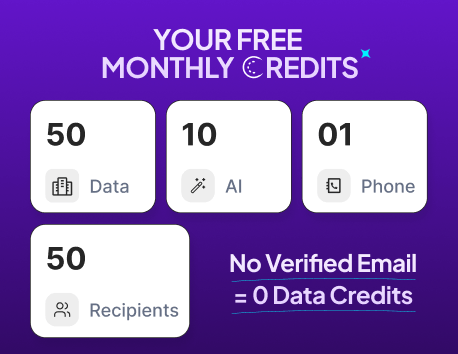
Claim Your FREE Credits
Outbound sales is getting easier to automate, but choosing the right AI sales agent is getting harder.
Some tools help you research prospects or write emails. Others can find leads, personalize outreach, handle replies, and book meetings with far less manual work. The challenge is figuring out how much each platform actually automates and where you still need a human.
That’s why you need to look beyond the “AI sales agent” label.
In this guide, you’ll discover:
- The 10 best outbound AI sales agents for B2B teams
- How their autonomy, data, outreach, and pricing compare
- How to test them before buying
How We Evaluated the Best Outbound AI Sales Agents
Calling a product an “AI sales agent” tells you surprisingly little about what it actually removes from your workload.
So, we evaluated all 10 tools using the same practical criteria: autonomy, prospect data, research and signals, outbound execution, deliverability, governance, and total cost.
Vendor-reported statistics are treated as vendor claims rather than independent performance benchmarks.
End-to-End Outbound Autonomy
We looked at the entire journey from identifying an ICP to booking a meeting.
The key question was simple: Where do you still need to step in?
We checked whether each platform can independently:
- Find relevant prospects and decision-makers
- Research and personalize outreach
- Execute sequences and follow-ups
- Interpret replies and progress interested prospects toward meetings
A tool scores higher on autonomy when fewer steps require you to research, approve, configure, or manually respond.
Suggested Reading:
10 B2B Outbound Lead Generation Strategies That Actually WorkProspect Data Accuracy and Verification
A large contact database means little if records are outdated or emails bounce. Salesforce’s State of Sales research found only 35% of sales professionals completely trust their organization’s data accuracy.
We therefore evaluated email and phone verification, freshness, enrichment methods, duplicates, and job-change handling. Published database sizes indicate coverage, not accuracy.
For your outbound team, current, verified contacts ultimately matter more than millions of unverified records.
Suggested Reading:
Email Address Verification: Top Tools and Free Online Options for 2026AI Research, Signals, and Contextual Personalization
Finally, we examined whether AI research actually influences outreach.
Useful agents can recognize signals such as funding, hiring, technology changes, expansion, job changes, or buyer intent.
More importantly, they should use that context to prioritize prospects or change the message.
If a platform simply displays a signal while you decide what to do with it, we treat that as assistance not autonomous decision-making.
Outreach Channels and Reply Automation
Having multiple channels listed on a feature page does not mean the platform can actually execute them autonomously.
We checked whether each tool can natively run email, LinkedIn, calls, SMS, and follow-ups, or whether it simply creates tasks for your reps.
Reply handling received similar scrutiny. We considered how the agent responds when a prospect:
- Shows interest or asks for a meeting
- Raises an objection or asks a question
- Requests to unsubscribe
- Sends an out-of-office response
- Needs escalation to a human
The stronger agents can classify these replies and take the appropriate next action without breaking the workflow.
Deliverability and Sending Controls
Automation loses value if higher sending volume damages your sender reputation. Google’s email sender guidelines recommend keeping spam rates below 0.1% and avoiding rates of 0.3% or higher.
We therefore compared email verification, warm-up, throttling, mailbox rotation, bounce protection, monitoring, and automatic pausing.
We also use documented mailbox and sending limits where available, rather than relying on broad claims about “strong” or “better” deliverability.
Workflow Integration, Governance, and Human Oversight
Next, we looked at what happens around the agent.
That includes CRM and calendar integrations, APIs, webhooks, MCP support, CRM write-back, permissions, approval checkpoints, and human handoffs.
For enterprise platforms, we also consider documented security and governance controls rather than assuming more integrations automatically mean better enterprise readiness.
Pricing and Total Cost of Ownership
The subscription price is only part of your outbound cost. Salesforce’s State of Sales research shows reps spend 60% of their workweek on non-selling activities, making human time a meaningful cost.
We therefore consider platform fees, data, credits, enrichment, mailboxes, integrations, implementation, and human time. Comparing cost per usable verified prospect shows what you actually spend to generate an ICP-fit, contactable prospect not merely the advertised monthly price.
Outbound AI Sales Agents: Quick Comparison Table
Before comparing individual tools, it helps to recognize that “AI sales agent” covers very different products. Some can execute large parts of outbound autonomously, while others primarily help your reps research, prioritize, or engage prospects.
The table below gives you a practical starting point. Autonomy reflects how independently the tool can move through outbound not simply how many AI features it offers. Pricing reflects publicly available starting points where vendors publish them.
Oppora figures are vendor-reported and should be treated as coverage claims rather than independent measures of data accuracy. Its supplied pricing documentation lists a free plan and Pro at $34/month.
10 Best Outbound AI Sales Agents for B2B Sales Teams
The comparison gives you a quick view, but choosing the right outbound AI sales agent requires looking deeper at how each tool actually works.
Some platforms can manage most of your outbound workflow, while others are stronger at specific stages like prospecting, research, or engagement. Below, we break down each tool by its outbound capabilities, pricing, best fit, and limitations so you can see where it fits your sales process.
1. Oppora

Oppora is built to consolidate outbound steps that you might otherwise handle across separate prospecting, enrichment, and engagement tools. Its 8 AI sales agents work together inside configurable workflows, reducing manual handoffs between finding a prospect and starting a conversation.
How Oppora Works for Outbound Sales
You start by defining what you sell and who you want to reach. From there, the workflow can run:
Define ICP → find companies and decision-makers → enrich and verify → apply buying signals → personalize → sequence → outreach and follow-up
This means you do not have to repeatedly export lead lists, move them into an enrichment tool, verify emails separately, and then upload them into another platform for outreach. Oppora connects these stages within one workflow.
Key AI and Outbound Capabilities
For day-to-day outbound, you can use Oppora to:
- Find companies and relevant decision-makers.
- Enrich prospects through waterfall sourcing and verify emails in real time.
- Filter prospects using buying signals and personalize messages with AI.
- Automate email and LinkedIn sequences, follow-ups, and campaign actions.
Oppora reports access to 120M+ verified contacts, supported by multiple enrichment providers and optional external data-provider integrations.
Pricing
Oppora offers Free, Pro at $34/month, Max at $79/month, and Enterprise from $499/month.
Pro includes 5,000 email-search and verification credits, 5,000 enrichment credits, and up to 25 mailboxes.
For a 1,000-prospect workflow, Pro should provide enough listed search, verification, and enrichment credits without requiring extra packs, assuming roughly one credit from each category per prospect. Actual usage can vary by workflow.
Best Fit and Limitations
Oppora fits you best when you want prospecting, enrichment, signals, and outreach consolidated rather than connected manually across several tools.
Key considerations include:
- LinkedIn and email are its primary documented outbound channels.
- Complex enterprise teams may need deeper governance or engagement controls.
- Highly customized data workflows may be better suited to dedicated orchestration platforms.
For lean B2B teams, the main advantage is reducing tool switching and manual handoffs.
2. 11x Alice

11x Alice is designed to take ownership of outbound execution rather than simply help your SDRs complete individual tasks. You define your ICP, positioning, and constraints; Alice handles much of the work between targeting and a booked conversation.
How 11x Alice Works for Outbound Sales
The workflow follows Identify → Research → Personalize → Engage. Alice uses signals such as job changes, funding, hiring, technology adoption, and website activity to identify prospects.
It then researches each buyer, creates contextual messaging, runs outreach, classifies replies, and can book meetings on rep calendars.
Your reps can therefore enter later in the process instead of manually researching and sequencing every prospect.
Key AI and Outbound Capabilities
Alice combines several SDR activities in one workflow:
- Live prospect and company identification
- Web and prospect research
- AI-generated personalization
- Multichannel sequences across email, LinkedIn, phone, SMS, and WhatsApp
- Reply classification and meeting scheduling
- Bi-directional CRM synchronization
11x reports that one customer achieved a 1.5x increase in qualified meetings; treat this as a vendor-reported customer outcome, not a typical performance benchmark.
Pricing
Alice Growth starts at $3,750/month billed annually and includes 2,000 new prospects monthly, up to five users, managed Gmail mailboxes, CRM sync, onboarding, and support. Pro and Enterprise use custom pricing.
Best Fit and Limitations
Alice fits larger B2B teams wanting to reduce repetitive SDR execution.
Its relatively high entry price and annual commitment can make it harder to justify for smaller teams.
You also give the agent substantial execution responsibility, so strong ICP definitions, company knowledge, initial configuration, and ongoing quality reviews remain important.
3. Artisan Ava

Artisan’s Ava is an autonomous AI BDR designed to handle recurring outbound work from finding prospects through booking meetings. You set the ICP, campaign goals, messaging rules, and approval points; Ava handles much of the execution.
How Artisan Ava Works for Outbound Sales
In practice, the workflow looks like:
Prospect → research and enrich → prioritize → personalize → sequence → outreach → reply → meeting
Ava can search Artisan’s database or pull contacts from your CRM, enrich them with relevant context and intent signals, then create personalized outreach. It can run email and social sequences, follow up, handle objections, and schedule qualified meetings.
Key AI and Outbound Capabilities
Useful capabilities include:
- Prospect discovery and waterfall enrichment
- Intent signals such as funding, hiring, and website activity
- AI research and personalized messaging
- Autonomous replies and meeting booking
- Salesforce and HubSpot synchronization
Artisan reports 250M+ verified B2B contacts across 200+ countries, with enrichment from 22+ data sources. These are vendor-reported coverage figures rather than independent accuracy benchmarks.
Pricing
Artisan does not publish fixed monthly prices. Its Team plan targets roughly 2,500 contacted leads per month, while Scale targets around 6,000. Pricing is customized based on lead volume, mailboxes, and dialer seats; the AI dialer is an additional per-seat add-on.
Best Fit and Limitations
Ava fits teams wanting an AI BDR to execute outbound with less day-to-day rep involvement.
You can add approval gates, messaging rules, and escalation controls, which helps when you are not ready for full autonomy. However, pricing requires a sales conversation, implementation involves onboarding, and Ava does not autonomously make phone calls.Calls are queued for your reps through its dialer.
4. Jason AI SDR

Jason AI SDR by Reply is built to coordinate prospecting and engagement as one workflow rather than leaving you to manage each channel separately. It can operate autonomously or use approval mode when you want more control.
How Jason AI SDR Works for Outbound Sales
You define your offer, ICP, and playbook. Jason can then find prospects → research and personalize → launch multichannel sequences → process replies → move interested prospects toward meetings.
Email and LinkedIn activities can run within the same sequence, while calls can be added as tasks. Replies from email and LinkedIn can also flow into one inbox, reducing channel switching.
Key AI and Outbound Capabilities
Jason brings several outbound tasks together:
- Real-time prospect search and intent signals
- AI personalization for individual prospects
- Email and LinkedIn sequence automation
- Reply classification and AI-generated responses
- Meeting-intent detection and scheduling
- CRM-connected contact and activity management
Reply reports access to 1B+ B2B contacts and 60M+ companies. These are vendor-reported coverage figures, not independent accuracy measures.
Pricing
Jason AI SDR currently starts at $500/month, according to Reply’s main pricing page. Plans include real-time B2B contacts, AI personalization, intent signals, multichannel automation, and unlimited users, while higher-volume requirements increase the cost.
Best Fit and Limitations
Jason fits you well if email and LinkedIn need to work together without your reps manually coordinating every touch.
Its multichannel flexibility is useful, but phone outreach still relies partly on tasks rather than fully autonomous conversations. Larger organizations may also need deeper governance and approval structures than Jason’s outbound-focused workflow provides.
5. Instantly

Instantly is best viewed as an email-first outbound platform with AI agents layered across prospecting, sending, and reply management. It can automate substantial cold-email work, but it is not equivalent to a fully autonomous multichannel SDR.
How Instantly Works for Outbound Sales
Your workflow can move from lead search → enrichment → AI personalization → campaign → sending → reply management. SuperSearch finds and verifies prospects, while AI tools research accounts and create personalized messages.
You then launch campaigns across connected inboxes and manage responses through Unibox or the AI Reply Agent.
Key AI and Outbound Capabilities
Its strongest capabilities center on scalable email:
- SuperSearch prospecting with waterfall enrichment across 5+ providers
- AI web research and email personalization
- Unlimited connected email accounts and warm-up on Outreach plans
- Campaign sequencing, scheduling, analytics, and bounce protection
- AI Reply Agent for objections, follow-ups, calendar links, and CRM updates
Instantly currently reports 610M+ B2B contacts through SuperSearch. Treat this as vendor-reported database coverage rather than independent accuracy evidence.
Pricing
Email Outreach Growth starts at $47/month, covering 1,000 uploaded contacts and 5,000 monthly emails.
Lead data and AI use a separate Credits subscription, with Growth starting at $47/month for 1,500 credits. A combined Starter bundle costs $85/month. Domains and sending accounts can add further costs.
Best Fit and Limitations
Instantly fits agencies and B2B teams running email-heavy outbound at scale, especially when you manage multiple sending accounts. Its mailbox, warm-up, and deliverability controls support that workflow.
However, calls, SMS, and LinkedIn are less central. If you need one autonomous agent coordinating deeper multichannel outreach, other platforms may fit better.
6. Amplemarket

Amplemarket is useful when you want outbound to start from a reason to contact someone, rather than simply working through a static prospect list. Its AI and buying signals help you identify accounts showing relevant activity and prioritize them for outreach.
How Amplemarket Works for Outbound Sales
The practical workflow is signal detected → account prioritized → prospect researched → message personalized → outreach launched.
Signals can surface events such as job changes, hiring activity, company growth, or engagement. Your team can then use that context to decide who should enter a sequence and why the timing makes sense.
Key AI and Outbound Capabilities
Amplemarket combines prospect intelligence with execution through:
- B2B contact and company data with enrichment
- Buying and intent signals for prospect prioritization
- Duo AI for prospect research and personalized messaging
- Email, LinkedIn, and calling workflows
- Automated sequences and follow-ups
- CRM integrations, including Salesforce and HubSpot
Amplemarket says its data platform provides access to 500M+ contacts and 30M+ companies. These are vendor-reported coverage figures, so they indicate database scale rather than independently verified accuracy.
Pricing
Amplemarket’s Startup plan starts at $600/month when billed annually and includes two user seats and 27,000 contact credits. Higher Growth and Elite tiers use custom pricing and add more advanced workflows, integrations, and controls.
Best Fit and Limitations
Amplemarket fits B2B teams that want signals to influence who they contact instead of relying only on static lists.
However, the combination of data, signals, AI, and multichannel workflows can be more than you need for straightforward outbound. Smaller teams focused mainly on basic cold email may find simpler platforms easier and less expensive to operate.
7. Clay

Clay is less of a predefined AI SDR and more of a configurable research and data orchestration platform. It gives you control over how prospects are enriched, researched, scored, and prepared before they reach your engagement tools.
How Clay Works for Outbound Sales
A typical workflow looks like accounts → enrichment waterfall → Claygent research → scoring → personalization → engagement platform.
You can import or find target accounts, enrich missing fields across multiple providers, and use Claygent to research details such as company initiatives or prospect context. Qualified prospects can then be pushed into your CRM or sequencing platform.
Key AI and Outbound Capabilities
Clay is particularly useful when your outbound process requires several data steps:
- Waterfall enrichment across 150+ data providers
- Claygent AI for web and account research
- Signals for job changes, hiring, and company activity
- AI formulas, scoring, and personalized message generation
- CRM and outbound-tool integrations
- Automated enrichment and routing workflows
Clay reports access to 150+ data providers, giving you flexibility to combine sources rather than depend on one database.
Pricing
Clay offers a Free plan, while Launch starts at $185/month. Pricing combines data credits and actions, depending on the plan and workflow.
Credit usage can increase quickly in multi-step enrichment. If 1,000 prospects each require email lookup, verification, company enrichment, and AI research, several paid actions or data credits may be consumed per prospect rather than one.
Best Fit and Limitations
Clay fits RevOps and growth teams that want to design highly customized prospecting workflows.
That flexibility also creates complexity. You need to configure enrichment logic, scoring, integrations, and destinations yourself.
If you want an AI SDR that arrives with prospecting, outreach, replies, and booking already connected, Clay requires more setup and ongoing workflow maintenance.
Suggested Reading:
10 Best Clay Alternative & Competitors for AI Outreach & Lead Enrichment8. Apollo

Apollo combines prospect data and sales engagement, so you can build lists and contact prospects without constantly moving records between separate tools.
How Apollo Works for Outbound Sales
The practical workflow is database search → contact selection → sequence → engagement → CRM update.
You can search by job title, company, industry, location, buying intent, and other filters. Once you select prospects, you can add them to sequences combining automated emails, calls, and rep tasks.
Key AI and Outbound Capabilities
Apollo brings several prospecting and engagement functions together:
- 65+ filters for contact and account targeting
- Buying intent, lead scoring, and signals
- Data enrichment and verified contact information
- AI research and personalized messaging
- Email sequences and built-in calling
- Salesforce and HubSpot integrations
Apollo currently reports 240M+ verified contacts. Treat this as a vendor-published coverage metric, not independent evidence that every record is accurate.
Pricing
Apollo offers a Free plan with 900 annual credits. Basic costs $49/user/month billed annually with 30,000 credits, while Professional costs $79 with 48,000 credits. Organization costs $119 per user with a three-seat minimum.
Credits matter when estimating your actual cost. Email access, mobile numbers, enrichment, and AI research can consume different amounts, so high-volume prospecting may require more than the subscription alone.
Best Fit and Limitations
Apollo fits you well when you want prospect discovery, enrichment, sequencing, and calling in one workspace.
However, it remains more rep-led than a fully autonomous AI SDR. If you need complex enrichment waterfalls or highly customized research workflows, a specialized orchestration platform may provide deeper flexibility.
Suggested Reading:
5 Best Apollo.io Alternatives for B2B Lead Generation9. Salesloft

Salesloft is built for established sales teams that want AI embedded into a structured engagement process. Rather than removing reps entirely, it helps them prioritize prospects, execute consistent cadences, and act on buyer signals.
How Salesloft Works for Outbound Sales
Your reps typically work through prospects → Cadence → AI-prioritized actions → engagement → CRM updates.
Cadence organizes email, calling, and social touchpoints. Rhythm then pulls buyer signals into a prioritized workflow, helping reps decide which prospect needs attention and what action to take next.
Key AI and Outbound Capabilities
Salesloft combines engagement and intelligence through:
- AI account research, buyer identification, and email drafting
- Multichannel Cadences with email, calls, and social steps
- Rhythm for AI-driven prioritization
- Conversation Intelligence with summaries, coaching, and follow-ups
- Analytics, automation rules, and CRM synchronization
- Enterprise integrations and workflow controls
Salesloft reports 180+ integrations, making it particularly relevant when your sales organization already operates across a larger revenue stack.
Pricing
Salesloft does not publish standard per-user pricing. You need to request a custom quote based on your required platform capabilities and deployment.
For larger implementations, consider onboarding, CRM configuration, integrations, administration, and enablement alongside the subscription cost.
Best Fit and Limitations
Salesloft fits mature sales organizations that prioritize rep productivity, repeatable processes, visibility, and governance.
It is less suitable if your main goal is replacing most SDR prospecting and outreach with one autonomous agent. Your reps remain central to execution, while AI primarily researches, prioritizes, recommends, and automates supporting work.
10. Outreach

Outreach is designed for sales organizations that need structured execution across many reps, teams, and workflows. AI supports that process, but the platform still keeps sellers and administrators involved rather than operating as a fully autonomous SDR.
How Outreach Works for Outbound Sales
Your workflow typically moves through prospect → sequence → activity signals → AI insights → rep action → CRM update.
Sequences organize touchpoints and tasks, while prospect activity helps reps understand what happened and what requires attention.
Outreach’s newer Omni agent can surface account, prospect, sequence, and conversation context, then help sellers turn those insights into actions such as drafting follow-up emails.
Key AI and Outbound Capabilities
Outreach brings enterprise execution into one controlled environment through:
- Email and voice sequencing with configurable rules
- Omni for conversational AI insights and actions
- Kaia conversation intelligence and coaching
- Reporting and sequence-performance analytics
- CRM integrations, APIs, webhooks, and connectors
- Admin profiles, permissions, and sequence governance
Outreach states that 5,500+ companies use its Sales Execution Platform, providing useful context for its enterprise footprint.
Pricing
Outreach does not publish standard subscription prices, so you need a custom quote.
When budgeting, also consider implementation, CRM configuration, administration, enablement, and usage-based voice costs. Outreach confirms that dialer customers can incur charges for voice minutes and phone numbers.
Best Fit and Limitations
Outreach fits larger sales organizations where consistent processes, permissions, CRM alignment, and governance matter across many sellers.
It can be excessive if you simply want a lightweight agent to find prospects and autonomously run outbound. You gain deeper administrative control, but that typically means more configuration and human involvement than an autonomous SDR-first platform.
How to Test an Outbound AI Agent Before You Buy
A demo can show what an AI sales agent can do. It rarely tells you how well it performs on your actual prospects.
That matters because Salesforce’s 2026 State of Sales research found 74% of sales professionals are prioritizing data cleansing to improve AI outcomes. Instead of relying on vendor demos, test 2–3 shortlisted tools with the same inputs and scoring criteria.
Run the Same 100-Prospect Test Across Your Shortlist
Build a list of 100 prospects representing your real industries, company sizes, personas, and regions. Keep your ICP criteria, offer, and messaging goals consistent across tools.
Treat 100 prospects as a controlled working sample, not a universal statistical benchmark. If platforms cannot accept identical records, create equivalent samples using the same ICP rules.
Measure Verified Contact and Buying-Signal Accuracy
Track the outcomes that directly affect usable pipeline:
- ICP match rate
- Verified email and phone coverage
- Accurate buying signals
- Stale or duplicate records
- Credits consumed
- Cost per usable contact
Manually check a subset against company websites, LinkedIn, or other reliable sources rather than trusting a platform’s “verified” label.
Review 25–50 AI-Generated Messages for Research Errors
Review 25–50 messages for incorrect facts, invented context, irrelevant signals, generic personalization, repetition, and poor offer alignment.
This matters because NIST specifically identifies AI “confabulation,” or confidently generated false information, as a generative AI risk.
Use a simple metric:
Research Error Rate = Messages with material errors ÷ Messages reviewed × 100
Run the same calculation for every shortlisted tool so your comparison is based on observed quality, not product claims.
Measure How Much Human Work the Agent Still Requires
Autonomy should reduce your workload, not shift it to cleanup and supervision. Track time spent on setup, prompting, approvals, data cleanup, campaign management, replies, CRM updates, and corrections.
This matters because McKinsey’s B2B sales research found that non-selling activities consume about two-thirds of the average sales team’s time.
Use one comparable metric:
Human Minutes per 100 Prospects = Total human operating minutes ÷ Prospects processed × 100
Calculate Cost per Usable Prospect and Qualified Meeting
Combine subscription fees, data credits, enrichment, mailboxes, add-ons, infrastructure, and measurable human time.
Then calculate:
Cost per Usable Prospect = Total Test Cost ÷ Verified ICP-Fit Prospects
Once you have enough campaign volume, also measure Total Outbound Cost ÷ Qualified Meetings. This shows whether cheaper software actually produces cheaper pipeline.
Test Failure Conditions Before Enabling Full Autonomy
Finally, create 10–20 realistic edge cases, including:
- Unsubscribe and out-of-office replies
- Existing customers or duplicate prospects
- Job changes and outdated roles
- Incorrect signals or conflicting data
Score every case as correct action, incorrect action, or human escalation required. If the agent mishandles basic safeguards during testing, giving it more autonomy will only scale those mistakes.
How to Choose the Right Outbound AI Sales Agent
The best outbound AI sales agent is not necessarily the platform with the most automation. It is the one that removes your biggest bottleneck without adding unnecessary cost or complexity.
That distinction matters. Gartner found AI saves sellers an average of 4.8 hours per week, yet 72% of sales organizations struggle to reinvest that saved time effectively.
Choose Based on How Much of the Outbound Workflow You Want to Automate
Start with the stage creating the most manual work:
- Poor contact coverage → prioritize data and enrichment.
- Slow research → prioritize AI research.
- Generic messaging → prioritize contextual personalization.
- Manual sequencing → prioritize engagement automation.
- Multiple disconnected tools → consider an end-to-end agent.
If only one stage is broken, paying for full autonomy may create more software than you need.
Match the Agent to Your Sales Motion and Operating Model
Your priorities change with your team. Small B2B teams usually benefit from simple setup and low overhead. High-volume outbound teams should prioritize deliverability and unit economics.
Enterprise teams need stronger permissions, governance, CRM synchronization, and reporting, while RevOps-heavy organizations may value configurable data and workflow orchestration more than predefined autonomy.
Compare Total Cost Against the Workflow You Are Replacing
Finally, compare your current software + SDR operating time against the new platform’s:
subscription + data + credits + mailboxes + infrastructure + implementation + remaining human work
Use your controlled test results here. A tool only consolidates your stack if it removes meaningful costs or labor. Otherwise, it may simply become another paid layer.
Conclusion
Outbound AI sales agents can remove hours of prospecting, research, personalization, and follow-up work, but more autonomy does not automatically mean better results.
Start with the bottleneck slowing your team down. Then test shortlisted tools using real prospects, measure data accuracy and human effort, and compare the total cost against the workflow you already use.
If your biggest challenge is managing prospect discovery, enrichment, buying signals, personalization, and outreach across separate tools, a consolidated workflow becomes especially useful.
That is where Oppora is worth exploring. You can start free and test how its connected AI sales agents fit your outbound process before committing to a paid plan.
Frequently Asked Questions (FAQs)
Can an outbound AI sales agent replace an SDR completely?
Usually, no. An AI sales agent can automate prospecting, research, personalization, follow-ups, and parts of reply handling. You still benefit from human involvement for complex objections, strategic accounts, relationship building, negotiations, and unusual situations where context and judgment matter more than automated execution.
How long does it take to implement an outbound AI sales agent?
Implementation depends on your workflow complexity. A straightforward setup may take hours or days, while enterprise deployments can require longer for CRM integration, permissions, data mapping, messaging rules, and approvals. Start with one controlled campaign before expanding automation across your entire outbound operation.
Do outbound AI sales agents need CRM access?
Not always, but CRM access can make the agent more useful. It helps prevent duplicate outreach, recognize existing customers, record activities, update prospect stages, and give your reps better context. Before connecting your CRM, check exactly what information the agent can read, modify, or create.
What data should you give an outbound AI sales agent?
Give it enough context to make relevant decisions: your ICP, buyer personas, product positioning, exclusions, messaging guidelines, qualification criteria, and approved offers. You should avoid unnecessary sensitive information. Better structured business context generally produces more useful research, personalization, and prospect qualification.
How do you keep AI-generated outbound messages from sounding generic?
Give the agent specific ICP criteria, positioning, prospect signals, and clear messaging rules instead of relying on broad prompts. Review early campaigns for repetitive language and weak personalization. The strongest messages connect verified prospect context to a relevant business problem rather than inserting superficial details into templates.
Summarize with AI
Share